
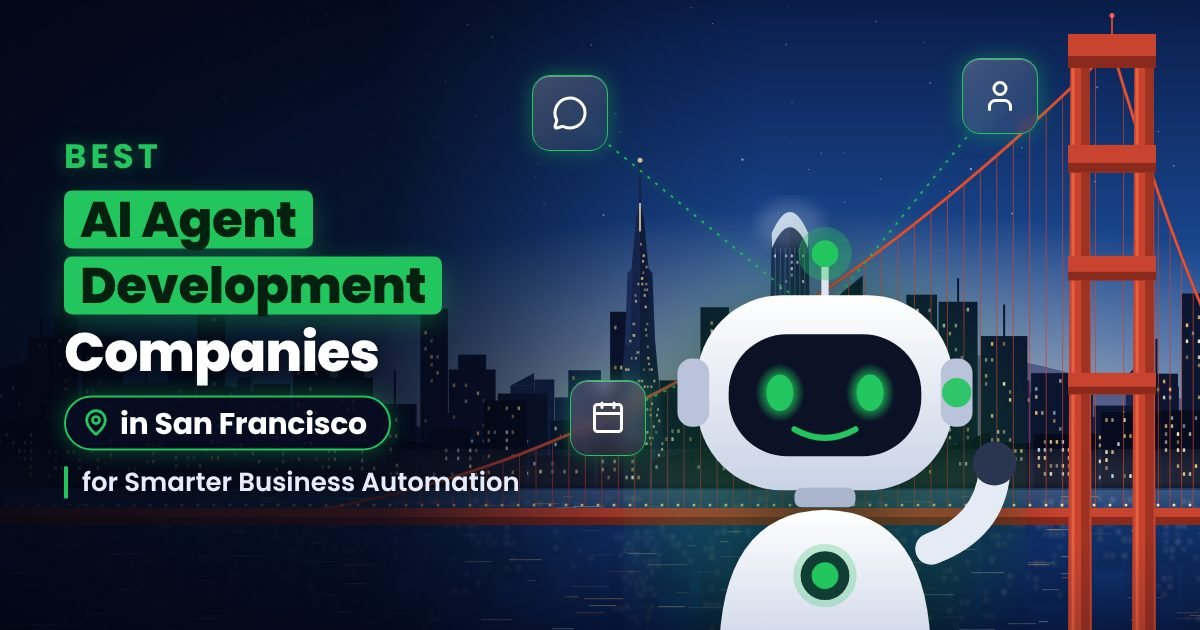
AI agents are the hottest category in tech right now. San Francisco sits at the center of it.
- Finished agents launch fast for common tasks; frameworks offer flexibility and require developer skill and longer build time.
- Customer service is the most mature finished-agent use case; frameworks suit unique workflows and complex automation.
- Choose by use case, maintenance owner, agent permissions, success metrics, and pricing model before committing.
- Common failures: launch without testing, grant too much freedom, lack escalation, or use poor data; simulate and monitor early.
- San Francisco firms span finished agents and frameworks; notable players include Sierra, Decagon, Crescendo, Bland, Cognition, LangChain, CrewAI, Relevance AI, Letta, Browserbase.
An agent does more than answer questions. It plans, takes action, and finishes tasks across your systems. That shift has made AI agent development companies in San Francisco some of the fastest-growing businesses in the world.
This guide covers 10 of them. Some sell finished agents. Others sell the frameworks developers use to build their own. You will see where each one fits.
What Is an AI Agent?
An AI agent is software that works toward a goal on its own. It decides what steps to take, uses tools, and checks its work.
Picture a customer who wants to change a flight. A chatbot explains the policy. An agent checks availability, rebooks the seat, applies the fare difference, and sends a confirmation.
The best agents also know when to stop. They hand difficult or risky cases to a human.
Finished Agents vs. Agent Frameworks
San Francisco’s agent companies fall into two camps. Choosing the right camp saves time and money.
| Finished Agent Platforms | Agent Frameworks and Infrastructure | |
|---|---|---|
| What you get | A ready-made agent for a job | Tools to build your own agents |
| Who uses it | Business teams | Developers |
| Time to launch | Weeks | Months |
| Flexibility | Lower | Higher |
| Examples here | Sierra, Decagon, Crescendo, Bland, Cognition | LangChain, CrewAI, Relevance AI, Letta, Browserbase |
Customer service is the most mature use case for finished agents. Frameworks shine when your workflow is unique.
How We Picked These Companies
Each company here is headquartered in San Francisco or runs its main US base there. Each one builds AI agents or the infrastructure behind them.
We considered:
- What kinds of agents each company builds or enables
- Funding, revenue, and named customers
- Adoption signals like usage numbers
- Gaps buyers should weigh
Valuations and usage figures come from company announcements and press coverage. They show momentum, not guaranteed results.
Quick Comparison: AI Agent Companies in San Francisco
| Company | Type | Agent Focus | Best For |
|---|---|---|---|
| Sierra | Finished agents | Customer service | Large consumer brands |
| Decagon | Finished agents | Customer experience | Enterprises replacing legacy support tools |
| Crescendo | Finished agents plus humans | Managed contact center | Teams wanting outcomes, not software |
| Bland | Finished agents | Long, complex phone calls | Healthcare and finance call centers |
| Cognition | Finished agents | Software engineering | Engineering teams |
| LangChain | Framework | Agent building and monitoring | Developers building custom agents |
| CrewAI | Framework | Multi-agent teams | Enterprises orchestrating many agents |
| Relevance AI | No-code platform | AI workforce for business teams | Sales and ops teams |
| Letta | Framework | Agents with long-term memory | Apps needing persistent context |
| Browserbase | Infrastructure | Web browsing for agents | Agents that use websites |
The 10 Best AI Agent Development Companies in San Francisco
1. Sierra: Customer Service Agents for Major Brands
Sierra is a San Francisco company co-founded by Bret Taylor and Clay Bavor. It builds AI agents that handle customer service for large companies.
Sierra’s agents process returns, verify identities, replace credit cards, and even help customers apply for mortgages. Customers include SiriusXM, ADT, Cigna, Discord, and SoFi.
Sierra reached $100 million in annual revenue run rate in under two years. It was valued at $10 billion in September 2025.
Best for: Large consumer brands with high support volumes.
Watch out for: Outcome-based pricing ties cost to results. Model your expected volumes carefully.
2. Decagon: AI Concierge for Customer Experience
Decagon is a fast-growing AI customer experience company with roots in San Francisco. It positions its agents as an “AI concierge” that improves from feedback.
Decagon serves travel, healthcare, retail, and financial services companies. It added more than 100 enterprise customers in a year, including Avis Budget Group and Block.
In January 2026, Decagon raised $250 million at a $4.5 billion valuation, led by Coatue and Index Ventures.
Best for: Enterprises replacing older customer service software.
Watch out for: Sierra and Decagon compete head to head. Run both through the same test scenarios.
3. Crescendo: An AI-Native Contact Center
Crescendo was founded in 2023 in San Francisco. Unlike pure software vendors, it runs a full contact center that blends AI with human experts.
Its AI handles voice, chat, email, and text. Crescendo says it resolves about 90% of issues automatically and sends complex cases to trained people. It offers outcome-based guarantees on results.
Crescendo raised $50 million at a $500 million valuation in 2024, led by General Catalyst.
Best for: Companies that want to outsource support outcomes, not manage software.
Watch out for: Outsourcing support means less direct control. Define service levels clearly.
4. Bland: Voice Agents for Complex Calls
Bland is a San Francisco company that builds its own AI voice models. It handles more than 3.5 million calls a week.
Bland focuses on long, complex calls that can run 30 to 45 minutes. One example: guiding a patient through a medical device and deciding when to escalate. It serves more than 250 enterprises, mostly in healthcare and financial services.
In June 2026, Bland raised a $50 million Series C led by Dell Technologies Capital.
Best for: Regulated industries with long, detailed phone conversations.
Watch out for: Voice agents in regulated fields need careful compliance review and call recording policies.
5. Cognition: AI Software Engineers
Cognition is headquartered in San Francisco and builds Devin, an AI software engineer. Its founders were gold medalists in international programming competitions.
Devin can plan, write, and test code across real projects. Cognition also acquired Windsurf, an AI coding environment, in 2025.
Cognition was valued at $26 billion in May 2026. Bloomberg later reported talks at a valuation of at least $40 billion.
Best for: Engineering teams that want agents to handle routine coding work.
Watch out for: AI-written code still needs review, tests, and security checks.
6. LangChain: The Toolkit Many Agent Builders Start With
LangChain is a San Francisco company behind one of the most popular open-source frameworks for building AI agents. Its tools include LangGraph for agent workflows and LangSmith for testing and monitoring.
Developers use LangChain to connect models, tools, and data into working agents. LangSmith then shows what each agent did and why, which helps teams fix problems.
LangChain was valued at about $1.3 billion in an October 2025 round backed by Sequoia.
Best for: Developer teams building custom agents from scratch.
Watch out for: Frameworks offer flexibility but need skilled engineers to use well.
7. CrewAI: Teams of Agents Working Together
CrewAI builds a platform for multi-agent systems, where several AI agents each handle part of a task. Think of a research agent, a writing agent, and a review agent working as a team.
CrewAI’s open-source framework runs more than 10 million agents a month. The company says nearly half of the Fortune 500 use its platform.
CrewAI raised $18 million, including a Series A led by Insight Partners. Angel investors include Andrew Ng.
Best for: Enterprises coordinating many agents across complex workflows.
Watch out for: More agents mean more failure points. Monitor each agent’s output closely.
8. Relevance AI: An AI Workforce for Business Teams
Relevance AI started in Sydney and opened a San Francisco office, where it now runs its US operations. It lets business teams build AI agents without coding.
Users create agents for sales research, lead qualification, and support tasks. More than 40,000 agents were created on the platform in January 2025 alone. Customers include Activision, Qualified, and SafetyCulture.
Relevance AI raised a $24 million Series B in May 2025, led by Bessemer Venture Partners.
Best for: Sales and operations teams wanting agents without engineering help.
Watch out for: No-code agents still need clear rules and review to stay accurate.
9. Letta: Agents That Remember
Letta is a UC Berkeley spinout behind MemGPT, a well-known research project on AI memory. It builds agents that remember information across sessions.
Most agents forget everything when a conversation ends. Letta’s agents keep long-term memory, so they learn about users and tasks over time. Its Letta Cloud lets developers deploy these agents through simple APIs.
Letta raised a $10 million seed round led by Felicis, with angels including Google’s Jeff Dean.
Best for: Apps where agents must build long-term context, like assistants and tutors.
Watch out for: Stored memory raises privacy questions. Plan what agents may remember.
10. Browserbase: Giving Agents a Web Browser
Browserbase builds web browsers that AI agents can control. Many tasks still require clicking through websites with no API.
Its platform launches thousands of browsers in seconds. Its Stagehand tool combines reliable scripts with flexible AI agents. Its Director product lets business users automate web tasks with plain-English prompts.
Browserbase raised a $40 million Series B in June 2025, led by Notable Capital, at a reported $300 million valuation.
Best for: Teams building agents that fill forms, research sites, or place orders online.
Watch out for: Website changes can break automations. Build in monitoring and retries.
How to Choose an AI Agent Partner
Ask these questions first:
- Is your use case common or unique? Common tasks suit finished agents. Unique ones suit frameworks.
- Who will maintain the agent? Frameworks need developers. Platforms need business owners.
- What can the agent do without approval? Set clear limits on money, data, and customer changes.
- How is success measured? Track resolution rate, accuracy, and customer satisfaction.
- How is it priced? Per conversation, per outcome, and per seat models produce very different bills.
What Doesn’t Work With AI Agents
Agent projects fail in familiar ways:
- Launching without testing: Simulate real conversations before customers see the agent.
- Too much freedom: Start with narrow permissions and expand slowly.
- No escalation path: Customers need a fast route to a human.
- Poor data underneath: Agents cannot act correctly on wrong or outdated records.
A real example: a subscription company deploys a cancellation agent that offers discounts too freely. Revenue drops before anyone notices. Adding approval limits and daily reviews fixed it within a week.
Final Thoughts
AI agent development companies in San Francisco lead the world in both finished agents and the tools to build them. Sierra, Decagon, Crescendo, and Bland transform customer conversations. Cognition automates coding. LangChain, CrewAI, Relevance AI, Letta, and Browserbase give builders what they need.
Pick finished agents for common tasks and frameworks for unique ones. Then test hard, limit permissions, and expand only as trust grows.
FAQs
What are the leading AI agent companies in San Francisco?
Top names include Sierra, Decagon, Crescendo, Bland, Cognition, LangChain, CrewAI, Relevance AI, Letta, and Browserbase.
What is the difference between an AI agent and a chatbot?
A chatbot answers questions. An AI agent takes actions, like processing a return or updating an account.
Should I buy an AI agent or build one?
Buy for common tasks like customer support. Build with frameworks when your workflow is unique or highly technical.
How much do AI customer service agents cost?
Pricing varies. Many vendors charge per conversation or per resolved issue rather than per seat.
Are AI agents safe to use with customers?
Yes, with testing, clear permissions, human escalation, and logs of every action the agent takes.


 AI/ML Strategy and Consulting
 Data Science And Data Analytics
 Generative AI
 AI Consulting Services
 AI Automation Solutions
 API Integration