
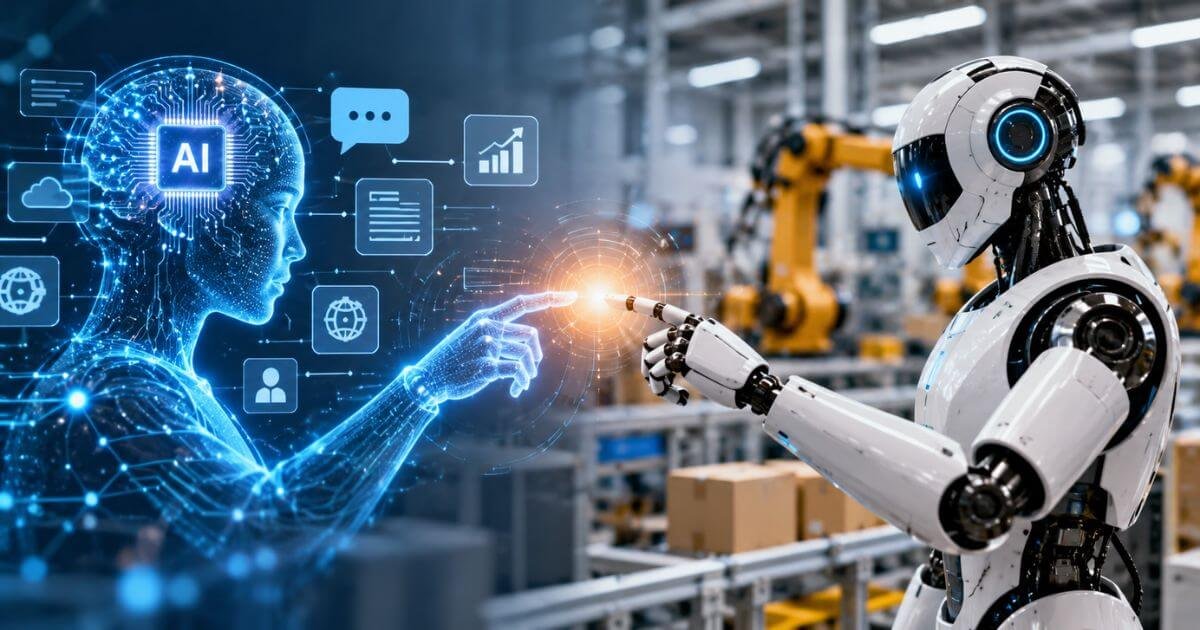
For most of the last decade, these were two separate industries.
- vision-language-action models let learned policies output motor commands, so robots pursue goals instead of following fixed scripts.
- Deployments show real gains but remain narrow: structured, fixed-station tasks dominate, autonomy about 78 percent, below the 95 percent industrial need.
- Practical steps for businesses: separate automation and AI, demand intervention rates and defined pilots, and budget integration and supervision alongside hardware.
Software agents lived in text. They read documents, answered questions, and called APIs. Robots lived in factories. They repeated one motion, millions of times, with no understanding of what they were doing.
Those two worlds are now merging. The same model architecture that reads your email can increasingly direct a physical arm. That shift is real, and it is already running in a handful of production facilities.
But the gap between the demo videos and the operational data is wide. This guide covers both honestly: what the convergence actually is, where it works, and what the published numbers really say.
What Convergence Actually Means Here
Convergence does not mean robots got smarter hardware. It means they started using the same kind of brain as software agents.
A traditional industrial robot runs explicit instructions. An engineer writes the path. The robot follows it. Change the task, and someone reprograms it.
An AI agent works differently. You give it a goal. It decides the steps. It adapts when conditions change.
The convergence is the moment that second approach starts controlling physical machines. The robot stops executing a script. It starts pursuing an objective.
That single change has large consequences. A robot that interprets goals can handle tasks nobody programmed in advance.
The Software Breakthrough Behind It
The enabling technology is a model class called vision-language-action, usually shortened to VLA.
How a Vision-Language-Action Model Works
A VLA model takes three things and produces one.
- It takes camera images of the real scene.
- It takes a natural-language instruction, such as “put the red part in the left bin.”
- It takes the robot’s current physical state.
- It outputs motor commands.
The important part is that last step. Earlier models could describe a scene beautifully. They could not move anything. VLA models produce actions directly, in the same way a language model produces words.
Google DeepMind’s Gemini Robotics, launched in March 2025 and built on Gemini 2.0, is one example. It shipped alongside an embodied reasoning variant, and an on-device version followed in June 2025 for robots that cannot rely on the cloud.
Why This Replaced Traditional Robot Programming
Old-style automation needed a fixed world. Parts arrived in the same orientation. Lighting stayed constant. Anything unexpected stopped the line.
VLA models relax that requirement. Because they learn from demonstration rather than instruction, they generalise. Show them a task a few thousand times, and they can attempt variations.
This is why the economics changed. The expensive part of industrial robotics was never the metal. It was the integration engineering. Models that learn tasks cut into that cost directly.
Where the Two Worlds Are Meeting Right Now
It helps to separate three categories, because companies blur them constantly in their marketing.
| Category | What it does | Maturity in 2026 |
|---|---|---|
| Software-only agents | Research, write, analyse, call APIs, move data | Widely deployed, well understood |
| Classic automation | Repeats a fixed physical motion precisely | Mature for 40 years, no AI needed |
| Converged embodied agents | Interprets a goal, then acts physically | Early pilots, very few production fleets |
Only the third row is new. Most “AI robot” announcements describe the second row with a language interface bolted on top.
The genuinely converged systems share one trait: a learned policy decides the motion, rather than a programmer.
What Real Deployments Actually Show
This is where you need to separate press releases from operating data. Two enterprise programmes have published meaningful numbers. Almost none of the others have.
The Two Programmes With Published Results
BMW Spartanburg with Figure AI. Over roughly eleven months, the robots supported production of more than 30,000 BMW X3 vehicles and handled over 90,000 sheet-metal parts across 1,250+ hours of weekday shifts. BMW published these figures. The cycle time and placement-accuracy claims came from the company rather than an outside audit. The programme closed when that robot generation was retired in late 2025.
GXO Logistics with Agility Robotics. Digit moved more than 100,000 totes at a Georgia facility, announced in November 2025. Agility later disclosed 65,000+ operating hours across nine facilities. Intervention rates, downtime, and cost per tote were not published.
Both successes share a shape. Structured task. Fixed station. Repetitive material handling. High utilisation.
The Gap Between Demos and Production
Three numbers explain why adoption is slower than the videos suggest.
Autonomy sits near 78%, not 95%. One independent assessment put autonomous task performance at roughly 78% after more than a million training trajectories. Unsupervised industrial work generally needs 95% or better. The remaining gap is handled by people.
Only about one in ten units reached real work. Interact Analysis estimated in July 2026 that roughly 10% of the 20,000+ humanoids produced in 2025 entered genuine operational environments. The rest went to labs, demos, and development.
Hardware is only part of the cost. Industry benchmarking puts the robot itself at 55–65% of five-year total cost. Integration, training data, maintenance, and supervision make up the rest.
No commercial humanoid programme has published uptime benchmarks. That absence is itself a finding.
Business Use Cases That Work Today
Convergence pays off in specific conditions. These are the patterns with real traction.
- Fixed-station material handling. Loading, unloading, tote moves. Repetitive, bounded, measurable.
- Mixed-SKU picking in warehouses. Where item variety defeats traditional automation but the environment stays controlled.
- Inspection and anomaly detection. A mobile platform with a vision model, flagging issues for humans.
- Machine tending. Feeding parts into CNC machines or presses across varied part shapes.
- Hazardous-environment work. Tasks where removing a person has value even at low autonomy.
Notice what is absent. No unstructured human environments. No complex assembly. No tasks requiring fine force control over long sequences.
What Breaks When a Software Agent Gets a Body
Giving an agent physical capability introduces problems that text-based agents never had.
Errors become physical. A software agent that misreads an instruction produces a wrong paragraph. A robot that misreads one damages a part, a machine, or a person. Safety certification exists for a reason, and learned policies are harder to certify than fixed programs.
Latency stops being a convenience issue. A two-second delay is annoying in chat. It is dangerous mid-motion. This is why on-device model variants matter.
Liability has no settled answer. When a learned policy causes damage, responsibility is unclear between the robot maker, the model provider, and the operator. Few contracts address this cleanly yet.
Training data becomes the moat. Real-world robot data is expensive and slow to collect. This is the actual constraint on progress, more than compute or hardware.
Labour relations enter the room. Hyundai’s deployment plans met union opposition in January 2026 over the absence of a labour agreement. This will recur.
What Business Leaders Should Do in the Next 12 Months
The honest recommendation is narrow but useful.
- Separate your automation questions from your AI questions. If a task is truly fixed, conventional automation is cheaper, faster, and proven. Convergence only helps where variation defeats fixed programming.
- Ask every vendor for intervention rates. Not accuracy. Not cycle time. How often does a human step in? Vendors who cannot answer have not measured it.
- Demand a pilot with published acceptance criteria. Define uptime, intervention rate, and cost per unit of work before anyone installs anything.
- Budget for the other 40%. Integration, data collection, and supervision will cost roughly as much as the hardware over five years.
- Watch the software layer, not the chassis. The models are improving far faster than the bodies. A robot bought today may run a much better policy in two years.
Final Thoughts
The convergence of AI agents and physical robots is genuinely happening, and it is not hype at the research level. Vision-language-action models solved a problem that blocked robotics for decades: how to get a machine to handle situations nobody programmed.
But the deployment picture is early. Two programmes have real published numbers. Autonomy runs near 78% where industry needs 95%. Roughly one in ten manufactured units reached actual work.
That combination — real breakthrough, thin deployment — is the accurate read. It means the opportunity is genuine and the timeline is longer than the announcements imply.
For most businesses, the right move in 2026 is not to buy a robot. It is to identify which of your physical tasks defeat traditional automation because of variation, and to measure them properly. When the models cross the autonomy threshold, you will know exactly where to put them.




 AI/ML Strategy and Consulting
 Data Science And Data Analytics
 Generative AI
 AI Consulting Services
 AI Automation Solutions
 API Integration