
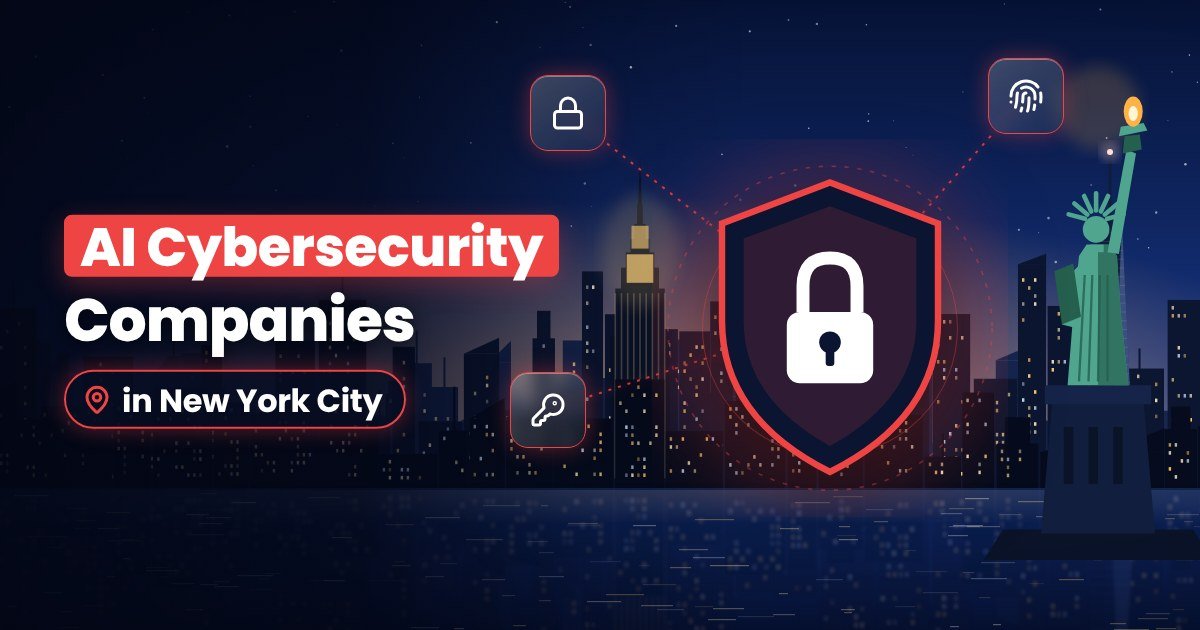
Attackers now use AI to write fake emails and find weak spots. They move fast. Security teams cannot keep up by hand.
- New York companies lead in data security, offering DSPM, discovery, classification, and automated protection for cloud, SaaS, and databases.
- AI agent security is a growing category, covering discovery, prompt injection defenses, runtime guardrails, and blocking harmful agent actions.
- Pick vendors by mapping risks, testing with real data, measuring false positives, confirming integrations, and limiting automation until accuracy is proven.
At the same time, firms are rolling out AI agents that touch private data. Those agents bring new risks.
AI cybersecurity companies in New York City are tackling both problems. This guide covers 10 of them, what they protect, and where each one fits.
What Do AI Cybersecurity Companies Do?
These firms use AI to find, stop, and fix threats. A growing group also guards AI tools themselves.
Their work falls into a few areas:
- Data security: Finding sensitive data and controlling who can reach it
- Threat detection and response: Spotting attacks and helping analysts act fast
- Asset and exposure management: Knowing every device, app, and weak point
- Third-party risk: Rating the security of vendors and partners
- AI and agent security: Protecting language models and AI agents from misuse
New York’s banks, hospitals, and media firms make it a natural home for them. These firms hold valuable data and face strict rules.
Why AI Agents Create New Security Risks
AI agents act on your systems. That makes them useful, and risky.
An agent might read customer records, send emails, or change settings. A clever attacker could trick it with hidden instructions in a document. This is called prompt injection.
Staff may also set up agents without telling IT. These are often called “shadow agents.” Teams need to find them before attackers do.
Several companies on this list now focus directly on this problem.
How We Picked These Companies
Every company here is based in New York City or co-headquartered there. Each one uses AI as a core part of its security product.
We considered:
- What the product protects and how AI powers it
- Funding, revenue, or public-company scale
- Named customers and analyst recognition
- Gaps buyers should know about
Most figures come from company announcements and earnings reports. Ask vendors to prove claims in your own environment.
Quick Comparison: AI Cybersecurity Companies in NYC
| Company | Security Category | AI Focus | Best For |
|---|---|---|---|
| Cyera | Data security | AI-native data discovery and DLP | Enterprises with sprawling cloud data |
| Varonis | Data security | Automated data protection and AI controls | Microsoft 365 and file-heavy firms |
| BigID | Data security and privacy | Data discovery and AI risk | Privacy and compliance teams |
| Axonius | Asset intelligence | AI-ranked fixes and asset data | IT and security operations |
| Claroty | Cyber-physical security | Claire AI agent for OT | Factories, hospitals, utilities |
| Torq | AI SOC automation | Alert triage and agent builder | Overloaded security teams |
| Dataminr | Threat intelligence | Real-time event detection | Global risk and security teams |
| SecurityScorecard | Third-party risk | AI vendor risk platform | Supply chain and vendor risk |
| Noma Security | AI agent security | Discover and protect AI apps | Companies deploying agents |
| Rein Security | AI agent runtime security | Guardrails at execution | Teams running custom agents |
The 10 Best AI Cybersecurity Companies in New York City
1. Cyera: AI-Native Data Security at Scale
Cyera is a fast-growing data security company with New York at its core. It helps companies find and protect sensitive data across cloud systems.
Its platform checks where private data lives and who can reach it. This is called data security posture management. It also stops data leaks and guards AI agents. Cyera says it sorts data with more than 95% precision.
In June 2026, Cyera raised $600 million at a $12 billion valuation. Customers include Paramount, Chipotle, and Valvoline.
Best for: Large enterprises with data spread across many cloud and SaaS tools.
Watch out for: Rapid growth can strain support. Check references for deployment experience.
2. Varonis: Data Protection With Automated Response
Varonis was founded in 2005 and is headquartered on Broadway in Manhattan. It trades on Nasdaq and focuses on protecting data where it lives.
Varonis is moving customers to its cloud platform. Its SaaS annual recurring revenue reached $726 million in mid-2026. New products include Atlas, aimed at AI security, and database activity monitoring.
Its CEO says AI security and data security are one problem. Its products reflect that view.
Best for: Organizations with heavy Microsoft 365, file share, and database footprints.
Watch out for: Self-hosted customers face a move to SaaS. Plan the migration timeline carefully.
3. BigID: Data Discovery for Privacy and AI Risk
BigID was founded in 2016 and is based in New York. It helps companies discover, classify, and secure data across cloud, SaaS, and on-premise systems.
The platform helps with privacy rules, data security, and AI risk. A common use: finding personal data before it lands in an AI model’s training set.
BigID has raised about $306 million, including a $60 million round in 2024.
Best for: Privacy, compliance, and data governance teams in regulated industries.
Watch out for: Discovery tools need tuning. Budget time for setup and classification rules.
4. Axonius: Seeing Every Asset, Including AI
Axonius is a New York-based firm that shows teams every device, user, app, and cloud tool they own. You cannot protect what you cannot see.
Its AI now ranks which fixes matter most. It also tracks AI tools as their own type of asset.
Axonius surpassed $200 million in annual recurring revenue in 2026. Joe Diamond became CEO in May 2026.
Best for: IT and security teams struggling with incomplete asset inventories.
Watch out for: Its value depends on connecting many data sources. Plan integration work upfront.
5. Claroty: AI Security for Factories and Hospitals
Claroty is a New York-based firm that guards physical systems. It protects factory controls, medical devices, and building systems.
In May 2026, Claroty launched Claire, an AI security agent built for these environments. Claire prioritizes fixes, supports safety and uptime, and maps assets to regulations. It draws on data from more than 6,500 equipment makers.
Claroty’s platform runs at more than 20,000 sites in over 60 countries.
Best for: Manufacturers, utilities, and hospitals protecting operational technology.
Watch out for: It is specialized for physical systems. You will still need IT security tools.
6. Torq: AI That Clears the Alert Backlog
Torq is based in New York. It builds AI for security teams that watch for attacks. Its goal is to handle the flood of alerts analysts face each day.
The platform sorts alerts on its own and can cut review time by up to 90%. Teams can also build their own AI agents for custom tasks.
In January 2026, Torq raised $140 million at a $1.2 billion valuation. Customers include Marriott, PepsiCo, Siemens, and Uber.
Best for: Security teams drowning in alerts with limited headcount.
Watch out for: Automated responses need guardrails. Start with low-risk actions and expand slowly.
7. Dataminr: Real-Time Threat Detection From Public Data
Dataminr is a New York-based firm known for spotting major events as they happen. Its AI scans public data for signs of cyber flaws, data leaks, and physical threats.
Dataminr agreed to acquire threat intelligence firm ThreatConnect for $290 million. The goal is “client-tailored” intelligence that blends public signals with each customer’s internal data using AI agents.
This helps security teams answer a key question fast: does this new threat affect us?
Best for: Global security and risk teams that track both cyber and physical threats.
Watch out for: Integration of the ThreatConnect deal takes time. Ask about the combined roadmap.
8. SecurityScorecard: AI-Powered Vendor Risk Ratings
SecurityScorecard was founded in 2013 and is based on Avenue of the Americas. It rates how secure a company is, much like a credit score.
Its TITAN AI platform targets third-party risk management. The company says its TITAN Assess module completes security questionnaires up to 18 times faster than manual work. It also publishes guidance on managing “shadow AI” vendors.
Insurers use its ratings to help underwrite cyber policies.
Best for: Firms that work with hundreds of vendors.
Watch out for: Outside ratings can miss what happens inside a vendor. Pair them with direct reviews.
9. Noma Security: Protecting AI Apps and Agents
Noma Security was founded in 2023 and is based in New York and Tel Aviv. It focuses entirely on securing AI systems.
It finds, watches, tests, and guards AI apps and agents. That includes chatbots, document search tools, and agents that act on their own.
Noma raised a $100 million Series B in July 2025, led by Evolution Equity Partners. Total funding stands at about $132 million.
Best for: Enterprises rolling out many AI apps and agents across teams.
Watch out for: AI security is a young category. Compare several vendors before committing.
10. Rein Security: Guardrails Where Agents Act
Rein Security is co-headquartered in New York and Tel Aviv. It describes itself as a runtime security platform for AI agents.
Runtime means it watches agents at the moment they act. Rein sees the code agents run and the files they touch. It can block harmful actions on the spot, with no extra gateway.
In October 2026, Rein raised a $25 million Series A co-led by Glilot Capital and Sienna Venture Capital.
Best for: Engineering teams running custom AI agents in production.
Watch out for: It is an early-stage company. Validate maturity with a focused pilot.
How AI Is Changing the Security Operations Center
Security operations centers, or SOCs, are where analysts watch for attacks. AI is reshaping that work in three ways.
- Triage: AI sorts thousands of alerts and flags the few that matter.
- Investigation: AI pulls facts from many tools so analysts decide faster.
- Response: AI takes approved actions, like isolating a laptop, within seconds.
The best results come when AI handles routine work and analysts focus on judgment calls.
How to Choose an AI Cybersecurity Vendor
Match the vendor to your biggest risk. Use these steps:
- Map your top risks. Data leaks, ransomware, vendor hacks, or AI misuse each need different tools.
- Test with your own data. Run a proof of concept in your real environment.
- Measure false positives. A tool that floods analysts with noise makes things worse.
- Check automation controls. Know exactly what the AI can do without approval.
- Confirm integrations. Make sure it works with your SIEM, identity, and cloud tools.
- Review data handling. Security vendors see your most sensitive data. Vet them carefully.
What Doesn’t Work in AI Security
AI is powerful, but it does not fix weak basics.
- Skipping fundamentals: AI cannot replace patching, strong passwords, and access controls.
- Full automation on day one: Let AI recommend actions first. Automate only after accuracy is proven.
- Ignoring AI agents: Many firms secure laptops and servers but forget the agents employees deploy.
- Too many tools: Overlapping products create alert noise and gaps.
A real example: a financial services firm deploys an internal AI assistant with broad file access. A test reveals it will summarize confidential HR files for any employee who asks. Tightening data permissions fixed the problem before launch.
Final Thoughts
AI cybersecurity companies in New York City cover every major risk area. Cyera, Varonis, and BigID lead in data security. Axonius and Claroty map and protect assets. Torq and Dataminr help security teams act faster.
A new wave, including Noma Security and Rein Security, protects the AI agents companies are racing to deploy.
Start with your biggest gap, test vendors on real data, and expand automation only as trust grows.
FAQs
What are the top AI cybersecurity companies in New York City?
Leading names include Cyera, Varonis, BigID, Axonius, Claroty, Torq, Dataminr, SecurityScorecard, Noma Security, and Rein Security.
How does AI improve cybersecurity?
AI sorts alerts, spots unusual behavior, and speeds investigations. It helps small teams handle far more threats without burning out.
What is AI agent security?
AI agent security protects autonomous AI tools from misuse. It covers discovery, permissions, prompt injection defense, and real-time guardrails.
What is data security posture management (DSPM)?
DSPM continuously finds sensitive data and checks who can access it. It helps prevent leaks across cloud and SaaS systems.
Can AI replace cybersecurity analysts?
No. AI handles routine triage and data gathering. Analysts still make judgment calls and lead response to serious incidents.

 AI/ML Strategy and Consulting
 Data Science And Data Analytics
 Generative AI
 AI Consulting Services
 AI Automation Solutions
 API Integration