

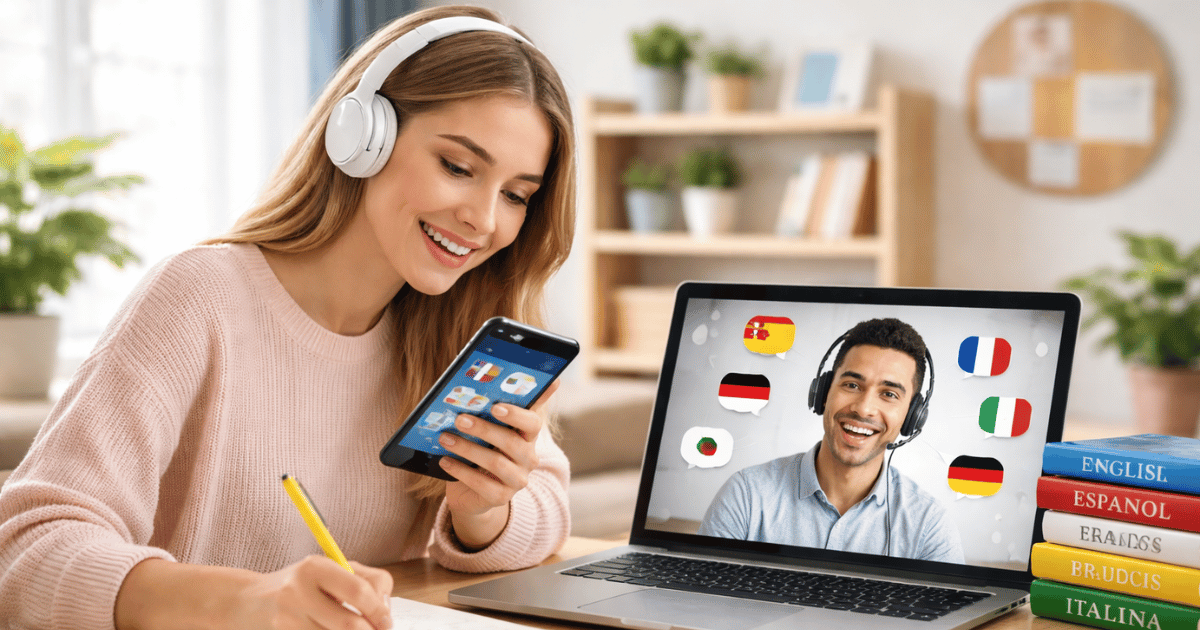
Traditional language learning follows a rigid path. Memorize vocabulary lists. Study grammar rules. Hope you remember it all when a real conversation happens. AI tools for language learning break that pattern entirely.
- Use AI conversation tools for immersive, adaptive practice that simulates natural dialogue and gives instant, personalized feedback.
- Prioritize speaking from day one; real fluency comes from producing language, not passive recognition.
- Pick tools by goal and level: structured apps for beginners, AI conversation tools for intermediate, flexible LLMs for advanced practice.
- Avoid passive clicking and tool hopping; commit to one primary app, speak aloud daily, and use feedback to target weak areas.
These tools create immersive, adaptive experiences that respond to your level in real time. They simulate natural conversations, correct pronunciation instantly, and adjust difficulty based on your progress. You practice speaking from day one — not after months of textbook study.
The shift matters because fluency requires practice, not just knowledge. AI removes the barriers of cost, scheduling, and embarrassment that keep learners from getting the speaking practice they need most.
How AI Makes Language Practice More Effective
Human tutors are excellent but expensive. Group classes move at the group’s pace, not yours. AI-powered language practice fills the gap between self-study and live instruction.
AI language apps analyze your speech patterns, identify weak sounds, and drill you on exactly what you struggle with. They adapt every session to your performance. A human tutor does this intuitively. AI does it with data across thousands of interactions.
The best AI conversation practice tools now sound remarkably natural. You hold open-ended dialogues, not scripted exchanges. The AI responds to what you actually say, creating the unpredictability that real conversations demand.
10 AI Tools for Language Learning That Deliver Results
1. Speak — The Best AI Speaking Tool on the Market
Speak focuses almost entirely on spoken fluency. It uses AI to create roleplay scenarios — ordering coffee, negotiating a deal, asking for directions and evaluates your responses in real time.
The AI tutor explains grammar mistakes in context, not in isolation. Lessons feel like conversations, not exercises. Speak currently supports Spanish, French, Korean, Japanese, German, Italian, and several other languages. Its voice recognition is among the most accurate available.
Best for: Speaking fluency, pronunciation correction, and real-world conversation practice.
2. Duolingo — Gamified Learning With AI at Its Core
Duolingo remains the most popular language learning software worldwide. Its AI engine personalizes lesson sequences, adjusts review timing using spaced repetition, and tracks mastery across skills.
The newer AI features include Duolingo Max, which offers roleplay conversations and detailed explanations of mistakes powered by GPT-5. The free tier covers structured lessons. The premium tier unlocks the full AI conversation experience.
Best for: Building daily study habits, structured progression, and beginner to intermediate learners.
3. Praktika — AI Tutors With Personality
Praktika offers AI-powered conversation practice through avatar-based tutors, each with a distinct personality and teaching style. Learners choose scenarios ranging from casual small talk to job interviews.
The AI evaluates fluency, grammar, vocabulary range, and pronunciation after each session. Progress reports show exactly where you improve week over week. It feels closer to working with a personal tutor than any flashcard app.
Best for: Conversational confidence, scenario-based practice, and detailed performance tracking.
4. TalkPal — Conversation Practice Across 50+ Languages
TalkPal supports an impressive range of languages — over 50 at last count. Its AI engages learners in open-ended conversations on topics they choose. You talk about your day, debate a topic, or practice a specific situation.
The tool adjusts vocabulary and sentence complexity to your level automatically. It also offers voice-based and text-based modes, making it flexible for learners who are not yet comfortable speaking aloud.
Best for: Multilingual learners, conversation variety, and flexible practice modes.
5. Univerbal — AI Conversations That Feel Human
Univerbal creates remarkably natural AI dialogues. Its speech engine processes responses quickly enough that conversations flow without awkward pauses. The AI adapts not just to your level but to your interests and preferred topics.
After each session, it delivers a breakdown of errors, suggestions for improvement, and new vocabulary worth learning. The experience closely mirrors a real tutoring session at a fraction of the cost.
Best for: Natural conversation flow, personalized feedback, and intermediate to advanced learners.
6. Memrise — Learn From Real Native Speaker Content
Memrise combines AI with video clips of native speakers using language in real-world contexts. You hear how words and phrases actually sound on the street — not in a recording studio.
Its AI features now include a conversation partner that references the vocabulary you have recently studied. This bridges the gap between memorization and active use. The spaced repetition system ensures long-term retention of new words.
Best for: Vocabulary acquisition, native pronunciation exposure, and contextual learning.
7. Lingvist — AI That Focuses on What You Do Not Know
Lingvist uses AI to identify exactly which words and grammar structures you have not yet mastered. It then builds every session around those gaps. No time wasted reviewing material you already know.
The algorithm analyzes response speed and accuracy to estimate true proficiency. Courses adapt continuously. Business-specific and travel-specific modules make it practical for professionals preparing for real situations.
Best for: Efficient vocabulary building, gap-targeted practice, and professional language preparation.
8. Elsa Speak — Pronunciation Coaching With Surgical Precision
Elsa Speak specializes in English pronunciation. Its AI analyzes your speech at the phoneme level — individual sounds within words — and identifies exactly where your accent diverges from native patterns.
It scores fluency, intonation, and stress patterns for every sentence you speak. The visual feedback shows which sounds need work. Professionals preparing for English-language presentations or interviews find it particularly valuable.
Best for: English pronunciation, accent reduction, and phoneme-level speech correction.
9. Busuu — AI Plus a Global Community of Native Speakers
Busuu combines AI-driven lessons with a community of native speakers who review your written and spoken exercises. The AI handles structured learning. Real humans provide cultural context and natural corrections.
This hybrid model bridges a gap that pure AI tools struggle with — genuine human nuance. The AI tracks your progress and recommends when to seek community feedback. It supports 14 languages with CEFR-aligned course structures.
Best for: Structured courses with human feedback, writing practice, and CEFR-aligned progression.
10. ChatGPT — The Most Flexible AI Conversation Partner
ChatGPT is not a dedicated language app, but it is one of the most versatile AI conversation practice tools available. Ask it to roleplay a scenario in your target language. Request grammar explanations. Have it correct your writing and explain every error.
Its strength is total flexibility. You control the topic, difficulty, and format. Advanced learners use it to practice formal writing, debate topics, or simulate professional situations no other app covers.
Best for: Advanced conversation practice, writing correction, and custom scenario creation.
Quick Comparison: Finding the Right Tool for Your Goal
| Learning Goal | Best Tool | Free Tier |
|---|---|---|
| Speaking fluency | Speak | Limited |
| Daily habit building | Duolingo | Yes |
| Tutor-style practice | Praktika | Limited |
| 50+ languages | TalkPal | Yes |
| Natural conversations | Univerbal | Limited |
| Native speaker exposure | Memrise | Yes |
| Efficient vocab building | Lingvist | Limited |
| English pronunciation | Elsa Speak | Yes |
| Human + AI feedback | Busuu | Yes (limited) |
| Flexible practice | ChatGPT | Yes |
How to Choose the Right AI Language App for Your Level
Beginners benefit most from structured apps like Duolingo or Busuu. These provide guided paths, clear grammar explanations, and progressive difficulty. They build the foundation that conversation tools require.
Intermediate learners should prioritize speaking practice. Tools like Speak, Praktika, and TalkPal push you into active production. This is where most learners plateau and where AI conversation practice makes the biggest difference.
Advanced learners need flexibility and nuance. ChatGPT and Univerbal let you practice complex scenarios, debate abstract topics, and refine subtleties that structured apps do not cover. Pair these with Elsa Speak if pronunciation remains a weak point.
Mistakes That Slow Down AI-Assisted Language Learning
The biggest mistake is passive use. Clicking through lessons without speaking aloud builds recognition, not fluency. Always choose tools that force you to produce language, not just consume it.
Another common error is tool hopping. Switching apps every week prevents meaningful progress in any of them. Commit to one primary tool for at least 30 days before evaluating results.
Finally, do not skip the uncomfortable part. Speaking with AI feels awkward at first. That discomfort is the learning happening. Lean into it. The learners who speak from day one progress fastest — every study confirms this.
What the Future Holds for AI in Language Learning
AI pronunciation apps will soon offer real-time accent coaching during live conversations — not just practice sessions. Imagine receiving subtle pronunciation nudges while on an actual video call in your target language.
Multimodal AI will combine visual, audio, and text-based learning in a single seamless experience. You will point your phone at a menu, hear the words pronounced, and practice ordering — all within one interaction.
Emotional intelligence in AI tutors is also advancing. Future language learning software will detect frustration or boredom and adjust pacing, encouragement, and content style accordingly. The experience will feel less like an app and more like a patient, perceptive teacher.
FAQs
Speak, Duolingo, Praktika, TalkPal, and Elsa Speak are top choices. Each excels in a different area — from speaking fluency and pronunciation to structured courses and conversation variety.
AI handles daily practice, pronunciation correction, and vocabulary building effectively. However, human tutors provide cultural nuance, emotional encouragement, and complex error correction that AI still struggles to match fully.
Speak and Praktika are the strongest AI speaking tools available. Both simulate real conversations, provide instant pronunciation feedback, and adjust difficulty to your level automatically.
Yes. Duolingo, Memrise, and TalkPal offer strong free tiers that cover structured learning and conversation practice. Free versions work well for beginners and intermediate learners building consistent habits.
It depends on the language and your daily practice time. Most learners reach conversational comfort in three to six months with 20 to 30 minutes of daily AI-assisted practice focused on speaking and listening.




 AI/ML Strategy and Consulting
 Data Science And Data Analytics
 Generative AI
 AI Consulting Services
 AI Automation Solutions
 API Integration


