

Picking the best LLMs in 2026 is harder than ever. New large language models launch almost every month. Prices shift, benchmarks get updated, and yesterday’s leader becomes today’s runner-up. This guide cuts through the noise. We compare the top llm ai models on the market, explain what the benchmarks actually mean, and help you match a model to your real work.
- Match models to tasks, not rankings; test two or three candidates on your own data before committing.
- Prioritize agentic ability and large context windows for multi-step, multimodal work; benchmark scores are signals, not verdicts.
- Balance cost-per-task over sticker rates; use tiered models, cached pricing, and backups to control price and uptime risk.
What Are Large Language Models?
A large language model is an AI system trained on huge amounts of text. It can write, summarize, answer questions, and reason through problems. Modern large language models also write and debug code. Many can now use tools, browse the web, and complete multi-step tasks on their own. That shift, from simple chatbots to capable digital coworkers, is why choosing the right model matters so much in 2026.
How We Compare the Best LLMs in 2026
Benchmark names sound similar but measure very different things. Here is what the main ones actually tell you.
- SWE-bench Verified: Can the model fix real bugs in real codebases? This is the most practical coding test available.
- GPQA Diamond: Can the model reason through graduate-level science questions? High scores predict strong multi-step reasoning.
- Terminal-Bench and agentic benchmarks: How well does the model complete real work using tools, not just chat?
- WebDev Arena: How good is the model at building working front-end code that people actually rate as usable?
One caution: labs report different versions of the same benchmark name. An independent audit published in July 2026 found that roughly 30% of tasks in one popular coding benchmark were flawed or misleading. Treat any single score as a signal, not a verdict.
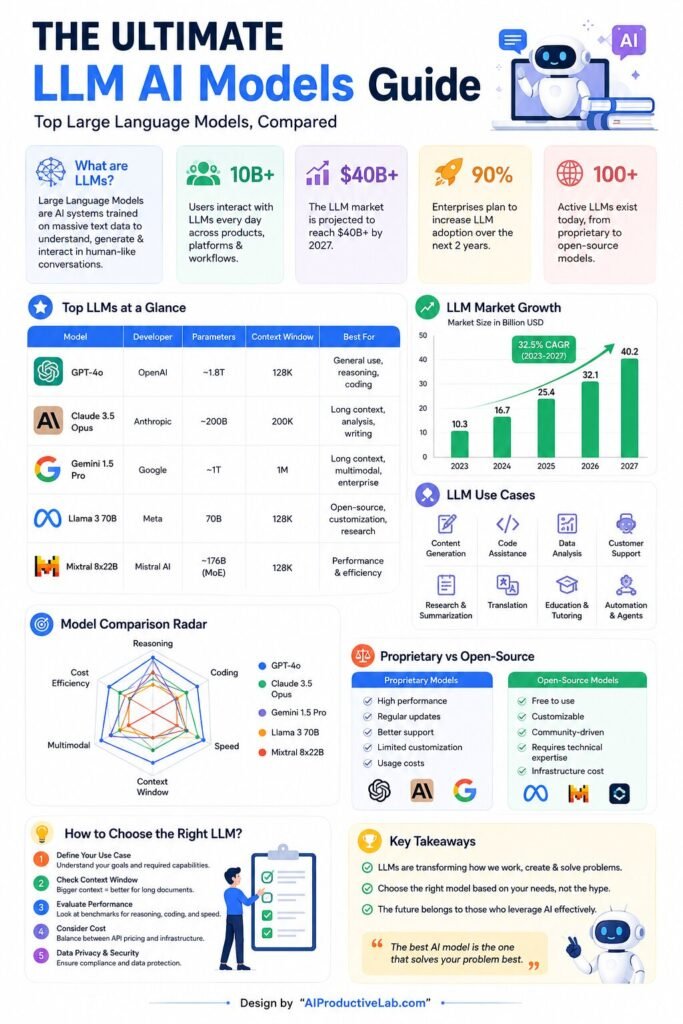
Best LLMs in 2026 at a Glance
| Model | Best For | Context Window | Approx. Price (per 1M tokens, input/output) |
|---|---|---|---|
| Claude Fable 5 | Overall quality, hard reasoning | 1M | $10 / $50 |
| Claude Opus 5 | Complex reasoning and agentic work | 1M | Premium tier |
| Claude Sonnet 5 | Best value, daily coding work | 1M | $2–3 / $10–15 |
| GPT-5.6 Sol | Flagship reasoning, coding | 1.05M | $5 / $30 |
| GPT-5.6 Terra / Luna | Budget agentic tasks | 1.05M | Under $2 / $12 |
| Gemini 3.1 Pro | Huge documents, multimodal | 1M | $2–4 / $12–18 |
| Kimi K3 | Best open-weight frontier model | 1M | $3 / $15 |
| Grok 4.5 | Cheapest high-volume API use | Large | ~$1–2 input |
| DeepSeek V4 Pro | Best free self-hosted option | 1M | $0.14 / $0.28 hosted |
Prices change often, so always check the provider’s live pricing page before you commit.
Best LLMs Reviewed: Top Picks for Every Use Case
Best Overall Quality: Claude Fable 5
Claude Fable 5 sits at the top of Anthropic’s lineup, above the long-standing Opus tier. It leads most independent coding and reasoning rankings. The trade-off is cost: it runs several times more expensive than Anthropic’s mid-tier model. Access has also been briefly interrupted in the past due to export rules, so enterprise buyers should build in a fallback model.
Best Value for Daily Work: Claude Sonnet 5
Claude Sonnet 5 delivers most of the flagship’s capability at a fraction of the price. It is built for agentic coding and long, multi-step tool use. Anthropic offers introductory pricing through the end of August 2026, making it one of the cheapest ways to get near-frontier performance right now.
Best for Coding at Scale: GPT-5.6 Sol
OpenAI’s GPT-5.6 line now ships in three tiers: Sol, Terra, and Luna. Sol is the reasoning flagship and now powers ChatGPT by default. It offers a large context window and strong agentic coding scores, though it costs more per output token than most rivals.
Best for Huge Documents and Multimodal Work: Gemini 3.1 Pro
Gemini 3.1 Pro was built natively multimodal from day one. It handles text, image, video, and audio in a single request. With a 1 million token context window, it can process an entire long report or hours of video in one pass. It also remains one of the more affordable flagship models at typical prompt lengths.
Best Open-Weight Frontier Model: Kimi K3
Moonshot AI’s Kimi K3 is a 2.8 trillion parameter model with open weights and a 1 million token context window. It ranks as the strongest open model on independent intelligence indexes. Running it yourself takes serious hardware, but hosted access is available at competitive rates.
Cheapest High-Volume Option: Grok 4.5 and GPT-5.6 Luna
If your workload is high volume and cost-sensitive, xAI’s Grok 4.5 and OpenAI’s Luna tier are worth testing. Both price input tokens well under most flagship models, making them a practical choice for automation and background agent tasks.
Best Open-Source LLM AI Models in 2026
Open-weight models have closed most of the gap with closed, proprietary systems. For many everyday tasks, the difference is now single digits on benchmark scores, while the cost can be four to ten times lower.
- DeepSeek V4 Pro: MIT licensed, strong at code and math, and the most cost-efficient self-hosted pick for most teams.
- GLM-5.2: MIT licensed, fast throughput, and competitive with premium models on graduate-level reasoning tests.
- Qwen 3.6 and 3.7: Alibaba’s flagship series, strong on reasoning and instruction following, with a long context window.
- Llama 4: Meta’s widely deployed family, a solid general-purpose choice with an active community and tooling ecosystem.
- Kimi K2.6 and K3: Strong for agentic coding and long-horizon tool use, released under a modified MIT license.
Before deploying any open model commercially, check its exact license. MIT and Apache 2.0 are the cleanest for commercial use. Some licenses cap usage by monthly active users or region.
LLM Pricing Compared: What You Actually Pay
Pricing usually has two parts: an input rate and a higher output rate, both listed per million tokens.
- Budget tier models (GPT-5.6 Luna, DeepSeek V4 Pro, GLM-5.2) often cost under $1 per million input tokens.
- Mid-tier flagships (Claude Sonnet 5, Gemini 3.1 Pro, GPT-5.6 Terra) typically land between $2 and $3 per million input tokens.
- Top-tier flagships (Claude Opus 5, Claude Fable 5, GPT-5.6 Sol) run $5 or more per million input tokens, with output priced several times higher.
Cached or batch pricing can cut costs significantly for repeat prompts. Always compare cost-per-completed-task, not just the sticker rate, since a cheaper model that needs more retries can end up costing more.
How to Choose the Right LLM AI Model for Your Needs
Match the model to the job, not the leaderboard rank.
- Writing and brainstorming: A mid-tier model like Claude Sonnet 5 or GPT-5.6 Terra is usually enough.
- Software engineering: Test Claude Fable 5, GPT-5.6 Sol, or the open-weight GLM-5.2 on your own codebase.
- Long documents or video: Gemini 3.1 Pro’s native multimodal design and large context window are hard to beat.
- Tight budgets or high volume: Start with GPT-5.6 Luna, Grok 4.5, or a self-hosted open model like DeepSeek V4 Pro.
- Data privacy or on-premise needs: Choose an open-weight model you can host yourself, such as Qwen or Llama.
Many teams now run more than one model, routing each request to whichever LLM handles that specific task best.
Trends Shaping the Best LLMs in 2026
A few patterns stand out this year. First, the 1 million token context window has become standard, not a premium feature. Second, tiered model families are now the norm. OpenAI, Anthropic, and others each ship a flagship, a balanced mid-tier, and a budget option, instead of one general-purpose model.
Third, open-source LLMs have narrowed the quality gap. A year ago, open models trailed the frontier by a wide margin. Today, models like GLM-5.2 and DeepSeek V4 Pro sit close to premium systems on many real-world tasks, at a fraction of the price.
Finally, agentic ability now matters as much as raw intelligence. Buyers care less about a model’s exam scores and more about whether it can complete a multi-step task, use tools correctly, and recover from its own mistakes. That shift is reshaping how labs train and market their models.
Buying Tips for Teams and Enterprises
Choosing an LLM for a company is different from picking one for personal use. A few extra factors matter.
- Test on your own data. Public benchmarks rarely match your actual workload. Run a small pilot before committing.
- Check data handling policies. Confirm whether your prompts are used for training and what retention period applies.
- Plan for multiple models. Many teams route simple tasks to a cheap model and hard tasks to a flagship model, cutting costs without hurting quality.
- Watch for pricing windows. Introductory rates, like Claude Sonnet 5’s current discount, can expire and raise your bill without warning.
- Confirm uptime and access history. Some frontier models have faced temporary access restrictions. Always keep a backup provider ready.
Final Thoughts
There is no single best LLM for everyone in 2026. The field has genuinely different strengths across coding, reasoning, multimodal work, and cost. Start with your actual use case, test two or three candidates against your own tasks, and revisit the choice every quarter. This market moves fast, and the best llms of today will have new competition within weeks.
FAQs
Claude Fable 5 and GPT-5.6 Sol currently lead most independent benchmarks, though pricing and access vary.
GPT-5.6 Luna and open-weight models like DeepSeek V4 Pro offer strong performance at very low per-token cost.
Most 2026 flagships, including Gemini 3.1 Pro, GPT-5.6 Sol, and Claude Sonnet 5, now support around 1 million tokens.
On many everyday tasks, yes. Models like GLM-5.2 and Qwen 3.7 now score within a few points of premium alternatives.
Claude Fable 5, GPT-5.6 Sol, and the open-weight GLM-5.2 all rank highly on real-world coding benchmarks.




 AI/ML Strategy and Consulting
 Data Science And Data Analytics
 Generative AI
 AI Consulting Services
 AI Automation Solutions
 API Integration