
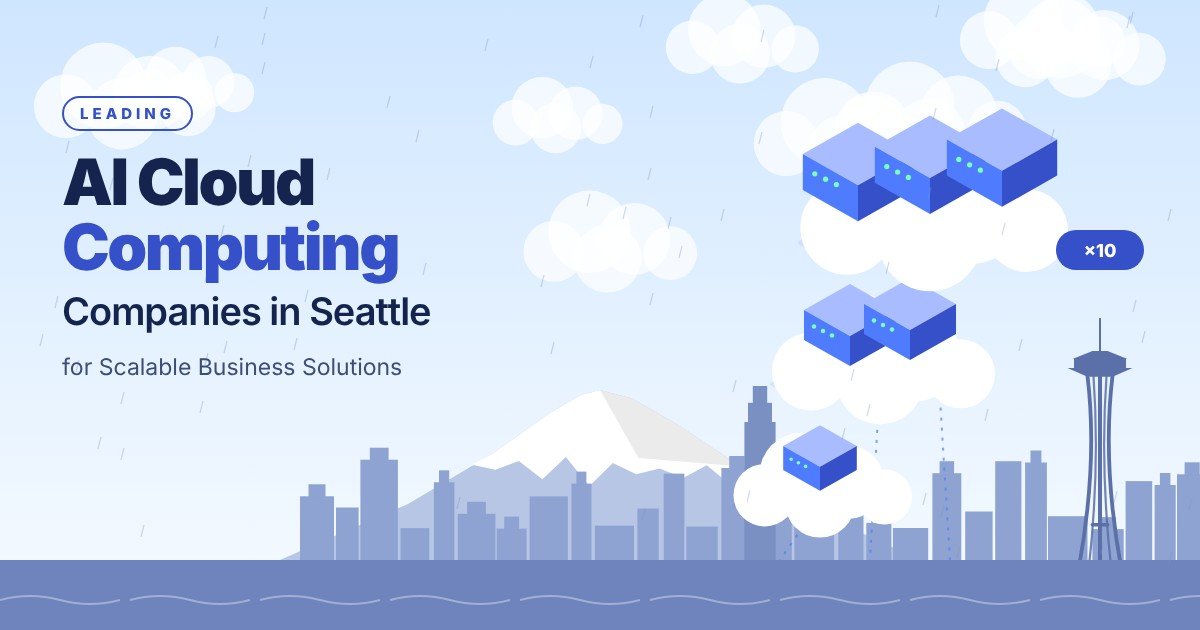
Seattle is the home of the modern cloud. Amazon Web Services and Microsoft Azure both grew up here.
- AI cloud is a layered stack: compute, storage, orchestration, observability, security, and power; each layer demands specialized tools.
- Seattle startups cover the stack: orbital GPUs, fusion power, photonics, secure images, orchestration, observability, storage, and cost management.
- Pick partners by your bottleneck, cloud compatibility, pricing model, outage plans, and product maturity.
- Control AI costs: tag resources, right-size GPUs, set budgets and alerts, cut log volume, and review spending weekly.
That talent has spread into a new wave of AI infrastructure companies. Some build data centers in orbit. Others secure AI software, run AI workloads, control cloud costs, or supply power to data centers.
This guide covers 10 AI cloud computing companies in Seattle and nearby cities. You will see what each one does, who it serves, and where it fits.
What Is AI Cloud Computing?
AI cloud computing means renting the computing power, storage, and software needed to build and run AI. You pay for what you use instead of buying hardware.
AI puts heavy demands on the cloud:
- Compute: GPUs that train and run models
- Storage: Fast access to huge datasets
- Orchestration: Running long AI jobs reliably
- Observability: Watching systems and catching failures
- Security: Trusted software for AI workloads
- Power: Energy for fast-growing data centers
The companies here cover each of these layers.
The AI Cloud Stack, Layer by Layer
Think of the AI cloud as a stack. Each layer depends on the one below it.
| Layer | What It Does | Companies Here |
|---|---|---|
| Power and hardware | Energy and faster chip connections | Helion, NLM Photonics |
| Data centers | Places to run AI compute | Starcloud |
| Storage | Fast, scalable file data | Qumulo |
| Software supply chain | Secure building blocks | Chainguard, Entire |
| Orchestration | Running AI workflows | Union.ai |
| Operations and cost | Monitoring, governance, spending | Edge Delta, MontyCloud, Apptio |
Most buyers interact with the top layers. The bottom layers shape cost and capacity for everyone.
How We Picked These Companies
Each company here is based in Seattle or nearby Bellevue, Redmond, Kirkland, or Everett. Each one supplies infrastructure, tools, or power that AI cloud workloads depend on.
We left out Microsoft and Amazon Web Services because they appear in our Seattle generative AI guide. None of these companies appear in our other Seattle AI guides.
We looked at:
- What layer of the AI stack each company serves
- Funding, growth, and named customers
- Limits buyers should weigh
Figures come from company releases and press reports.
Quick Comparison: AI Cloud Computing Companies in Seattle
| Company | Category | Standout Strength | Best For |
|---|---|---|---|
| Starcloud | Orbital data centers | First data-center GPU in orbit | Future large-scale AI compute |
| Chainguard | Secure software | Hardened container images, incl. AI | Teams shipping AI to production |
| Union.ai | AI orchestration | Company behind open-source Flyte | ML and data platform teams |
| Edge Delta | AI observability | AI Teammates for operations | SRE and DevOps teams |
| Qumulo | Cloud data storage | Scalable file data for AI | Enterprises with huge datasets |
| Apptio | Cloud cost management | Cloudability and Kubecost GPU tools | Finance and FinOps teams |
| MontyCloud | Cloud operations | Automated governance and cost control | MSPs and enterprises |
| Entire | Code infrastructure | Git built for AI coding agents | Teams running many coding agents |
| NLM Photonics | Data center chips | Lower power to move data | Network and chip makers |
| Helion | Data center power | Fusion power deal with Microsoft | Long-term data center energy |
The 10 Best AI Cloud Computing Companies in Seattle
1. Starcloud: Data Centers in Orbit
Starcloud is based in Redmond and went through Y Combinator in 2024. It builds data centers in space, powered by constant sunlight.
In November 2025, Starcloud-1 launched with an NVIDIA H100 GPU, the first data-center-grade GPU in orbit. The company trained an AI model in space. Crusoe is an early customer, and Starcloud partners with AWS, Google Cloud, and NVIDIA.
In August 2026, Starcloud raised $250 million at a $2.3 billion valuation, bringing total funding to $450 million.
Best for: Organizations watching long-term options for massive AI compute.
Watch out for: Orbital compute is early. It is not a near-term replacement for ground data centers.
2. Chainguard: Secure Building Blocks for AI Software
Chainguard is headquartered in Kirkland. It builds “hardened-by-default” open-source software, starting with secure container images.
Chainguard AI Images include CPU- and GPU-ready images like PyTorch. Its automated software factory patches and signs more than 13,000 open-source packages. Customers include Canva, Snowflake, Anduril, and GitLab.
Chainguard raised a $356 million Series D in 2025 at a $3.5 billion valuation.
Best for: Teams shipping AI workloads that must pass strict security reviews.
Watch out for: Switching base images takes testing. Plan a gradual rollout.
3. Union.ai: Running AI Workflows Reliably
Union.ai is based in Bellevue and was co-founded in 2020 by Ketan Umare and Haytham Abuelfutuh. Umare helped build Flyte while at Lyft.
Flyte is an open-source tool for running complex machine learning and data workflows. Union.ai builds on it with AI development infrastructure for training, inference, and observability. Customers include Spotify, Carfax, and Hopper.
Union.ai’s revenue grew three times in 2025. It has raised a $38.1 million Series A led by NEA.
Best for: ML and data platform teams running many AI pipelines.
Watch out for: Orchestration tools need engineering skill to set up well.
4. Edge Delta: AI Teammates for Cloud Operations
Edge Delta was founded in 2018 and is based in Seattle. It manages logs, metrics, and traces from cloud systems.
In October 2025, Edge Delta launched AI Teammates. These role-based agents act as SRE, DevOps, security, and cloud engineers. Risky actions need human approval. In 2026, it made its telemetry pipelines free at any scale, charging only for storage and AI usage.
Edge Delta has raised about $81 million, including a $63 million Series B.
Best for: SRE and DevOps teams buried in alerts and log costs.
Watch out for: Agent benchmarks are company-reported. Test on your own incidents.
5. Qumulo: File Data for AI at Scale
Qumulo is a Seattle company that stores and manages huge amounts of file data across data centers and the cloud.
Its Cloud Data Fabric aims to speed enterprise AI and other heavy workloads. Cloud Native Qumulo saw cloud storage use jump 485% in a year after launch. Qumulo serves more than 1,000 customers in media, energy, healthcare, and finance.
The company reported profitable growth in 2025.
Best for: Enterprises feeding AI with very large files, like video, images, or scientific data.
Watch out for: Storage moves are complex. Plan migration and test performance first.
6. Apptio: Controlling Cloud and GPU Costs
Apptio is an IBM company based in Bellevue. It helps businesses track and manage technology spending.
In November 2025, Apptio launched new FinOps tools. Cloudability Governance estimates cloud costs before deployment and gives AI-powered savings tips. IBM Kubecost 3.0 adds GPU monitoring and automated right-sizing for containers.
AI workloads make cloud bills grow fast. These tools help teams see where money goes.
Best for: Finance and FinOps teams managing large cloud and GPU budgets.
Watch out for: Cost tools need clean tagging. Fix labels before you rely on reports.
7. MontyCloud: Automated Cloud Operations
MontyCloud was founded in 2018 and is based in Redmond. It automates how companies run and govern cloud infrastructure.
MontyCloud enforces governance policies and trims cloud spend automatically. Cloud spend under its management grew more than 400% over two years, and recurring revenue nearly tripled. It serves managed service providers and enterprises.
In January 2026, MontyCloud raised a Series B led by Riverside Acceleration Capital.
Best for: MSPs and IT teams managing many cloud accounts.
Watch out for: Automated policies can block teams if set too tight. Start in monitor mode.
8. Entire: Infrastructure for AI Coding Agents
Entire was founded by Thomas Dohmke, the former CEO of GitHub. It builds infrastructure for code written by AI agents.
Entire’s open-source technology includes a Git-compatible database for AI-made code and a layer for coordinating many agents. Its first product, Checkpoints, links agent code to the prompts that produced it. It later launched a distributed Git network built for agent workloads.
Entire raised a $60 million seed round at a $300 million valuation, led by Felicis.
Best for: Engineering teams running many AI coding agents at once.
Watch out for: It is new. Expect fast changes as the product matures.
9. NLM Photonics: Lower-Power Data Movement
NLM Photonics is a Seattle company spun out of the University of Washington. It makes a material that helps chips move data with light.
Its Selerion material does modulator work 10 to 15 times more efficiently than silicon, the company says. Target uses include links between servers in AI data centers. It has shipped 1.6- and 3.2-terabit chip samples to customers.
NLM has raised at least $26 million, with backers including Mitsubishi Chemical’s venture arm.
Best for: Network and chip companies building faster AI data center links.
Watch out for: Efficiency claims are company-reported. Watch for independent results.
10. Helion: Fusion Power for Data Centers
Helion is headquartered in Everett. It is building fusion power plants, a potential clean energy source for data centers.
Helion signed a deal to supply Microsoft with at least 50 megawatts starting in 2028. Its Orion plant in Malaga, Washington, is under construction. Helion raised a Series G of up to $500 million in 2026 at a $15.5 billion valuation.
Power is now a major limit on AI growth.
Best for: Data center developers and cloud providers planning long-term power.
Watch out for: Fusion timelines are uncertain. Full output may not arrive until 2029 or later.
How to Choose AI Cloud Infrastructure Partners
Ask these questions:
- Which layer is our bottleneck? Compute, storage, cost, or operations each need different tools.
- Does it work with our current cloud? Confirm support for AWS, Azure, or Google Cloud.
- How is it priced? Usage pricing can rise quickly with AI workloads.
- What happens in an outage? Ask about fallbacks and support.
- How mature is the product? Balance new ideas against proven tools.
How to Control AI Cloud Costs
Practical steps that work:
- Tag every resource: You cannot cut costs you cannot see.
- Right-size GPUs: Match GPU types to each workload.
- Set budgets and alerts: Catch surprise bills early.
- Cut log volume: Filter noisy logs before storing them.
- Review weekly: AI costs change fast.
What Doesn’t Work With AI Cloud Infrastructure
Common mistakes include:
- Overbuying GPUs early: Idle hardware burns cash.
- No observability: Teams learn about failures from customers.
- Ignoring security of base images: Old containers carry known flaws.
- Untracked spending: AI experiments quietly pile up costs.
A real example: a startup runs AI training jobs without tags or budgets. A forgotten GPU cluster runs for three weeks. Adding cost alerts and automatic shutdown rules prevents a repeat.
Final Thoughts
AI cloud computing companies in Seattle cover every layer of the stack. Starcloud, NLM Photonics, and Helion push the limits of compute and power. Qumulo, Chainguard, and Entire handle data, secure software, and agent code. Union.ai, Edge Delta, MontyCloud, and Apptio keep AI workloads running, governed, and affordable.
Find your bottleneck, track costs from day one, and build in security from the start.
FAQs
What are the top AI cloud computing companies in Seattle?
Leading names include Starcloud, Chainguard, Union.ai, Edge Delta, Qumulo, Apptio, MontyCloud, Entire, NLM Photonics, and Helion.
Why is Seattle a hub for cloud computing?
Amazon Web Services and Microsoft Azure grew up here, creating a deep pool of cloud talent and startups.
What is FinOps?
FinOps is the practice of tracking and managing cloud spending so engineering and finance teams share cost accountability.
What are hardened container images?
They are minimal, regularly patched software packages that reduce known security flaws in cloud applications.
Can space-based data centers power AI?
They are being tested now. Starcloud has run AI on a GPU in orbit, but large-scale use is still years away.

 AI/ML Strategy and Consulting
 Data Science And Data Analytics
 Generative AI
 AI Consulting Services
 AI Automation Solutions
 API Integration