
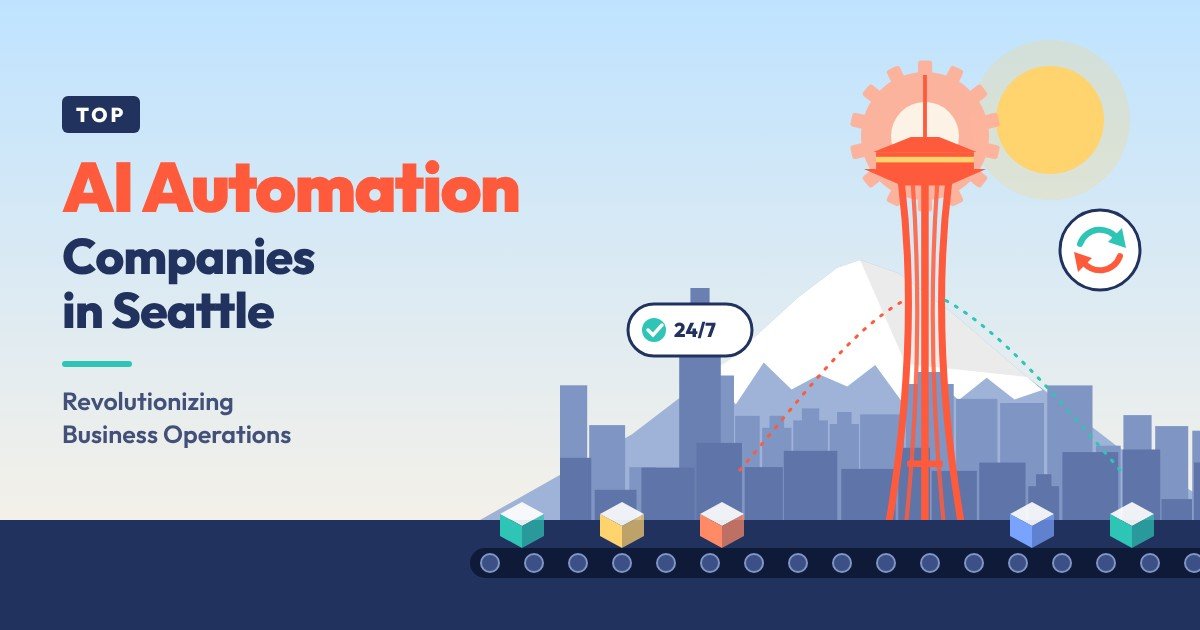
Seattle built much of the modern cloud. Now its companies are building the AI that runs work on top of it.
- AI automation blends rules-based safety with agentic decision making; most tools use both, sending hard calls to humans.
- Choose tools that fit your systems, start with the most painful process, and keep humans in the loop for approvals and failures.
- Seattle firms cover wide business areas: reliable agent platforms, tax, contracts, supply chain, marketing, meetings, scheduling, and revenue ops.
Former Amazon and Microsoft leaders are behind many of these firms. They know how large operations work, and where they break.
This guide covers 10 AI automation companies in Seattle and the wider Eastside. You will see what each one automates, who it serves, and where it fits.
What Is AI Automation?
AI automation uses artificial intelligence to finish work that people used to do by hand. Older automation followed fixed rules. AI automation can read, decide, and adapt.
Common examples include:
- Scheduling meetings from email threads
- Filing tax returns and checking compliance
- Reviewing contracts for risky terms
- Reallocating stock when a supplier falls short
- Updating web pages across a large marketing site
The best tools still send hard calls to a human.
Rules-Based vs. Agentic Automation
Two styles of automation now work side by side.
| Rules-Based Automation | Agentic Automation | |
|---|---|---|
| How it works | Follows fixed steps | Plans steps toward a goal |
| Handles surprises | Poorly | Adapts, then escalates |
| Best for | Stable, repeated tasks | Messy tasks with many inputs |
| Risk | Breaks when inputs change | Can make wrong calls without guardrails |
Most firms on this list blend both. Rules handle the safe parts. Agents handle the judgment calls.
How We Picked These Companies
Each company here is based in Seattle or nearby Bellevue. Each one uses AI to automate real business work.
We looked at:
- What each product automates
- Funding, growth, and named customers
- Fit for different company sizes
- Limits buyers should weigh
Most figures come from company news and press reports. Test any tool on your own process before you sign.
Quick Comparison: AI Automation Companies in Seattle
| Company | What It Automates | Standout Strength | Best For |
|---|---|---|---|
| Temporal | Long-running code and AI agents | Work survives crashes | Engineering teams |
| Smartsheet | Projects and work management | AI agents inside familiar sheets | Large project teams |
| Nintex | Business workflows | Agents inside orchestrated flows | Process-heavy firms |
| Avalara | Tax and compliance | Deep tax content plus AI | Online sellers and finance teams |
| Icertis | Contract work | AI tied to contract terms | Large legal and procurement teams |
| Auger | Supply chain decisions | Acts across ERP and warehouse tools | Retail and manufacturing |
| Gradial | Marketing operations | Agents inside Adobe and Salesforce | Enterprise marketing teams |
| Read AI | Meeting notes and follow-ups | Works across meetings, email, chat | Busy teams and managers |
| Howie | Meeting scheduling | Runs fully over email | Founders and executives |
| Tektonic AI | Sales and revenue operations | Agents that act across apps | Revenue ops teams |
The 10 Best AI Automation Companies in Seattle
1. Temporal: Keeping Automated Work Running
Temporal was founded in 2019 and calls the Seattle area home. It builds open-source software that keeps long tasks running, even when systems crash.
This matters for AI agents. An agent may work for hours across many tools. If one step fails, Temporal picks up where it left off.
In September 2026, Temporal raised $550 million at a $12.55 billion valuation, led by Lightspeed. It has more than 4,300 paying customers, including OpenAI, Netflix, NVIDIA, and JPMorgan Chase. Its revenue run rate passed $250 million.
Best for: Engineering teams building reliable automations and AI agents.
Watch out for: It is a developer tool. Business teams will need engineers to use it.
2. Smartsheet: AI Agents for Project Work
Smartsheet is based in Bellevue. More than 123,000 organizations use it to run projects, including teams at 85% of the Fortune 500.
In November 2025, Smartsheet unveiled its AI plans. Smart Agents act as digital coworkers. The first one tracks projects, ranks risks, and suggests fixes. Smart Flows build automated workflows from plain-language prompts.
Smartsheet went private in an $8.4 billion deal.
Best for: Large teams that already run projects in Smartsheet.
Watch out for: Several AI features launched in early access programs. Check what is fully available.
3. Nintex: Agents Inside Business Workflows
Nintex is headquartered in Bellevue. More than 7,000 organizations in over 100 countries use it to automate business processes.
In March 2026, Nintex launched Agent Designer and Nintex Orchestration in beta. Teams can build AI agents that run inside structured workflows. Agents plan steps, pull in context, and hand off to people when firm control is needed.
Nintex also offers robotic process automation and document processing.
Best for: Firms with many approval-heavy processes, like HR, finance, and operations.
Watch out for: The new agent tools are in beta. Pilot them before broad rollout.
4. Avalara: Automating Tax and Compliance
Avalara is a Seattle tax compliance company. Its tools calculate sales tax, file returns, and manage exemption forms for businesses.
Avalara is now moving from AI that assists to AI that acts. Its Aviator agent hub and AI tools sort products into tax categories, assign tariff codes, and answer tax questions in plain language.
Avalara connects with Shopify, NetSuite, SAP, QuickBooks, Salesforce, and many other systems.
Best for: Online sellers and finance teams handling tax in many places.
Watch out for: Tax rules carry legal risk. Keep a tax expert reviewing edge cases.
5. Icertis: AI for Contract Work
Icertis is based in Bellevue and builds contract management software. More than one third of the Fortune 100 use it.
Icertis offers agentic automation for contracts. Its Vera AI pairs language models with contract data. That lets it act on business needs while staying within agreed terms.
A 2026 study backed by Icertis found AI enthusiasm among contract teams rose from 36% to 56% in a year.
Best for: Large legal, sales, and procurement teams with many contracts.
Watch out for: It suits large firms. Smaller teams may find it more than they need.
6. Auger: Automating Supply Chain Decisions
Auger was launched in 2024 by Dave Clark, a former top Amazon operations leader. It is based in Bellevue.
Auger sits on top of existing ERP, warehouse, shipping, and planning systems. AI agents make routine supply chain choices and carry them out. They flag unusual cases for human review.
Auger raised a $50 million Series B in July 2026, led by Eclipse, bringing total funding to $150 million. Customers include Meta’s Reality Labs, Fanatics, and Kimberly-Clark.
Best for: Retailers and manufacturers with complex supply chains.
Watch out for: It relies on clean data from your existing systems. Audit data quality first.
7. Gradial: Agents for Marketing Operations
Gradial was founded in 2023 by four Dartmouth classmates and is based in Seattle. It builds AI agents for enterprise marketing teams.
The agents work inside Adobe, Salesforce, and Sitecore. They write and check content, enforce brand rules, and route updates through approvals. They also spot gaps in AI search results and publish fixes.
Gradial raised a $65 million Series C in June 2026, led by Insight Partners. Customers include AWS, T-Mobile, Vanguard, and US Bank.
Best for: Large marketing teams managing big websites and content libraries.
Watch out for: It fits firms on major marketing platforms. Smaller sites may not need it.
8. Read AI: Automating Meeting Follow-Up
Read AI was founded in 2021 and is based in Seattle. It records meetings, writes summaries, and pulls insights from email and chat.
In February 2026, Read AI launched Ada, an email-based digital twin. Ada handles scheduling and answers questions for users. Read AI also connects to Claude and ChatGPT through an MCP server.
Read AI raised a $50 million Series B in 2024, led by Smash Capital, at a reported $450 million valuation.
Best for: Teams that lose time to meeting notes and follow-ups.
Watch out for: Recording meetings raises consent issues. Set clear policies first.
9. Howie: An AI Scheduling Assistant
Howie is based in Seattle’s Fremont neighborhood. Users copy Howie on email threads, and it books the meeting.
Howie finds times, adds events to calendars, follows up, and checks for conflicts. Users set their preferences in a simple document. Hard cases go to human reviewers.
Howie raised a $6 million seed round led by True Ventures. At launch, it had more than 1,000 paying customers. Plans start at $25 a month.
Best for: Founders, investors, and executives who book many meetings.
Watch out for: It focuses on scheduling. You will need other tools for broader tasks.
10. Tektonic AI: Agents for Revenue Operations
Tektonic AI is a Seattle startup. CEO Nic Surpatanu held leadership roles at UiPath, Tanium, and Microsoft.
Tektonic builds AI agents that pull data and take action across many business apps. Users talk to them in plain language. The first focus is sales and revenue operations, such as deal desk work.
Tektonic raised a $10 million seed round led by Madrona and Point72 Ventures.
Best for: Revenue ops teams buried in deal reviews and approvals.
Watch out for: It is an early-stage company. Check product maturity and support.
How to Choose an AI Automation Partner
Ask these questions before you buy:
- Which process costs us the most time? Start there, not with the flashiest tool.
- What can the AI do without approval? Know where humans step in.
- Does it fit our current systems? Check links to your ERP, CRM, and email.
- How do we measure success? Agree on hours saved, errors cut, or faster cycle times.
- What happens when it fails? Ask about fallbacks, logs, and support.
What Does AI Automation Cost?
Pricing varies widely:
- Personal assistants like Howie: About $25 to $95 per user each month
- Work management tools: Per-seat plans, with AI features often at higher tiers
- Enterprise platforms: Custom contracts, often tens of thousands of dollars a year or more
- Developer platforms like Temporal: Free open-source option, with paid cloud usage
Hidden costs include setup, data cleanup, and staff training.
What Doesn’t Work in AI Automation
Common mistakes include:
- Automating a broken process: AI makes a bad process run faster, not better.
- No human checkpoints: Agents need clear points where people approve.
- Messy data: Wrong inputs lead to wrong actions at scale.
- Too many tools: Overlapping products confuse staff and split data.
A real example: a distributor lets an AI agent reorder stock with no limits. A bad demand forecast triggers a huge order. Adding spending caps and human approval above a set amount fixed the problem.
Final Thoughts
AI automation companies in Seattle cover almost every part of the business. Temporal keeps automated work running. Smartsheet and Nintex bring agents to everyday workflows. Avalara and Icertis automate tax and contracts. Auger runs supply chain decisions. Gradial, Read AI, Howie, and Tektonic AI save teams hours in marketing, meetings, and sales.
Start with one painful process, keep humans in the loop, and expand as results prove out.
FAQs
What are the top AI automation companies in Seattle?
Leading names include Temporal, Smartsheet, Nintex, Avalara, Icertis, Auger, Gradial, Read AI, Howie, and Tektonic AI.
What is agentic automation?
Agentic automation uses AI agents that plan and complete multi-step tasks toward a goal, escalating to humans when needed.
How is AI automation different from RPA?
RPA follows fixed rules. AI automation can read messy inputs, make decisions, and adapt when things change.
Can small businesses use AI automation?
Yes. Tools like Howie and Read AI cost little per user and need almost no setup.
Will AI automation replace jobs?
It mostly removes repetitive tasks. People shift to judgment, relationships, and handling exceptions.

 AI/ML Strategy and Consulting
 Data Science And Data Analytics
 Generative AI
 AI Consulting Services
 AI Automation Solutions
 API Integration