
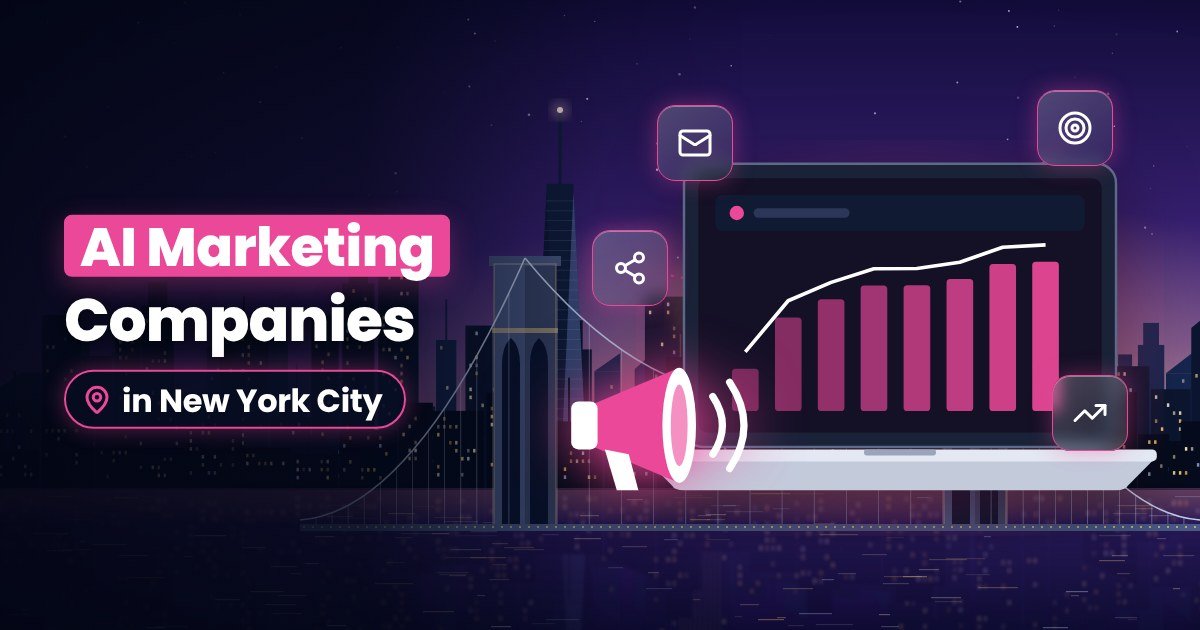
Marketing has two big AI shifts happening at once.
- New York firms span four core AI marketing categories: customer engagement, content personalization, AI search visibility, and advertising technology.
- Generative engine optimization tracks brand mentions and sources in AI assistant answers, crucial for discovery and competing in AI-driven buying.
- Build a practical AI marketing stack in four layers: engagement, content, visibility, and ads; start with the layer causing the most pain.
- AI amplifies both gains and risks; require holdout testing, human review for brand voice, and controls for frequency, compliance, and ad safety.
First, AI now writes, personalizes, and sends messages at a scale no team could match by hand. Second, customers increasingly ask ChatGPT, Claude, or Perplexity what to buy instead of searching Google.
AI marketing companies in New York City sit at the center of both changes. This guide covers 10 of them, what they do best, and where they fall short.
What Do AI Marketing Companies Do?
AI marketing companies use artificial intelligence to plan, create, deliver, or measure marketing. Most fall into four groups:
- Customer engagement: Sending the right email, SMS, or push message to each person
- Content and personalization: Generating copy and visuals tailored to each customer
- AI search visibility: Tracking and improving how brands appear in AI assistant answers
- Advertising technology: Buying, optimizing, and protecting ad placements
New York leads in all four. It is home to many of the brands, agencies, and publishers these tools serve.
What Is AI Search Visibility (GEO)?
AI search visibility is the newest category on this list. It is often called generative engine optimization, or GEO.
When someone asks an AI assistant for the best running shoes, the answer names a few brands. GEO tools track whether your brand appears, how it is described, and which sources the AI cites.
This matters because AI answers often replace a page of search results. If your brand is missing from the answer, you lose the customer before they ever see a link.
How We Chose These AI Marketing Companies
Every company on this list is based in New York City. Each one sells AI-driven marketing technology to businesses.
We looked at:
- Core AI capabilities and recent product launches
- Named customers and reported results
- Funding, revenue, or public-company scale
- Gaps and risks marketers should weigh
Most performance figures come from company announcements. Treat them as directional and ask vendors for proof in your category.
Quick Comparison: AI Marketing Companies in NYC
| Company | Category | Standout AI Capability | Best For |
|---|---|---|---|
| Braze | Customer engagement | BrazeAI agents and decisioning | Large consumer brands |
| Attentive | SMS and email | AI campaigns and reporting agent | Ecommerce and retail |
| Movable Ink | Personalization | Da Vinci AI content selection | Retail and travel email |
| Persado | AI copywriting | Motivation-based language AI | Banks and regulated marketers |
| Profound | AI search visibility | Tracks brand presence in AI answers | Enterprise brand teams |
| Bluefish | AI search visibility | Agentic GEO platform | Fortune 500 marketers |
| Yext | Brand data and local | Scout AI visibility agent | Multi-location brands |
| Insider One | Customer engagement | Agentic commerce marketing | Retailers (now with Bluecore) |
| Taboola | Performance ads | Realize+ agentic ad optimization | Performance advertisers |
| DoubleVerify | Ad verification | AI content classification | Brand safety at scale |
The 10 Best AI Marketing Companies in New York City
1. Braze: AI-Powered Customer Engagement
Braze is headquartered in New York and runs 15 offices worldwide. It helps brands send personalized messages across email, SMS, push, and in-app.
Its AI suite, BrazeAI, includes Operator, Agent Console, and Decisioning Studio. Operator can now build campaign steps from a simple conversational prompt. Decisioning Studio picks the best offer and timing for each customer.
In the quarter ending July 2026, Braze grew revenue 26% to $227 million. It serves nearly 2,800 customers.
Best for: Consumer brands with large audiences and multiple messaging channels.
Watch out for: It is an enterprise platform. Small brands may pay for more than they use.
2. Attentive: AI-Led SMS and Email Marketing
Attentive is a New York-based platform for SMS and email marketing. It works closely with ecommerce platforms like Shopify.
At its Thread 2026 event, Attentive unveiled new AI tools. They include AI Campaigns, which builds whole campaigns from customer signals, and a Reporting Agent that answers performance questions in plain language.
Brands drove more than $6 billion in revenue through Attentive in the first quarter of 2026. Named customers include Lands’ End, Carter’s, and Crate & Barrel.
Best for: Ecommerce and retail brands that rely on text and email revenue.
Watch out for: SMS marketing faces strict consent rules. Keep opt-in practices clean.
3. Movable Ink: AI Content Personalization at Send Time
Movable Ink is a New York-based personalization company best known for dynamic email content. Its AI engine is called Da Vinci.
Da Vinci combines predictive and generative AI to choose content for each customer. Its Creative IQ picks content and subject lines. Messaging IQ decides when to send and how often. Performance IQ runs continuous tests in place of manual A/B testing.
Movable Ink integrates with major email platforms, including Salesforce, Adobe, Braze, and Iterable.
Best for: Retail, travel, and media brands with large, image-rich email programs.
Watch out for: It layers on top of your email platform. Budget for both tools.
4. Persado: AI Copy That Speaks to Motivation
Persado was founded in 2012 and is headquartered on East 26th Street in Manhattan. It generates marketing language using AI trained on what motivates people to act.
Its main product creates personalized web and email copy. Persado also offers a Marketing Compliance AI platform. It helps financial services teams speed up the legal review of marketing content.
Named customers include Marks & Spencer, Tapestry, and Carrefour.
Best for: Banks, credit unions, and retailers that need on-brand, compliant copy at scale.
Watch out for: Its edge is language. You will still need other tools for targeting and delivery.
5. Profound: Leading the AI Search Visibility Category
Profound is a New York-based company that helps brands understand and improve how AI assistants talk about them. It tracks which brands appear in AI answers and which sources those answers cite.
In September 2026, Profound raised a $180 million Series D at a $1.8 billion valuation. Sequoia Capital and Kleiner Perkins led the round.
A practical example: a software company learns ChatGPT recommends two rivals for its core use case. Profound shows which review sites and articles the AI relies on. The team then targets those sources.
Best for: Enterprise brand and SEO teams responding to AI-driven discovery.
Watch out for: AI answers change often. Treat visibility scores as trends, not fixed rankings.
6. Bluefish: Agentic Marketing for AI Discovery
Bluefish is a New York-based startup building an agentic marketing platform for AI discovery. It helps brands monitor, influence, and measure their presence in AI answers.
The platform covers ChatGPT, Google’s AI products, Claude, Perplexity, and Amazon’s Rufus shopping assistant. Bluefish says about 10% of the Fortune 500 use it.
In April 2026, Bluefish raised a $43 million Series B co-led by Threshold Ventures and NEA. Amex Ventures and Salesforce Ventures also joined.
Best for: Large consumer brands that care about AI shopping assistants like Rufus.
Watch out for: The GEO category is young. Compare Bluefish and Profound on your own brand data before buying.
7. Yext: AI Visibility for Multi-Location Brands
Yext is a New York-based public company known for managing brand listings and reviews. It now positions itself as an agentic marketing platform.
Its Scout agent tracks AI search visibility and competitor activity. Its Action Center lets brands act on Scout’s findings across listings, reviews, and social. Hearing care brand Beltone saw local AI citations rise 186% using Scout.
Yext also launched Corvo AI, a free agent that texts small business owners local marketing tips.
Best for: Restaurants, retailers, healthcare networks, and other brands with many locations.
Watch out for: Its strength is structured brand data. Pure content marketers may need other tools.
8. Insider One: Agentic Commerce Marketing, Now With Bluecore
Insider One is a New York-based customer engagement platform focused on agentic commerce marketing. In May 2026, it acquired Bluecore, a retail marketing specialist.
The deal brings Bluecore retail clients like J.Crew, Sephora, Bloomingdale’s, and Ralph Lauren into Insider One. The combined company serves more than 1,500 brands and retailers.
Insider One uses AI to predict what each shopper wants and personalize messages across channels.
Best for: Retailers that want AI personalization and retail-specific forecasting.
Watch out for: Mergers bring product changes. Bluecore customers should ask about roadmap and support plans.
9. Taboola: AI-Driven Performance Advertising
Taboola was founded in Israel in 2007 and moved its headquarters to New York City soon after. It trades on Nasdaq and reported about $1.9 billion in 2025 revenue.
Its Realize platform serves native, display, and video ads aimed at measurable results like leads and sales. In April 2026, Taboola launched Realize+, an agentic AI system that makes optimization decisions for advertisers.
Taboola’s reach comes from deals with Yahoo, Microsoft’s MSN, Apple News, and major publishers.
Best for: Performance marketers seeking scale beyond search and social ads.
Watch out for: Ad quality varies across placements. Monitor where your ads run.
10. DoubleVerify: AI That Protects Your Ad Spend
DoubleVerify is a New York-based ad verification company. It checks that ads appear in safe, suitable places and reach real people.
Its Universal Content Intelligence engine analyzes text, images, video, and audio. For video, it reviews content frame by frame. In May 2026, DoubleVerify launched AI-powered pre-screen controls on Meta’s Threads feed.
These controls block unsuitable placements before ads run, and they refresh every hour.
Best for: Large advertisers protecting brand reputation across platforms.
Watch out for: Verification adds cost per impression. Weigh it against your brand risk.
How to Build an AI Marketing Stack
Most brands do not need all 10. A practical stack covers four layers:
- Engagement: One platform for messaging, like Braze or Attentive
- Content: A personalization or copy tool, like Movable Ink or Persado
- Visibility: A GEO tool, like Profound, Bluefish, or Yext
- Ads and protection: A performance platform plus verification
Start with the layer causing the most pain. Add others once the first one shows results.
How to Evaluate AI Marketing Tools
Use these questions in every demo:
- What results did similar brands see? Ask for case studies in your industry and size.
- How is success measured? Insist on holdout tests, not just before-and-after charts.
- Who controls brand voice? Check approval steps for AI-generated content.
- What data does it need? Confirm integrations with your CRM and commerce platform.
- How is it priced? Usage-based pricing can rise fast as message volume grows.
What Doesn’t Work With AI Marketing
AI magnifies both good and bad marketing.
- Personalizing bad offers: Better targeting cannot save a weak product or price.
- Removing human review: Unchecked AI copy can drift off-brand or break regulations.
- Chasing AI visibility scores alone: Being mentioned in AI answers matters only if it drives revenue.
- Over-messaging: More AI-generated messages often mean more unsubscribes.
A real example: a retailer lets AI generate daily SMS campaigns. Revenue rises for two weeks, then opt-outs spike. Adding frequency caps and smarter send-time rules restored the balance.
Final Thoughts
AI marketing companies in New York City cover every part of the modern stack. Engagement leaders like Braze and Attentive handle messaging. Profound, Bluefish, and Yext lead the new fight for AI search visibility. Taboola and DoubleVerify shape how ad budgets perform and stay safe.
Pick tools that solve your biggest current gap. Measure with holdout tests, keep humans reviewing brand voice, and expand only when results hold.
FAQs
What are the best AI marketing companies in New York City?
Leading names include Braze, Attentive, Movable Ink, Persado, Profound, Bluefish, Yext, Insider One, Taboola, and DoubleVerify.
What is generative engine optimization (GEO)?
GEO improves how brands appear in AI assistant answers. It tracks mentions, descriptions, and the sources AI tools cite.
How do AI marketing tools improve ROI?
They personalize messages, optimize send times and bids, and cut manual work. Gains depend on clean data and solid testing.
Is AI-generated marketing copy safe for regulated industries?
It can be, with compliance controls and human review. Tools like Persado offer compliance features for financial services.
Do small businesses need AI marketing platforms?
Not always. Start with AI features in your email or SMS tool. Free tools like Yext’s Corvo AI can also help.


 AI/ML Strategy and Consulting
 Data Science And Data Analytics
 Generative AI
 AI Consulting Services
 AI Automation Solutions
 API Integration