

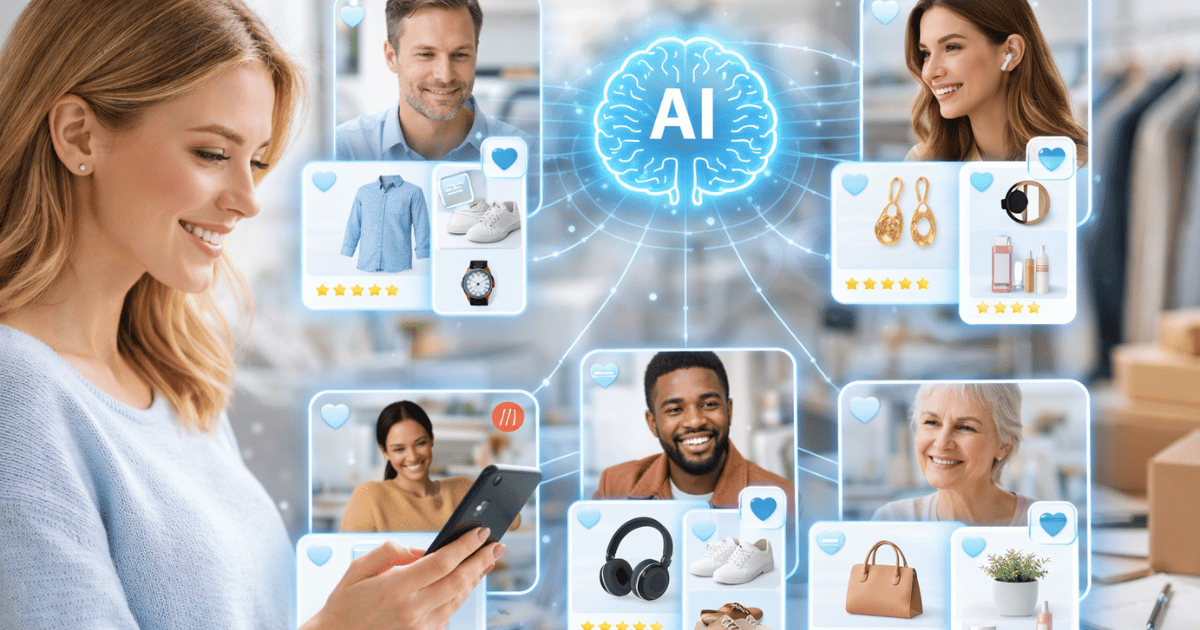
Customers in 2026 expect every interaction to feel relevant. Generic messaging and one-size-fits-all experiences push buyers toward competitors who understand their preferences. Personalization has shifted from a nice-to-have feature to a core business requirement.
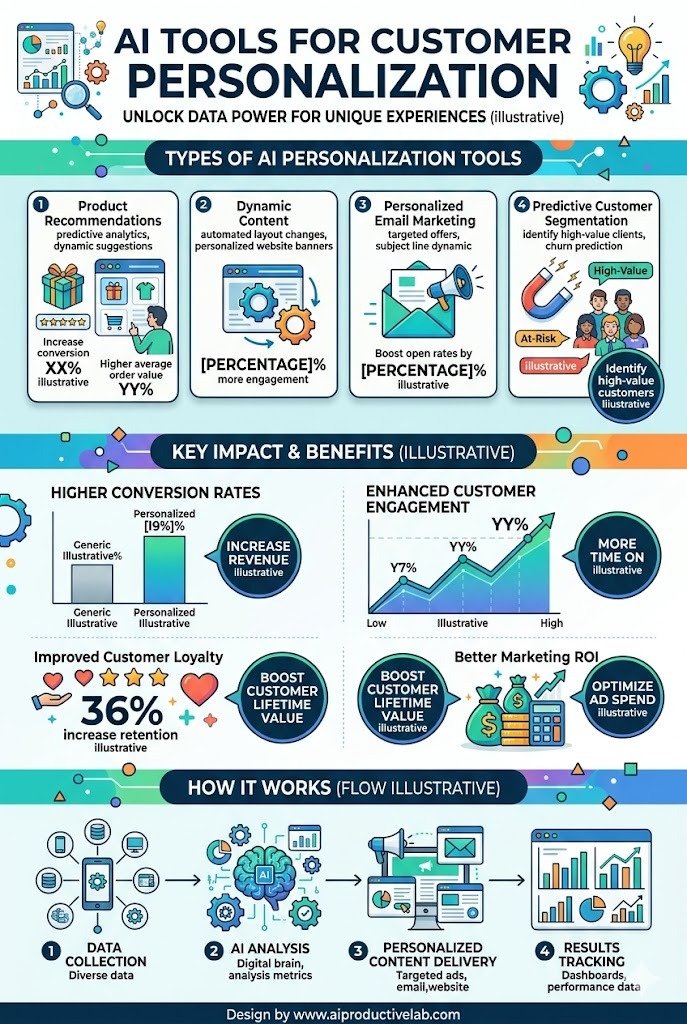
- True personalization uses real-time data and predictive recommendation engines to adapt experiences dynamically while maintaining transparency to build trust.
- Begin with clean, unified customer data as the foundation, then select tools by channel and maturity, adding capabilities gradually for compounding value.
- Track conversion, AOV, revenue per visitor, and engagement; use attribution and regular model recalibration to ensure personalization delivers measurable ROI.
AI tools for customer personalization make this possible at scale. They analyze behavior, predict intent, and deliver tailored content across every channel in real time. Without automation, delivering this level of relevance to thousands or millions of customers simply is not feasible.
Research consistently shows that personalized experiences increase conversion rates by 10 to 30 percent. Customer retention improves when buyers feel understood. Revenue per visitor climbs when product suggestions, emails, and on-site content align with individual preferences.
The brands winning market share today are not necessarily the biggest. They are the ones using AI-driven personalization platforms to treat every customer like their only customer.
What Defines Effective AI Personalization?
Before evaluating specific tools, it helps to understand what separates meaningful personalization from surface-level tricks. Adding a first name to an email subject line is not true personalization. That era ended years ago.
Effective personalization uses real-time data to adapt experiences dynamically. It considers browsing history, purchase patterns, device type, location, time of day, and even weather conditions. The goal is to present the right content, product, or offer at the exact moment it matters most.
Strong AI recommendation engines go further by predicting what a customer needs before they search for it. They identify patterns across millions of interactions and apply those insights to individual sessions. This is where machine learning creates a genuine competitive advantage.
Transparency also plays a critical role. Customers appreciate relevant suggestions but distrust platforms that feel invasive. The best tools balance deep personalization with clear data practices that build rather than erode trust.
10 AI Tools for Customer Personalization Worth Evaluating
1. Dynamic Yield
Dynamic Yield is an enterprise-grade personalized customer experience software used by brands like McDonald’s, Sephora, and IKEA. It personalizes web content, product recommendations, emails, and app experiences from a single platform.
Its decision engine runs hundreds of simultaneous experiments. It tests layouts, messaging, and offers to find the highest-performing combination for each audience segment. Marketers get actionable results without needing data science expertise.
2. Nosto
Nosto delivers AI-powered personalization specifically for eCommerce. It analyzes each visitor’s browsing behavior and purchase history to display the most relevant products, content, and pop-ups in real time.
The platform excels at on-site product recommendations and personalized search results. It integrates natively with Shopify, Magento, and BigCommerce. Most merchants see measurable lifts in average order value within the first few weeks of deployment.
3. Segment
Segment is a customer data platform that collects, cleans, and unifies data from every touchpoint. It feeds accurate, real-time customer profiles into your personalization and marketing tools. Without clean data, even the best AI models produce poor results.
Think of Segment as the foundation layer. It connects your website, app, email platform, and advertising channels into a single source of truth. Over 25,000 businesses rely on it to power their personalization strategies with trustworthy data.
4. Braze
Braze is a customer engagement platform that uses AI to orchestrate personalized messaging across email, push notifications, SMS, and in-app channels. Its Canvas Flow tool lets marketers build complex, behavior-triggered journeys without writing code.
What makes Braze stand out is its real-time processing engine. It reacts to customer actions within seconds, not hours. When a shopper abandons a cart or browses a specific category, Braze triggers relevant follow-ups instantly.
5. Algolia
Algolia powers AI-driven search and discovery for websites and apps. Its personalization layer reranks search results based on each user’s preferences, past clicks, and purchase behavior. Customers find what they want faster, which directly improves conversion rates.
Search is one of the most underutilized personalization opportunities. Visitors who use site search convert at significantly higher rates. Algolia ensures those high-intent moments deliver relevant results every single time.
6. Insider
Insider is an all-in-one growth management platform with deep personalization capabilities. It uses predictive segments to group users by likelihood to purchase, churn, or engage with specific content categories.
The platform supports personalization across web, mobile, email, WhatsApp, and even offline channels. Its AI models predict optimal send times, preferred channels, and the content formats most likely to drive action for each individual user.
7. Bloomreach
Bloomreach combines content management, search, and merchandising into a unified commerce experience platform. Its AI engine, called Loomi, personalizes product discovery, site navigation, and marketing campaigns simultaneously.
Loomi processes billions of data points to understand customer intent in real time. It adjusts product rankings, banners, and category pages based on what each visitor is most likely to buy. Enterprise retailers use Bloomreach to manage personalization at massive scale.
8. Optimizely
Optimizely is best known for experimentation, but its personalization capabilities are equally powerful. It lets teams create targeted experiences based on audience attributes, behavioral data, and contextual signals.
The platform connects experimentation with personalization seamlessly. You test a hypothesis, identify winning variations, and then deploy personalized versions to relevant segments automatically. This data-driven approach removes guesswork from personalization decisions entirely.
9. MoEngage
MoEngage is a customer engagement platform popular with mobile-first brands. Its AI engine, called Sherpa, optimizes message timing, channel selection, and content for each user based on historical engagement patterns.
It works especially well for apps, gaming companies, and subscription businesses. MoEngage predicts when a user is most likely to open a notification or engage with a campaign. This precision reduces message fatigue and improves response rates significantly.
10. Recombee
Recombee is a dedicated AI recommendation engine that integrates into any digital product via API. It powers personalized product suggestions, content feeds, and search results using advanced machine learning models.
What distinguishes Recombee is its flexibility. Unlike platform-specific tools, it works across eCommerce, media, job boards, and any scenario requiring behavioral targeting software. Setup is developer-friendly, and the recommendation quality improves continuously as it processes more interaction data.
Side-by-Side Comparison: Choosing the Right Fit
| Tool | Core Strength | Best For | Key Channels |
|---|---|---|---|
| Dynamic Yield | Full-stack personalization | Enterprise brands | Web, app, email |
| Nosto | eCommerce recommendations | Online retailers | Web, email |
| Segment | Data unification | Data-driven teams | All (feeds other tools) |
| Braze | Cross-channel messaging | Mobile-first brands | Email, SMS, push, in-app |
| Algolia | Search personalization | Content-rich sites | Web, app |
| Insider | Predictive segmentation | Growth-focused teams | Web, mobile, WhatsApp |
| Bloomreach | Commerce experience | Enterprise retail | Web, search, merchandising |
| Optimizely | Experimentation + personalization | Testing-focused teams | Web, app |
| MoEngage | Mobile engagement | App-centric businesses | Push, in-app, email |
| Recombee | Flexible recommendations | Developers and custom builds | Any (API-based) |
How to Build a Personalization Stack That Works
Selecting AI tools for customer personalization is not about choosing the flashiest platform. It starts with understanding your data maturity, team capabilities, and the specific customer touchpoints that matter most to your business.
If your data is scattered across disconnected systems, begin with a customer data platform like Segment. Clean, unified data is the prerequisite for every personalization effort. Without it, AI models receive noisy inputs and produce unreliable outputs.
Next, identify your highest-impact channel. For eCommerce brands, on-site personalization typically delivers the fastest ROI. Tools like Nosto or Bloomreach can generate measurable revenue improvements within weeks. For mobile-first companies, Braze or MoEngage will have greater immediate impact.
Layer additional tools gradually. Add search personalization after your core recommendation engine is performing well. Introduce experimentation through Optimizely once you have enough traffic to run statistically valid tests. Each addition compounds the value of your existing stack.
Avoid the mistake of over-investing in tools before your team can use them effectively. A well-configured single platform outperforms a poorly managed suite of five every time.
Measuring Personalization Success
Deploying real-time personalization tools is only valuable if you track outcomes rigorously. Start with clear baseline metrics before activating any AI features. This gives you an honest benchmark for comparison.
Key metrics to monitor include conversion rate by segment, average order value, revenue per visitor, and customer lifetime value. Track engagement indicators like click-through rates on recommendations and time spent on personalized pages. These numbers reveal whether your AI models are improving experiences or simply adding complexity.
Attribution matters too. Understand which personalization touchpoints contribute most to purchase decisions. Multi-touch attribution models help you allocate budget toward the tools and channels driving the strongest returns.
Review performance monthly and recalibrate your models quarterly. Customer behavior shifts with seasons, trends, and economic conditions. AI tools that performed well last quarter may need updated training data or adjusted parameters to maintain effectiveness.
FAQs
They are software platforms that use artificial intelligence to tailor content, recommendations, and messaging to individual customers based on their behavior, preferences, and real-time interactions.
They analyze customer data to deliver relevant product suggestions, targeted offers, and optimized content at the right moment, reducing friction and increasing the likelihood of purchase.
Yes. Tools like Nosto and Recombee offer scalable pricing and deliver meaningful results even for stores with modest traffic. Personalization benefits businesses of every size.
A recommendation engine suggests relevant products or content. A personalization platform covers a broader scope, including messaging, site layout, search results, and cross-channel experiences.
Most platforms require two to six weeks for full setup and integration. Simpler tools with native connectors can go live within days, while enterprise platforms need more configuration time.


 AI/ML Strategy and Consulting
 Data Science And Data Analytics
 Generative AI
 AI Consulting Services
 AI Automation Solutions
 API Integration


