

Every online shopper has abandoned a store because they could not find what they wanted. Poor product discovery kills conversions silently. Shoppers leave, and store owners never know what went wrong.
- AI recommendation engines combine collaborative, content-based, and real-time behavioral models to deliver personalized, relevant product suggestions for each shopper.
- Choose platforms based on catalog size, traffic volume, technical resources, multi-channel needs, and A/B testing capabilities to align with business goals.
- Proper placement, configuration, and continuous testing drive measurable lifts in conversion and average order value; start on high-traffic pages and iterate.
AI tools for product recommendations solve this problem at scale. They analyze browsing behavior, purchase patterns, and real-time intent to surface the right product for every visitor. This guide covers platforms that help online businesses turn browsers into loyal buyers.
Why Product Recommendations Need AI
Generic product suggestions frustrate shoppers. Showing bestsellers to everyone ignores individual preferences. Static “you might also like” sections rarely feel relevant or timely.
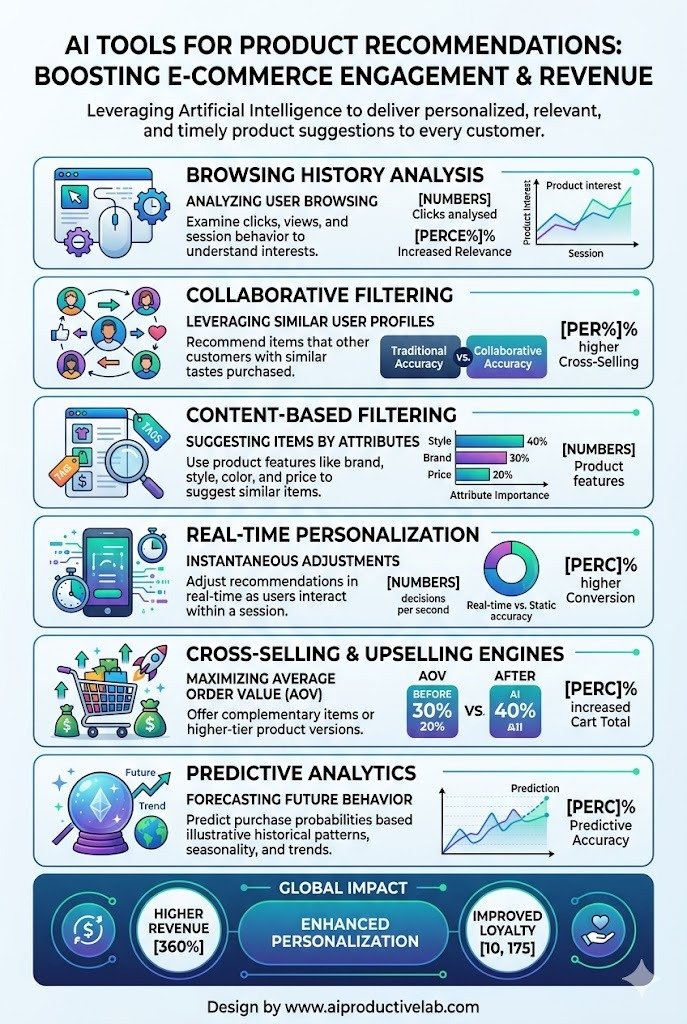
AI recommendation engines process thousands of data signals per visitor. They evaluate what a shopper clicks, how long they browse, what they add to cart, and what similar customers purchased. The result is a personalized storefront experience that feels curated for each individual.
Retailers using AI-powered recommendations see measurable revenue lifts. Average order values climb when shoppers discover complementary products. Return visits increase because customers trust the store to understand their taste. Personalized product suggestions are no longer a luxury. They are a revenue driver.
How AI Product Recommendation Engines Work
Understanding the mechanics helps you evaluate platforms more effectively. Most recommendation engines rely on a combination of proven techniques.
Collaborative Filtering
This method finds patterns across customer groups. If customers who bought Product A also frequently bought Product B, the engine recommends Product B to new shoppers browsing Product A. It works well for stores with large customer bases and rich purchase histories.
Content-Based Filtering
This approach analyzes product attributes like color, size, category, and price. It recommends items similar to what a shopper has already viewed or purchased. Content-based filtering is effective even for new stores with limited transaction data.
Real-Time Behavioral Analysis
Advanced engines track what a visitor does during a single session. They adjust recommendations dynamically based on clicks, scroll depth, and time spent on product pages. This ensures suggestions stay relevant as shopper intent evolves throughout the visit.
Hybrid Models
The most effective platforms combine collaborative filtering, content-based filtering, and real-time behavior into one unified model. Hybrid approaches deliver the most accurate and personalized recommendations across different shopping scenarios.
10 AI Tools for Product Recommendations That Deliver Results
These platforms represent the leading options available to online retailers in 2026. Each one takes a different approach to personalized product discovery.
1. Nosto — Real-Time Personalization Across Every Touchpoint
Nosto delivers AI-powered product recommendations across web, email, mobile, and advertising channels. It builds individual shopper profiles in real time and adapts recommendations as behavior changes during each session.
The platform supports dynamic bundles, cross-sell suggestions, and personalized category pages. Mid-market and enterprise retailers use Nosto to create cohesive, personalized experiences without heavy development resources. It integrates with Shopify, Magento, BigCommerce, and custom platforms.
2. Bloomreach — AI-Driven Search and Merchandising Platform
Bloomreach combines product discovery, search, and recommendations into one intelligent commerce experience platform. Its AI engine, called Loomi, processes customer data to predict what each shopper wants to see next.
The platform excels at connecting search queries with personalized product results. Retailers using Bloomreach report significant improvements in revenue per visitor. It serves major brands across fashion, home goods, and specialty retail.
3. Constructor — AI-Native Product Discovery Engine
Constructor builds its recommendation engine from the ground up using machine learning optimized for commerce metrics. Unlike generic AI models, Constructor trains specifically on revenue and conversion data rather than just click behavior.
This commercial focus means recommendations prioritize products that drive actual sales, not just engagement. The platform handles search, browse, recommendations, and quizzes in a single system. Enterprise retailers choose Constructor for its measurable impact on bottom-line revenue.
4. Klevu — Smart Search With Integrated Recommendations
Klevu pairs AI-powered site search with contextual product recommendations. When a shopper searches for a specific item, Klevu suggests complementary and alternative products alongside the search results. This turns every search query into a discovery opportunity.
The platform’s machine learning engine learns continuously from shopper interactions. It supports Shopify, Magento, BigCommerce, and headless commerce architectures. Stores with large catalogs benefit most from Klevu’s ability to surface relevant products from deep within the inventory.
5. Dynamic Yield — Enterprise Personalization and Recommendation Engine
Dynamic Yield, now part of Mastercard, offers a comprehensive personalization platform with powerful recommendation capabilities. It serves product suggestions based on affinity modeling, predictive targeting, and algorithmic testing across web, app, and email.
The platform supports A/B testing of different recommendation strategies. Retailers can compare algorithms and layouts to find what converts best. Dynamic Yield is popular among enterprise brands in retail, travel, and media.
6. Barilliance — Behavioral Product Recommendations for Online Retail
Barilliance specializes in real-time behavioral recommendations for eCommerce stores. It tracks visitor actions and delivers personalized suggestions at critical moments, including product pages, cart pages, and exit-intent pop-ups.
The platform also powers personalized email recommendations triggered by browsing and purchase behavior. Online retailers use Barilliance to recover abandoned carts and re-engage lapsed customers with products tailored to their demonstrated interests.
7. ConversionBox — Conversational AI Shopping Assistant
ConversionBox takes a different approach to product recommendations. Instead of passive suggestion widgets, it uses a conversational AI assistant that engages shoppers in dialogue. Visitors describe what they need, and the assistant recommends the best matches from the catalog.
This guided selling method works particularly well for stores with complex or technical products. Shoppers who interact with ConversionBox convert at higher rates because they receive confident, tailored guidance instead of browsing aimlessly.
8. Recombee — API-First AI Recommendation Engine
Recombee provides a flexible, API-driven recommendation engine that developers integrate into any platform or application. It uses deep learning models to deliver personalized product, content, and search recommendations at scale.
The platform processes real-time interactions and adjusts suggestions within milliseconds. Recombee suits businesses that need full customization over how and where recommendations appear. It works across eCommerce, media, job boards, and any platform requiring intelligent matching.
9. Netcore Unbxd — AI-Powered Search and Product Recommendations
Netcore Unbxd combines intelligent site search with AI product recommendations and category merchandising. Its recommendation engine uses visitor behavior, product attributes, and purchase history to deliver relevant suggestions throughout the shopping journey.
The platform supports strategies like variant-level recommendations, where AI suggests specific sizes or colors based on individual preferences. Retailers using Unbxd report improved product discovery rates and higher conversion from category and search pages.
10. Octane AI — Quiz-Based Product Recommendations
Octane AI powers interactive product recommendation quizzes that guide shoppers to their ideal product. Visitors answer a short series of questions, and the AI matches their responses to the best items in your catalog. This approach works exceptionally well for brands with personalized or customizable offerings.
Beauty, wellness, nutrition, and apparel brands see the strongest results. Quizzes collect valuable zero-party data while increasing conversion rates. Shoppers feel more confident in their purchase because the recommendation process feels personal and intentional.
Comparing the Top AI Product Recommendation Platforms
Use this table to identify which engine aligns with your store’s needs and technical setup.
| Tool | Recommendation Approach | Best For | Platform Support |
|---|---|---|---|
| Nosto | Real-time personalization | Mid-market to enterprise retailers | Shopify, Magento, BigCommerce |
| Bloomreach | Search + discovery + recs | Large retail brands | Multi-platform |
| Constructor | Revenue-optimized ML | Enterprise revenue focus | Custom, headless |
| Klevu | Search-integrated recs | Large catalog stores | Shopify, Magento, BigCommerce |
| Dynamic Yield | Enterprise personalization | Multi-channel retailers | Multi-platform |
| Barilliance | Behavioral triggers | Cart recovery and re-engagement | Multi-platform |
| ConversionBox | Conversational guided selling | Complex product catalogs | Multi-platform |
| Recombee | API-first custom engine | Developer-led teams | Any via API |
| Netcore Unbxd | Search + variant-level recs | Fashion and multi-variant stores | Multi-platform |
| Octane AI | Quiz-based recommendations | DTC and personalized brands | Shopify |
What to Consider Before Choosing a Recommendation Engine
Not every platform suits every store. Evaluate these factors before making a decision.
- Catalog size and complexity: Stores with thousands of SKUs need engines that handle deep catalogs efficiently. Simpler catalogs may only need lightweight quiz-based or search-integrated solutions.
- Traffic volume: High-traffic stores benefit from engines that process millions of interactions in real time. Lower-traffic stores should prioritize platforms that perform well with limited behavioral data.
- Technical resources: API-first tools like Recombee offer maximum flexibility but require developer involvement. Plug-and-play platforms like Nosto and Octane AI suit teams without dedicated engineering support.
- Measurement and testing: Choose platforms that support A/B testing of recommendation strategies. This lets you compare algorithms and optimize for conversion rate and average order value over time.
- Multi-channel needs: If you recommend products across web, email, mobile apps, and ads, choose a platform that supports all channels from one unified engine. Fragmented recommendation systems create inconsistent customer experiences.
What Kind of Results Can You Expect?
AI product recommendation engines consistently deliver measurable business impact. Retailers commonly see a 10% to 30% increase in average order value when recommendations are properly implemented. Conversion rates on product pages improve because shoppers find relevant items faster.
Personalized email recommendations generate higher open rates and click-through rates than generic promotional blasts. Cart recovery campaigns powered by behavioral AI recapture revenue that would otherwise be lost. Quiz-based tools like Octane AI report conversion rates two to three times higher than standard product pages.
The key is implementation quality. The best engine in the world underperforms if placed in the wrong location on your site or configured with poor merchandising rules. Start with high-traffic pages, measure performance weekly, and iterate based on data.
FAQs
They are software platforms that use machine learning to analyze shopper behavior and suggest relevant products automatically. They personalize the shopping experience to increase sales and engagement.
They show each visitor products aligned with their interests and purchase intent. This increases conversion rates, average order values, and repeat purchase frequency across your store.
Yes. Platforms like Octane AI and Nosto offer plans accessible to smaller stores. Quiz-based and search-integrated tools work well even with limited traffic and transaction data.
Collaborative filtering recommends products based on what similar customers purchased. Content-based filtering suggests items with similar attributes to what a shopper has already viewed or bought.
Most platforms begin delivering personalized suggestions within days of installation. Meaningful revenue impact typically becomes measurable within two to four weeks as the engine learns from shopper interactions.




 AI/ML Strategy and Consulting
 Data Science And Data Analytics
 Generative AI
 AI Consulting Services
 AI Automation Solutions
 API Integration