


Your customers are asking ChatGPT about your industry right now. The question is: Is your brand appearing in those answers?
- Regularly run and log targeted prompts across major AI platforms to see if and how your brand appears.
- Combine automated AI visibility tools with manual testing, social listening, and analytics for full coverage.
- Track metrics that tie to outcomes: share of voice, sentiment, citation frequency, recommendation position, and referral traffic.
- Improve visibility by optimizing clear website content, building authoritative external presence, and generating quality reviews.
AI search has fundamentally changed how people discover businesses. According to Semrush, AI search traffic increased by 527% year over year in 2025. Meanwhile, research from Yext reveals that 62% of global consumers now trust AI tools to guide their brand decisions.
This shift creates a visibility gap most businesses haven’t addressed. Traditional SEO tools track Google rankings. But who’s monitoring what AI assistants say about your brand?
In this guide, you’ll learn practical ways to track brand mentions in AI search. You’ll discover which tools work best, what metrics matter, and how to build a monitoring system that keeps you informed.
Why Tracking Brand Mentions in AI Search Matters Now
The way people search for information has changed dramatically. AI-powered search tools like ChatGPT, Perplexity, Google’s AI Overviews, and Microsoft Copilot now handle millions of queries daily.
Yext’s research shows that 43% of consumers use AI search tools daily or more frequently. When someone asks an AI assistant to recommend a product or service in your category, your brand either appears or it doesn’t.
Unlike traditional search results, AI responses don’t show ten blue links. They provide direct answers. Often, they mention specific brands by name. These mentions shape purchasing decisions before customers ever visit your website.
The business impact is significant. AI platforms generated 1.13 billion referral visits in June 2025 alone, according to Exposure Ninja. That represents a 357% increase from the previous year.
If you’re not monitoring AI brand mentions, you’re flying blind in a rapidly growing channel.
Understanding How AI Search Mentions Work
Before you can track brand mentions in AI search, you need to understand how they occur. AI assistants pull information from multiple sources to generate responses.
Where AI Gets Brand Information
AI models learn about brands through several channels:
- Training data: Information from websites, articles, reviews, and public content
- Real-time retrieval: Some AI tools search the web live for current information
- Knowledge bases: Structured data from Wikipedia, business directories, and databases
- User-generated content: Reviews, social media posts, and forum discussions
When someone asks ChatGPT “What’s the best CRM for small businesses?” the response draws from all these sources. Your brand appears based on how prominently it features across this landscape.
Types of AI Brand Mentions
Not all mentions carry equal weight. Understanding the types helps you measure what matters:
- Direct recommendations: The AI explicitly suggests your brand
- Comparative mentions: Your brand appears in a list with competitors
- Neutral citations: The AI references your brand as a source of information
- Negative mentions: The AI discusses problems or criticisms about your brand
Each type requires different monitoring approaches and response strategies.
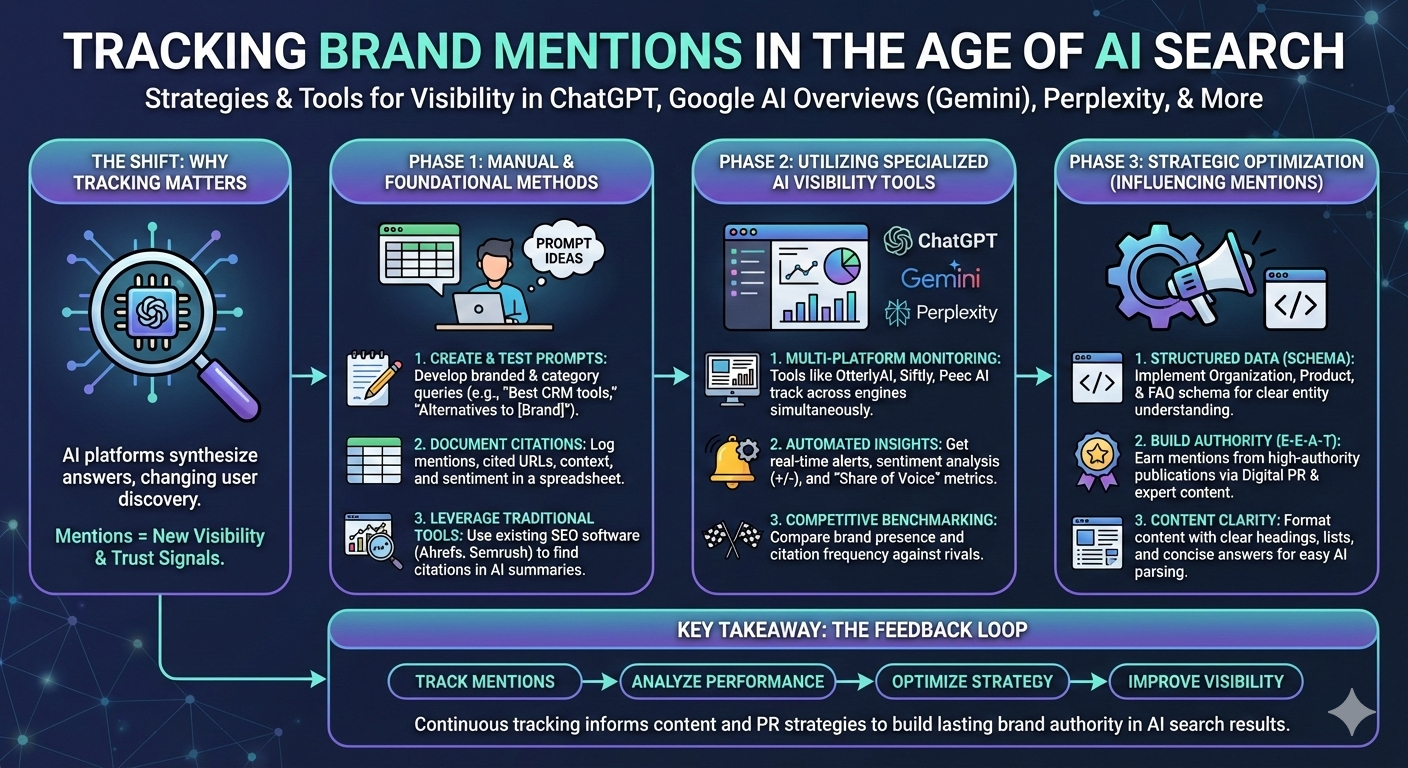
Manual Methods to Track Brand Mentions in AI Search
You don’t need expensive tools to start monitoring AI brand mentions. Manual tracking provides valuable insights and costs nothing.
Running Test Queries
Create a list of prompts your target customers might ask. Test these regularly across multiple AI platforms.
Effective test prompts include:
- “What are the best [your product category] companies?”
- “Compare [your brand] vs [competitor]”
- “Who should I hire for [your service]?”
- “What do people say about [your brand]?”
- “Recommend a [your product type] for [specific use case]”
Run these queries weekly. Document which platforms mention your brand and in what context.
Creating a Tracking Spreadsheet
Build a simple spreadsheet to log your findings. Include columns for the date, platform tested, prompt used, whether your brand appeared, and the context of the mention.
Over time, this data reveals patterns. You’ll see which platforms favor your brand and which prompts trigger mentions.
Testing Multiple AI Platforms
Don’t limit testing to one platform. Consumer behavior varies across AI tools.
Key platforms to monitor include:
- ChatGPT (OpenAI)
- Claude (Anthropic)
- Perplexity AI
- Google Gemini
- Microsoft Copilot
- Meta AI
Each platform has different training data and retrieval methods. Your visibility may vary significantly across them.
AI Search Monitoring Tools and Platforms
As AI search visibility becomes more important, specialized tools have emerged to automate tracking.
Dedicated AI Visibility Platforms
Several companies now offer tools specifically designed to monitor brand presence in AI responses. These platforms automate query testing and provide structured reports.
According to Search Influence’s 2026 analysis of AI SEO tracking tools, the most useful platforms share common capabilities. They monitor brand mentions and positions in AI search tools. They identify which prompts trigger visibility. They track changes over time across multiple AI assistants.
When evaluating tools, look for features like automated query scheduling, competitor tracking, historical trend analysis, and alert notifications for significant changes.
Adapting Traditional SEO Tools
Many established SEO platforms now include AI search monitoring features. If you already use tools like Semrush, Ahrefs, or Moz, check for AI visibility modules.
These integrations won’t be as specialized as dedicated AI monitoring tools. However, they provide a convenient starting point if you’re already invested in those ecosystems.
Combining Tools for Complete Coverage
No single tool covers everything perfectly. The most effective monitoring systems combine multiple approaches.
A practical stack might include:
- One dedicated AI visibility tool for automated tracking
- Manual testing for nuanced queries specific to your business
- Social listening tools to catch indirect brand discussions
- Analytics to measure referral traffic from AI platforms
This layered approach ensures you catch mentions regardless of where they occur.
Key Metrics for AI Brand Mention Tracking
Tracking mentions is only valuable if you measure the right things. Focus on metrics that connect to business outcomes.
Share of Voice in AI Responses
Share of voice measures how often your brand appears compared to competitors. When AI tools recommend solutions in your category, what percentage mention you?
Track this metric monthly. An increasing share of voice indicates growing AI visibility.
Mention Sentiment
Not all mentions help your brand. Track whether AI responses position you positively, neutrally, or negatively.
Negative mentions require immediate attention. They may stem from outdated information, misunderstood data, or genuine issues requiring resolution.
Citation Frequency
Some AI responses cite sources explicitly. Track how often your content gets cited as authoritative information.
High citation frequency suggests AI models view your content as trustworthy. This metric also helps identify which content pieces perform best.
Recommendation Position
When AI lists multiple brands, position matters. Being mentioned first carries more weight than appearing last in a list.
Track your typical position in comparative responses. Work to improve your ranking over time.
Traffic Attribution
Connect AI visibility to actual business results. Most analytics platforms now identify traffic from AI referrers.
Monitor referral traffic from ChatGPT, Perplexity, and other AI sources. Growing traffic confirms your visibility efforts are working.
Building an AI Brand Monitoring System
Effective monitoring requires consistent processes. Here’s how to build a sustainable system.
Define Your Monitoring Scope
Start by listing the prompts and platforms most relevant to your business. You can’t track everything. Focus on high-value queries your customers actually ask.
Prioritize prompts related to purchase decisions, brand comparisons, and industry expertise.
Set a Monitoring Schedule
Consistency matters more than frequency. Weekly monitoring catches most important changes without overwhelming your team.
Assign clear ownership. Someone specific should be responsible for running tests, updating tracking documents, and flagging significant changes.
Establish Baseline Metrics
Before you can measure improvement, you need to know where you stand. Spend two to four weeks gathering baseline data.
Document current mention frequency, sentiment, and competitive position across your priority platforms and prompts.
Create Response Protocols
Decide in advance how you’ll respond to different findings. Positive mentions might warrant amplification. Negative mentions require investigation and potential content updates.
Having protocols prevents reactive decision-making and ensures consistent brand management.
Improving Your Brand’s AI Search Visibility
Tracking alone doesn’t help your business. Use insights to improve your presence in AI responses.
Optimize Your Content Foundation
AI models learn from your published content. Ensure your website clearly explains what you do, who you serve, and why you’re trustworthy.
Include comprehensive FAQ sections. Answer common questions directly. Structure content so AI can easily understand and extract information.
Build Authoritative External Presence
AI tools pull information from across the web. Your brand needs strong presence on third-party sites.
Focus on industry publications, review platforms, Wikipedia entries (where appropriate), and business directories. Consistent, accurate information across sources reinforces AI model understanding.
Generate Quality Reviews and Mentions
Customer reviews heavily influence AI responses. Encourage satisfied customers to share experiences on relevant platforms.
Earn mentions in industry publications. Pursue speaking opportunities and thought leadership that generate natural brand references.
Monitor and Adapt Continuously
AI models update regularly. What works today may change tomorrow. Your monitoring system helps you spot shifts early.
Use tracking data to identify what’s working. Double down on successful strategies. Adjust approaches that aren’t generating results.
Conclusion
Tracking brand mentions in AI search isn’t optional anymore. With AI search traffic growing over 500% year over year, this channel shapes how customers discover and evaluate businesses.
Start with manual testing if budget is limited. Upgrade to automated tools as AI visibility becomes more central to your strategy. Focus on metrics that connect to real business outcomes.
The brands that monitor and optimize for AI search today will dominate their categories tomorrow. Those that ignore this shift will wonder where their customers went.
Want to understand how AI search affects your specific business? Talk to our team about building a monitoring strategy tailored to your industry.
FAQs
AI search brand monitoring tracks when and how AI assistants like ChatGPT mention your brand in their responses to user queries.
Weekly monitoring provides a good balance between staying informed and managing time effectively for most businesses.
Prioritize ChatGPT, Perplexity, Google AI Overviews, and Microsoft Copilot as they handle the highest search volumes currently.
Yes, manual testing with documented prompts across AI platforms provides valuable insights without requiring software investment.
Different AI platforms use different training data and retrieval methods, causing variation in which brands appear for similar queries.




 AI/ML Strategy and Consulting
 Data Science And Data Analytics
 Generative AI
 AI Consulting Services
 AI Automation Solutions
 API Integration


