
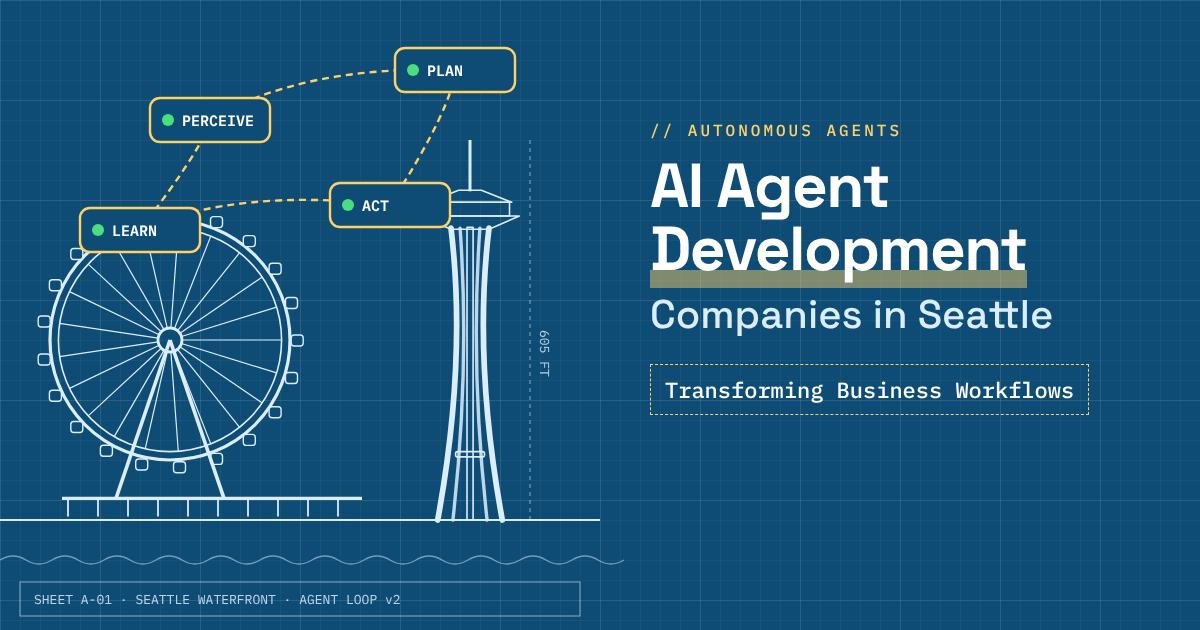
AI agents do more than answer questions. They plan steps, use tools, and finish tasks on their own.
- Seattle is a hotspot for AI agent startups led by former Amazon, Microsoft, and Google engineers, spanning frameworks, platforms, and ready-made agents.
- Three main approaches: developer frameworks, configurable platforms, or ready-made agents, each matching different team needs and speed-versus-control tradeoffs.
- Choose partners by asking build versus buy, agent autonomy limits, data hosting and access, testing plans, and failure monitoring and support.
- Start small with a clear task, restrict agent access, require human checkpoints, and budget for ongoing model and support costs.
Seattle has become a hotspot for building them. Many founders here once built Amazon, Microsoft, and Google systems. Now they are building the tools, frameworks, and ready-made agents that companies use.
This guide covers 10 AI agent development companies in Seattle. You will see what each one builds, who it serves, and how to choose.
What Is an AI Agent?
An AI agent is software that works toward a goal with little human help. It can read information, make decisions, and take actions in other apps.
A chatbot answers one message at a time. An agent can:
- Break a goal into steps
- Use tools like email, browsers, and databases
- Check its own work and retry
- Hand off to a person when unsure
That makes agents useful for longer, messier tasks.
Three Ways to Get an AI Agent
Seattle companies help businesses get agents in three main ways.
| Approach | What You Get | Examples Here | Best For |
|---|---|---|---|
| Build with developer tools | Frameworks to create your own agents | CopilotKit, Boundary, SageOx, Intuned | Teams with engineers |
| Use a platform | Tools to configure agents for your workflows | Backdrop, Kanu AI, Feather | Teams wanting speed with some control |
| Buy a ready-made agent | An agent built for one job | Aurelian, Bridgetown Research, Actual AI | Teams with a specific problem |
Most companies mix approaches as their needs grow.
How We Picked These Companies
Each company here is based in Seattle. Each one builds AI agents or the tools developers use to create them.
We looked at:
- What each company builds and for whom
- Funding, adoption, and named customers
- How mature each product is
- Limits buyers should weigh
None of these companies appear in our Seattle AI automation or generative AI guides. Figures come from company news and press reports.
Quick Comparison: AI Agent Development Companies in Seattle
| Company | Type | Standout Strength | Best For |
|---|---|---|---|
| CopilotKit | Developer framework | AG-UI protocol for agents inside apps | Product teams adding agents to apps |
| Boundary | Developer language | BAML for reliable LLM code | Engineers building agent pipelines |
| SageOx | Agent memory | Shared context for humans and coding agents | Software teams using AI coding agents |
| Intuned | Browser agent platform | AI builds and repairs web automations | Data and ops teams |
| Kanu AI | Workflow platform | Turns spreadsheets and email into software | Regulated enterprises |
| Backdrop | AI coworker platform | Agents with shared company memory | Small and mid-sized teams |
| Feather | Voice agent platform | Human-like phone calls | Call-heavy businesses |
| Aurelian | Ready-made voice agent | Handles non-emergency 911 calls | Public safety agencies |
| Bridgetown Research | Ready-made research agents | Due diligence in 24 hours | Investors and consultants |
| Actual AI | Ready-made management agent | Assistant for engineering managers | Mid-sized software teams |
The 10 Best AI Agent Development Companies in Seattle
1. CopilotKit: Putting Agents Inside Your App
CopilotKit was founded in 2023 by brothers Atai and Uli Barkai. It builds open-source tools that let developers add AI agents directly into their apps.
CopilotKit created AG-UI, an open standard for how agents talk to software. Google, Microsoft, Amazon, and Oracle have adopted it. Its open-source tools have more than 40,000 GitHub stars. Customers include Deutsche Telekom, Docusign, Cisco, and S&P Global.
In May 2026, CopilotKit announced $27 million in combined seed and Series A funding, led by Glilot Capital, NFX, and SignalFire.
Best for: Product teams that want agents to work inside their own apps, not in a separate chat window.
Watch out for: It is a developer tool. You still need engineers to design the agent.
2. Boundary: A Language Built for AI Agents
Boundary went through Y Combinator in 2023. Its founders previously worked at Microsoft, Google, and AWS.
Boundary created BAML, a programming language for building AI agents. It handles structured outputs, tool calls, and testing. It can run AI calls in parallel without extra code. Boundary calls it “like using React for AI.”
BAML is open source and works alongside other languages.
Best for: Engineers who want agent code that is easier to test and trust.
Watch out for: Adopting a new language takes training. Start with one project.
3. SageOx: Shared Memory for Humans and AI Agents
SageOx is led by CEO Ajit Banerjee, a former engineering leader at Amazon, Facebook, and Apple. Its CTO was one of Amazon’s first engineers.
SageOx helps people and AI coding agents work together. It captures knowledge from chats, meetings, and coding sessions. Then it passes that context to new agents, so they stay aligned as a project changes.
SageOx raised a $15 million seed round led by Canaan Partners.
Best for: Software teams running several AI coding agents at once.
Watch out for: It is early, with design partners. Check fit with your tools.
4. Intuned: Agents That Build Web Automations
Intuned went through Y Combinator in 2022 and has about 15 employees. It runs a code-first platform for browser automation.
Its AI agent builds web scrapers, crawlers, and automations from plain prompts. When a website changes and a run fails, the agent repairs the code. Developers deploy projects in TypeScript or Python.
That self-healing approach cuts the upkeep that usually breaks web automation.
Best for: Data and operations teams that pull information from many websites.
Watch out for: Scraping must follow site rules and laws. Review terms of service.
5. Kanu AI: Turning Business Processes Into Software
Kanu AI is a Seattle startup led by CEO Karan Grover. It captures how work happens in spreadsheets and email, then turns it into custom software workflows.
Kanu runs inside a client’s own cloud. It is built for security, compliance, and audit trails, which matters for regulated industries.
In September 2026, Kanu AI raised an $11.7 million seed round led by Trilogy Equity Partners, with a16z speedrun, BMW i Ventures, and Accel joining.
Best for: Enterprises running key processes on spreadsheets and email.
Watch out for: It just raised its first big round. Ask about support and roadmap.
6. Backdrop: AI Coworkers for Your Team
Backdrop was founded in 2023 by Caitlin Short and Akanksha Singh and went through Y Combinator. It lets teams build AI coworkers for specific jobs.
These coworkers connect to Slack, Gmail, HubSpot, and GitHub. Teams decide what each agent can reach and which actions need approval. A shared company memory helps agents learn from work across tools.
People and agents can work together in shared conversations.
Best for: Agencies, e-commerce firms, and service businesses wanting quick AI help.
Watch out for: It is a very small team. Plan for limited enterprise support.
7. Feather: Human-Like Voice Agents
Feather went through Y Combinator in 2022 and has a team of about eight. It builds a platform for human-like phone calls at AI speed.
Voice agents can handle outbound calls, follow-ups, and simple conversations. That helps businesses that rely on phones but cannot staff every call.
Feather focuses on natural speech and quick responses.
Best for: Businesses that make or take many routine phone calls.
Watch out for: Calling rules vary by state and country. Confirm consent and disclosure needs.
8. Aurelian: An AI Agent for 911 Centers
Aurelian is a Seattle company led by CEO Max Keenan. Its voice agent answers non-emergency calls for 911 centers, like noise complaints and parking issues.
The agent works in more than 35 languages across voice, text, and web chat. Aurelian serves centers covering nearly 5 million Americans. It automates about 74% of non-emergency calls, saving each dispatcher around three hours a day.
Aurelian raised a $14 million Series A led by NEA.
Best for: Public safety agencies with dispatcher shortages.
Watch out for: Public sector buying takes time. Expect long approval cycles.
9. Bridgetown Research: Research Agents for Due Diligence
Bridgetown Research was founded in December 2023 by Harsh Sahai, formerly of McKinsey and Amazon. It builds AI agents that speed up business research.
One agent interviews industry experts by voice. Another analyzes the answers. A third turns findings into presentations. Bridgetown says it can deliver a first due diligence analysis within 24 hours.
It raised a $19 million Series A co-led by Accel and Lightspeed. Clients include private equity funds, consulting firms, and large corporations.
Best for: Investors and consultants who need fast market research.
Watch out for: Expert interviews still need human review. Check sources before big decisions.
10. Actual AI: An Agent for Engineering Managers
Actual AI is a Seattle startup founded by former AWS, Google, Meta, and Microsoft engineers. It builds an AI assistant for engineering managers.
The agent sorts issues, writes sprint summaries, routes code reviews, and checks design consistency. It targets companies with 50 to 500 developers.
Actual AI raised a $3.2 million seed round in 2025, led by AlleyCorp.
Best for: Growing software teams where managers spend hours on busywork.
Watch out for: It is early stage. Run a short pilot with one team first.
How to Choose an AI Agent Development Partner
Ask these questions before you commit:
- Build or buy? Ready-made agents launch fast. Custom agents fit unique workflows.
- What can the agent do alone? Set clear limits and approval steps.
- Where does our data go? Check hosting, access controls, and audit logs.
- How will we test it? Build real test cases before launch.
- What happens when it fails? Ask about monitoring, fallbacks, and support.
How Much Does AI Agent Development Cost?
Costs depend on your approach:
- Open-source frameworks: Free to start, plus engineering time and model usage
- Agent platforms: Monthly subscriptions, often priced per seat or per task
- Ready-made agents: Annual contracts, often tied to call or task volume
- Fully custom agents: Commonly $50,000 to $300,000 or more with an outside team
Ongoing model costs grow with usage. Budget for them from day one.
What Doesn’t Work With AI Agents
Common mistakes include:
- Giving agents too much access: Start with read-only access and add actions slowly.
- Skipping human checkpoints: Agents need approval steps for risky actions.
- No testing: Agents behave differently with real data. Test before launch.
- Vague goals: Agents perform best on clear, measurable tasks.
A real example: a services firm lets an AI agent send customer emails with no review. A wrong price goes out to hundreds of clients. Adding approval for any email with pricing stops the problem.
Final Thoughts
AI agent development companies in Seattle cover every layer. CopilotKit, Boundary, SageOx, and Intuned give developers strong building blocks. Kanu AI, Backdrop, and Feather help teams configure agents fast. Aurelian, Bridgetown Research, and Actual AI deliver agents built for one clear job.
Start with one well-defined task, limit agent access, and expand as trust grows.
FAQs
What are the top AI agent development companies in Seattle?
Leading names include CopilotKit, Boundary, SageOx, Intuned, Kanu AI, Backdrop, Feather, Aurelian, Bridgetown Research, and Actual AI.
What is the difference between a chatbot and an AI agent?
A chatbot answers questions. An AI agent plans steps, uses tools, and completes tasks on its own.
What is the AG-UI protocol?
AG-UI is an open standard, created by CopilotKit, that defines how AI agents communicate with apps and users.
Should I build or buy an AI agent?
Buy for common tasks like calls or research. Build when your workflow is unique or gives you an edge.
Are AI agents safe for business use?
Yes, with limits. Restrict access, require approval for risky actions, and log everything agents do.

 AI/ML Strategy and Consulting
 Data Science And Data Analytics
 Generative AI
 AI Consulting Services
 AI Automation Solutions
 API Integration