


Your competitors publish content daily while your team struggles to produce one article per week. The demand for fresh content never stops. Blog posts, social media updates, emails, and videos multiply faster than any team can handle manually. How do you keep pace?
- AI dramatically speeds content production and enables scalable personalization while reducing costs for marketing teams.
- Human oversight remains essential for fact-checking, brand voice preservation, legal compliance, and authentic creative input.
- Best results come from combining clear prompts, iterative prompt improvement, and integrated AI-human workflows and review processes.
AI content creation has emerged as the answer for overwhelmed marketing teams. According to Salesforce research, 76% of marketers now use generative AI for content creation. The technology has moved from experimental novelty to essential workflow tool in remarkably short time.
The business adoption is equally striking. Qualtrics reports that 42% of all businesses have adopted generative AI for content creation, customer engagement, and related marketing functions. This represents mainstream acceptance rather than early adopter experimentation.
But adoption raises important questions. What can AI actually produce? Where does it excel and where does it fall short? How should organizations integrate these tools without sacrificing quality or authenticity?
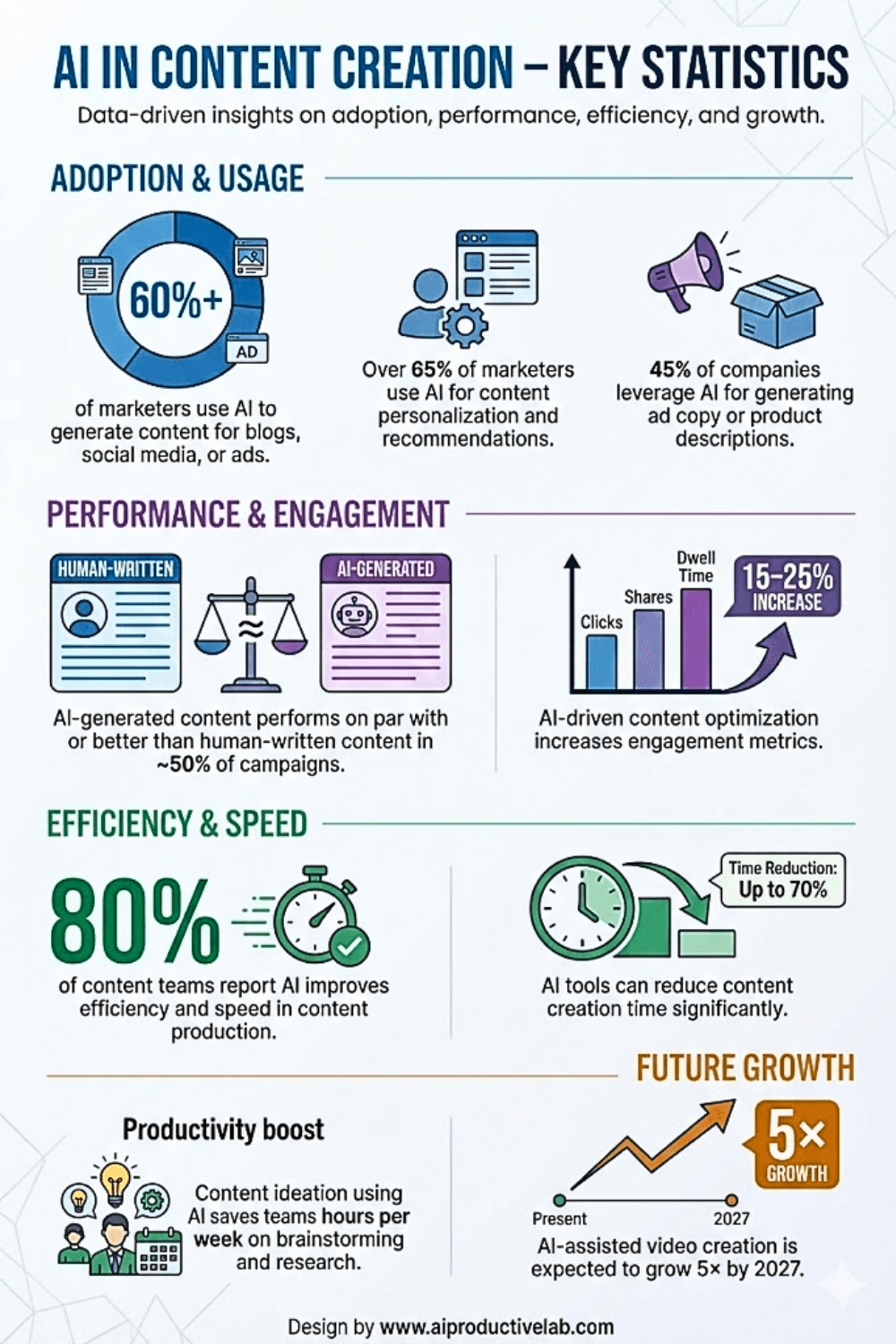
This guide addresses these questions comprehensively. You will learn specific AI content creation capabilities available today. You will understand the genuine benefits and realistic limitations. You will see how organizations integrate AI tools effectively. Most importantly, you will gain practical strategies for applying AI content creation within your own marketing operations.
What Is AI Content Creation?
AI content creation uses machine learning and natural language processing to generate written, visual, and multimedia content. These systems produce drafts, variations, and finished pieces based on prompts and parameters you provide.
The technology has evolved dramatically in recent years. Early AI writing tools produced awkward, obviously artificial text. Modern generative AI creates content that often matches human-written quality. The improvement stems from advanced language models trained on vast text datasets.
AI content creation spans multiple formats:
- Written content: Blog posts, articles, emails, social media posts, ad copy, and product descriptions
- Visual content: Images, graphics, illustrations, and design elements
- Video content: Scripts, automated video creation, and editing assistance
- Audio content: Voiceovers, podcast scripts, and audio generation
The technology works through sophisticated pattern recognition. AI systems learn language structures, writing styles, and content conventions from training data. They apply these patterns to generate new content matching specified requirements.
Human oversight remains essential. AI generates raw material that benefits from human editing, fact-checking, and creative direction. The most effective approach combines AI efficiency with human judgment and creativity.
Key Applications of AI Content Creation
Blog Posts and Long-Form Articles
AI tools accelerate blog content production significantly. They generate outlines, first drafts, and section expansions based on topic prompts. Writers receive starting points rather than blank pages.
Blog creation AI capabilities include:
- Outline generation: Creating structured content frameworks from topic keywords
- Draft production: Writing complete first drafts for human refinement
- Section expansion: Developing specific points into fuller explanations
- Research synthesis: Incorporating information into coherent narratives
- SEO optimization: Suggesting keywords and structural improvements
Many content teams use AI for initial drafts while humans handle editing, fact-verification, and voice refinement. This workflow produces more content without sacrificing quality standards.
Social Media Content
Social platforms demand constant fresh content across multiple channels. AI tools generate posts, captions, and variations efficiently.
Social media AI capabilities include:
- Post generation: Creating platform-appropriate content from brief prompts
- Caption writing: Developing engaging captions for images and videos
- Hashtag suggestions: Recommending relevant tags for visibility
- Content adaptation: Reformatting content for different platforms
- Variation creation: Producing multiple versions for testing and scheduling
AI enables consistent social presence without consuming excessive team time. Humans review and approve content while AI handles production volume.
Email Marketing Content
Email marketing requires personalized content at scale. AI generates subject lines, body copy, and personalized variations.
Email content AI capabilities include:
- Subject line generation: Creating attention-grabbing subject options for testing
- Body copy drafting: Writing email content matching campaign objectives
- Personalization tokens: Suggesting personalization opportunities
- Sequence development: Creating multi-email nurture campaign content
- A/B variations: Producing content versions for performance testing
Teams report significant time savings when AI handles initial email drafts. Human editors refine voice and ensure brand consistency.
Advertising Copy
Advertising demands compelling copy that drives action. AI tools generate ad variations for testing across platforms.
Advertising AI capabilities include:
- Headline generation: Creating multiple headline options rapidly
- Description writing: Developing ad body copy matching objectives
- Call-to-action variations: Suggesting action-driving phrases
- Platform optimization: Adapting copy for different ad formats
- Testing variations: Producing numerous versions for multivariate testing
AI accelerates advertising iteration cycles. Teams test more variations and optimize faster than manual copywriting allows.
Product Descriptions
E-commerce requires unique descriptions for potentially thousands of products. AI generates descriptions at scale while maintaining consistency.
Product description AI capabilities include:
- Bulk generation: Creating descriptions for large product catalogs
- Feature highlighting: Emphasizing key product attributes
- Benefit framing: Connecting features to customer value
- Tone consistency: Maintaining brand voice across descriptions
- SEO optimization: Including relevant keywords naturally
Retailers report dramatic efficiency gains when AI handles product description volume. Human review ensures accuracy and brand alignment.
Visual Content Creation
AI image generation has advanced remarkably. Tools create original images, graphics, and design elements from text descriptions.
Visual AI capabilities include:
- Image generation: Creating original visuals from text prompts
- Style transfer: Applying artistic styles to images
- Background generation: Creating contextual backdrops for products
- Graphic design assistance: Suggesting layouts and design elements
- Image editing: Modifying existing visuals based on instructions
Visual AI democratizes graphic design capabilities. Teams without dedicated designers produce professional visual content.
Benefits of AI Content Creation
Dramatically Increased Production Speed
AI accelerates content creation substantially:
- Faster first drafts: AI produces initial versions in minutes rather than hours
- Rapid iteration: Teams test more variations quickly
- Reduced research time: AI synthesizes information efficiently
- Parallel production: Multiple content pieces develop simultaneously
- Eliminated writer’s block: AI provides starting points that spark momentum
Salesforce research indicates 71% of marketers use generative AI specifically for creative inspiration. AI breaks through creative barriers that slow manual production.
Significant Cost Efficiency
AI content creation reduces production costs:
- Lower per-piece costs: AI handles volume without proportional expense increases
- Reduced outsourcing needs: In-house teams produce more content independently
- Efficient resource allocation: Human creativity focuses on high-value work
- Scaled personalization: Customized content without custom production costs
- Testing affordability: More variations tested without additional production expense
Consistent Quality and Voice
AI maintains consistency across content:
- Brand voice adherence: AI learns and applies consistent tone
- Style guide compliance: Automated adherence to writing standards
- Quality baselines: AI establishes minimum quality levels reliably
- Terminology consistency: Correct terms used throughout
- Format standardization: Consistent structure across content types
Enhanced Personalization
AI enables personalization at scale:
- Individual customization: Content variations for different audience segments
- Dynamic adaptation: Real-time content adjustment based on context
- Localization assistance: Adaptation for different markets and languages
- Preference alignment: Content matching individual interests and behaviors
- Journey-stage relevance: Appropriate content for customer relationship stages
Improved SEO Performance
AI assists with search optimization:
- Keyword integration: Natural inclusion of target terms
- Content structure: SEO-friendly formatting and organization
- Topic coverage: Comprehensive treatment improving search relevance
- Meta content: Title tags and descriptions optimized efficiently
- Content gap identification: Finding opportunities for new content
Limitations and Challenges
Accuracy and Fact-Checking Requirements
AI content requires human verification:
- Factual errors: AI may generate plausible-sounding but incorrect information
- Outdated information: Training data may not reflect current facts
- Source verification: AI cannot verify source reliability
- Citation accuracy: References require human confirmation
- Technical accuracy: Specialized topics need expert review
Human fact-checking remains essential for published content. AI provides drafts, not verified final copy.
Originality and Authenticity Concerns
AI-generated content raises uniqueness questions:
- Pattern repetition: AI may reproduce common structures and phrases
- Distinctive voice challenges: Generic outputs may lack brand personality
- Competitive differentiation: Similar AI outputs across competitors
- Audience perception: Some readers may recognize AI-generated content
- Creative limitations: AI struggles with truly novel ideas
Human creativity distinguishes content from AI-generic outputs. Editing adds unique perspective and voice.
Quality Control Requirements
AI content needs oversight:
- Editing necessity: Raw AI output typically requires refinement
- Brand alignment: Ensuring content matches brand standards
- Audience appropriateness: Confirming content fits target audiences
- Tone adjustment: Calibrating emotional resonance
- Legal compliance: Verifying claims and representations
Quality control processes must evolve alongside AI adoption. Automation increases volume but not oversight efficiency.
Ethical Considerations
AI content creation raises ethical questions:
- Transparency: Disclosure of AI involvement in content creation
- Intellectual property: Ownership and rights questions
- Bias reflection: AI may reproduce biases from training data
- Misinformation potential: AI-generated false content concerns
- Labor impact: Implications for content creator employment
Organizations should establish ethical guidelines for AI content use. Transparency builds trust with audiences.
Best Practices for AI Content Creation
Start With Clear Prompts and Guidelines
AI output quality depends heavily on input quality:
- Specific objectives: Define exactly what content should accomplish
- Audience descriptions: Describe target readers in detail
- Tone specifications: Indicate desired voice and style
- Length requirements: Set clear word or character limits
- Format expectations: Describe structure and organization
Better prompts produce better outputs. Invest time in prompt refinement.
Implement Human Review Processes
Establish consistent review workflows:
- Fact verification: Check all claims and statistics
- Brand alignment review: Ensure voice and style consistency
- Quality assessment: Evaluate against content standards
- Legal review: Verify compliance requirements where relevant
- Final approval: Designated approver for publication decisions
Human oversight maintains quality as AI increases volume.
Blend AI Efficiency With Human Creativity
Optimize the human-AI combination:
- AI for drafts: Let AI handle initial production
- Humans for refinement: Focus human creativity on editing and enhancement
- AI for variations: Generate options for human selection
- Humans for strategy: Maintain human control of content direction
- AI for optimization: Use AI for SEO and performance improvements
The combination produces better results than either alone.
Maintain Authenticity and Voice
Preserve brand distinctiveness:
- Voice training: Teach AI your specific brand voice through examples
- Unique perspectives: Add human insights AI cannot generate
- Story integration: Include authentic experiences and examples
- Personality injection: Edit for distinctive character
- Audience connection: Ensure content resonates emotionally
AI provides efficiency while humans maintain authenticity.
Continuously Improve Prompts and Processes
Refine AI content workflows over time:
- Track quality metrics: Monitor content performance
- Document successful prompts: Build prompt libraries for reuse
- Learn from failures: Analyze when AI outputs fall short
- Update guidelines: Refine processes based on experience
- Stay current: Keep pace with AI tool improvements
Continuous improvement maximizes AI content value over time.
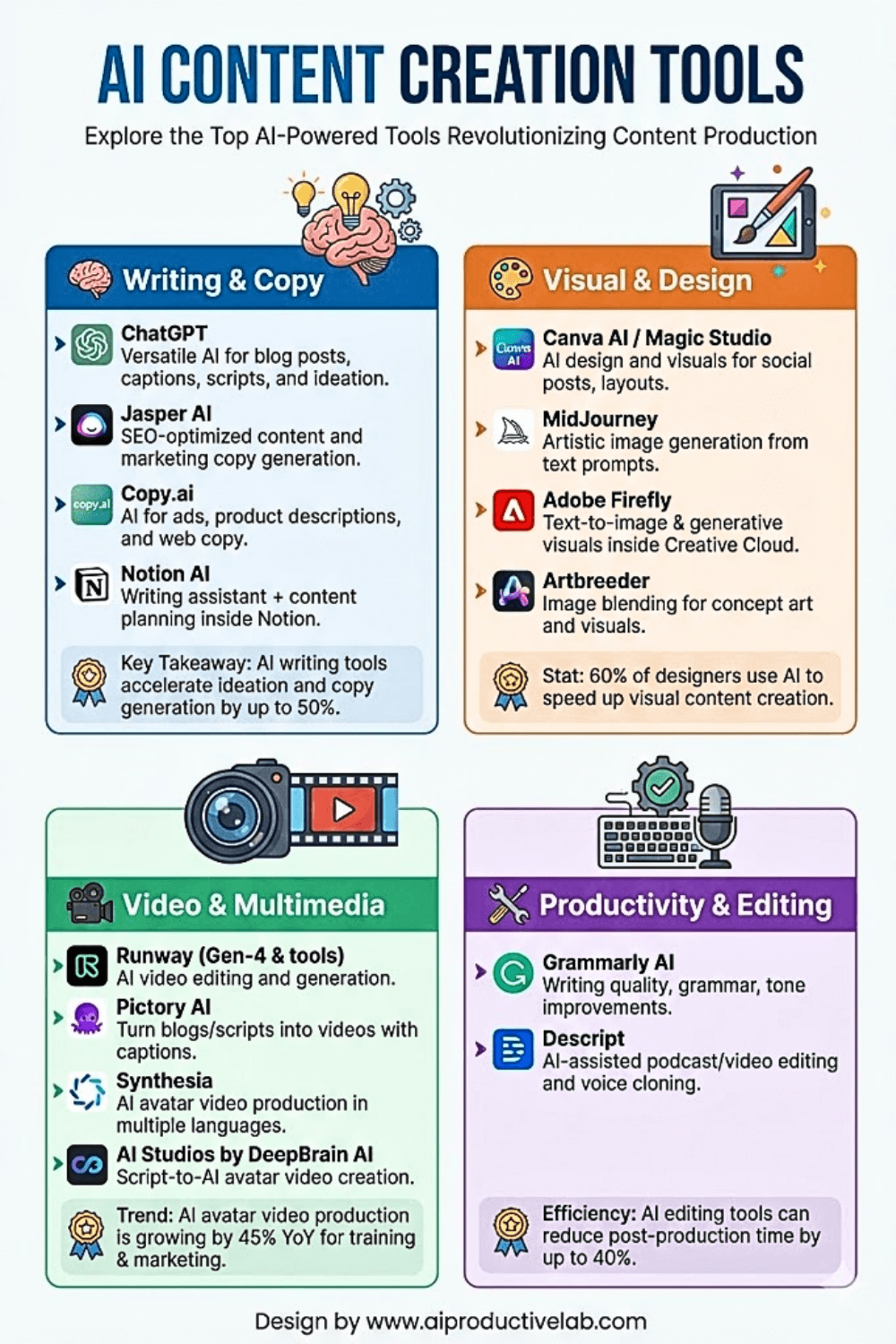
Popular AI Content Creation Tools
ChatGPT
OpenAI’s ChatGPT has become the most widely adopted AI writing tool. The system handles diverse content types from blog posts to emails to creative writing. GPT-4 offers enhanced capability for complex tasks.
Claude
Anthropic’s Claude excels at longer-form content and nuanced writing tasks. The system handles complex instructions and maintains consistency across extended pieces.
Jasper
Jasper focuses specifically on marketing content creation. The platform includes templates for common marketing content types and brand voice training features.
Copy.ai
Copy.ai provides accessible AI copywriting for smaller teams. The platform offers templates for social media, emails, and advertising copy.
Midjourney and DALL-E
These image generation tools create visual content from text descriptions. Marketers produce original images without graphic design expertise.
Canva Magic Write
Canva integrates AI writing into their design platform. Users generate text content alongside visual design within familiar workflows.
Conclusion
AI content creation has transformed from experimental technology to essential marketing capability. Organizations across industries deploy AI tools for blog posts, social media, emails, advertising, and visual content. The benefits include dramatically increased production speed, cost efficiency, consistency, and personalization at scale.
Successful implementation requires attention to quality control, fact-checking, and authenticity preservation. AI generates raw material that benefits from human editing, creativity, and strategic direction. The combination produces better results than either approach alone.
The technology continues advancing rapidly. Organizations building AI content capabilities now establish foundations for long-term competitive advantage. Those delaying risk falling behind competitors who produce more content, faster, while maintaining quality standards.
Content teams that embrace AI become more productive and creative rather than less relevant. AI handles production workload while humans focus on strategy, voice, and audience connection.
Explore how AI content creation could transform your marketing operations and content output. Talk to our experts to understand which tools and workflows fit your specific content strategy and team capabilities.
FAQs
AI content creation uses machine learning to generate written, visual, and multimedia content from prompts. It includes blog posts, social media content, emails, images, and videos.
Yes, Google evaluates content quality regardless of creation method. AI content that provides genuine value, accuracy, and expertise can rank well in search results.
Yes, using AI tools for content creation is legal. However, organizations should verify accuracy, avoid plagiarism, and consider disclosure practices for transparency.
Costs range from free tiers on tools like ChatGPT to enterprise plans costing hundreds monthly. Most businesses find AI content tools significantly cheaper than equivalent human production.
AI augments rather than replaces human creators. AI handles production volume while humans provide creativity, strategy, fact-checking, and authentic voice that AI cannot replicate.




 AI/ML Strategy and Consulting
 Data Science And Data Analytics
 Generative AI
 AI Consulting Services
 AI Automation Solutions
 API Integration


