


Your bank processes thousands of transactions while you sleep. Customers expect instant answers at midnight. Fraudsters never stop probing for weaknesses. How do banks keep up?
- AI automates customer service, loan processing, fraud detection, and back-office tasks, delivering faster, more accurate operations and 24/7 availability.
- Successful AI adoption requires data quality, legacy system integration, regulatory compliance, and strong governance to manage risk and explainability.
- Banks gain cost reductions, scalability, personalized customer experiences, and competitive advantage by prioritizing high-value use cases and continuous optimization.
The answer increasingly is artificial intelligence. AI in banking has evolved from experimental technology to strategic imperative. According to nCino research, financial institutions now treat AI as essential infrastructure rather than innovation projects. The transformation touches every aspect of banking operations.

The financial impact is substantial. ElectroIQ reports that banking automation drives approximately 72 billion USD in cost savings across financial services in 2025. Predictive analytics alone delivers 14% cost reductions for adopting institutions. These numbers explain why banks invest aggressively in AI capabilities.
Customer expectations accelerate this shift further. Digital-native consumers demand instant, personalized service across channels. They compare banking experiences to Amazon and Netflix, not just other banks. Meeting these expectations requires capabilities only AI can provide at scale.
This guide explains how AI transforms banking automation comprehensively. You will learn the key applications reshaping the industry. You will understand benefits for both banks and customers. You will see real examples from institutions leading this transformation.
What Is AI Banking Automation?
AI banking automation uses machine learning, natural language processing, and intelligent process automation to perform banking tasks with minimal human intervention. These systems handle everything from customer interactions to back-office processing to risk decisions.
Traditional banking automation followed rigid rules and scripts. Systems executed predefined steps without adaptation. They handled simple, repetitive tasks but struggled with complexity or exceptions.
AI automation adapts and learns. Systems improve through experience rather than explicit programming. They handle nuanced situations that confuse rule-based approaches. They make decisions that previously required human judgment.
The technology spans the entire banking value chain. Customer-facing AI handles inquiries and provides advice. Middle-office AI processes transactions and manages risk. Back-office AI reconciles accounts and generates reports. Integration across functions creates comprehensive automation.
Key Use Cases for AI in Banking
Customer Service Automation
AI-powered chatbots and virtual assistants handle millions of customer interactions daily. They answer questions, resolve issues, and complete transactions around the clock. Natural language processing enables conversational interactions that feel increasingly human.
Modern banking chatbots understand context and intent. They remember conversation history and customer preferences. They recognize when issues require human escalation. Their capabilities extend far beyond simple FAQ responses.
Customer service AI applications include:
- Account inquiries: Checking balances, transaction history, and payment status
- Transaction support: Initiating transfers, paying bills, and managing cards
- Problem resolution: Addressing common issues without human involvement
- Product guidance: Explaining features and helping customers choose appropriate products
- Proactive alerts: Notifying customers of important account activity
Major banks report handling over 80% of routine inquiries through AI systems. This automation reduces costs while improving response times and availability.
Loan Processing Automation
Loan origination traditionally required extensive manual review. Loan officers evaluated applications, verified documents, and made credit decisions. The process took days or weeks and involved substantial labor costs.
AI transforms loan processing speed and efficiency. According to PwC research, banks use AI to unlock value from data by automating time-intensive tasks like document processing, data verification, and credit analysis. Applications that once took weeks now complete in minutes.
AI loan automation capabilities include:
- Document extraction: Reading and capturing data from financial documents automatically
- Income verification: Analyzing bank statements and tax documents to confirm income
- Credit decisioning: Evaluating creditworthiness using machine learning models
- Compliance checking: Ensuring applications meet regulatory requirements
- Underwriting support: Providing recommendations to human underwriters for complex cases
Digital lenders pioneered these capabilities. Traditional banks now adopt similar approaches to remain competitive and efficient.
Fraud Detection and Prevention
Fraud threatens banks and customers constantly. Criminal tactics evolve rapidly, exploiting new vulnerabilities as defenses strengthen. AI provides essential capabilities for detecting and preventing fraudulent activity.
Machine learning models analyze transaction patterns in real-time. They identify anomalies indicating potential fraud within milliseconds. They adapt to new fraud schemes without explicit reprogramming.
AI fraud prevention applications include:
- Transaction monitoring: Evaluating each transaction for fraud indicators instantly
- Account takeover detection: Identifying unauthorized access attempts
- Synthetic identity detection: Recognizing fabricated identities during account opening
- Card fraud prevention: Blocking suspicious card usage in real-time
- Money laundering detection: Identifying transaction patterns indicating illicit activity
Banks report catching significantly more fraud with AI while reducing false positives that inconvenience legitimate customers.
Personalized Financial Guidance
AI enables banks to provide personalized advice at scale. Systems analyze individual financial situations and offer tailored recommendations. Every customer receives guidance previously available only to wealthy clients with dedicated advisors.
Personalization AI capabilities include:
- Spending insights: Analyzing transaction patterns to identify savings opportunities
- Budgeting assistance: Helping customers manage expenses against goals
- Product recommendations: Suggesting appropriate products based on individual needs
- Financial health scoring: Assessing overall financial wellness and suggesting improvements
- Goal tracking: Monitoring progress toward savings and investment objectives
These capabilities deepen customer relationships while improving financial outcomes. Banks differentiate through superior personalization powered by AI.
Back-Office Process Automation
Behind every customer interaction lies extensive back-office processing. Account reconciliation, regulatory reporting, document management, and data maintenance consume substantial resources. AI automates these processes with greater speed and accuracy.
Intelligent process automation combines AI with robotic process automation. Bots handle routine tasks while AI manages decisions and exceptions. The combination addresses processes too complex for simple automation.
Back-office AI applications include:
- Account reconciliation: Matching and resolving discrepancies automatically
- Regulatory reporting: Generating required submissions accurately and on time
- Document processing: Extracting, classifying, and routing documents
- Data quality management: Identifying and correcting data errors
- Compliance monitoring: Tracking adherence to policies and regulations
Banks report significant cost reductions from back-office automation while improving accuracy and audit trails.
Risk Assessment and Management
Banking involves managing multiple risk types continuously. Credit risk, market risk, operational risk, and compliance risk all require sophisticated assessment. AI enhances risk management capabilities across these categories.
Risk AI applications include:
- Credit portfolio monitoring: Tracking exposure and early warning indicators
- Market risk modeling: Predicting potential losses from market movements
- Operational risk detection: Identifying process failures and control weaknesses
- Stress testing: Modeling impacts of adverse scenarios automatically
- Regulatory compliance: Ensuring adherence to evolving requirements
AI enables more accurate risk quantification and earlier detection of emerging threats. Banks make better decisions with AI-enhanced risk intelligence.
Benefits of AI Banking Automation
For Banks
AI automation delivers substantial operational and strategic benefits:
- Cost reduction: Automating manual processes decreases operational expenses significantly
- Efficiency gains: Faster processing improves throughput without proportional resource increases
- Accuracy improvement: AI reduces human errors in repetitive tasks
- Scalability: Systems handle volume growth without proportional cost increases
- Competitive advantage: Superior capabilities differentiate from slower competitors
- Regulatory compliance: Automated monitoring ensures consistent adherence
- Employee productivity: Staff focus on high-value activities rather than routine processing
For Customers
Banking AI improves customer experience meaningfully:
- Instant service: AI provides immediate responses without waiting for human availability
- 24/7 availability: Systems operate continuously regardless of time or location
- Personalized guidance: AI tailors advice to individual circumstances
- Faster decisions: Loan approvals and other decisions happen in minutes rather than days
- Proactive assistance: AI identifies issues and opportunities before customers ask
- Consistent experience: Automated processes deliver uniform quality across interactions
Challenges and Considerations
Legacy System Integration
Most banks operate complex technology environments built over decades. Legacy systems were not designed for AI integration. Connecting modern AI capabilities to established infrastructure presents technical challenges.
Integration strategies must address data access, real-time connectivity, and process orchestration. Middleware and APIs help bridge legacy and modern systems. Gradual modernization enables AI adoption without complete replacement.
Data Quality and Governance
AI effectiveness depends on data quality. Banks often have data fragmented across systems with inconsistent formats and definitions. Quality issues undermine AI performance regardless of algorithmic sophistication.
Investment in data infrastructure precedes successful AI implementation. Data governance establishes standards and accountability. Clean, integrated data enables effective modeling across applications.
Regulatory Compliance
Banking is heavily regulated, and AI applications face scrutiny. Regulators expect transparency in automated decisions. Explainability requirements constrain some AI approaches.
Banks must demonstrate that AI systems comply with fair lending laws, consumer protection regulations, and safety requirements. Model risk management frameworks address regulatory expectations. Ongoing engagement with regulators informs acceptable approaches.
Change Management
AI automation changes how banking employees work. Roles evolve as routine tasks shift to machines. Resistance and anxiety are natural responses to these changes.
Effective change management ensures successful adoption. Training builds capability and confidence with new tools. Clear communication addresses concerns about job impacts. Thoughtful transition planning manages workforce evolution.
Cybersecurity Risks
AI systems create new attack surfaces requiring protection. Adversaries might attempt to manipulate AI decisions or corrupt training data. Security must evolve alongside AI capabilities.
Banks must protect AI models, training data, and decision processes. Security testing identifies vulnerabilities before attackers exploit them. Robust controls maintain system integrity.
Real-World Examples of AI in Banking
JPMorgan Chase: COiN and Beyond
JPMorgan Chase deploys AI extensively across their operations. Their COiN platform uses natural language processing to analyze legal documents. Work that previously required 360,000 hours of lawyer time annually completes in seconds.
The bank applies AI to fraud detection, customer service, trading, and risk management. They employ thousands of data scientists and engineers focused on AI development. CEO Jamie Dimon has called AI transformative for the banking industry.
Bank of America: Erica Virtual Assistant
Bank of America’s Erica virtual assistant has handled over 2 billion client interactions since launch. The AI-powered assistant helps customers with account management, spending insights, and financial guidance.
Erica understands natural language and provides personalized responses. The system handles routine inquiries while escalating complex issues to human agents. Bank of America demonstrates customer-facing AI at massive scale.
DBS Bank: Intelligent Banking Platform
Singapore-based DBS Bank has built comprehensive AI capabilities across their operations. Their intelligent banking platform uses machine learning for customer insights, risk assessment, and process automation.
DBS applies AI to personalize customer experiences based on transaction patterns and life events. Their chatbot handles millions of customer interactions monthly. The bank has won recognition for AI innovation in financial services.
Capital One: Machine Learning Foundation
Capital One transformed from traditional bank to technology company with AI at its core. Machine learning powers fraud detection, credit decisions, customer service, and marketing across the organization.
The company recruits heavily from technology firms and invests substantially in AI research. Their approach demonstrates how AI can become competitive advantage rather than just operational efficiency.
How to Implement AI Banking Automation
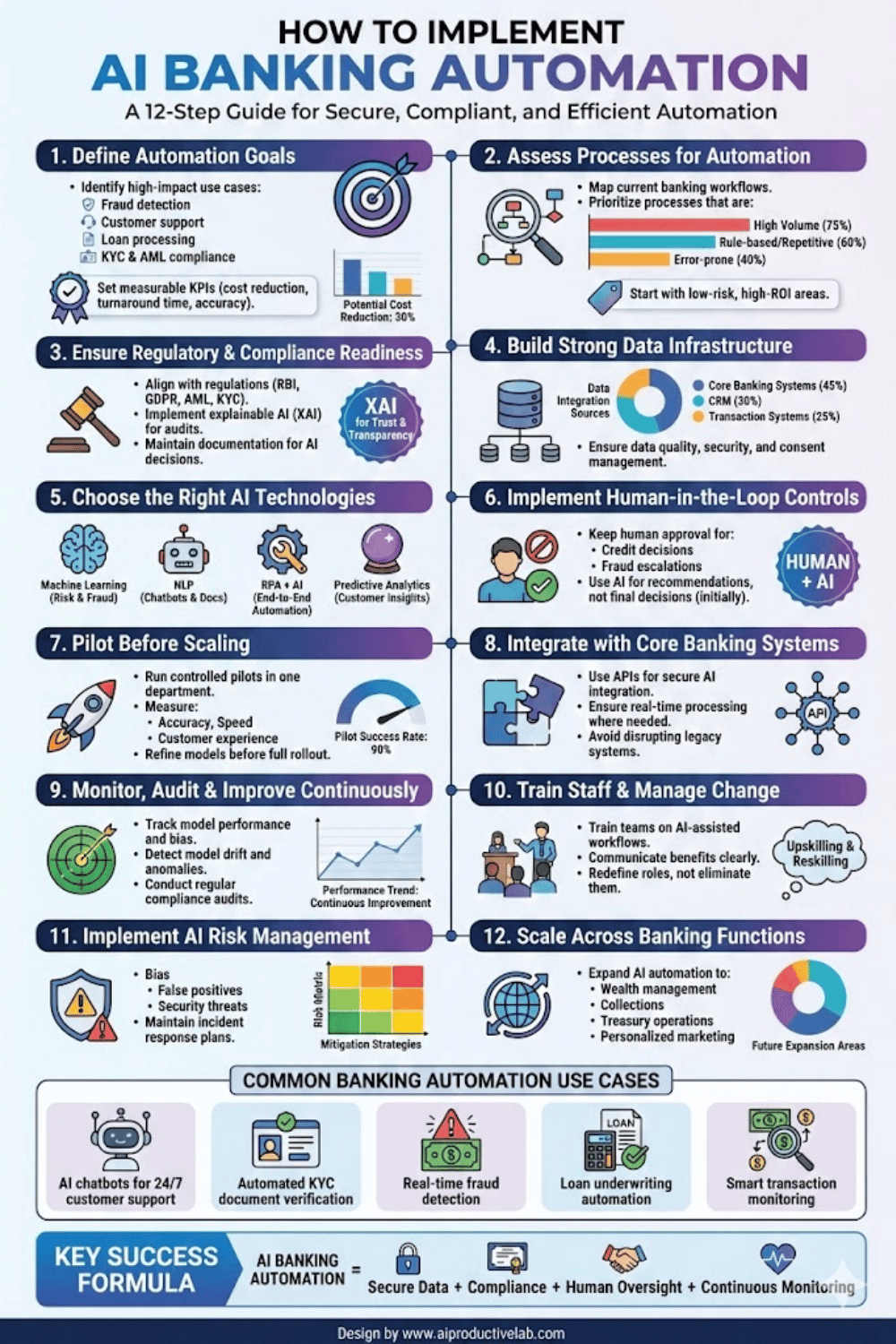
Step 1: Identify High-Value Opportunities
Evaluate operations to identify processes most suited for AI automation. Consider transaction volumes, labor intensity, error rates, and customer impact. Prioritize opportunities combining high value with feasible implementation.
Customer service, loan processing, and fraud detection often provide attractive starting points. These areas offer clear business cases with proven AI solutions.
Step 2: Assess Technology Readiness
Evaluate existing technology infrastructure honestly. Identify data quality issues, integration challenges, and capability gaps. Understand what investments precede successful AI implementation.
Build roadmaps addressing infrastructure requirements alongside AI deployment. Sequence investments to enable progressive capability building.
Step 3: Choose Implementation Approach
Decide between building custom AI capabilities, purchasing vendor solutions, or combining approaches. Consider internal skills, timeline requirements, and differentiation needs.
Many banks partner with fintech companies or technology vendors for specific capabilities. Custom development addresses unique requirements or competitive differentiation.
Step 4: Deploy With Appropriate Governance
Implement AI systems with strong oversight and risk management. Establish model validation, monitoring, and documentation practices. Ensure compliance with regulatory expectations.
Start with limited deployment to build confidence and organizational capability. Expand gradually as performance proves satisfactory.
Step 5: Scale and Optimize Continuously
Expand successful AI applications across additional use cases. Build enterprise platforms supporting multiple automation initiatives. Monitor performance and refine systems based on experience.
Continuous improvement sustains competitive advantage. Learning from each deployment informs subsequent initiatives.
Conclusion
AI in banking has matured from experimental technology to operational foundation. Automation transforms customer service, lending, fraud prevention, and back-office operations comprehensively. The benefits extend to both banks and their customers.
Implementation requires attention to legacy integration, data quality, regulatory compliance, and change management. These challenges are manageable with thoughtful planning and execution. Organizations that address them effectively gain substantial advantages.
The banking industry’s AI transformation continues accelerating. Institutions building capabilities now establish foundations for long-term success. Those delaying risk falling behind competitors and failing to meet evolving customer expectations.
Explore how AI banking automation could transform your operations and customer experience. Talk to our experts to understand which applications fit your specific situation and strategic priorities.
FAQs
AI banking automation uses machine learning and intelligent systems to perform banking tasks with minimal human intervention. It handles customer service, loan processing, fraud detection, and back-office operations.
Research indicates AI automation can deliver up to 14% cost savings through predictive analytics alone. Total industry savings reach approximately 72 billion USD annually across financial services.
AI automates routine tasks but creates new roles requiring human skills. Banks redeploy employees to higher-value activities like complex problem-solving, relationship management, and AI oversight.
Modern AI chatbots understand context and can handle increasingly complex inquiries. They recognize when issues require human expertise and seamlessly escalate to live agents.
Banks implement robust security controls protecting AI systems. Regulatory oversight ensures appropriate risk management. AI actually enhances security through improved fraud detection capabilities.




 AI/ML Strategy and Consulting
 Data Science And Data Analytics
 Generative AI
 AI Consulting Services
 AI Automation Solutions
 API Integration


