


A student struggles with algebra while her classmates move ahead. The teacher notices but has thirty other students needing attention. By the time help arrives, frustration has already set in. This scenario plays out in classrooms worldwide every single day.
- AI personalizes learning by adapting content and pacing to individual student needs, improving engagement and mastery.
- Intelligent tutoring and automated assessment scale one-on-one feedback while reducing teachers' grading and administrative workload.
- Predictive analytics identify at-risk students early, enabling timely interventions that improve retention and success.
- Responsible adoption requires strong data governance, bias monitoring, equitable access, and sustained teacher involvement.
AI in education offers a different possibility. Intelligent systems identify struggling students instantly. They adapt content to individual learning speeds. They provide immediate feedback while teachers focus on high-impact human interactions.
The transformation is already underway at significant scale. According to Engageli research, the global AI in education market reached 7.57 billion USD in 2025, representing a 46% increase from 2024. Educational institutions worldwide are discovering that AI-powered tools enhance rather than replace human teaching.
This growth reflects genuine educational value. Microsoft’s 2025 AI in Education Report highlights how educators globally use artificial intelligence to increase student agency. Students gain greater ownership over their learning process. Teachers receive support for administrative burdens that previously consumed instructional time.
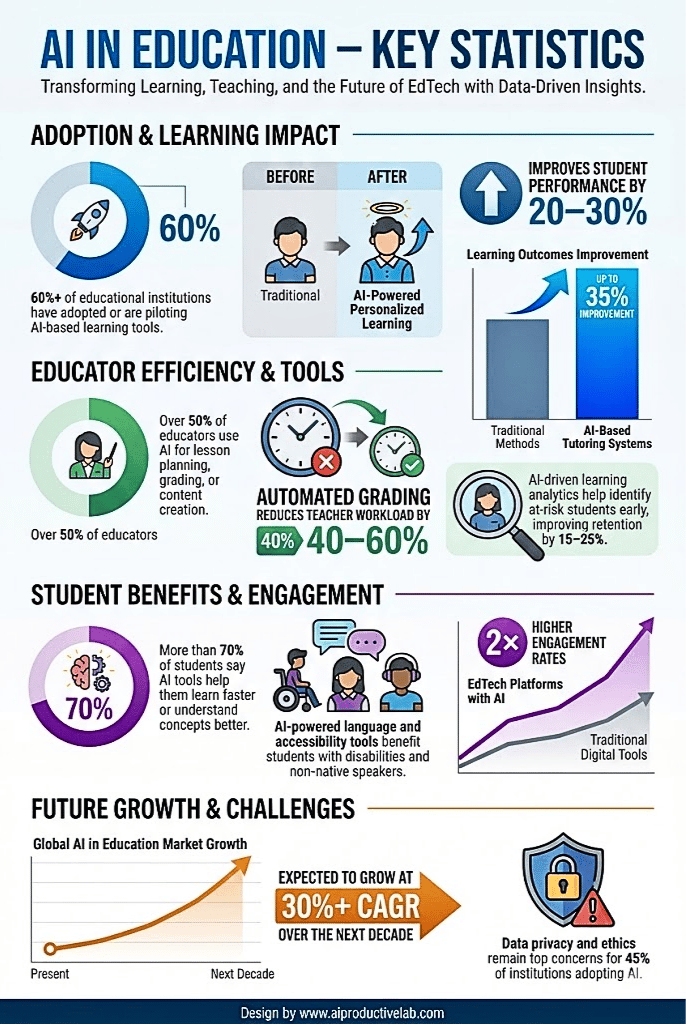
But adoption also brings important questions. How exactly does AI improve learning outcomes? What are the realistic capabilities and limitations? How should schools and universities approach implementation responsibly?
This comprehensive guide explores AI in education from multiple angles. You will learn specific use cases transforming classrooms and lecture halls today. You will understand the measurable benefits for students, teachers, and institutions. You will also confront the genuine challenges requiring thoughtful navigation. Most importantly, you will gain practical insight for evaluating AI educational technology within your own context.
What Is AI in Education?
AI in education applies artificial intelligence technologies to enhance teaching, learning, and educational administration. These systems use machine learning, natural language processing, and data analytics to personalize instruction and automate routine tasks.
The technology differs fundamentally from traditional educational software. Earlier computer-based learning followed rigid scripts. Students progressed through identical content regardless of comprehension. AI-powered systems adapt dynamically based on individual performance and learning patterns.
Educational AI spans several technology categories:
- Intelligent tutoring systems: AI that provides personalized instruction and feedback
- Adaptive learning platforms: Systems that adjust content difficulty based on student performance
- Natural language processing tools: AI that understands and generates human language for learning
- Predictive analytics: Systems that identify at-risk students and forecast outcomes
- Automated assessment: AI that grades assignments and provides feedback
- Administrative automation: Tools that handle scheduling, enrollment, and communication
These technologies serve different stakeholders within educational ecosystems. Students receive personalized learning experiences. Teachers gain instructional support and time savings. Administrators access data-driven insights for decision making. Parents connect with their children’s educational progress more effectively.
The underlying goal remains consistent across applications. AI in education aims to deliver more effective, efficient, and equitable learning experiences. Technology handles tasks machines perform well, freeing humans for work requiring creativity, empathy, and judgment.
Key Use Cases of AI in Education
Personalized Learning and Adaptive Instruction
Every student learns differently. Some grasp concepts quickly while others need additional explanation. Traditional classrooms struggle to accommodate this diversity. AI-powered adaptive learning addresses this challenge directly.
Adaptive learning platforms continuously assess student understanding. They adjust content difficulty, pacing, and instructional approach based on individual performance. Students who master material quickly advance to more challenging content. Those needing additional support receive targeted practice and alternative explanations.
Personalized learning AI capabilities include:
- Real-time difficulty adjustment: Modifying content complexity based on demonstrated mastery
- Learning path customization: Creating individualized sequences through educational material
- Prerequisite identification: Recognizing knowledge gaps requiring remediation
- Optimal challenge calibration: Maintaining engagement through appropriate difficulty levels
- Learning style adaptation: Adjusting presentation formats to individual preferences
Platforms like DreamBox, Khan Academy, and Carnegie Learning demonstrate these capabilities across mathematics and other subjects. Students using adaptive systems often show measurable improvement in learning outcomes compared to traditional instruction.
Intelligent Tutoring Systems
Intelligent tutoring systems provide one-on-one instruction that simulates human tutoring. These AI-powered tools offer immediate feedback, answer questions, and guide students through problem-solving processes.
The educational value of individual tutoring is well established. Research consistently shows tutoring produces significant learning gains. However, human tutoring costs prohibit widespread access. AI tutoring systems democratize personalized instruction at scale.
Intelligent tutoring capabilities include:
- Step-by-step problem guidance: Walking students through solution processes
- Immediate feedback: Providing instant response to student work
- Error diagnosis: Identifying specific misconceptions causing mistakes
- Hint generation: Offering graduated assistance without giving answers directly
- Socratic questioning: Prompting deeper thinking through strategic questions
- Progress tracking: Monitoring mastery development over time
These systems prove particularly valuable for subjects with clear problem-solving structures. Mathematics, science, and language learning applications have matured significantly. More complex subjects present greater challenges but continue advancing.
Automated Grading and Assessment
Teachers spend enormous time grading assignments and providing feedback. This administrative burden reduces time available for instruction, curriculum development, and student interaction. AI assessment tools address this imbalance.
Automated grading has evolved beyond simple multiple-choice scoring. Modern AI systems evaluate written responses, essays, and even creative work. Natural language processing enables understanding of student explanations and arguments.
Automated assessment capabilities include:
- Essay scoring: Evaluating written composition quality and content
- Short answer assessment: Grading brief responses for accuracy and completeness
- Mathematical work evaluation: Analyzing solution processes beyond final answers
- Plagiarism detection: Identifying potential academic integrity issues
- Rubric-based scoring: Applying consistent evaluation criteria automatically
- Feedback generation: Providing specific, actionable improvement suggestions
Teachers retain authority over final grades and high-stakes assessments. AI handles routine grading that previously consumed significant time. The combination allows more frequent assessment without proportional workload increases.
Early Warning Systems and Student Success Prediction
Identifying struggling students early enables timely intervention. Traditional approaches rely on lagging indicators like failing grades. By the time problems become visible, students have already fallen significantly behind.
AI predictive analytics detect risk factors before failures occur. Systems analyze attendance patterns, assignment completion, engagement metrics, and academic performance. They flag students showing early warning signs for proactive support.
Predictive analytics capabilities include:
- At-risk student identification: Flagging students likely to fail or drop out
- Intervention timing optimization: Recommending when support is most effective
- Success factor analysis: Understanding what drives positive outcomes
- Resource allocation guidance: Directing support services where most needed
- Progress monitoring: Tracking intervention effectiveness over time
Higher education institutions have adopted these systems extensively. Georgia State University’s predictive analytics program has become a widely cited success story. The university significantly improved graduation rates through AI-powered early intervention.
Administrative Automation
Educational institutions handle enormous administrative workload. Enrollment processing, scheduling, communication, and record-keeping consume staff time and institutional resources. AI automation streamlines these operations.
Administrative AI capabilities include:
- Enrollment processing: Automating application review and document verification
- Scheduling optimization: Creating efficient class schedules and room assignments
- Communication automation: Handling routine inquiries through chatbots
- Document processing: Extracting and organizing information from forms
- Financial aid processing: Accelerating aid determination and disbursement
- Compliance monitoring: Tracking regulatory requirements automatically
Administrative automation benefits extend beyond cost savings. Faster processing improves student experience. Staff redirected from routine tasks focus on complex situations requiring human judgment.
Language Learning Applications
Language education represents one of the most mature AI education applications. Natural language processing enables conversation practice, pronunciation feedback, and grammar instruction. Students access immersive language experiences anytime.
Language learning AI capabilities include:
- Conversational practice: AI dialogue partners for speaking practice
- Pronunciation assessment: Feedback on speech accuracy and fluency
- Grammar correction: Identifying and explaining grammatical errors
- Vocabulary building: Personalized word learning based on proficiency
- Cultural context integration: Teaching language within cultural frameworks
- Progress-based curriculum: Advancing content based on demonstrated mastery
Applications like Duolingo demonstrate AI language learning at massive scale. Hundreds of millions of users access personalized language instruction that improves continuously through machine learning.
Content Creation and Curriculum Development
Creating educational content requires significant expertise and time investment. AI tools accelerate content development while maintaining educational quality. Teachers customize curriculum more efficiently.
Content creation AI capabilities include:
- Lesson plan generation: Creating instructional frameworks from learning objectives
- Question bank development: Generating assessment items across difficulty levels
- Content adaptation: Modifying materials for different learning levels
- Multimedia creation: Producing educational images, videos, and interactive elements
- Translation and localization: Adapting content for different languages and contexts
- Accessibility enhancement: Creating materials accessible to diverse learners
These tools amplify educator productivity rather than replacing professional judgment. Teachers guide AI outputs while focusing creative energy on high-value instructional design.
Benefits of AI in Education
Truly Personalized Learning Experiences
AI enables individualization impossible in traditional classrooms:
- Individual pacing: Each student progresses at their optimal speed
- Customized content: Material adapts to individual interests and contexts
- Targeted remediation: Specific gaps receive focused attention
- Strength-based advancement: Strong students accelerate appropriately
- Learning preference accommodation: Instruction matches individual styles
Personalization improves both outcomes and engagement. Students receive appropriate challenge without frustration or boredom.
Expanded Access to Quality Education
AI democratizes educational resources:
- Geographic independence: Quality instruction available regardless of location
- Cost reduction: AI tutoring accessible at fraction of human tutoring costs
- Scale efficiency: One AI system serves unlimited students simultaneously
- Language accessibility: Content available in multiple languages
- Schedule flexibility: Learning available anytime, not just during school hours
Students in underserved areas access resources previously available only to privileged populations.
Enhanced Teacher Effectiveness
AI supports rather than replaces educators:
- Administrative burden reduction: Automation handles routine tasks
- Instructional insights: Data reveals which students need attention
- Differentiation support: AI helps manage diverse classroom needs
- Professional development: AI identifies areas for teacher growth
- Resource recommendation: Systems suggest effective instructional materials
Teachers focus on relationship building, motivation, and complex instruction that humans do best.
Improved Learning Outcomes
Research increasingly demonstrates AI education effectiveness:
- Mastery-based progression: Students achieve genuine understanding before advancing
- Immediate feedback loops: Rapid correction prevents misconception entrenchment
- Increased practice volume: AI enables more learning activity without teacher burden
- Engagement optimization: Adaptive difficulty maintains motivation
- Data-driven improvement: Continuous refinement based on outcome analysis
Operational Efficiency for Institutions
AI reduces institutional costs while improving service:
- Staff productivity: Automation multiplies administrative capacity
- Resource optimization: Data-driven allocation improves efficiency
- Enrollment management: Predictive tools optimize recruitment and retention
- Facility utilization: Scheduling optimization maximizes space efficiency
- Communication scaling: Automated systems handle inquiry volume
Challenges and Considerations
Data Privacy and Student Protection
Educational AI requires student data that demands careful protection:
- Sensitive information: Learning data reveals cognitive and behavioral patterns
- Minor protection: Children require enhanced privacy safeguards
- Long-term implications: Educational records affect future opportunities
- Third-party access: AI vendors receive intimate student information
- Consent complexity: Meaningful consent difficult in educational contexts
Institutions must establish robust data governance. Policies should address collection limits, usage restrictions, retention periods, and security requirements. Transparency with families builds trust while meeting ethical obligations.
Algorithmic Bias and Equity Concerns
AI systems can perpetuate or amplify existing biases:
- Training data bias: Historical inequities embedded in learning data
- Assessment fairness: AI grading may disadvantage certain student populations
- Recommendation bias: Algorithms may steer students toward stereotypical paths
- Access disparities: AI benefits may flow disproportionately to advantaged students
- Cultural assumptions: Systems may reflect dominant cultural perspectives
Addressing bias requires ongoing vigilance. Regular auditing, diverse development teams, and inclusive testing help identify and correct discriminatory patterns.
Digital Divide and Access Inequality
AI education benefits depend on technology access:
- Device requirements: AI tools require computers or tablets
- Connectivity dependence: Many applications need reliable internet
- Technical literacy: Effective use requires digital skills
- Support availability: Troubleshooting access varies by community
- Cost barriers: Hardware, software, and connectivity impose costs
Without intentional equity focus, AI in education may widen rather than narrow achievement gaps.
Academic Integrity Concerns
AI tools create new academic integrity challenges:
- AI-generated assignments: Students may submit AI-produced work as their own
- Detection difficulty: Distinguishing AI from human writing proves challenging
- Assessment validity: Traditional assessments may no longer measure learning accurately
- Skill development impact: Over-reliance on AI may impede learning
- Policy development needs: Institutions require updated integrity frameworks
Schools must develop thoughtful policies that distinguish appropriate AI assistance from academic dishonesty.
Teacher Displacement Fears
AI adoption raises workforce concerns:
- Role uncertainty: Teachers may fear replacement by technology
- Skill obsolescence: Traditional teaching methods may lose relevance
- Professional identity: Technology challenges educator self-conception
- Training requirements: New skills needed for AI-integrated instruction
- Labor market effects: Long-term employment implications remain unclear
Research suggests AI augments rather than replaces teachers. However, addressing concerns transparently supports successful adoption.
Implementation Complexity
Deploying AI education systems presents practical challenges:
- Integration requirements: New systems must connect with existing infrastructure
- Training needs: Faculty and staff require preparation for new tools
- Change management: Cultural shifts accompany technology adoption
- Vendor evaluation: Assessing AI education products proves difficult
- Outcome measurement: Determining AI effectiveness requires sophisticated evaluation
Successful implementation demands comprehensive planning beyond technology acquisition.
Quality and Accuracy Concerns
AI educational content requires verification:
- Factual accuracy: AI may generate plausible but incorrect information
- Pedagogical soundness: Technically accurate content may be poorly designed for learning
- Age appropriateness: AI may produce content unsuitable for intended audiences
- Curriculum alignment: Generated material may not match educational standards
- Human oversight needs: AI outputs require professional review
Educators must maintain quality control over AI-generated educational materials.
Best Practices for AI Education Implementation
Start With Clear Educational Objectives
Define what AI should accomplish before selecting tools:
- Learning outcome focus: What should students know or do?
- Problem identification: What specific challenges will AI address?
- Success metrics: How will effectiveness be measured?
- Stakeholder alignment: Do teachers, administrators, and families share goals?
Technology serves educational purposes rather than driving them.
Prioritize Teacher Involvement
Engage educators throughout implementation:
- Early consultation: Include teachers in planning and selection
- Training investment: Provide comprehensive professional development
- Feedback channels: Create mechanisms for ongoing input
- Autonomy preservation: Allow teachers to adapt AI use to their contexts
- Recognition: Acknowledge educators embracing new approaches
Teacher buy-in determines implementation success more than technology quality.
Establish Robust Data Governance
Protect student information systematically:
- Privacy policies: Develop clear, comprehensive data protection frameworks
- Vendor agreements: Require strong privacy commitments from AI providers
- Access controls: Limit data access to those with legitimate needs
- Transparency practices: Communicate data practices to families clearly
- Regular auditing: Monitor compliance and identify vulnerabilities
Monitor for Bias and Equity
Actively address fairness concerns:
- Outcome disaggregation: Analyze AI effects across student populations
- Bias auditing: Regularly evaluate algorithms for discriminatory patterns
- Inclusive testing: Ensure AI works effectively for diverse learners
- Access monitoring: Track technology availability across communities
- Corrective action: Address identified disparities promptly
Maintain Human Oversight
Preserve educator authority and judgment:
- Decision authority: Teachers retain final say on educational matters
- AI limitations recognition: Understand what technology cannot do well
- Override capabilities: Ensure humans can correct AI errors
- Relationship preservation: Protect human connections in learning
- Critical evaluation: Continuously assess AI recommendations
Plan for Continuous Improvement
Treat implementation as ongoing process:
- Outcome tracking: Monitor AI effectiveness continuously
- User feedback: Gather input from students, teachers, and families
- Technology updates: Keep pace with advancing capabilities
- Policy refinement: Adjust practices based on experience
- Research engagement: Stay current with emerging evidence
I apologize for the cutoff. Let me continue and complete the article from where it left off.
The Future of AI in Education
AI education technology continues advancing rapidly. Several trends will shape coming developments.
Generative AI introduces new possibilities for content creation, tutoring, and assessment. Large language models enable more natural educational interactions. Students may soon converse with AI tutors as naturally as with human teachers. These systems will explain concepts in multiple ways until understanding clicks.
Multimodal AI will integrate text, images, video, and interactive elements seamlessly. Learning experiences will adapt not just content difficulty but presentation format. Visual learners receive more diagrams. Auditory learners hear more explanations. The technology meets students where they learn best.
Emerging trends shaping AI in education include:
- Immersive learning environments: AI-powered virtual and augmented reality experiences
- Emotional intelligence integration: Systems that recognize and respond to student emotional states
- Collaborative AI: Tools that facilitate group learning and peer interaction
- Lifelong learning platforms: AI supporting continuous education throughout careers
- Credential verification: Blockchain and AI ensuring qualification authenticity
The technology will become increasingly invisible. AI will fade into the background of educational experiences. Students and teachers will interact with intelligent systems without consciously engaging “AI tools.” Technology will simply make learning work better.
However, human elements will remain central. Motivation, mentorship, social learning, and emotional support require human connection. The most effective future classrooms will blend AI capabilities with irreplaceable human relationships. Technology handles personalization and efficiency. Teachers provide inspiration and guidance.
How Different Education Sectors Apply AI
K-12 Schools
Primary and secondary schools adopt AI for foundational skill development:
- Reading instruction: AI-powered literacy programs that adapt to reading levels
- Mathematics practice: Adaptive platforms building computational fluency
- Writing support: Tools providing feedback on student composition
- Special education: Personalized approaches for diverse learning needs
- Parent communication: Automated updates on student progress
K-12 applications focus on fundamental skills and early intervention. Identifying learning difficulties early produces lifelong benefits.
Higher Education
Colleges and universities leverage AI for scale and student success:
- Large course management: AI supporting classes with hundreds of students
- Retention initiatives: Predictive analytics keeping students enrolled
- Research support: AI tools accelerating academic discovery
- Career guidance: Systems matching students with appropriate opportunities
- Admissions processing: Automation handling application volume
Higher education AI often addresses challenges of institutional scale while maintaining educational quality.
Corporate Training
Businesses apply AI to workforce development:
- Onboarding acceleration: Personalized training for new employees
- Skill gap identification: AI assessing workforce capabilities
- Compliance training: Efficient delivery of required education
- Leadership development: Personalized executive education
- Performance support: Just-in-time learning at point of need
Corporate applications emphasize efficiency and measurable business impact.
Professional Development
Continuing education benefits from AI personalization:
- Certification preparation: Adaptive study for professional exams
- Skill maintenance: Keeping credentials current efficiently
- Career transition support: Reskilling for new roles
- Industry updates: Continuous learning on evolving practices
- Networking facilitation: AI connecting professionals for peer learning
Professionals access learning that fits demanding schedules while advancing careers.
Evaluating AI Education Solutions
Organizations considering AI education investments should evaluate solutions systematically.
Effectiveness Evidence
Demand evidence that solutions actually improve learning:
- Research basis: Is the approach grounded in learning science?
- Outcome studies: What results have other implementations achieved?
- Comparison data: How does the solution compare to alternatives?
- Independent evaluation: Has effectiveness been verified by unbiased parties?
Marketing claims require verification through credible evidence.
Implementation Requirements
Understand what successful deployment demands:
- Technical infrastructure: What hardware and connectivity are needed?
- Integration complexity: How will systems connect with existing tools?
- Training investment: What preparation do staff require?
- Ongoing support: What vendor assistance is available?
- Timeline realism: How long until benefits materialize?
Total Cost Consideration
Evaluate full financial implications:
- Licensing costs: What are ongoing subscription or usage fees?
- Implementation expenses: What does deployment actually cost?
- Training investment: What preparation costs exist?
- Opportunity costs: What alternatives does this investment preclude?
- Expected returns: What value should the investment generate?
Privacy and Security Assessment
Ensure student data receives appropriate protection:
- Data practices: What information does the vendor collect and retain?
- Security measures: How is student data protected?
- Compliance status: Does the solution meet regulatory requirements?
- Breach protocols: What happens if security incidents occur?
- Data ownership: Who controls student information?
Vendor Stability
Consider long-term partnership viability:
- Company history: How established is the vendor?
- Financial health: Will the company exist in five years?
- Product roadmap: How will the solution evolve?
- Customer base: Who else uses this solution successfully?
- Exit provisions: What happens if the relationship ends?
Conclusion
AI in education represents a transformative force reshaping how students learn and teachers teach. From intelligent tutoring systems to predictive analytics, the technology addresses longstanding educational challenges. Personalization at scale becomes possible. Administrative burdens decrease. Early intervention prevents student failure.
The benefits are substantial and increasingly well-documented. Students receive individualized attention previously available only through expensive private tutoring. Teachers focus on high-impact human interactions rather than routine grading. Institutions operate more efficiently while improving outcomes.
However, responsible implementation requires navigating genuine challenges. Data privacy demands rigorous protection. Algorithmic bias requires active monitoring and correction. Digital divides may widen without intentional equity focus. Academic integrity frameworks need updating for AI-enabled environments.
Success depends on maintaining human-centered approaches. AI serves educational goals rather than driving them. Teachers retain authority over instructional decisions. Technology handles what machines do well while humans provide what only humans can offer. The combination produces results neither achieves alone.
The market growth reflects genuine educational value. Organizations investing thoughtfully in AI education capabilities position themselves for improved outcomes. Those delaying adoption risk falling behind institutions already realizing AI benefits.
Explore how AI in education could transform learning outcomes within your institution or organization. Talk to our experts to understand which applications fit your specific context, learners, and educational objectives.
FAQs
AI in education uses artificial intelligence technologies like machine learning and natural language processing to personalize learning, automate assessment, predict student outcomes, and streamline educational administration.
AI analyzes individual student performance data to adjust content difficulty, pacing, and instructional approach in real-time. Students receive customized learning paths based on their specific strengths and gaps.
No, AI augments rather than replaces teachers. Technology handles routine tasks like grading and content delivery while teachers focus on mentorship, motivation, and complex instruction requiring human judgment.
Key challenges include protecting student data privacy, addressing algorithmic bias, ensuring equitable access, maintaining academic integrity, and managing implementation complexity across diverse educational environments.
Costs vary widely from free tools like Khan Academy to enterprise solutions costing thousands annually. Many platforms offer tiered pricing, and grant funding increasingly supports educational AI adoption.




 AI/ML Strategy and Consulting
 Data Science And Data Analytics
 Generative AI
 AI Consulting Services
 AI Automation Solutions
 API Integration


