


Imagine walking into a hospital where your diagnosis happens in minutes instead of days, where treatment plans are personalized down to your genetic code, and where doctors have an intelligent assistant catching what human eyes might miss. This isn’t science fiction—it’s the reality that AI in healthcare is creating right now.
- AI improves diagnostic accuracy by analyzing medical images and detecting subtle disease patterns that clinicians might miss.
- AI accelerates drug discovery and development through virtual screening, molecular simulation, and candidate repurposing.
- Predictive analytics use EHRs and sensor data to forecast risks like sepsis, readmission, and disease progression for proactive care.
- Major adoption challenges include data quality and bias, regulatory complexity, system integration, and ensuring clinical trust and ethics.
The global healthcare AI market, valued at approximately 20.9 billion USD in 2024, is projected to surge past 148 billion USD by 2034. From detecting cancers earlier to accelerating drug discovery from decades to months, artificial intelligence in healthcare is fundamentally reshaping how we approach human wellness.
But what exactly makes AI so transformative for medicine? What are the real-world applications already saving lives? And what challenges must we overcome? Let’s dive deep into the world of healthcare AI.
What is AI in Healthcare?
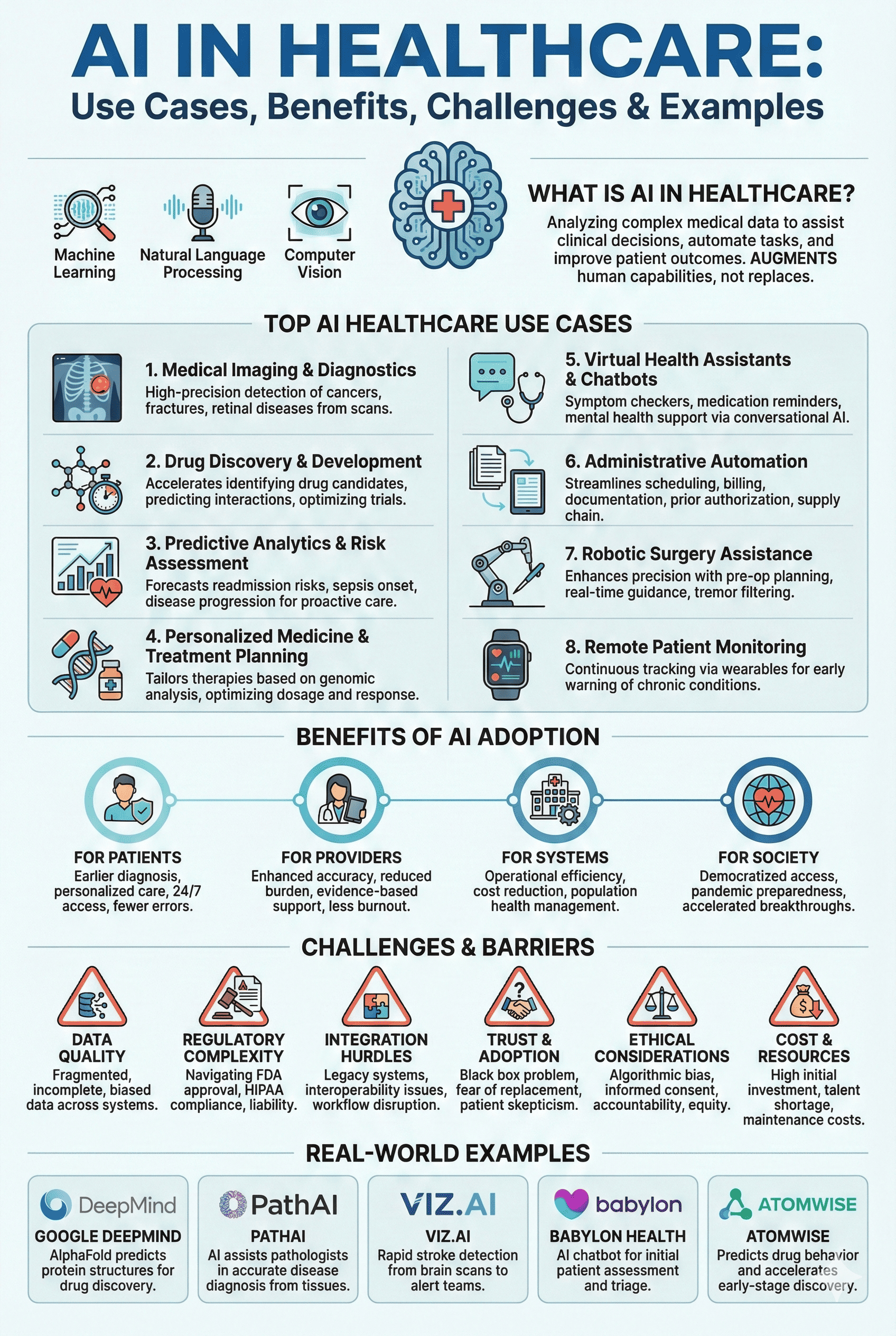
AI in healthcare refers to the use of machine learning algorithms, natural language processing, computer vision, and other artificial intelligence technologies to analyze complex medical data, assist clinical decision-making, automate administrative tasks, and improve patient outcomes.
Unlike traditional software that follows rigid rules, AI systems can:
- Learn from data patterns to improve accuracy over time
- Process unstructured information like medical images, clinical notes, and research papers
- Make predictions about patient risks, disease progression, and treatment responses
- Adapt to new information without explicit reprogramming
The goal isn’t to replace healthcare professionals but to augment their capabilities—giving them superpowers to deliver faster, more accurate, and more personalized care.
Top AI Healthcare Use Cases Transforming Medicine
The applications of artificial intelligence in healthcare span virtually every aspect of the medical ecosystem. Here are the most impactful AI healthcare use cases currently revolutionizing the industry:
1. Medical Imaging and Diagnostics
AI excels at analyzing medical images with superhuman precision. Deep learning algorithms can detect subtle patterns in X-rays, MRIs, CT scans, and pathology slides that even experienced radiologists might miss.Key applications include:
- Cancer detection: AI systems identify tumors, lesions, and malignancies in mammograms, lung scans, and skin images with accuracy rates exceeding 94%
- Retinal disease screening: Algorithms detect diabetic retinopathy and macular degeneration from fundus photographs
- Cardiac imaging: AI analyzes echocardiograms and cardiac MRIs to identify structural abnormalities
- Fracture detection: Automated systems flag bone fractures in emergency room X-rays
2. Drug Discovery and Development
Traditional drug development takes 10-15 years and costs billions. AI is compressing this timeline dramatically by:
- Identifying drug candidates through molecular simulation and virtual screening
- Predicting drug interactions and potential side effects before clinical trials
- Optimizing clinical trial design by identifying ideal patient populations
- Repurposing existing drugs for new therapeutic applications
Companies like Insilico Medicine have used AI to identify novel drug candidates in as little as 18 months—a process that traditionally takes over a decade.
3. Predictive Analytics and Risk Assessment
AI algorithms analyze electronic health records, lab results, vital signs, and social determinants to predict:
- Hospital readmission risk within 30 days of discharge
- Sepsis onset hours before clinical symptoms appear
- Disease progression in chronic conditions like diabetes and heart failure
- Mortality risk to inform care intensity decisions
These predictions enable proactive interventions that save lives and reduce healthcare costs.
4. Personalized Medicine and Treatment Planning
Every patient is unique, and AI helps tailor treatments accordingly:
- Genomic analysis identifies which cancer therapies will work best based on tumor genetics
- Dosage optimization calculates precise medication amounts based on individual metabolism
- Treatment response prediction forecasts how patients will respond to specific interventions
- Clinical decision support recommends evidence-based treatment protocols
5. Virtual Health Assistants and Chatbots
AI-powered conversational agents are transforming patient engagement:
- Symptom checkers help patients understand when to seek care
- Medication reminders improve treatment adherence
- Mental health support through therapeutic chatbots like Woebot and Wysa
- Post-operative follow-up monitoring recovery and flagging complications
6. Administrative Automation
Healthcare drowns in paperwork. AI automates:
- Clinical documentation through voice-to-text and auto-coding
- Prior authorization processing for insurance approvals
- Appointment scheduling optimization
- Revenue cycle management including billing and claims processing
- Supply chain forecasting for medical equipment and medications
Studies suggest administrative tasks consume nearly 34% of healthcare spending—AI could recover billions in efficiency gains.
7. Robotic Surgery Assistance
AI enhances surgical precision through:
- Pre-operative planning with 3D modeling and simulation
- Real-time guidance during procedures
- Tremor filtering for microsurgery
- Autonomous suturing and tissue manipulation in controlled scenarios
Systems like the da Vinci surgical robot, now incorporating AI capabilities, enable minimally invasive procedures with faster recovery times.
8. Remote Patient Monitoring
Wearables and IoT devices combined with AI enable:
- Continuous vital sign monitoring for chronic disease management
- Early warning systems detecting deterioration before emergencies
- Cardiac arrhythmia detection through smartwatches
- Sleep disorder analysis and intervention recommendations
Benefits of AI in Healthcare
The adoption of AI in healthcare delivers transformative advantages across the entire medical ecosystem:
For Patients
- Earlier and more accurate diagnoses catching diseases at treatable stages
- Reduced wait times for test results and appointments
- Personalized treatment plans tailored to individual needs
- 24/7 access to health information and support
- Fewer medical errors through AI-assisted clinical decisions
- Lower costs from efficiency gains passed to consumers
For Healthcare Providers
- Enhanced diagnostic accuracy with AI as a second opinion
- Reduced administrative burden freeing time for patient care
- Evidence-based decision support at the point of care
- Burnout reduction by automating tedious tasks
- Continuous learning from AI-curated medical literature
For Healthcare Systems
- Operational efficiency through predictive resource allocation
- Cost reduction from preventive care and reduced readmissions
- Population health management identifying at-risk communities
- Research acceleration mining data for clinical insights
- Scalability extending specialist expertise to underserved areas
For Society
- Democratized access to quality healthcare regardless of geography
- Pandemic preparedness through early outbreak detection
- Accelerated medical breakthroughs benefiting future generations
- Sustainable healthcare systems managing aging population demands
Challenges and Barriers to AI Adoption in Healthcare
Despite its promise, artificial intelligence in healthcare faces significant hurdles:
1. Data Quality and Availability
AI models are only as good as their training data. Healthcare faces:
- Fragmented data across incompatible electronic health record systems
- Incomplete records with missing information and inconsistent documentation
- Data bias from historically underrepresented populations leading to algorithmic disparities
- Privacy constraints limiting data sharing for research
2. Regulatory and Compliance Complexity
Medical AI must navigate:
- FDA approval processes for clinical AI applications
- HIPAA compliance for patient data protection
- Liability questions when AI recommendations cause harm
- International regulatory variations complicating global deployment
3. Integration with Existing Systems
Healthcare infrastructure often includes:
- Legacy systems resistant to modern integrations
- Interoperability challenges between different vendors
- Workflow disruption requiring change management
- Technical debt accumulated over decades
4. Trust and Adoption Barriers
Both clinicians and patients harbor concerns:
- Black box problem: Many AI models can’t explain their reasoning
- Fear of replacement: Healthcare workers worry about job displacement
- Patient skepticism: Trust issues with machine-made medical decisions
- Validation requirements: Need for rigorous clinical trials before adoption
5. Ethical Considerations
AI raises profound ethical questions:
- Algorithmic bias potentially perpetuating or amplifying health disparities
- Informed consent for AI-assisted care
- Accountability when AI contributes to adverse outcomes
- Equity of access ensuring AI benefits reach underserved populations
6. Cost and Resource Constraints
Implementation requires:
- Significant upfront investment in technology and infrastructure
- Specialized talent in short supply globally
- Ongoing maintenance and model retraining
- Training programs for staff adoption
Real-World Examples of AI in Healthcare
Let’s examine how leading organizations are deploying AI healthcare use cases today:
Google DeepMind – AlphaFold
DeepMind’s AlphaFold solved a 50-year-old biology challenge by predicting protein structures with remarkable accuracy. This breakthrough accelerates drug discovery by helping researchers understand disease mechanisms at the molecular level. The technology has been used to study COVID-19 viral proteins and identify potential therapeutic targets.
IBM Watson for Oncology
Though it faced early challenges, IBM Watson demonstrated AI’s potential in cancer care by analyzing patient records against vast medical literature to recommend personalized treatment options. The system reviewed over 300 medical journals, 200 textbooks, and 15 million pages of clinical information.
PathAI – Pathology Analysis
PathAI uses machine learning to assist pathologists in diagnosing diseases from tissue samples. Their algorithms help identify cancer cells in biopsies with improved accuracy, reducing diagnostic errors that could lead to inappropriate treatments.
Tempus – Precision Medicine
Tempus has built one of the world’s largest libraries of clinical and molecular data. Their AI platform analyzes genetic sequences alongside clinical records to identify optimal cancer treatments, matching patients with clinical trials, and predicting treatment responses.
Viz.ai – Stroke Detection
Viz.ai’s FDA-cleared platform uses AI to analyze brain CT scans and detect signs of stroke within minutes. The system automatically alerts stroke teams, reducing time-to-treatment—critical in stroke care where “time is brain.”
Babylon Health – Virtual Care
Babylon’s AI-powered chatbot conducts initial patient assessments, triaging symptoms and providing health information. The platform has served millions of users globally, demonstrating AI’s potential to extend healthcare access.
Zebra Medical Vision – Radiology AI
Zebra Medical offers AI solutions that analyze medical imaging for multiple conditions including cardiovascular disease, liver disease, and bone health. Their algorithms have received regulatory clearances across multiple jurisdictions.
Atomwise – Drug Discovery
Atomwise uses AI and supercomputers to predict how potential drugs will behave before they’re synthesized. Their virtual screening technology evaluates millions of molecular compounds to identify promising candidates, dramatically accelerating early-stage drug discovery.
The Future of AI in Healthcare
The trajectory of AI in healthcare points toward increasingly sophisticated applications:Emerging trends include:
- Multimodal AI integrating imaging, genomics, clinical notes, and wearable data for holistic patient understanding
- Foundation models like GPT-4 being adapted for clinical applications
- Federated learning enabling AI training across institutions without sharing sensitive data
- Digital twins creating virtual patient models for treatment simulation
- Ambient clinical intelligence documenting patient encounters automatically
- AI-native medical devices with embedded intelligence at the point of care
Healthcare will increasingly operate as a data-driven, AI-augmented ecosystem where human expertise combines with machine intelligence to deliver care that’s more precise, more proactive, and more personalized than ever before.
Conclusion: Embracing the AI Healthcare Revolution
AI in healthcare isn’t a distant promise—it’s a present reality transforming medicine at an unprecedented pace. From catching cancers earlier to discovering life-saving drugs faster, from personalizing treatments to automating administrative burdens, artificial intelligence in healthcare is delivering tangible benefits today.
Yet realizing AI’s full potential requires navigating genuine challenges: data quality issues, regulatory complexity, integration hurdles, and ethical considerations demand thoughtful solutions. Success will come not from viewing AI as a replacement for human healthcare workers, but as a powerful tool that amplifies their capabilities.
The organizations and healthcare systems that embrace AI thoughtfully—prioritizing patient outcomes, addressing bias, ensuring equity, and maintaining human oversight—will lead the transformation of healthcare for generations to come.




 AI/ML Strategy and Consulting
 Data Science And Data Analytics
 Generative AI
 AI Consulting Services
 AI Automation Solutions
 API Integration


