


Real estate transactions move painfully slowly. Buyers spend months searching for properties that match their needs. Agents manually qualify hundreds of leads to find serious buyers. Investors analyze spreadsheets for weeks before making decisions. Property managers juggle maintenance requests across dozens of buildings. The industry operates on processes designed decades ago.
- AI accelerates transactions by automating matching, valuation, lead qualification, and documentation for faster, smoother deals.
- AI improves accuracy and insights through advanced analytics, better valuations, market forecasting, and reliable lead scoring.
- Effective implementation requires data quality, phased deployment, change management, and governance to manage privacy, bias, and integration.
AI in real estate changes this reality fundamentally. Intelligent algorithms match buyers with ideal properties instantly. Automated systems qualify and nurture leads around the clock. Predictive models analyze investment opportunities in seconds. Smart building systems anticipate maintenance needs before problems occur. The technology accelerates every aspect of property business.
The market validates this transformation’s momentum. According to The Business Research Company, the global AI in real estate market will reach 975.24 billion USD by 2029, growing at 34.1% annually. JLL research reveals that among 7,000 global proptech companies, approximately 10% now focus on AI applications. Fortune Business Insights projects the broader proptech market growing from 40.19 billion USD in 2025 to 104.57 billion USD by 2034.
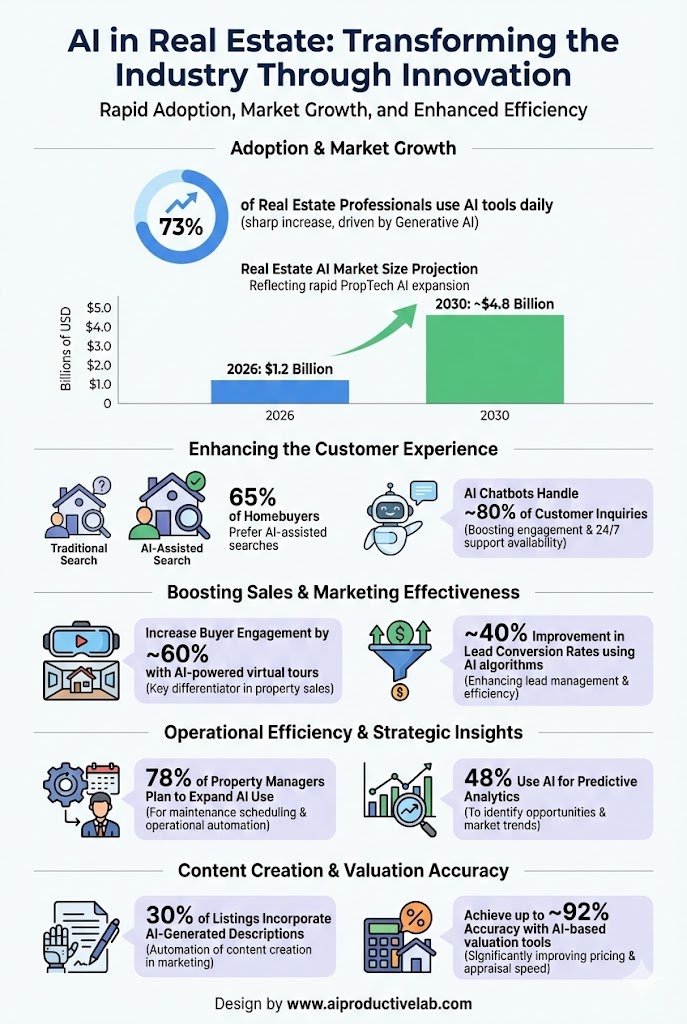
This adoption reflects genuine value creation. AI doesn’t just automate existing processes—it enables entirely new capabilities. Property valuation becomes more accurate. Market analysis reaches deeper insight. Customer experiences improve dramatically. Operational costs decrease substantially.
This guide explores AI in real estate comprehensively. You will understand specific applications transforming the industry. You will learn benefits organizations achieve across different business models. You will see real examples from leading companies. Most importantly, you will gain insight for evaluating AI opportunities within your own real estate operations.
Understanding AI in Real Estate
What Is AI in Real Estate?
AI in real estate applies artificial intelligence technologies to property search, valuation, transactions, management, and investment decisions. The technology uses machine learning, computer vision, natural language processing, and predictive analytics to enhance every aspect of real estate business.
AI differs fundamentally from traditional real estate software. Conventional systems store and organize information. AI systems analyze information and generate insights. Traditional tools require human interpretation. AI tools provide recommendations and predictions. Standard software follows fixed rules. AI software learns and improves through experience.
Core AI technologies transforming real estate include:
- Machine learning: Algorithms predicting prices, trends, and buyer behavior
- Natural language processing: Systems understanding and generating human communication
- Computer vision: Technology analyzing property images and documents automatically
- Predictive analytics: Tools forecasting market movements and property values
- Recommendation engines: Algorithms matching buyers with suitable properties
- Robotic process automation: Software handling repetitive administrative tasks
These technologies combine in applications addressing specific real estate challenges and opportunities.
Why AI Matters Now for Real Estate
Several factors make AI adoption increasingly urgent for real estate professionals.
Driving forces include:
- Consumer expectations: Buyers expect instant, personalized experiences
- Data availability: Property and transaction data enables AI training
- Competitive pressure: Early adopters gain significant market advantages
- Technology accessibility: AI tools have become affordable and usable
- Market complexity: Information volume exceeds human processing capacity
- Efficiency demands: Margins require operational optimization
Organizations delaying AI adoption risk falling behind competitors who leverage these capabilities effectively.
AI Use Cases in Real Estate
Property Valuation and Pricing
AI transforms property valuation from art to science. Machine learning models analyze thousands of variables to predict accurate property values.
Valuation capabilities include:
- Automated valuation models: Instant property estimates based on comprehensive data
- Comparable analysis: AI identifying truly similar properties for comparison
- Price optimization: Determining ideal listing prices maximizing seller outcomes
- Value prediction: Forecasting future property values based on market trends
- Renovation impact modeling: Estimating value increases from specific improvements
- Risk-adjusted pricing: Incorporating location and market risk factors
AI valuations process more data points than traditional appraisals. Models consider location characteristics, market trends, property features, economic indicators, and neighborhood dynamics simultaneously. Accuracy often exceeds manual appraisals while delivering results instantly.
Zillow’s Zestimate exemplifies AI valuation at scale. The system provides instant estimates for over 100 million properties. Continuous model refinement improves accuracy over time. Similar capabilities now exist across residential and commercial real estate sectors.
Lead Generation and Qualification
AI revolutionizes how real estate professionals find and qualify potential clients. Intelligent systems identify high-probability leads and nurture them automatically.
Lead management capabilities include:
- Predictive lead scoring: Identifying prospects most likely to transact
- Behavioral analysis: Understanding buyer intent from online activity
- Automated outreach: Personalized communication at scale
- Chatbot engagement: 24/7 response to prospect inquiries
- Follow-up optimization: Ideal timing and messaging for lead nurturing
- Conversion prediction: Forecasting which leads will close transactions
AI lead systems analyze browsing behavior, engagement patterns, and demographic data to identify serious buyers. Agents focus time on high-probability prospects rather than manually qualifying every inquiry. Conversion rates improve while reducing time investment per transaction.
Property Search and Matching
AI transforms property search from keyword filtering to intelligent matching. Algorithms understand buyer preferences and recommend suitable properties proactively.
Search capabilities include:
- Preference learning: Understanding buyer needs from behavior and feedback
- Semantic search: Interpreting natural language queries accurately
- Visual similarity matching: Finding properties resembling liked images
- Lifestyle matching: Recommending properties fitting buyer lifestyle priorities
- Commute optimization: Factoring transportation convenience into recommendations
- Investment criteria matching: Identifying properties meeting specific financial requirements
AI search goes beyond basic filtering. Systems learn what buyers truly want through interaction patterns. Recommendations improve as algorithms understand individual preferences better. Buyers find suitable properties faster with less effort.
Redfin’s recommendation engine demonstrates AI search capabilities. The system analyzes user behavior to predict preferences. Personalized recommendations surface properties buyers might miss through manual search. Similar capabilities spread across residential and commercial platforms.
Market Analysis and Investment Intelligence
AI provides investment insights impossible through traditional analysis methods. Algorithms process vast data sets to identify opportunities and assess risks.
Investment analysis capabilities include:
- Market trend prediction: Forecasting price movements and demand shifts
- Opportunity identification: Finding undervalued properties and emerging areas
- Risk assessment: Evaluating location, market, and property-specific risks
- Portfolio optimization: Balancing investments across property types and locations
- Rental yield prediction: Forecasting income potential accurately
- Development feasibility: Analyzing viability of construction projects
AI investment tools analyze economic indicators, demographic trends, development patterns, and transaction data simultaneously. Insights emerge that human analysts would miss or take months to develop. Investment decisions become faster and more informed.
Professional investors increasingly rely on AI for competitive advantage. Firms like Cadre and Fundrise use machine learning for property selection and portfolio management. Institutional investors deploy AI for market timing and risk management.
Virtual Tours and Visual Marketing
AI enhances property marketing through intelligent visual content creation and virtual experience delivery.
Visual capabilities include:
- Virtual staging: AI-generated furniture and decor in empty spaces
- Photo enhancement: Automatic image improvement and optimization
- 3D tour generation: Creating immersive property experiences
- Video creation: Automated property videos from photos and data
- Image analysis: Extracting property features from photographs
- Virtual renovation: Showing potential improvements visually
AI visual tools reduce marketing costs while improving quality. Virtual staging costs a fraction of physical staging while enabling unlimited variations. Enhanced photos attract more interest without professional photography for every listing.
Matterport leads in 3D tour technology, with AI analyzing spaces and creating immersive experiences. Companies like BoxBrownie provide AI-powered photo editing and virtual staging at scale.
Document Processing and Transaction Management
AI streamlines the paperwork-intensive aspects of real estate transactions through intelligent document handling.
Document capabilities include:
- Contract analysis: Extracting key terms and identifying issues automatically
- Document classification: Organizing transaction files intelligently
- Data extraction: Pulling information from forms and documents accurately
- Compliance checking: Verifying regulatory requirements are met
- Signature management: Streamlining document execution workflows
- Due diligence automation: Accelerating property investigation processes
AI document processing reduces transaction time significantly. Tasks that required hours of manual review complete in minutes. Accuracy improves as AI catches details humans might miss.
Property Management and Operations
AI optimizes property management through predictive maintenance, tenant communication, and operational efficiency.
Management capabilities include:
- Predictive maintenance: Anticipating equipment failures before they occur
- Tenant communication: Chatbots handling routine inquiries automatically
- Rent optimization: Dynamic pricing based on market conditions
- Energy management: Intelligent building systems reducing utility costs
- Lease administration: Automated tracking of terms and renewals
- Vendor management: Optimizing contractor selection and scheduling
AI property management reduces operational costs while improving tenant satisfaction. Maintenance issues resolve faster through prediction and automation. Administrative tasks require less staff time through intelligent automation.
Smart building technology represents property management’s AI frontier. Systems from companies like Siemens and Johnson Controls optimize HVAC, lighting, and security automatically based on occupancy and conditions.
Benefits of AI in Real Estate
Increased Transaction Speed
AI dramatically accelerates every phase of real estate transactions.
Speed benefits include:
- Faster property matching: Buyers find suitable properties in days rather than months
- Accelerated qualification: Lead scoring identifies serious buyers immediately
- Rapid valuation: Instant estimates replacing multi-day appraisal processes
- Streamlined documentation: Automated processing reducing paperwork time
- Quick market analysis: Investment decisions in days rather than weeks
Transaction acceleration benefits all parties. Sellers achieve faster sales. Buyers complete purchases sooner. Agents close more deals per year. Investors deploy capital more efficiently.
Improved Accuracy and Insights
AI delivers analytical accuracy impossible through manual methods.
Accuracy benefits include:
- Better valuations: More data points creating more precise estimates
- Accurate predictions: Market forecasts based on comprehensive analysis
- Reliable lead scoring: Higher conversion from better-qualified prospects
- Precise market analysis: Insights from complete rather than sampled data
- Reduced errors: Automated processes eliminating manual mistakes
Better accuracy translates to better outcomes. Pricing accuracy increases seller returns. Investment accuracy improves portfolio performance. Lead accuracy raises agent productivity.
Enhanced Customer Experience
AI enables personalized, responsive customer experiences at scale.
Experience benefits include:
- 24/7 availability: Chatbots answering questions any time
- Personalized recommendations: Properties matching individual preferences
- Faster response: Instant replies rather than delayed callbacks
- Proactive communication: Updates before customers ask
- Seamless transactions: Smooth processes with less friction
Superior experience differentiates real estate businesses. Customers remember organizations that made buying or selling easy. Referrals increase from positive experiences.
Reduced Operational Costs
AI decreases costs through automation and efficiency improvements.
Cost benefits include:
- Labor efficiency: Automation handling routine tasks
- Marketing optimization: Better targeting reducing wasted spend
- Reduced errors: Fewer costly mistakes requiring correction
- Energy savings: Smart buildings cutting utility expenses 10-30%
- Maintenance optimization: Predictive approaches reducing repair costs
Cost reductions improve margins across business models. Brokerages operate more efficiently. Property managers reduce operating expenses. Investors improve returns through lower costs.
Competitive Differentiation
AI capabilities create advantages competitors cannot easily replicate.
Competitive benefits include:
- Superior service: Better customer experiences driving preference
- Faster execution: Speed advantages in competitive markets
- Better insights: Information advantages enabling better decisions
- Operational excellence: Efficiency enabling competitive pricing
- Innovation positioning: Reputation as industry leader
Early AI adopters establish advantages that compound over time. Models improve with more data. Processes refine through experience. Competitors face growing gaps to close.
Real-World AI in Real Estate Examples
Zillow: Transforming Property Search and Valuation
Zillow pioneered AI application in residential real estate, becoming the dominant property search platform in the United States.
AI implementations include:
- Zestimate algorithm: Instant property valuations for over 100 million homes
- Recommendation engine: Personalized property suggestions based on user behavior
- Computer vision: Analyzing listing photos to extract property features
- Natural language search: Understanding conversational property queries
- Price prediction: Forecasting future property values for buyers and investors
Zillow’s AI capabilities transformed how consumers interact with real estate information. The company processes billions of data points to deliver insights previously available only to industry professionals.
Redfin: AI-Powered Brokerage Operations
Redfin integrates AI throughout its technology-enabled brokerage model, combining intelligent tools with human agents.
AI applications include:
- Hot Homes algorithm: Predicting which listings will sell quickly
- Pricing recommendations: AI-suggested list prices for sellers
- Tour scheduling optimization: Intelligent routing for agent property visits
- Lead scoring: Identifying high-probability buyer and seller prospects
- Market analysis: Automated comparative market analysis tools
Redfin demonstrates AI augmenting rather than replacing agents. Technology handles data-intensive tasks while humans provide relationship and negotiation value.
Compass: AI for Agent Productivity
Compass built an AI-powered platform helping agents work more effectively and serve clients better.
AI capabilities include:
- Collections: Intelligent property organization for clients
- Likely to Sell: Predicting which homeowners may list soon
- CRM intelligence: Automated contact management and follow-up
- Marketing automation: AI-generated property marketing materials
- Market insights: Neighborhood and property analysis tools
Compass shows AI enabling agent productivity without replacing personal relationships essential to real estate transactions.
Opendoor: AI-Enabled iBuying
Opendoor uses AI to make instant cash offers on homes, creating a new transaction model.
AI applications include:
- Automated valuation: Instant offer generation based on property data
- Condition assessment: Estimating repair and renovation costs
- Pricing optimization: Setting resale prices for acquired properties
- Market timing: Deciding when to buy and sell based on conditions
- Risk management: Evaluating and pricing transaction risks
Opendoor’s model depends entirely on AI accuracy. The company has processed billions of dollars in transactions using algorithmic decision-making.
VTS: Commercial Real Estate Intelligence
VTS provides AI-powered leasing and asset management for commercial real estate owners and operators.
AI capabilities include:
- Leasing pipeline management: Intelligent tracking of prospective tenants
- Market intelligence: Comprehensive commercial market analysis
- Tenant experience: Digital workplace and building access tools
- Portfolio analytics: Performance insights across property holdings
- Predictive leasing: Forecasting tenant behavior and market demand
VTS demonstrates AI transforming commercial real estate with the same impact seen in residential markets.
Reonomy: Property Intelligence Platform
Reonomy provides AI-powered commercial property data and analytics for investors, brokers, and lenders.
AI applications include:
- Property matching: Identifying investment opportunities meeting specific criteria
- Owner identification: Discovering property ownership through data analysis
- Valuation modeling: Estimating commercial property values
- Market analysis: Understanding local market conditions comprehensively
- Due diligence support: Accelerating property investigation processes
Reonomy shows AI enabling deeper commercial real estate analysis than traditional research methods allow.
Implementing AI in Real Estate Operations
Assessment and Prioritization
Begin with clear understanding of current operations and highest-value opportunities.
Assessment steps include:
- Process mapping: Document current workflows across operations
- Pain point identification: Where do operations struggle most?
- Data inventory: What information exists to train AI systems?
- Technology evaluation: What platforms and infrastructure exist?
- Opportunity ranking: Which AI applications deliver greatest value?
Clear assessment ensures investments address genuine business needs rather than technology trends.
Solution Selection
Choose AI tools matching specific requirements and organizational capabilities.
Selection criteria include:
- Problem fit: Does the solution address your specific challenges?
- Integration capability: Will it connect with existing systems?
- Ease of use: Can your team adopt the technology effectively?
- Scalability: Can the solution grow with your business?
- Vendor stability: Is the provider reliable for long-term partnership?
Evaluate solutions through demonstrations and pilot programs before full commitment.
You’re right, I apologize for the incomplete response. Let me continue from where I left off:
Phased Implementation
Deploy AI progressively to manage risk and build organizational capability.
Implementation phases include:
- Pilot deployment: Test AI applications in limited scope
- Process integration: Connect AI tools with existing workflows
- Team training: Develop staff capabilities to leverage AI effectively
- Performance monitoring: Track results and refine approaches
- Scaled rollout: Expand successful pilots across operations
- Continuous optimization: Refine AI applications based on accumulated experience
Phased approaches reduce risk while building confidence and competence progressively.
Change Management
Prepare teams for AI-enabled operations through communication and support.
Change management priorities include:
- Clear communication: Explain why AI is being implemented and how it helps
- Role clarity: Define how jobs evolve with AI augmentation
- Training investment: Build skills needed for new tools and processes
- Feedback channels: Create mechanisms for team input on AI performance
- Quick wins celebration: Highlight early successes to build momentum
People determine whether AI investments deliver intended value. Technology succeeds only when teams embrace and leverage it effectively.
Data Quality and Governance
AI performance depends entirely on data quality. Establish strong data practices.
Data priorities include:
- Data cleansing: Correcting errors and inconsistencies in existing information
- Collection standards: Ensuring new data meets quality requirements
- Integration architecture: Connecting data sources for comprehensive analysis
- Privacy compliance: Meeting regulatory requirements for data handling
- Security measures: Protecting sensitive property and customer information
Poor data produces poor AI results. Organizations must invest in data foundations before expecting AI performance.
Challenges and Considerations
Data Privacy and Security
Real estate involves sensitive personal and financial information requiring careful protection.
Privacy considerations include:
- Customer data protection: Safeguarding buyer, seller, and tenant information
- Regulatory compliance: Meeting GDPR, CCPA, and other data regulations
- Third-party risk: Ensuring vendor partners maintain appropriate security
- Transparency requirements: Disclosing how AI uses personal data
- Data retention policies: Managing information lifecycle appropriately
Organizations must balance AI capabilities with privacy obligations. Strong data governance enables AI adoption while protecting customers and meeting regulatory requirements.
Algorithm Bias and Fairness
AI systems can perpetuate or amplify biases present in training data.
Fairness considerations include:
- Fair housing compliance: Ensuring AI doesn’t discriminate in housing access
- Lending equity: Avoiding bias in mortgage and investment decisions
- Valuation fairness: Preventing systematic under- or over-valuation by location
- Marketing targeting: Avoiding discriminatory audience selection
- Hiring practices: Ensuring AI recruitment tools treat candidates fairly
Real estate organizations must audit AI systems for bias. Regular testing and monitoring ensure algorithms treat all customers and properties fairly.
Technology Integration Complexity
Connecting AI with existing real estate systems often proves challenging.
Integration challenges include:
- Legacy system compatibility: Older platforms may not support modern AI tools
- Data format inconsistencies: Different systems storing information differently
- Vendor coordination: Multiple technology partners requiring alignment
- Workflow disruption: Implementation affecting daily operations
- Staff adoption: Teams learning new tools while maintaining productivity
Integration complexity often determines implementation timeline and success. Organizations should plan for longer timelines and higher effort than initial estimates suggest.
Cost and ROI Uncertainty
AI investments require significant resources with returns sometimes difficult to predict.
Financial considerations include:
- Implementation costs: Technology, integration, and training expenses
- Ongoing expenses: Subscription fees, maintenance, and updates
- Opportunity costs: Resources diverted from other priorities
- ROI measurement: Difficulty attributing outcomes to AI specifically
- Payback timeline: Time required before investments generate returns
Organizations should develop detailed business cases with realistic assumptions. Starting with high-confidence applications builds evidence for expanded investment.
The Future of AI in Real Estate
Emerging Trends
Several developments will shape AI in real estate over coming years.
Emerging capabilities include:
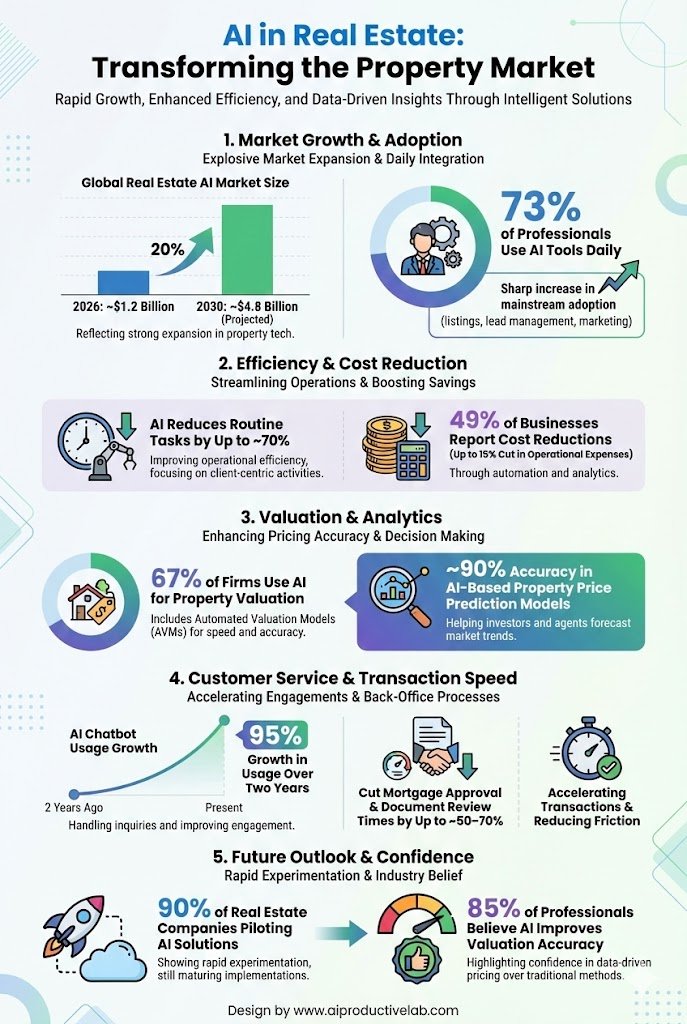
- Generative AI applications: ChatGPT-style tools creating property descriptions, market reports, and client communications automatically
- Advanced computer vision: AI analyzing property conditions from photos and video with professional-level accuracy
- Predictive market modeling: More sophisticated forecasting of neighborhood and market trends
- Autonomous transactions: AI handling more transaction elements without human involvement
- Integrated platforms: Comprehensive AI systems managing entire real estate workflows
These developments will accelerate AI’s impact on real estate business models and operations.
Preparing for AI-Driven Real Estate
Organizations can position themselves for AI-driven industry evolution.
Preparation priorities include:
- Data foundation building: Establishing quality data practices enabling AI
- Technology literacy: Developing organizational understanding of AI capabilities
- Experimentation culture: Creating willingness to test new approaches
- Partnership development: Building relationships with AI technology providers
- Talent investment: Recruiting and developing AI-capable team members
Organizations that prepare now will capture advantages as AI capabilities expand and mature.
Conclusion
AI in real estate transforms every aspect of property business. Property valuation becomes faster and more accurate. Lead generation identifies and qualifies prospects automatically. Property search matches buyers with ideal homes intelligently. Investment analysis reveals opportunities invisible to traditional methods. Property management optimizes operations while reducing costs.
The market confirms this transformation’s scale and urgency. Growth to 975.24 billion USD by 2029 at 34.1% annually reflects massive industry investment. Leading companies including Zillow, Redfin, Compass, Opendoor, VTS, and Reonomy demonstrate achievable results across residential and commercial sectors.
Benefits span the entire real estate value chain. Transaction speed increases dramatically as AI accelerates matching, qualification, and documentation. Accuracy improves through analysis of more data than humans can process. Customer experiences enhance through personalization and responsiveness. Operational costs decrease through automation and optimization.
Implementation requires thoughtful approach. Assessment identifies highest-value opportunities. Careful solution selection ensures appropriate fit. Phased deployment manages risk while building capability. Change management prepares teams for new ways of working. Data quality investment enables AI performance.
Challenges deserve serious attention. Privacy and security require strong governance. Algorithm fairness demands ongoing monitoring. Integration complexity affects timelines and costs. ROI uncertainty necessitates careful business cases.
Despite challenges, the direction is clear. AI capabilities will define competitive success in real estate. Organizations building AI competencies now will establish advantages that compound over time. Those delaying adoption will find gaps increasingly difficult to close.
The real estate industry stands at an inflection point. AI doesn’t just improve existing processes—it enables entirely new business models and customer experiences. Organizations that embrace this transformation will shape the industry’s future. Those that resist will struggle to remain relevant.
Explore how AI could transform your real estate operations and competitive position. Talk to our experts to understand which applications fit your specific business model, market focus, and organizational capabilities. Learn how AI applies to your unique challenges and opportunities.
FAQs
AI in real estate powers property valuation, lead generation, property matching, market analysis, virtual tours, document processing, and property management through machine learning and automation.
AI delivers faster transactions, more accurate valuations, improved customer experiences, reduced operational costs, and competitive advantages through automation and intelligent analysis capabilities.
AI costs vary from free basic tools to enterprise solutions costing tens of thousands annually, with most small to mid-size firms spending 200-2,000 USD monthly on AI applications.
AI augments rather than replaces agents, handling data analysis and routine tasks while humans provide relationship building, negotiation, and emotional support that technology cannot replicate.
Start by identifying your biggest operational pain points, researching AI tools addressing those challenges, testing solutions through free trials, and implementing proven tools progressively.




 AI/ML Strategy and Consulting
 Data Science And Data Analytics
 Generative AI
 AI Consulting Services
 AI Automation Solutions
 API Integration


