


A single hour of unplanned downtime costs industrial manufacturers an average of 260,000 USD. Equipment fails without warning. Production halts cascade through supply chains. Repair costs multiply when failures cause collateral damage. These scenarios repeat daily across industries worldwide.
- AI predictive maintenance forecasts equipment failures using continuous sensor data and machine learning, enabling proactive repairs before breakdowns occur.
- Adoption delivers strong financial returns: major downtime reductions (70–75%) and maintenance cost savings (25–30%), often achieving rapid payback.
- Successful implementation requires quality data, focused pilots, system integration, and change management to scale and sustain value.
AI predictive maintenance eliminates this costly guesswork. Intelligent systems monitor equipment continuously. Algorithms detect subtle patterns indicating impending failures. Maintenance teams receive advance warning to schedule repairs proactively. The technology transforms maintenance from reactive firefighting to strategic prevention.
The business case is compelling. According to industry research, 95% of companies implementing predictive maintenance report positive returns. Even more striking, 27% achieve full payback within just 12 months. These numbers explain why adoption accelerates across manufacturing, energy, transportation, and healthcare sectors.
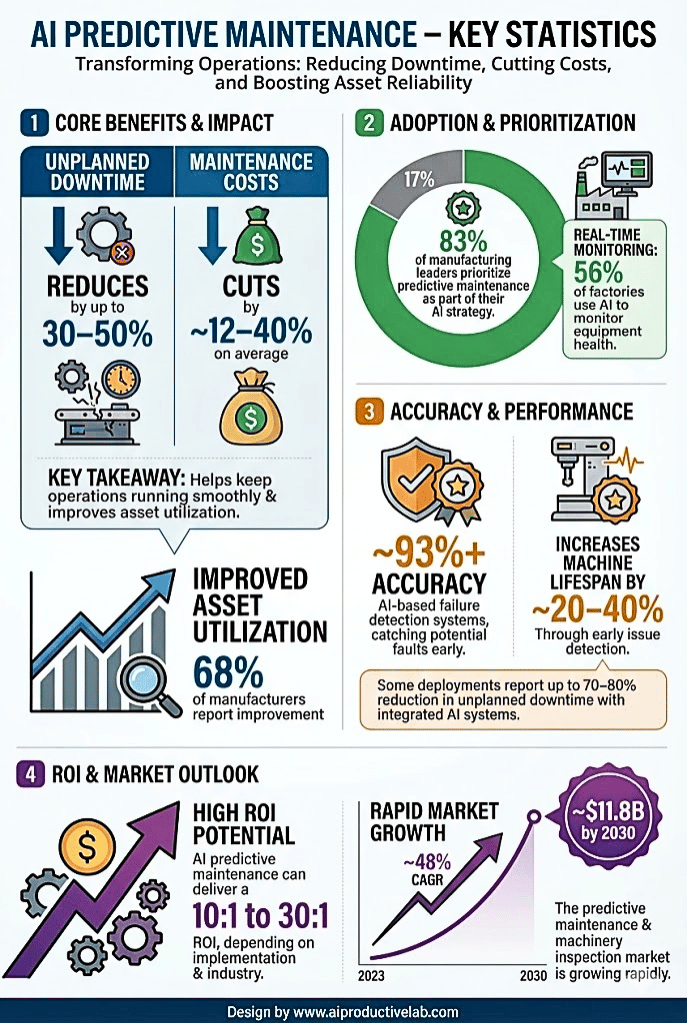
Traditional maintenance approaches cannot compete. Reactive maintenance waits for failures—accepting downtime as inevitable. Scheduled maintenance replaces components on fixed timelines—wasting resources on parts with remaining useful life. AI predictive maintenance optimizes both approaches through data-driven precision.
This guide explores AI predictive maintenance comprehensively. You will learn how the technology works in practical terms. You will understand specific benefits organizations achieve. You will see real-world applications across industries. Most importantly, you will gain insight for evaluating predictive maintenance opportunities within your own operations.
What Is AI Predictive Maintenance?
AI predictive maintenance uses artificial intelligence to forecast equipment failures before they occur. The technology analyzes sensor data, operational patterns, and historical information to identify problems developing invisibly within machinery.
The approach differs fundamentally from traditional maintenance strategies. Reactive maintenance responds after equipment fails. Preventive maintenance follows fixed schedules regardless of actual condition. Predictive maintenance intervenes precisely when data indicates intervention is needed.
Core technology components include:
- Sensors and data collection: Devices monitoring vibration, temperature, pressure, and other parameters
- Data integration platforms: Systems aggregating information from multiple sources
- Machine learning algorithms: AI analyzing patterns to detect anomalies and predict failures
- Alert and notification systems: Tools informing maintenance teams of developing issues
- Analytics dashboards: Interfaces presenting insights for decision-making
- Integration with maintenance systems: Connections to work order and scheduling platforms
The technology works continuously and tirelessly. Sensors collect thousands of data points per second. AI processes this information in real-time, comparing current conditions against normal patterns. When deviations suggest developing problems, the system alerts maintenance personnel with specific diagnoses and recommended actions.
This intelligence enables maintenance optimization impossible through human observation alone. Humans cannot monitor every machine continuously. Humans cannot process thousands of simultaneous data streams. Humans cannot detect subtle pattern changes indicating problems weeks before failure. AI can.
How AI Predictive Maintenance Works
Data Collection and Monitoring
Effective predictive maintenance begins with comprehensive data collection. Sensors attached to equipment capture operational information continuously.
Key data types collected include:
- Vibration data: Detecting imbalance, misalignment, and bearing wear
- Temperature readings: Identifying overheating and thermal stress
- Acoustic emissions: Recognizing sounds indicating mechanical problems
- Electrical parameters: Monitoring current, voltage, and power consumption
- Pressure measurements: Tracking hydraulic and pneumatic system health
- Oil analysis data: Assessing lubrication condition and contamination
Modern sensors are affordable, compact, and easy to install. Wireless connectivity eliminates complex wiring requirements. Battery power enables deployment on equipment lacking electrical connections. These advances make comprehensive monitoring practical for organizations of all sizes.
Pattern Recognition and Analysis
AI algorithms analyze collected data to establish normal operating patterns and detect deviations.
Machine learning approaches include:
- Anomaly detection: Identifying data points outside normal ranges
- Trend analysis: Recognizing gradual degradation over time
- Pattern matching: Comparing current conditions to known failure signatures
- Remaining useful life estimation: Predicting when components will fail
- Root cause analysis: Determining underlying problems from symptoms
The AI learns continuously from operational data. Models improve as they process more information. False alarm rates decrease while detection accuracy increases. The system becomes increasingly valuable over time.
Alerting and Action
When AI detects developing problems, it generates actionable alerts for maintenance teams.
Alert capabilities include:
- Severity classification: Distinguishing urgent issues from developing concerns
- Failure timeline estimates: Predicting when problems will become critical
- Diagnostic information: Explaining what the data indicates
- Recommended actions: Suggesting appropriate maintenance responses
- Parts and resource requirements: Identifying what repairs will need
Maintenance teams receive information enabling intelligent planning. They schedule repairs during convenient windows rather than responding to emergencies. They order parts before failures create urgent needs. They allocate resources efficiently based on actual equipment conditions.
Key Benefits of AI Predictive Maintenance
Dramatic Downtime Reduction
Unplanned downtime devastates operational performance. AI predictive maintenance reduces unexpected failures by 70-75% in typical implementations.
Downtime reduction benefits include:
- Production continuity: Manufacturing schedules proceed without disruption
- Customer commitment fulfillment: Orders ship on time as promised
- Revenue protection: Sales continue rather than halting for repairs
- Cascade prevention: Single failures don’t trigger broader shutdowns
- Reputation preservation: Reliability builds customer confidence
The financial impact is substantial. Organizations with high downtime costs recover investment quickly through disruption prevention alone.
Significant Cost Savings
AI predictive maintenance reduces maintenance expenses 25-30% compared to traditional approaches.
Cost reduction sources include:
- Optimized labor utilization: Technicians work on planned tasks rather than emergencies
- Reduced overtime expenses: Scheduled work happens during normal hours
- Parts inventory optimization: Stock levels match actual needs
- Extended component life: Parts run until replacement is truly needed
- Prevented collateral damage: Early intervention stops cascading failures
Organizations achieve savings through multiple mechanisms simultaneously. The combined effect creates substantial bottom-line improvement.
Extended Equipment Lifespan
Equipment properly maintained lasts longer. AI ensures maintenance happens at optimal intervals.
Lifespan extension benefits include:
- Capital expenditure deferral: Equipment replacement postpones further
- Depreciation optimization: Assets generate value longer
- Consistent performance: Well-maintained equipment operates at design specifications
- Warranty protection: Proper maintenance preserves manufacturer coverage
- Resale value preservation: Equipment maintains higher market value
Extending asset life even 10-15% represents significant capital savings for organizations with substantial equipment investments.
Improved Safety Performance
Equipment failures create safety hazards. Predictive maintenance prevents dangerous conditions.
Safety benefits include:
- Catastrophic failure prevention: Stopping problems before dangerous breakdowns
- Hazard elimination: Addressing issues creating workplace risks
- Compliance maintenance: Keeping equipment within safety parameters
- Emergency reduction: Fewer urgent situations requiring rushed responses
- Worker confidence: Employees trust equipment reliability
Safety improvements reduce human harm while decreasing liability exposure and regulatory compliance costs.
Enhanced Operational Efficiency
Beyond maintenance benefits, AI predictive systems improve overall operational performance.
Efficiency benefits include:
- Energy optimization: Equipment running properly consumes less energy
- Quality improvement: Well-maintained machines produce better output
- Throughput increase: Reliable equipment maximizes production capacity
- Planning accuracy: Maintenance predictability enables better scheduling
- Resource allocation: Staff and materials deploy where actually needed
These broader benefits multiply the value of predictive maintenance investments beyond direct maintenance cost savings.
Industry Applications and Examples
Manufacturing and Production
Manufacturing facilities deploy AI predictive maintenance extensively across production equipment.
Manufacturing applications include:
- CNC machines and machining centers: Monitoring spindle health and tool wear
- Assembly line equipment: Tracking conveyor systems and robotic arms
- Packaging machinery: Ensuring reliable filling, sealing, and labeling
- HVAC and facility systems: Maintaining climate control for production environments
- Compressed air systems: Monitoring compressors and distribution networks
Major manufacturers like General Electric, Siemens, and Boeing implement predictive maintenance at scale. These organizations report significant downtime reduction and maintenance cost savings.
Energy and Utilities
Energy infrastructure requires exceptional reliability. Predictive maintenance protects critical assets.
Energy sector applications include:
- Wind turbines: Monitoring gearboxes and generators in remote locations
- Power generation equipment: Tracking turbines, generators, and transformers
- Transmission infrastructure: Monitoring switchgear and distribution equipment
- Oil and gas equipment: Tracking pumps, compressors, and pipeline systems
- Solar installations: Monitoring inverters and tracking systems
Energy companies achieve substantial value given high costs of generation equipment failures and service interruptions.
Transportation and Logistics
Transportation companies apply predictive maintenance to fleet and infrastructure assets.
Transportation applications include:
- Commercial vehicle fleets: Monitoring engines, transmissions, and braking systems
- Rail systems: Tracking locomotives, railcars, and signaling equipment
- Aviation: Monitoring aircraft engines and critical flight systems
- Marine vessels: Tracking propulsion and auxiliary systems
- Warehouse equipment: Monitoring forklifts, conveyors, and sorting systems
Fleet operators reduce roadside breakdowns while extending vehicle service life through intelligent maintenance timing.
Healthcare Facilities
Medical equipment reliability directly impacts patient care. Predictive maintenance ensures availability.
Healthcare applications include:
- Imaging equipment: Monitoring MRI, CT, and X-ray systems
- Laboratory analyzers: Tracking diagnostic testing equipment
- HVAC and air handling: Maintaining critical environmental controls
- Surgical equipment: Ensuring operating room reliability
- Building infrastructure: Monitoring elevators, electrical systems, and plumbing
Healthcare organizations cannot accept equipment failures during critical procedures. Predictive maintenance provides reliability assurance.
Implementing AI Predictive Maintenance
Assessment and Planning
Successful implementation begins with thorough evaluation of current state and opportunities.
Assessment steps include:
- Critical asset identification: Which equipment matters most to operations?
- Current maintenance evaluation: How do you maintain equipment today?
- Data availability review: What information exists or could be collected?
- Infrastructure assessment: What technology foundation exists?
- ROI prioritization: Where will predictive maintenance deliver greatest value?
Clear understanding of starting position enables realistic planning and appropriate resource allocation.
Pilot Program Development
Begin with focused pilots demonstrating value before broader deployment.
Pilot best practices include:
- Select high-impact equipment: Choose assets where failure consequences are significant
- Define success metrics: Establish clear measures for evaluating results
- Ensure adequate data: Confirm information availability for AI analysis
- Engage stakeholders: Include maintenance teams in pilot design
- Plan for learning: Build time for adjustment and optimization
Successful pilots build organizational confidence while generating lessons for broader implementation.
Scaling and Optimization
Expand successful pilots systematically across operations.
Scaling considerations include:
- Standardized deployment approaches: Consistent methods enabling efficient expansion
- Integration with existing systems: Connection to maintenance management platforms
- Training and change management: Preparing teams for new workflows
- Continuous improvement processes: Refining approaches based on experience
- Performance monitoring: Tracking outcomes to ensure sustained value
Organizations scaling thoughtfully achieve better long-term results than those rushing deployment.
Challenges and Considerations
Data Quality Requirements
AI predictive maintenance requires quality data for accurate predictions.
Data challenges include:
- Sensor reliability: Equipment monitoring devices must function consistently
- Data completeness: Gaps in information reduce prediction accuracy
- Historical baseline: AI needs sufficient data to learn normal patterns
- Integration complexity: Multiple data sources must combine effectively
- Storage and processing: Large data volumes require appropriate infrastructure
Organizations should assess data readiness before committing to predictive maintenance investments.
Integration with Existing Systems
Predictive maintenance must connect with current operations.
Integration considerations include:
- Maintenance management systems: Work orders and scheduling platforms
- Enterprise resource planning: Parts ordering and inventory management
- Operational technology: Equipment control systems and SCADA
- Business intelligence: Reporting and analytics platforms
- Communication systems: Alert delivery and notification tools
Integration requirements vary by organization. Assessment should include technical architecture review.
Organizational Change Management
New technology requires new ways of working. People must adapt to predictive approaches.
Change management needs include:
- Maintenance team engagement: Technicians must trust and use AI recommendations
- Workflow redesign: Processes must incorporate predictive insights
- Skill development: Staff need training on new tools and methods
- Performance measurement: Metrics must reflect predictive maintenance value
- Cultural shift: Organizations must embrace data-driven decision-making
Technology alone does not deliver results. People and processes must evolve alongside tools.
Conclusion
AI predictive maintenance transforms equipment reliability and maintenance economics. Organizations reduce unplanned downtime 70-75% while cutting maintenance costs 25-30%. Equipment lasts longer. Safety improves. Operations run more efficiently.
The business case is proven. With 95% of implementing organizations reporting positive returns and 27% achieving full payback within 12 months, the financial justification is clear. Market growth reflects this value recognition as adoption accelerates across industries.
The technology is mature and accessible. Affordable sensors enable comprehensive monitoring. Cloud platforms provide AI capabilities without massive infrastructure investment. Implementation approaches are well-established through thousands of successful deployments.
Success requires thoughtful implementation. Assessment identifies priorities. Pilots demonstrate value. Scaling expands success systematically. Change management ensures people and processes evolve alongside technology.
Organizations delaying predictive maintenance adoption accept unnecessary costs and risks. Equipment fails that could have been repaired proactively. Downtime disrupts operations that could have continued uninterrupted. Maintenance budgets fund emergency responses rather than planned improvements.
The path forward is clear. Start with assessment of your most critical equipment. Evaluate data availability and infrastructure readiness. Launch focused pilots demonstrating value in your specific context. Scale success across operations systematically.
Explore how AI predictive maintenance could transform your equipment reliability and maintenance economics. Talk to our experts to understand which applications fit your specific industry, equipment types, and operational priorities.
FAQs
AI predictive maintenance uses artificial intelligence to analyze equipment sensor data and predict failures before they occur, enabling proactive repairs that prevent unplanned downtime.
Organizations implementing AI predictive maintenance typically reduce maintenance costs 25-30% while decreasing unplanned downtime by 70-75% compared to reactive maintenance approaches.
Manufacturing, energy and utilities, transportation, healthcare, and any industry with critical equipment assets benefit significantly from AI predictive maintenance implementation.
According to industry research, 27% of organizations achieve full payback within 12 months, and 95% report positive returns from their predictive maintenance investments.
Predictive maintenance requires sensor data including vibration, temperature, pressure, and electrical parameters, plus historical maintenance records and operational information for AI analysis.




 AI/ML Strategy and Consulting
 Data Science And Data Analytics
 Generative AI
 AI Consulting Services
 AI Automation Solutions
 API Integration


