


Accounting has always demanded precision. But precision shouldn’t require endless manual effort. Spreadsheets, data entry, and month-end reconciliations consume hours that accountants could spend on strategic advisory work instead.
- AI automates bookkeeping tasks like transaction categorization, invoice processing, reconciliation, and tax checks, freeing accountants to focus on advisory work.
- Leading platforms achieve over 95 percent accuracy after training and use anomaly detection to catch errors manual review may miss.
- Choose tools by core function, integrations, scalability, accuracy, learning curve, and pricing to solve your firm's biggest bottleneck first.
- Adopt incrementally: automate the most time consuming process, measure time saved and error reduction, then expand to adjacent workflows.
AI tools for accounting are changing that equation. They automate transaction categorization, flag anomalies, generate reports, and even assist with tax preparation. The technology doesn’t replace accountants. It removes the repetitive burden so professionals can focus on insight and client value.
This guide covers 10 platforms that accounting teams and firms are actively adopting. Each one tackles a different pain point, from automated bookkeeping to intelligent financial reporting and compliance.
Why Are Accounting Teams Adopting AI Now?
The accounting profession faces a talent shortage. Fewer graduates are entering the field while workloads keep growing. Firms and in-house teams need to do more with fewer people. Manual processes that once seemed manageable now create unsustainable bottlenecks.
AI accounting software addresses this directly. Machine learning models categorize transactions with over 95 percent accuracy after initial training. Natural language processing reads invoices, receipts, and contracts automatically. Anomaly detection catches errors that manual review might miss entirely.
The results go beyond efficiency. Firms using intelligent accounting automation report faster close cycles, fewer restatements, and higher client satisfaction. For CFOs, that means more reliable numbers delivered sooner. For accounting professionals, it means less drudgery and more meaningful work. The shift isn’t coming. It’s already here.
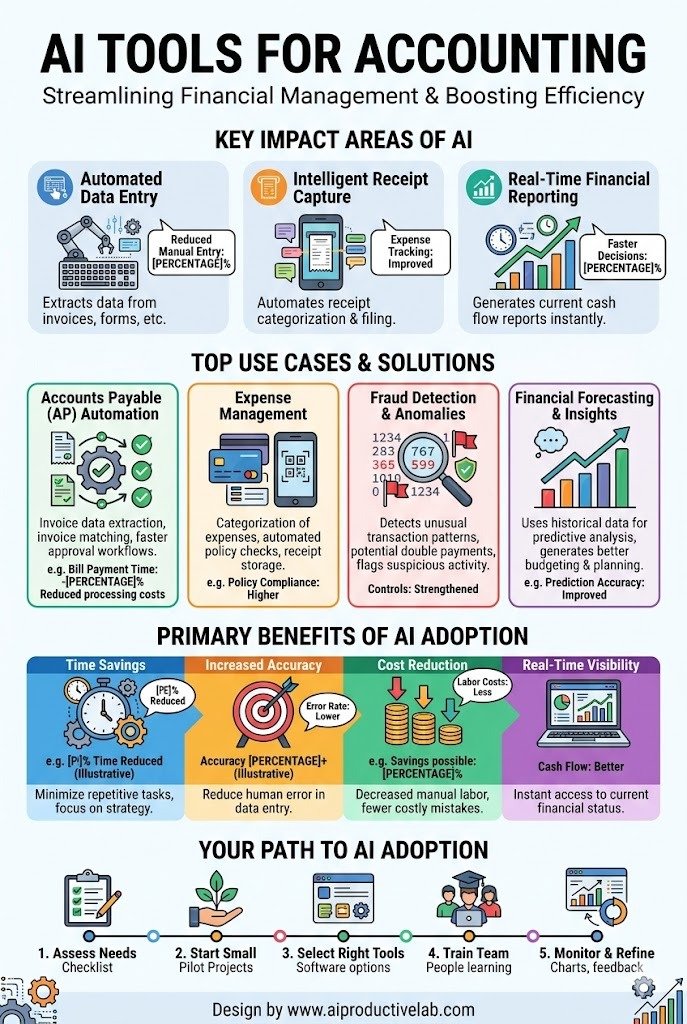
10 AI Tools for Accounting Worth Evaluating
1. Vic.ai
Vic.ai uses deep learning to automate invoice processing and accounts payable workflows. It learns from each transaction, improving accuracy continuously without manual rule creation.
- Best for: Mid-market and enterprise AP teams processing high invoice volumes
- Key feature: Autonomous invoice coding that learns from historical patterns
- Standout advantage: Achieves over 99 percent accuracy on invoice line-item coding after initial training
Vic.ai eliminates the most tedious part of accounts payable, manual data entry and coding, while giving controllers full visibility into every automated decision.
2. Dext (formerly Receipt Bank)
Dext captures, extracts, and categorizes financial documents using AI-powered recognition. It pulls data from receipts, invoices, and bank statements, then pushes clean entries into your accounting platform.
- Best for: Small businesses and accounting firms managing document-heavy client workflows
- Key feature: Multi-format document capture via mobile, email, and direct integrations
- Standout advantage: Connects natively with Xero, QuickBooks, and Sage for seamless data flow
Dext solves the first-mile problem in accounting, getting source documents into the system accurately without manual keying.
3. Botkeeper
Botkeeper combines AI with human oversight to deliver automated bookkeeping as a managed service. Its platform handles transaction categorization, reconciliation, and financial reporting while accountants review and approve the output.
- Best for: Accounting firms that want to scale bookkeeping capacity without hiring more staff
- Key feature: AI-assisted bookkeeping with a human-in-the-loop review layer
- Standout advantage: Enables firms to take on more clients without proportionally increasing headcount
Botkeeper is particularly valuable for growing firms where the bottleneck is bookkeeping volume, not client acquisition.
4. Blue Dot
Blue Dot focuses on AI-driven tax compliance and employee expense management. It automatically reviews transactions for tax implications, identifies deductible expenses, and flags compliance risks.
- Best for: Enterprises managing complex tax obligations across multiple jurisdictions
- Key feature: Real-time tax determination on employee spending and corporate transactions
- Standout advantage: Reduces tax leakage by identifying deductions and credits that manual review overlooks
Blue Dot fills a gap most general accounting tools ignore, proactive tax optimization embedded directly into the transaction flow.
5. Docyt
Docyt is an AI-powered accounting automation platform designed for small and mid-sized businesses. It handles bookkeeping, revenue reconciliation, and real-time financial reporting with minimal manual input.
- Best for: Multi-location businesses like restaurants, hotels, and franchises
- Key feature: Automated revenue reconciliation across POS systems, banks, and payment processors
- Standout advantage: Delivers real-time P&L statements instead of waiting for month-end close
Docyt is ideal for operators who need daily financial visibility but lack the accounting staff to produce it manually.
6. Trullion
Trullion uses AI to automate lease accounting, revenue recognition, and audit preparation. It reads contracts, extracts key terms, and maps them to the correct accounting standards automatically.
- Best for: Companies navigating complex standards like ASC 842 and ASC 606
- Key feature: AI-powered contract reading that extracts financial terms and populates accounting schedules
- Standout advantage: Turns weeks of lease and revenue accounting work into hours
Trullion targets one of accounting’s most painful compliance areas and automates it with precision that reduces restatement risk significantly.
7. Sage Intacct (with AI Features)
Sage Intacct is a cloud-based financial management platform that has embedded AI across its core modules. Its machine learning capabilities assist with transaction matching, anomaly detection, and cash flow forecasting.
- Best for: Mid-market companies and nonprofits needing robust cloud accounting with AI augmentation
- Key feature: Intelligent GL outlier detection that flags unusual journal entries during close
- Standout advantage: Combines mature, multi-entity accounting with modern AI-powered financial reporting
Sage Intacct appeals to finance teams that want AI benefits within a proven, auditor-friendly accounting system rather than bolting on separate tools.
8. Xero (with AI Capabilities)
Xero has steadily integrated AI into its cloud accounting platform. Features include automated bank reconciliation suggestions, smart invoicing, and predictive cash flow insights.
- Best for: Small businesses and sole practitioners wanting accessible AI built into everyday accounting
- Key feature: AI-suggested transaction matches that learn from user corrections over time
- Standout advantage: Massive app ecosystem with over 1,000 integrations extending AI capabilities further
Xero makes machine learning in accounting accessible to businesses that will never hire a data scientist but still benefit from smarter automation.
9. QuickBooks Online (with Intuit Assist)
QuickBooks Online now features Intuit Assist, a generative AI assistant embedded across the platform. It helps users categorize transactions, generate financial summaries, and get plain-language answers about their business finances.
- Best for: Small business owners and freelancers who manage their own books
- Key feature: Conversational AI that answers questions like “How did my expenses compare to last quarter?”
- Standout advantage: Turns complex accounting data into simple, actionable insights for non-accountants
QuickBooks with Intuit Assist makes AI-powered accounting genuinely accessible to business owners without any accounting background.
10. Tofu
Tofu is a newer AI bookkeeping platform built specifically for accounting firms handling international and multi-currency documents. It uses advanced OCR and language models to process documents in multiple languages and formats.
- Best for: Accounting firms with international clients or multilingual document workflows
- Key feature: AI extraction engine that handles documents in over 50 languages with high accuracy
- Standout advantage: Processes non-standard and international invoices that trip up other tools
Tofu fills a niche that most automated bookkeeping tools overlook, global document diversity, making it a strong choice for firms with cross-border clients.
How to Choose the Right AI Accounting Tool
The right platform depends on your firm’s size, client mix, and biggest operational bottleneck. This framework helps clarify the decision:
| Factor | What to Evaluate |
|---|---|
| Core Function | Do you need AP automation, bookkeeping, tax compliance, or financial reporting? |
| Integration | Does it connect with your existing accounting platform like Xero, QBO, or Sage? |
| Scalability | Can it handle your transaction volume today and as you grow? |
| Learning Curve | Can your team adopt it quickly without extensive training? |
| Accuracy | Does it offer confidence scores and human-review workflows for exceptions? |
| Pricing Model | Is it per-transaction, per-client, or flat subscription? |
Start by identifying your single most time-consuming manual process. Automate that first. Measure the time saved and error reduction. Then expand to adjacent workflows. This incremental approach delivers ROI faster and builds team confidence in the technology.
What Makes AI Accounting More Reliable Than Manual Processes?
Manual accounting depends on human consistency. Even skilled accountants make errors when processing hundreds of transactions under deadline pressure. Fatigue, distraction, and inconsistent coding decisions introduce risk into every close cycle.
AI accounting software applies the same logic to every transaction without variance. Once trained, it categorizes, matches, and reconciles with uniform precision. Anomaly detection models flag entries that deviate from established patterns, catching errors that manual review would likely miss.
The reliability advantage grows over time. Machine learning in accounting means each correction improves future accuracy. After several months of operation, well-configured AI tools process routine transactions with accuracy rates exceeding 95 percent. This frees accountants to focus their expertise on judgment calls, client advisory, and strategic planning rather than data entry.
FAQs
AI tools for accounting use machine learning and automation to handle tasks like bookkeeping, invoice processing, bank reconciliation, and financial reporting with minimal manual effort.
No. AI automates repetitive data tasks, but accountants remain essential for professional judgment, tax strategy, client advisory, and interpreting financial results in business context.
QuickBooks Online with Intuit Assist and Xero are top choices for small businesses. Both offer built-in AI features at accessible price points with minimal setup requirements.
Leading platforms like Vic.ai and Botkeeper achieve accuracy rates above 95% on routine transaction categorization. Accuracy improves continuously as the AI learns from corrections.
Yes. Reputable platforms use bank-level encryption, SOC 2 compliance, and role-based access controls. Always verify a vendor’s security certifications before sharing sensitive financial data.




 AI/ML Strategy and Consulting
 Data Science And Data Analytics
 Generative AI
 AI Consulting Services
 AI Automation Solutions
 API Integration


