
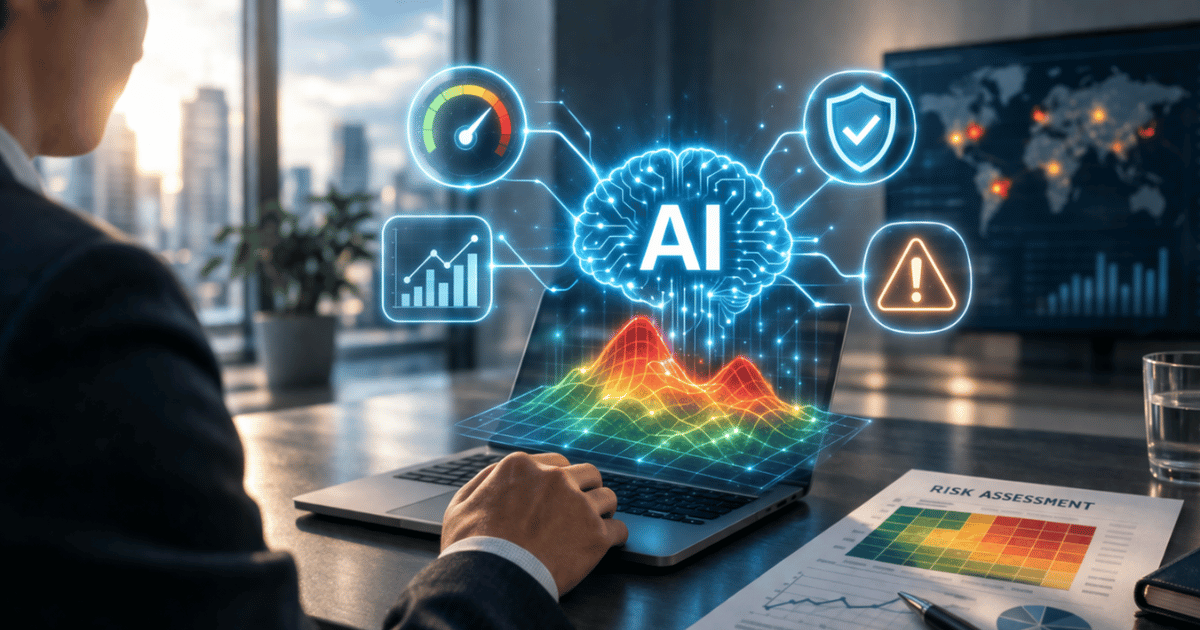
Business risks are multiplying in complexity and speed. Cyberattacks, regulatory changes, supply chain disruptions, market volatility, and geopolitical instability all demand attention simultaneously. Spreadsheets and quarterly risk reviews cannot keep pace with threats that evolve daily.
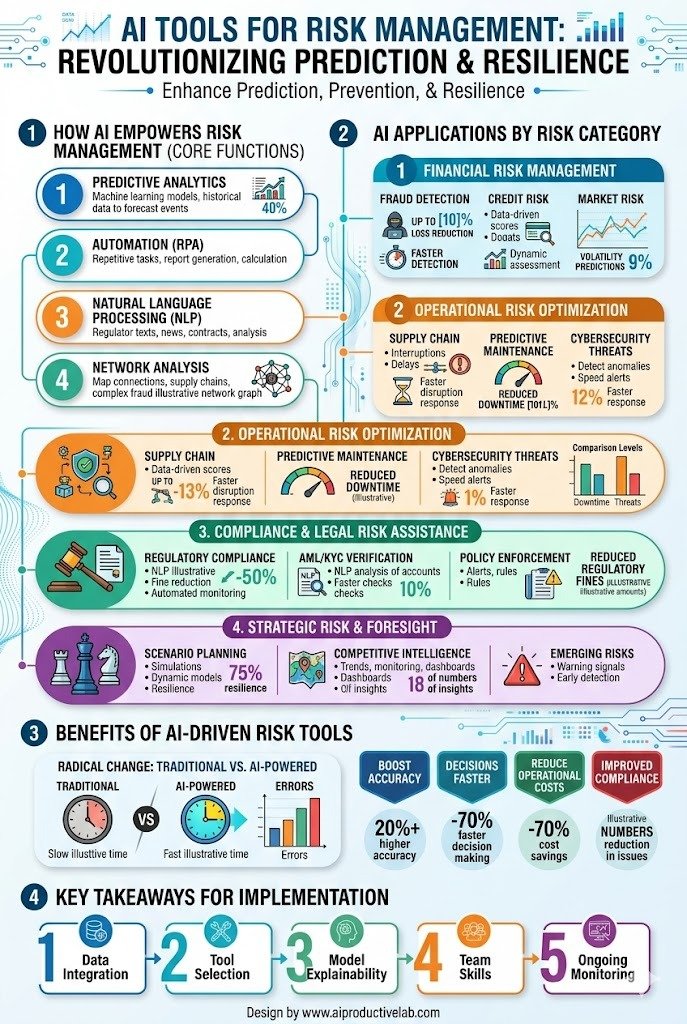
- Predictive modeling forecasts emerging risks using machine learning, quantifying probability and impact to prioritize responses.
- Continuous AI monitoring scans data streams in real time, surfacing anomalies and triggering immediate alerts for faster containment.
- Select platforms by core exposure, data quality, system integration, regulatory support, and realistic implementation and change management timelines.
- AI-driven scenario simulation and NLP turn risk management strategic, improving models over time and giving organizations a durable competitive edge.
Traditional risk management relies heavily on historical data and human judgment. Analysts review past incidents, build static models, and update risk registers manually. By the time a report reaches decision-makers, the risk landscape has already shifted.
AI tools for risk management transform this process fundamentally. They monitor data streams continuously, detect emerging threats in real time, and quantify risks with far greater precision than manual methods allow. Organizations using predictive risk analytics platforms identify problems weeks or months before they materialize.
The businesses that manage risk most effectively in 2026 are not the ones with the largest compliance teams. They are the ones deploying intelligent systems that never stop watching, learning, and adapting.
How AI Strengthens Risk Management Across the Organization
AI applies to risk management in several distinct ways. Understanding these categories helps clarify where automation delivers the greatest value.
Predictive modeling is the most transformative application. Machine learning algorithms analyze historical patterns alongside real-time signals to forecast where risks are most likely to emerge. These models quantify probability and potential impact, helping leaders prioritize resources toward the threats that matter most.
Continuous monitoring replaces periodic reviews. AI-powered risk assessment software scans internal operations, financial transactions, regulatory databases, news sources, and supply chain networks around the clock. It surfaces anomalies and escalates alerts the moment conditions change.
Scenario simulation allows teams to stress-test strategies before committing. Intelligent risk modeling solutions run thousands of simulated scenarios in minutes, revealing how different variables interact under extreme conditions. This capability turns risk management from a reactive function into a strategic planning advantage.
Natural language processing adds another dimension. AI reads contracts, regulations, audit reports, and news articles to extract risk-relevant information that human reviewers would take weeks to process manually.
10 AI Tools for Risk Management Worth Evaluating
1. Palantir AIP
Palantir’s Artificial Intelligence Platform integrates vast datasets across an organization and applies AI to identify operational, financial, and strategic risks. It connects structured databases with unstructured data sources to build comprehensive risk pictures.
Government agencies and Fortune 500 companies use Palantir to monitor supply chain vulnerabilities, geopolitical threats, and operational bottlenecks. The platform excels at revealing hidden connections between seemingly unrelated risk factors that siloed systems would never surface.
2. IBM OpenPages
IBM OpenPages is an enterprise risk management AI platform covering governance, risk, and compliance. It uses Watson AI to automate risk assessments, monitor regulatory changes, and streamline audit workflows across complex organizations.
The platform centralizes risk data from every business unit into a unified framework. It scores and prioritizes risks automatically, helping chief risk officers allocate attention where exposure is greatest. Financial institutions and heavily regulated industries rely on OpenPages for its depth and auditability.
3. SAS Risk Management
SAS delivers advanced predictive risk analytics platforms used by banks, insurers, and government agencies worldwide. Its machine learning models handle credit risk, market risk, operational risk, and regulatory capital calculations within a single integrated environment.
What distinguishes SAS is its analytical depth. The platform supports sophisticated modeling techniques while remaining accessible to risk analysts who are not data scientists. Pre-built industry models accelerate deployment, and custom models accommodate unique risk profiles.
4. Moody’s Analytics
Moody’s Analytics provides AI-driven credit risk, market risk, and climate risk assessment tools. Its platforms combine proprietary economic data with machine learning to forecast defaults, assess counterparty exposure, and model portfolio risk under various stress scenarios.
Banks and asset managers use Moody’s for AI credit risk management and regulatory stress testing. The platform’s economic scenario generators produce forward-looking projections that regulators expect to see in capital adequacy submissions.
5. Resolver
Resolver is an enterprise risk management AI platform that centralizes incident reporting, risk assessments, compliance tracking, and audit management. Its AI engine identifies trends across reported incidents and predicts where future risks are likely to concentrate.
The platform is especially strong for operational risk monitoring. It connects safety incidents, compliance violations, IT events, and third-party risks into a single view. Risk managers spot patterns that would remain invisible across disconnected departmental systems.
6. LogicGate Risk Cloud
LogicGate Risk Cloud is a no-code platform that lets organizations build custom risk management workflows powered by AI. It automates risk scoring, control testing, and compliance monitoring without requiring engineering resources.
The platform adapts to any risk framework including ISO 31000, COSO, and NIST. Teams configure workflows to match their specific processes rather than forcing operations into rigid software templates. This flexibility makes LogicGate popular across industries from financial services to healthcare.
7. Darktrace
Darktrace applies self-learning AI to cyber risk management. It monitors every device, user, and data flow within an organization’s network to detect threats that traditional security tools miss.
Cyber risk is now a board-level concern for every business. Darktrace identifies ransomware, insider threats, supply chain compromises, and zero-day attacks autonomously. It responds in real time, containing threats before they escalate into material incidents.
8. Quantexa
Quantexa uses AI-powered entity resolution and network analytics to detect financial crime and assess counterparty risk. It connects internal data with external sources to build relationship maps that reveal hidden risk exposures.
Banks, insurers, and government agencies use Quantexa to uncover money laundering networks, sanctioned entity connections, and supply chain risks. The platform turns fragmented data into actionable intelligence that risk teams can act on immediately.
9. Riskonnect
Riskonnect is an integrated risk management platform covering enterprise risk, compliance, claims, and insurance. Its AI capabilities automate risk identification, control effectiveness assessments, and loss trend analysis.
The platform serves risk managers who need a consolidated view across operational, financial, and insurable risks. It connects risk data with insurance program information, helping organizations understand their true cost of risk and optimize coverage decisions.
10. Climavision
Climavision applies AI to weather and climate risk assessment. Its proprietary radar network and machine learning models deliver hyper-local weather forecasts and long-range climate risk projections for businesses exposed to environmental threats.
Agriculture, energy, logistics, and insurance companies use Climavision to anticipate weather-driven disruptions. As climate volatility intensifies, the ability to predict and prepare for extreme weather events has become a critical risk management capability.
Comparison Table: Choosing the Right Risk Management Tool
| Tool | Core Function | Best For | Industry Focus |
|---|---|---|---|
| Palantir AIP | Data integration and risk intelligence | Strategic and operational risk | Cross-industry, government |
| IBM OpenPages | GRC automation | Enterprise governance | Financial services, regulated industries |
| SAS Risk Management | Predictive risk modeling | Credit, market, operational risk | Banking, insurance |
| Moody’s Analytics | Credit and economic risk | Portfolio and regulatory risk | Banking, asset management |
| Resolver | Incident and risk tracking | Operational risk management | Cross-industry |
| LogicGate Risk Cloud | Custom risk workflows | Flexible risk programs | Cross-industry |
| Darktrace | Cyber threat detection | IT and cyber risk | Cross-industry |
| Quantexa | Network and entity analytics | Financial crime and counterparty risk | Banking, insurance, government |
| Riskonnect | Integrated risk and insurance | Total cost of risk | Insurance, enterprise |
| Climavision | Weather and climate risk | Environmental exposure | Agriculture, energy, logistics |
How to Select the Right AI Risk Management Platform
Choosing among AI tools for risk management starts with mapping your organization’s most significant risk exposures. A bank focused on credit losses needs different capabilities than a logistics company managing supply chain disruptions.
Define your primary risk categories clearly. Financial risks, operational risks, cyber risks, compliance risks, and environmental risks each require specialized analytical approaches. Some platforms cover multiple categories while others excel in a single domain. Match the tool’s strength to your highest-priority exposure.
Assess your data infrastructure honestly. AI-powered risk assessment software delivers results proportional to the quality and breadth of data it receives. If your risk data lives in disconnected spreadsheets and email chains, consider platforms like Resolver or LogicGate that centralize data collection as part of their core functionality.
Integration with existing systems determines long-term success. The best intelligent risk modeling solutions connect to your ERP, financial systems, HR platforms, and operational databases. Isolated risk tools that require manual data feeds quickly become outdated and unreliable.
Regulatory requirements should influence your decision significantly. Industries like banking and insurance face specific model governance expectations. Platforms like SAS and IBM OpenPages include built-in audit trails and model documentation that regulators demand during examinations.
Budget realistically for implementation and training. Enterprise platforms typically require three to six months for full deployment. Factor in change management costs because risk management is ultimately a human discipline that AI enhances rather than replaces.
The Strategic Value of AI-Driven Risk Management
Organizations using predictive risk analytics platforms gain more than operational efficiency. They gain strategic clarity. When risk teams can quantify threats and model scenarios dynamically, leadership makes better decisions about capital allocation, market expansion, and operational investments.
Risk management shifts from a cost center to a competitive advantage. Companies that anticipate disruptions adjust faster than those caught off guard. They secure better insurance terms because they demonstrate stronger risk controls. They earn greater trust from investors, regulators, and customers.
The compounding benefit of AI in risk management mirrors what happens in fraud detection and financial forecasting. Models improve as they process more data. Risk assessments become more precise each quarter. The gap between AI-enabled organizations and those relying on manual processes widens steadily, creating a durable strategic edge.
FAQs
They are software platforms that use machine learning and data analytics to identify, assess, monitor, and predict business risks in real time across financial, operational, cyber, and compliance domains.
AI processes vastly more data, detects patterns humans miss, updates risk scores continuously, and models thousands of scenarios instantly, delivering faster and more accurate risk evaluations.
Banking, insurance, energy, healthcare, and logistics see the strongest returns due to high regulatory demands, complex operations, and significant financial exposure to unpredictable events.
Yes. Platforms like LogicGate and Resolver offer scalable pricing and configurable workflows that suit mid-sized businesses without requiring enterprise-level budgets or dedicated risk teams.
Most platforms require two to six months for full deployment, depending on data complexity and integration requirements. Cloud-based tools with pre-built frameworks deploy faster than custom enterprise solutions.




 AI/ML Strategy and Consulting
 Data Science And Data Analytics
 Generative AI
 AI Consulting Services
 AI Automation Solutions
 API Integration