


Running an online store has never been more competitive. Customer expectations keep rising. Margins stay tight. And managing everything from product listings to customer support demands constant attention.
- AI automates content, personalization, inventory forecasting, and customer support to boost conversions and reduce operating costs.
- Prioritize your biggest bottleneck, confirm platform compatibility, choose tools with easy adoption, and measure ROI before scaling your AI stack.
- Personalization and chatbots deliver quick wins; demand forecasting and content automation drive long-term efficiency and better margins.
AI tools for eCommerce now handle the heavy lifting across marketing, personalization, inventory, and customer service. They help store owners sell more while spending less time on repetitive tasks. This guide covers 15 platforms that are delivering real results for online businesses.
Why eCommerce Businesses Need AI Right Now
Online retail is evolving fast. Shoppers expect personalized experiences, instant support, and seamless checkout flows. Meeting those expectations manually is nearly impossible at scale.
AI automates the processes that consume the most time and resources. It writes product descriptions, predicts demand, personalizes recommendations, and resolves support tickets without human input. Store owners using these tools report higher conversion rates and lower operating costs.
The competitive advantage is clear. Brands that adopt AI tools for online selling move faster, test more ideas, and respond to market shifts in real time. Those that wait risk falling behind stores that already operate smarter.
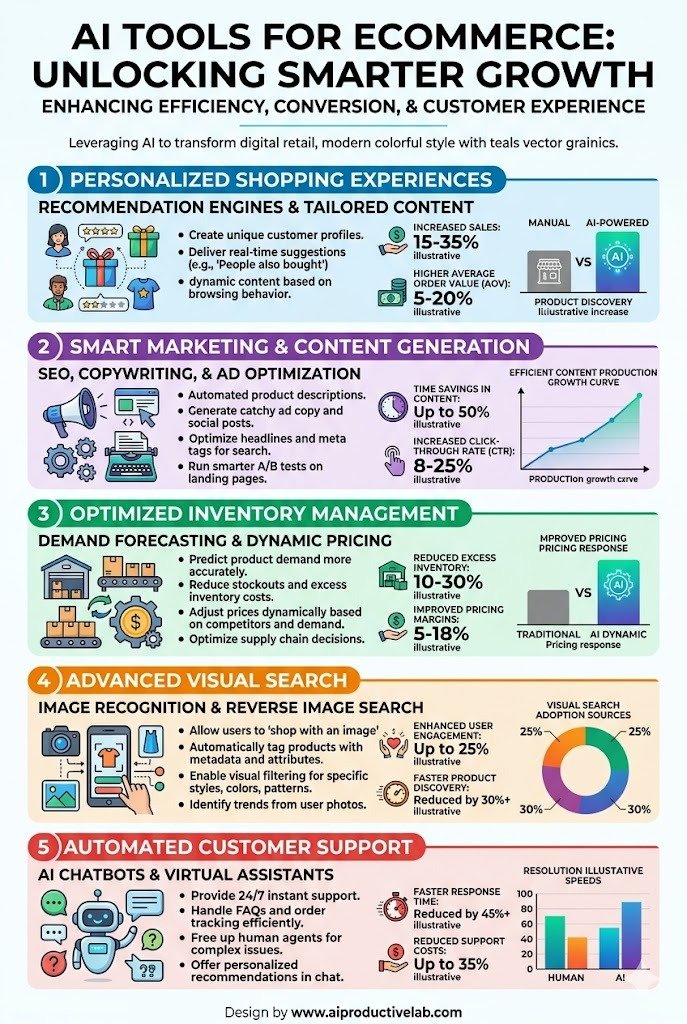
How AI Improves Key eCommerce Functions
AI impacts nearly every part of an online store’s operations. Understanding these categories helps you prioritize the right tools.
Personalized Shopping Experiences
AI analyzes browsing behavior, purchase history, and preferences to recommend the right products to each visitor. Personalized recommendations increase average order values and keep customers coming back. This is one of the highest-impact uses of artificial intelligence in online retail.
Automated Content and Product Listings
Creating product descriptions, ad copy, and email campaigns takes hours. AI content generation tools produce high-quality copy in seconds. Store owners scale their catalogs faster without hiring additional writers.
Smarter Inventory and Demand Forecasting
AI predicts which products will sell and when demand will spike. This reduces overstock situations and prevents stockouts during peak periods. Better forecasting directly improves cash flow and warehouse efficiency.
Customer Support Automation
AI chatbots handle common customer questions around the clock. They process returns, track orders, and resolve issues without human agents. This cuts support costs while improving response times significantly.
15 AI Tools for eCommerce Worth Exploring
Here are the platforms making a measurable difference for online stores across different business sizes and categories.
1. Shopify Magic — Built-In AI for Shopify Stores
Shopify Magic brings AI directly into the Shopify platform. It generates product descriptions, suggests email subject lines, and creates store content based on simple prompts. Merchants access these features without installing third-party apps.
The tool learns from your store’s tone and category to produce relevant copy. It saves hours of writing time, especially for stores with large product catalogs.
2. ConversionBox — AI Shopping Assistant for Higher Conversions
ConversionBox acts as an intelligent shopping assistant embedded on your storefront. It guides visitors through product discovery using conversational AI. Shoppers describe what they need, and the tool recommends the best options from your catalog.
The platform is purpose-built for eCommerce and integrates with major platforms. Stores using ConversionBox report noticeable lifts in conversion rates and average order values.
3. Jasper — AI Content Generation for Marketing Teams
Jasper creates marketing copy, blog posts, ad creatives, and social media content at scale. eCommerce teams use it to produce product descriptions, landing page copy, and email campaigns without bottlenecks.
The platform offers brand voice customization and templates designed for retail. Marketing teams produce more content in less time while maintaining a consistent tone across channels.
4. Klaviyo — AI-Powered Email and SMS Marketing
Klaviyo uses AI to segment audiences, predict customer behavior, and optimize send times for email and SMS campaigns. It identifies which customers are most likely to purchase, churn, or respond to a specific offer.
The platform integrates deeply with Shopify, WooCommerce, and other eCommerce systems. Merchants use Klaviyo’s predictive analytics to drive repeat purchases and increase customer lifetime value.
5. Tidio — AI Chatbot for eCommerce Customer Support
Tidio provides AI-powered chatbots that handle customer inquiries on your website in real time. It answers product questions, processes order updates, and manages returns automatically. The chatbot learns from past interactions to improve over time.
Small and mid-size stores benefit from Tidio’s quick setup and affordable pricing. It reduces the need for a large support team while keeping response times under a minute.
6. Nosto — AI-Driven Product Personalization
Nosto personalizes the entire shopping experience using behavioral data and machine learning. It delivers tailored product recommendations, dynamic bundles, and personalized content across web, email, and mobile touchpoints.
The platform serves mid-market and enterprise retailers who need sophisticated personalization without complex development work. Nosto’s real-time engine adapts to each visitor as they browse.
7. Prisync — AI-Powered Competitive Pricing
Prisync monitors competitor prices and market trends automatically. Its AI engine recommends optimal pricing strategies based on competitor movements, demand patterns, and your margin targets.
eCommerce businesses in competitive categories use Prisync to stay price-competitive without constantly checking rival stores manually. The platform supports dynamic pricing rules that adjust automatically.
8. Patterned AI — AI Product Design for Print and Fashion
Patterned AI generates unique surface patterns and textile designs using artificial intelligence. Fashion and home decor brands use it to create original prints without hiring graphic designers for every variation.
The tool accelerates product development cycles significantly. Brands launch new designs faster and test more variations with lower upfront costs.
9. Surfer SEO — AI-Optimized Content for eCommerce Sites
Surfer SEO helps online stores create search-optimized content for product pages, category pages, and blog posts. Its AI analyzes top-ranking pages and provides real-time recommendations for structure, keywords, and content length.
eCommerce brands use Surfer to improve organic search visibility and drive free traffic. The platform integrates with content editors like Google Docs and Jasper for a seamless workflow.
10. Gorgias — AI-Enhanced Helpdesk for Online Stores
Gorgias centralizes customer support across email, chat, social media, and SMS into one platform. Its AI features auto-tag tickets, suggest responses, and resolve common issues without agent intervention.
The platform is built specifically for eCommerce and pulls order data directly into support conversations. Agents resolve tickets faster because they see the full customer context immediately.
11. Inventory Planner — AI Demand Forecasting for Retail
Inventory Planner uses AI to forecast demand and generate purchase orders automatically. It analyzes sales velocity, seasonality, and lead times to recommend exactly how much stock to order and when.
The tool prevents overstocking and stockouts, both of which erode margins. Retailers using Inventory Planner report healthier inventory turnover rates and reduced carrying costs.
12. Photoroom — AI Product Photography and Editing
Photoroom removes backgrounds, enhances product images, and creates studio-quality photos using AI. Sellers produce professional listings without expensive photography equipment or studio sessions.
The platform is popular among marketplace sellers and direct-to-consumer brands. Clean, consistent product images directly improve click-through rates and buyer confidence.
13. Octane AI — AI-Powered Quizzes for Product Discovery
Octane AI builds interactive product recommendation quizzes powered by artificial intelligence. Shoppers answer a few questions, and the tool suggests personalized product matches based on their responses.
These quizzes capture zero-party data while increasing engagement and conversion rates. Brands in beauty, wellness, and apparel see especially strong results with this approach.
14. Recharge — AI-Optimized Subscription Management
Recharge manages subscription programs for eCommerce brands using AI-driven retention tools. It predicts churn risk, optimizes billing cycles, and personalizes subscription offers to keep customers active longer.
The platform supports major eCommerce systems and handles complex subscription models. Brands using Recharge build more predictable recurring revenue streams with lower cancellation rates.
15. ViSenze — AI Visual Search for Product Discovery
ViSenze enables visual search on eCommerce sites. Shoppers upload an image or screenshot, and the AI finds matching or similar products in your catalog instantly. This removes the friction of text-based search for visually driven categories.
Fashion, furniture, and home decor brands use ViSenze to improve product discovery. Visual search captures purchase intent that traditional keyword search often misses.
Comparing the Top AI eCommerce Tools
Use this table to identify which platforms align with your store’s priorities.
| Tool | Core Function | Best For | Platform Support |
|---|---|---|---|
| Shopify Magic | Content generation | Shopify merchants | Shopify native |
| ConversionBox | Shopping assistant | Conversion optimization | Multi-platform |
| Jasper | Marketing copy | Content-heavy brands | Standalone |
| Klaviyo | Email and SMS marketing | Retention-focused stores | Shopify, WooCommerce |
| Tidio | Customer support chatbot | Small to mid-size stores | Multi-platform |
| Nosto | Product personalization | Mid-market retailers | Multi-platform |
| Prisync | Competitive pricing | Price-sensitive categories | Standalone |
| Patterned AI | Product design | Fashion and decor brands | Standalone |
| Surfer SEO | SEO content optimization | Organic traffic growth | Standalone |
| Gorgias | Helpdesk automation | High-volume support teams | Shopify, BigCommerce |
| Inventory Planner | Demand forecasting | Inventory management | Shopify, multi-platform |
| Photoroom | Product photo editing | Marketplace sellers | Standalone, mobile |
| Octane AI | Product quizzes | DTC brands | Shopify |
| Recharge | Subscription management | Subscription brands | Shopify, BigCommerce |
| ViSenze | Visual search | Visually driven catalogs | Multi-platform |
How to Pick the Right AI Tools for Your Online Store
Every store has different priorities. Follow these guidelines to choose wisely.
- Start with your biggest bottleneck: Identify the task consuming the most time or causing the most lost revenue. Choose an AI tool that addresses that specific problem first before expanding.
- Check platform compatibility: Confirm the tool integrates with your eCommerce platform, whether that is Shopify, WooCommerce, BigCommerce, or a custom build. Poor integration creates more friction than it removes.
- Evaluate ease of adoption: Tools that require weeks of setup or heavy developer involvement slow you down. Prioritize platforms with intuitive interfaces and strong onboarding support.
- Measure ROI early: Set clear benchmarks before implementation. Track conversion rates, time savings, support ticket volume, or revenue lift to confirm the tool delivers real business value.
- Scale gradually: Start with one or two tools. Prove their impact before adding more to your technology stack. Overloading on AI tools without a clear strategy wastes budget.
What Results Can eCommerce Brands Expect from AI?
Brands using AI tools consistently see measurable performance improvements. Personalization engines like Nosto and Octane AI lift conversion rates by 10% to 30% in many cases. AI chatbots from Tidio and Gorgias cut average support response times to under 60 seconds.
Demand forecasting from Inventory Planner reduces excess stock by helping merchants order precisely what they need. Content tools like Jasper and Shopify Magic cut product listing creation time from hours to minutes. These gains compound as stores scale.
The brands seeing the strongest returns treat AI as a strategic advantage, not just a convenience. They choose tools deliberately, measure outcomes consistently, and reinvest savings into growth.
FAQs
Top platforms include Shopify Magic, Klaviyo, Jasper, Nosto, and Gorgias. The best choice depends on whether your priority is marketing, support, personalization, or operations.
They personalize product recommendations, automate marketing campaigns, optimize pricing, and improve the shopping experience. These actions drive higher conversion rates and repeat purchases.
Yes. Many platforms like Tidio, Photoroom, and Shopify Magic offer free tiers or affordable starter plans. Small stores can adopt AI incrementally without large upfront investments.
Most leading platforms integrate directly with Shopify, WooCommerce, and BigCommerce. Always verify compatibility with your specific platform version before purchasing.
Most stores notice improvements within two to four weeks of implementation. Tools focused on personalization and marketing automation typically show the fastest measurable impact on revenue.



 AI/ML Strategy and Consulting
 Data Science And Data Analytics
 Generative AI
 AI Consulting Services
 AI Automation Solutions
 API Integration


