

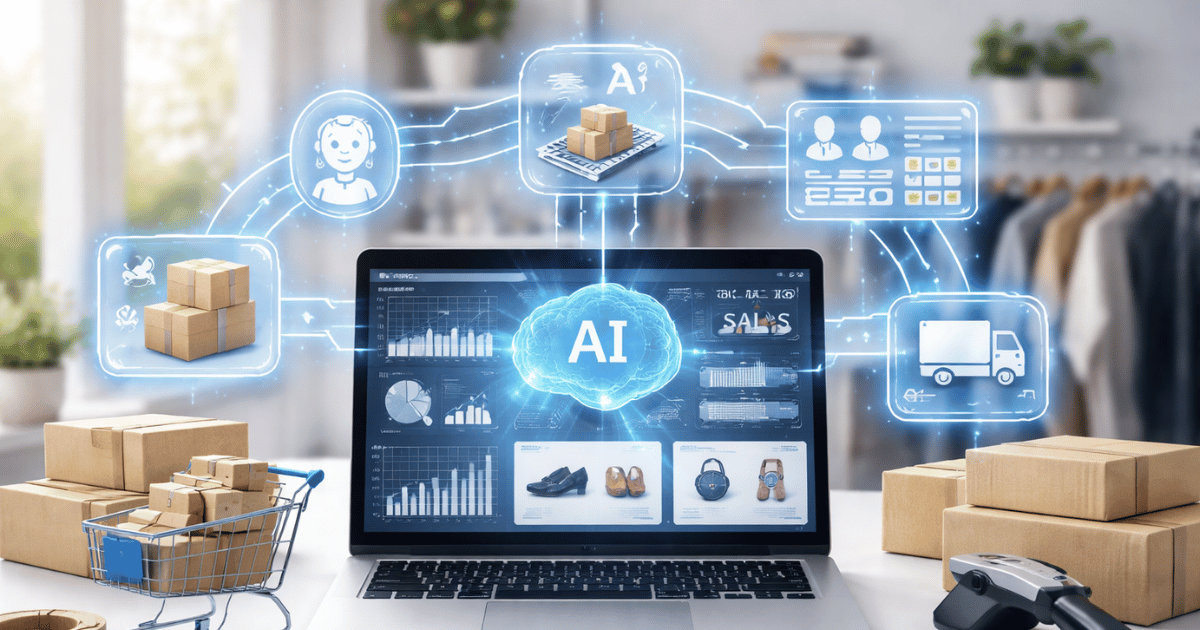
Running an online store in 2026 means juggling dozens of tasks simultaneously. From inventory updates to personalized marketing, the workload never stops growing. Manual processes slow teams down and leave money on the table.
- Pick AI tools that integrate with your tech stack, use machine learning to adapt, and provide transparent recommendations.
- Focus on personalization, predictive marketing, and automated support to raise conversions, retention, and operational efficiency.
- Deploy one or two high-impact tools first, measure results over 30 to 90 days, then expand while ensuring integrations.
That is exactly why AI tools for eCommerce automation have become essential. These platforms handle repetitive work, analyze customer behavior, and make real-time decisions faster than any human team could. The result is lower costs, higher conversions, and more time to focus on strategy.
According to recent industry data, businesses using AI-driven automation see revenue uplifts of 10 to 30 percent. Customer retention improves significantly when personalization engines deliver relevant experiences at every touchpoint.
What Makes a Great AI eCommerce Tool?
Not every tool labeled “AI-powered” delivers real value. Before diving into the list, here is what separates genuinely useful platforms from overhyped solutions.
A strong AI eCommerce tool should offer seamless integration with your existing tech stack. It should connect easily with your CRM, ERP, or eCommerce platform without requiring a full rebuild. API support and native connectors are non-negotiable.
It must also learn and adapt over time. Static rule-based automation is not true AI. Look for tools that use machine learning models to improve recommendations, predictions, and decisions as they process more data.
Finally, transparency matters. You should understand why the tool makes specific suggestions. Black-box systems erode trust with both your team and your customers.
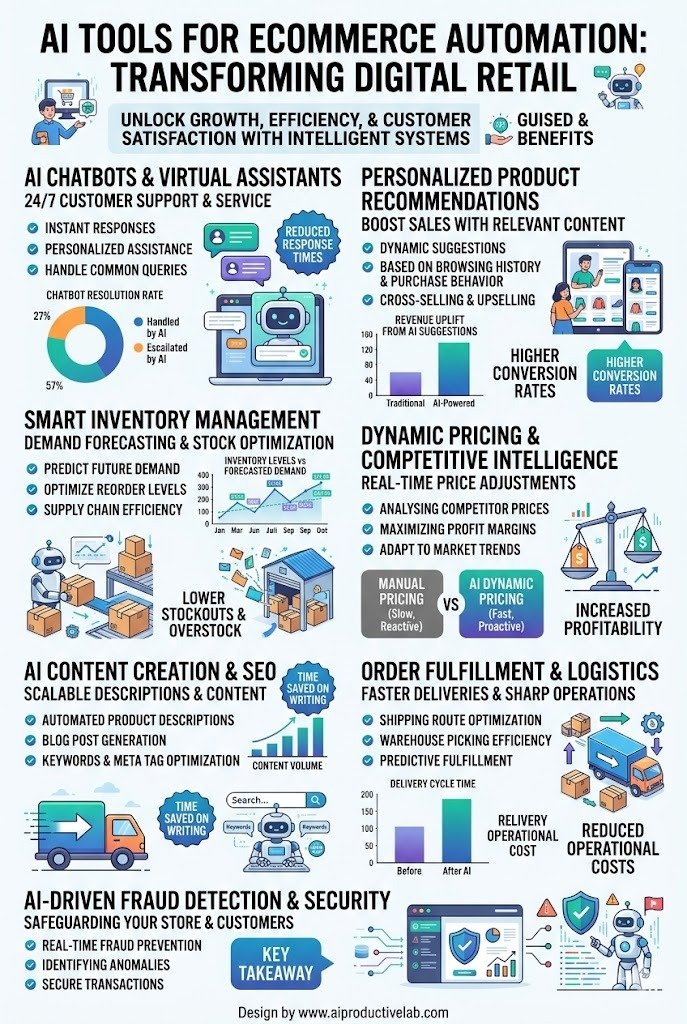
10 AI Tools for eCommerce Automation Worth Your Investment
1. Shopify Magic
Shopify Magic brings generative AI directly into the Shopify ecosystem. It writes product descriptions, suggests email subject lines, and generates FAQ responses automatically. Store owners save hours every week on content creation alone.
The tool learns your brand voice over time. It also helps optimize product listings for search visibility. For Shopify merchants, this is the most frictionless entry point into eCommerce automation software.
2. Klaviyo
Klaviyo is a marketing automation platform built specifically for eCommerce. Its AI engine segments audiences, predicts customer lifetime value, and triggers personalized email and SMS flows based on real-time behavior.
What sets Klaviyo apart is its predictive analytics suite. It forecasts next purchase dates, churn risk, and spending potential. This lets you allocate marketing budgets toward the customers most likely to convert.
3. Nosto
Nosto specializes in AI product recommendations and on-site personalization. It analyzes browsing patterns, purchase history, and real-time intent signals to display the most relevant products to each visitor.
Retailers using Nosto frequently report increases in average order value. The platform integrates with major eCommerce systems including Shopify, Magento, and BigCommerce. Setup is straightforward, and results typically appear within weeks.
4. Tidio
Tidio combines live chat with AI-powered chatbots to automate customer support. Its Lyro AI assistant handles up to 70 percent of routine inquiries without human intervention. It answers product questions, tracks orders, and processes simple returns.
For small to mid-sized stores, Tidio dramatically reduces support costs. It also captures leads and recommends products during conversations, turning support interactions into revenue opportunities.
5. Jasper
Jasper is a generative AI platform focused on marketing content. It produces blog posts, ad copy, social media captions, and landing page text tailored to eCommerce brands. You can train it on your brand guidelines for consistent messaging.
Content marketing drives organic traffic, and Jasper accelerates production without sacrificing quality. It supports over 30 languages, making it ideal for stores selling internationally.
6. Inventory Planner
Inventory Planner uses machine learning to forecast demand and automate restocking decisions. It analyzes sales velocity, seasonality, supplier lead times, and promotional calendars to generate accurate purchase orders.
Overstocking and stockouts are profit killers. This tool minimizes both by predicting exactly how much inventory you need and when. It integrates natively with Shopify, Amazon, and several wholesale platforms.
7. Prisync
Prisync is a competitive pricing intelligence tool powered by AI. It monitors competitor prices across the web and recommends optimal pricing strategies in real time. Dynamic pricing helps you stay competitive without constantly checking rival stores manually.
The platform supports rule-based and AI-driven repricing. You set the boundaries, and Prisync adjusts prices to maximize margins while maintaining market position. It is especially valuable in crowded product categories.
8. Octane AI
Octane AI builds interactive quizzes and conversational pop-ups that guide shoppers toward the right products. Its recommendation engine uses customer responses to deliver hyper-personalized suggestions. This approach works exceptionally well for brands with large catalogs.
Quiz-based shopping experiences increase engagement and reduce decision fatigue. Octane AI integrates with Klaviyo and Shopify, creating a connected ecosystem where quiz data feeds directly into your marketing automation workflows.
9. Gorgias
Gorgias is a helpdesk platform designed for eCommerce that uses AI to automate ticket routing, response drafting, and sentiment analysis. It centralizes support from email, chat, social media, and SMS into a single dashboard.
Its machine learning models prioritize urgent tickets and suggest accurate responses based on previous interactions. Support teams handle higher volumes without adding headcount. Revenue-generating tickets get flagged automatically so agents can focus on high-value conversations.
10. ViSenze
ViSenze powers visual search and smart product discovery using computer vision. Shoppers upload an image or screenshot, and the tool instantly finds matching or similar products in your catalog. This removes the friction of text-based search when customers cannot describe what they want.
Visual search is growing rapidly in fashion, home decor, and lifestyle categories. ViSenze integrates via API and supports both web and mobile experiences, making product discovery intuitive and fast.
Quick Comparison: Which Tool Fits Your Needs?
| Tool | Primary Function | Best For | Integration |
|---|---|---|---|
| Shopify Magic | Content generation | Shopify merchants | Native |
| Klaviyo | Email and SMS marketing | Retention-focused brands | Shopify, BigCommerce, WooCommerce |
| Nosto | Product recommendations | Personalization at scale | Shopify, Magento, BigCommerce |
| Tidio | Customer support chatbots | Small to mid-sized stores | Shopify, WordPress, Wix |
| Jasper | Marketing content creation | Content-driven brands | Standalone, API |
| Inventory Planner | Demand forecasting | Inventory-heavy businesses | Shopify, Amazon |
| Prisync | Competitive pricing | Price-sensitive markets | Standalone, API |
| Octane AI | Quiz-based recommendations | Large catalog brands | Shopify, Klaviyo |
| Gorgias | Helpdesk automation | High-volume support teams | Shopify, Magento |
| ViSenze | Visual search | Fashion, lifestyle, decor | API-based |
How to Choose the Right AI Automation Tools
Selecting the best automated eCommerce solutions depends on your store’s specific pain points. Start by identifying the tasks consuming the most time or causing the most revenue leakage.
If customer acquisition is your challenge, prioritize Klaviyo and Jasper. If support costs are eating into margins, Tidio or Gorgias will deliver the fastest return. Stores struggling with inventory management should look at Inventory Planner first.
Avoid the temptation to adopt every tool at once. Layer them strategically. Begin with one or two platforms that address your most urgent needs. Measure results over 60 to 90 days before expanding your stack.
Integration compatibility also matters significantly. Ensure each tool connects smoothly with your eCommerce platform and existing systems. Fragmented data across disconnected tools creates more problems than it solves.
Real Results: What AI Automation Delivers
Businesses that implement smart inventory management tools and personalization engines consistently outperform those relying on manual processes. Here is what the data shows across industries.
Stores using AI product recommendations see conversion rate improvements of 15 to 25 percent. Automated email flows through platforms like Klaviyo generate up to 30 percent of total eCommerce revenue for mature brands. Chatbot automation reduces average support response times from hours to seconds.
These are not theoretical projections. They reflect outcomes reported by merchants who committed to integrating machine learning for eCommerce into daily operations. The compounding effect of multiple AI tools working together amplifies each individual gain.
FAQs
They are software platforms that use artificial intelligence to automate tasks like marketing, inventory management, customer support, and product recommendations for online stores.
Pricing varies widely. Some tools like Shopify Magic are included in existing subscriptions, while platforms like Klaviyo or Gorgias charge based on usage volume or contact list size.
Absolutely. Tools like Tidio and Octane AI are designed for smaller stores and offer affordable plans that deliver immediate time savings and revenue improvements.
No. They handle repetitive and data-heavy tasks so your team can focus on strategy, creative work, and building customer relationships that require a human touch.
Most stores see measurable improvements within 30 to 90 days. Tools focused on personalization and marketing automation tend to show results fastest when configured properly.




 AI/ML Strategy and Consulting
 Data Science And Data Analytics
 Generative AI
 AI Consulting Services
 AI Automation Solutions
 API Integration


