


Healthcare systems worldwide face the same pressure. Rising patient volumes, staff shortages, administrative overload, and the constant demand for faster, more accurate care. Manual workflows cannot scale to meet these challenges.
- AI augments clinicians by automating diagnostics and documentation, improving accuracy and freeing time for higher value patient care.
- Medical imaging and pathology AI accelerate critical diagnoses, flagging urgent cases for faster specialist intervention and improved outcomes.
- Predictive analytics and operational AI optimize patient flow, reduce wait times, and prevent capacity bottlenecks.
- Choose platforms that integrate with EHRs, meet HIPAA standards, offer pilots, and demonstrate measurable ROI before wide deployment.
AI tools for healthcare are filling that gap. They assist clinicians with diagnostics, automate documentation, predict patient deterioration, and streamline hospital operations. These platforms do not replace doctors — they give them superpowers.
This guide covers ten platforms making a real difference across hospitals, clinics, and telehealth operations. Each tool addresses a specific challenge in modern healthcare delivery, from reading medical images to managing patient intake calls.
Why Healthcare Organizations Are Adopting AI
The healthcare industry generates more data per patient encounter than ever before. Lab results, imaging scans, clinical notes, insurance claims, and wearable device readings all pile up. Most of it goes underutilized because clinicians simply lack the time to process it all.
AI in medical diagnosis and operations changes that dynamic. Machine learning models identify patterns in data that human eyes might miss during a busy shift. They flag early signs of sepsis, detect tumors in radiology scans, and transcribe entire patient visits in real time.
The financial incentive is strong too. Hospitals using healthcare automation software report reduced administrative costs, shorter patient wait times, and fewer documentation errors. These savings free up resources that flow directly back into patient care.
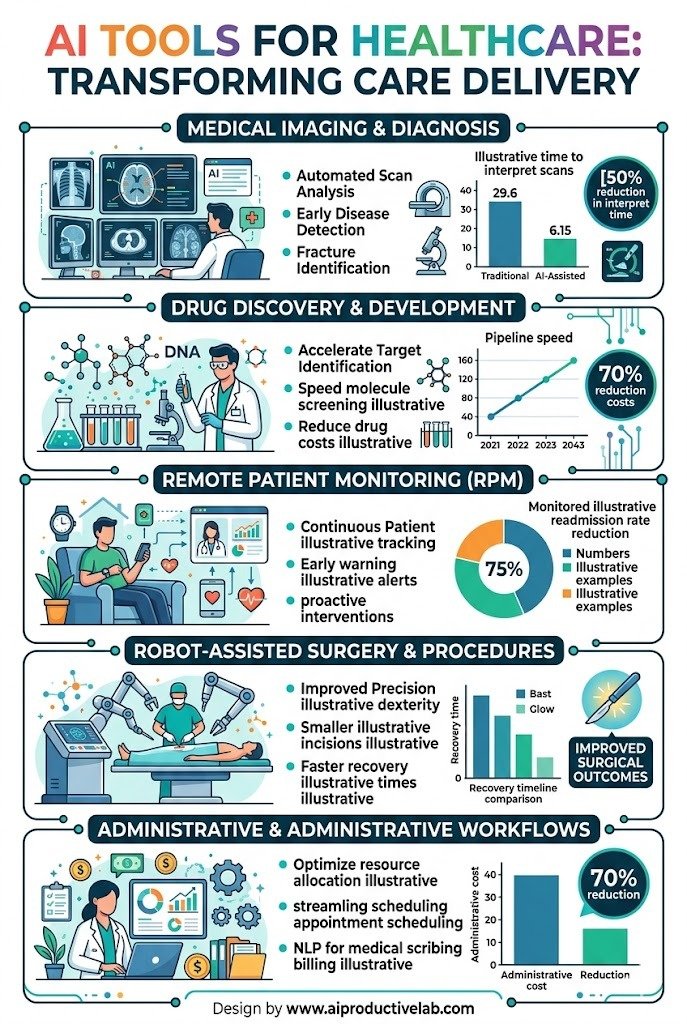
How AI Is Reshaping Core Healthcare Functions
AI touches nearly every department in a modern health system. Understanding where it delivers the most value helps you evaluate which tools deserve attention first.
- Medical imaging analysis — AI reads X-rays, MRIs, and CT scans to detect abnormalities faster and flag urgent cases for radiologists.
- Clinical documentation — Ambient AI listens to patient-physician conversations and generates structured clinical notes automatically.
- Predictive analytics — Machine learning identifies patients at high risk for readmission, sepsis, or rapid deterioration.
- Virtual health assistants — AI chatbots handle appointment scheduling, symptom triage, and patient follow-ups around the clock.
- Drug discovery — AI models simulate molecular interactions to accelerate the identification of promising drug candidates.
- Revenue cycle management — Automation tools reduce claim denials by catching coding errors before submission.
Each of these functions benefits from AI’s ability to process large data sets quickly and consistently without fatigue.
10 AI Tools for Healthcare Worth Exploring
1. Suki AI — Voice-Powered Clinical Documentation
Suki AI acts as a voice assistant for physicians. It listens during patient encounters and generates clinical notes directly inside the electronic health record system. Doctors speak naturally, and Suki translates the conversation into structured documentation.
The platform learns each physician’s preferences and specialty-specific terminology over time. It integrates with major EHR systems including Epic and Cerner. Suki reduces documentation time significantly, giving clinicians more face time with patients.
Best for: Physicians and specialists overwhelmed by after-hours charting and EHR documentation burden.
2. DeepScribe — Ambient AI for Medical Notes
DeepScribe captures the full patient-provider conversation using ambient listening technology. Its AI engine then produces accurate, context-aware clinical notes without the physician typing or dictating a single word.
The platform focuses on understanding medical context, not just transcribing speech. DeepScribe handles complex specialties like cardiology, orthopedics, and gastroenterology. It submits notes for physician review within minutes of the visit ending.
Best for: Multi-specialty clinics that need fast, accurate AI for clinical documentation across diverse practice areas.
3. Viz.ai — AI-Powered Medical Imaging Triage
Viz.ai analyzes medical imaging scans using deep learning algorithms to detect time-sensitive conditions like strokes, pulmonary embolisms, and aortic emergencies. When it identifies a critical finding, it alerts the specialist team immediately.
This speed matters enormously in emergency care. Minutes saved in stroke detection directly improve patient outcomes. Viz.ai integrates with hospital PACS systems and operates across hundreds of health systems in the United States.
Best for: Hospitals and emergency departments that need medical imaging AI to accelerate critical diagnosis and specialist notification.
4. Tempus — Precision Medicine Through Data Intelligence
Tempus builds AI-driven platforms that help oncologists and researchers match patients with the most effective treatments. It analyzes clinical and molecular data to identify patterns that guide personalized therapy decisions.
The platform maintains one of the largest libraries of clinical and molecular data in the world. Tempus partners with major academic medical centers and pharmaceutical companies. Its genomic sequencing and AI analysis tools support cancer care, cardiology, and neuropsychiatry.
Best for: Oncology practices and research institutions pursuing precision medicine with data-driven treatment recommendations.
5. Nuance DAX Copilot — Microsoft-Backed Clinical AI
Nuance DAX Copilot, powered by Microsoft, automates clinical documentation using ambient AI technology. It captures multi-party conversations during patient visits and generates draft notes inside the EHR for physician review.
DAX Copilot integrates natively with Epic, Oracle Health, and other major EHR platforms. It also assists with order entry, referral letter drafting, and patient instruction summaries. The Microsoft backing ensures enterprise-grade security and compliance.
Best for: Large health systems seeking a scalable, enterprise-ready AI-powered patient care documentation platform.
6. PathAI — AI for Pathology and Diagnostics
PathAI applies machine learning to pathology slides, helping pathologists detect cancer and other diseases with greater accuracy and consistency. Its algorithms analyze tissue samples at a cellular level and highlight areas of concern.
The platform supports both clinical diagnostics and pharmaceutical research. PathAI partners with biopharma companies to improve drug development through better biomarker identification. Pathology labs use it to reduce diagnostic variability and turnaround times.
Best for: Pathology labs and research organizations that need AI-assisted tissue analysis for cancer detection and drug development.
7. Qventus — AI-Driven Hospital Operations
Qventus focuses on the operational side of healthcare. Its AI platform predicts patient flow bottlenecks, automates bed management, and optimizes surgical scheduling across hospital departments.
The system analyzes real-time data from the EHR, ADT feeds, and staffing schedules to recommend actions that prevent delays and overcrowding. Qventus helps hospitals reduce patient wait times, improve throughput, and lower the risk of diversions.
Best for: Hospital administrators and operations teams that need healthcare automation software to manage capacity and patient flow.
8. Regard — Automated Clinical Diagnosis Support
Regard functions as a clinical decision support system that reviews patient charts automatically. It scans lab results, vitals, medications, and notes to surface diagnoses that clinicians may have overlooked.
The platform runs in the background and presents its findings when the physician opens the chart. Regard helps reduce missed diagnoses and supports more complete documentation, which also improves coding accuracy and reimbursement.
Best for: Hospitalists and internal medicine teams that want AI-assisted diagnosis detection to improve clinical thoroughness.
9. Talkie.ai — AI Phone Agent for Patient Scheduling
Talkie.ai handles inbound patient calls using a conversational AI voice agent. It schedules appointments, manages cancellations, sends reminders, and answers common patient questions without human staff involvement.
The platform operates around the clock and integrates with practice management systems. It reduces hold times, frees up front desk staff for in-person patient interactions, and captures appointment requests that would otherwise go to voicemail after hours.
Best for: Clinics and medical practices that lose appointments due to high call volumes and limited front desk capacity.
10. AKASA — AI for Healthcare Revenue Cycle Management
AKASA automates revenue cycle tasks like prior authorizations, claim status inquiries, and denial management using a combination of machine learning and human-in-the-loop workflows. Its AI handles repetitive billing processes that typically consume significant staff hours.
The platform learns from each transaction and improves accuracy over time. AKASA integrates with major EHR and billing systems. Health systems use it to accelerate reimbursement and reduce the administrative cost per claim.
Best for: Health systems and billing departments that need to automate revenue cycle workflows and reduce claim denial rates.
How to Choose the Right AI Healthcare Platform
Selecting a platform starts with your most urgent operational or clinical challenge. This table maps common priorities to the tools best suited to address them.
| Primary Need | Recommended Tools |
|---|---|
| Clinical documentation | Suki AI, DeepScribe, Nuance DAX Copilot |
| Medical imaging and diagnostics | Viz.ai, PathAI |
| Precision treatment planning | Tempus |
| Hospital operations and flow | Qventus |
| Missed diagnosis prevention | Regard |
| Patient scheduling automation | Talkie.ai |
| Revenue cycle efficiency | AKASA |
Evaluate each tool against three criteria: integration with your existing EHR or practice management system, compliance with HIPAA and relevant data privacy standards, and time to measurable ROI. Request pilot programs whenever available — most vendors offer them for healthcare clients.
Start with one use case. Prove the value internally, then expand to adjacent workflows. This phased approach builds institutional trust in AI without overwhelming clinical or IT teams.
Real-World Impact of AI in Healthcare Settings
Consider a 400-bed hospital where emergency department wait times averaged over three hours during peak periods. After deploying an AI-driven patient flow optimization platform, the operations team received real-time bed availability predictions and automated discharge planning alerts.
Within four months, average wait times dropped by nearly 40 minutes. Surgical scheduling conflicts decreased because the system flagged resource bottlenecks in advance. Nursing staff reported less time spent on phone calls coordinating transfers and more time at the bedside.
These results are typical for organizations that implement AI tools for healthcare strategically rather than broadly. Focused deployment on a single pain point delivers faster wins and stronger adoption across the organization.
What the Future Holds for AI in Healthcare
The next frontier includes multimodal AI models that combine imaging, genomic data, and clinical notes into unified diagnostic insights. Virtual health assistants will evolve from simple scheduling bots into conversational agents capable of chronic disease coaching and medication management.
Federated learning will allow hospitals to train AI models collaboratively without sharing sensitive patient data. Wearable device integration will bring continuous health monitoring data into clinical decision support systems in real time. Providers who build their AI infrastructure today will lead this next wave of intelligent care delivery.
FAQs
AI healthcare tools assist with clinical documentation, medical image analysis, patient scheduling, predictive analytics, and revenue cycle automation — helping providers deliver faster, more accurate care.
Yes. FDA-cleared AI tools like Viz.ai and PathAI have demonstrated diagnostic accuracy comparable to or exceeding human specialists in specific imaging and pathology applications.
Reputable healthcare AI platforms use end-to-end encryption, role-based access controls, and BAA agreements to meet HIPAA requirements. Always verify compliance certifications before purchasing.
Yes. Platforms like Talkie.ai and Suki AI offer subscription-based pricing accessible to small and mid-size practices. Many tools deliver ROI within months through reduced administrative labor.
No. AI tools for healthcare augment clinical teams by handling repetitive tasks and surfacing insights from data. They free providers to focus on complex decision-making and direct patient care.




 AI/ML Strategy and Consulting
 Data Science And Data Analytics
 Generative AI
 AI Consulting Services
 AI Automation Solutions
 API Integration


