


Healthcare generates more data than almost any other industry. Patient records, lab results, imaging scans, billing codes, and device readings create massive volumes every single day. The challenge is not collecting this data. It is making sense of it.
- AI processes complex health data quickly to predict outcomes, flag anomalies, and enable faster, more confident clinical and operational decisions.
- High impact areas include clinical outcome prediction, population health management, revenue cycle analytics, and operational planning to reduce costs and improve care.
- Choose platforms based on data readiness, use case alignment, seamless integration, HIPAA-compliant security, and total cost of ownership for sustainable deployment.
AI tools for healthcare data analysis turn raw information into actionable insights. They help hospitals predict patient outcomes, reduce costs, and improve clinical quality. This guide covers the platforms making that possible right now.
Why Healthcare Data Analysis Needs AI
Traditional analytics tools cannot keep pace with the scale and complexity of modern health data. Manual reporting takes weeks. Spreadsheets miss patterns buried deep within millions of records. Insights arrive too late to change outcomes.
AI changes that equation entirely. Machine learning models process vast datasets in minutes. They identify trends, flag anomalies, and deliver predictions that human analysts would take months to uncover. Hospitals gain a real-time view of what is happening and what is likely to happen next.
This is not about replacing analysts. It is about giving them faster, more powerful tools. Organizations that invest in AI-driven analytics make better decisions with greater speed and confidence.
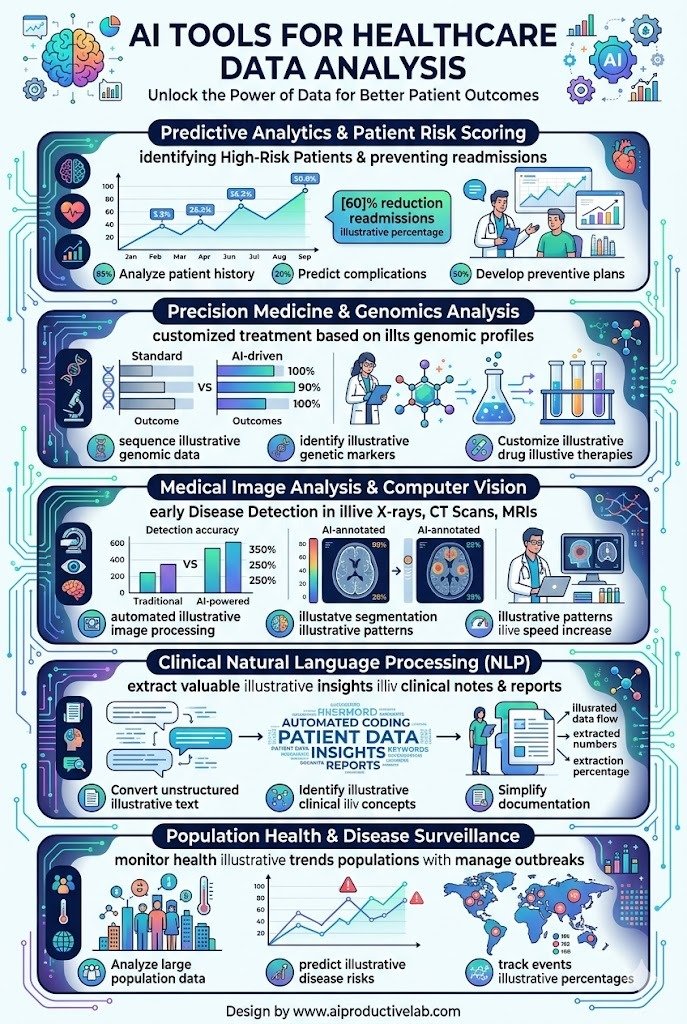
Key Areas Where AI Transforms Healthcare Data
AI touches nearly every data-intensive function in a healthcare organization. Here are the areas with the highest impact.
Clinical Outcome Prediction
AI models analyze patient histories, vitals, and treatment records to forecast outcomes. They predict risks like hospital readmissions, sepsis onset, and disease progression. Clinicians use these predictions to intervene earlier and improve survival rates.
Population Health Management
Healthcare systems use AI to analyze data across entire patient populations. These tools identify at-risk groups, track disease trends, and guide preventive care strategies. Public health teams and large provider networks benefit most from this capability.
Revenue Cycle and Financial Analytics
AI tools detect billing errors, predict claim denials, and optimize reimbursement workflows. They analyze payer data and coding patterns to recover lost revenue. Finance teams rely on these insights to improve cash flow and reduce administrative waste.
Operational Efficiency and Resource Planning
Hospitals use AI analytics to forecast patient volumes, optimize staffing schedules, and manage bed capacity. These models turn historical data into forward-looking plans. The result is lower costs and fewer bottlenecks during peak demand periods.
10 AI Tools for Healthcare Data Analysis Worth Knowing
These platforms represent the leading solutions hospitals and health systems rely on for data-driven decision-making.
1. Arcadia — Population Health Analytics Platform
Arcadia aggregates data from electronic health records, claims, and social determinants into a unified analytics platform. It helps health systems manage population health by identifying care gaps and tracking quality measures across large patient groups.
The platform excels at turning fragmented data into a single, comprehensive view. Care teams use Arcadia’s dashboards to monitor chronic conditions and guide value-based care strategies.
2. IBM Watson Health — Enterprise AI for Clinical and Operational Data
IBM Watson Health applies natural language processing and machine learning to clinical research, drug discovery, and hospital operations. It processes structured and unstructured data from multiple sources at enterprise scale.
The platform supports oncology treatment decisions, medical imaging analysis, and health plan analytics. Large academic medical centers and research institutions use Watson Health for complex, data-heavy initiatives.
3. Google Health AI — Machine Learning for Medical Research
Google Health AI develops machine learning models for medical imaging, genomics, and electronic health record analysis. Its research partnerships with major hospitals have produced models that match or exceed specialist performance in areas like diabetic retinopathy screening.
The platform contributes open-source tools and published research to the broader healthcare AI community. It is particularly strong in imaging analytics and large-scale data pattern recognition.
4. Tempus — AI-Driven Genomic and Clinical Data Analysis
Tempus combines molecular sequencing data with clinical records to power precision medicine. Its AI platform analyzes genomic, transcriptomic, and clinical data to recommend targeted cancer therapies. Oncologists use Tempus to match patients with optimal treatment pathways.
Beyond oncology, Tempus is expanding into cardiology, infectious disease, and mental health analytics. The platform also supports clinical trial matching by analyzing patient data against active study criteria.
5. Health Catalyst — Data Platform for Healthcare Quality Improvement
Health Catalyst provides a cloud-based data platform built specifically for healthcare analytics. It ingests data from disparate sources and normalizes it for reporting, benchmarking, and predictive modeling. Quality improvement teams use it to track clinical performance metrics.
The platform includes pre-built analytics applications for areas like surgical outcomes, patient safety, and financial performance. Over 400 health systems currently use Health Catalyst for data-driven quality initiatives.
6. Praxis EMR — Concept-Based AI for Clinical Data Learning
Praxis EMR takes a unique approach to healthcare data. Instead of using templates, it learns each physician’s clinical patterns through a concept processing engine. Over time, it builds a personalized knowledge base that accelerates documentation and surfaces relevant data during patient encounters.
This approach is especially valuable for independent practices that want AI insights without sacrificing clinical autonomy. The system adapts to how each provider thinks and works.
7. PathAI — AI-Powered Pathology Data Analysis
PathAI uses machine learning to analyze pathology slides with high precision. It assists pathologists in diagnosing diseases like cancer by identifying patterns in tissue samples that are difficult to detect visually. The platform improves diagnostic accuracy and consistency.
Pharmaceutical companies and research labs also use PathAI for drug development and biomarker discovery. The platform processes large volumes of pathology data faster than traditional manual review.
8. Arterys — Cloud-Based Medical Imaging Analytics
Arterys applies AI to medical imaging data in the cloud. It offers FDA-cleared tools for cardiac, liver, lung, and chest imaging analysis. Radiologists access AI-enhanced interpretations directly within their existing reading workflows.
The cloud-native architecture means hospitals avoid expensive on-premise hardware. Arterys processes imaging data rapidly and delivers quantified measurements that support more precise clinical decisions.
9. N1 Health — AI Analytics for Healthcare Payers
N1 Health focuses on data analytics for health insurance companies and payers. Its AI platform identifies high-cost members, predicts future claims, and recommends targeted interventions. Payers use these insights to manage risk and reduce unnecessary spending.
The platform connects claims data with clinical and behavioral information for a holistic member view. This helps payer organizations design better benefit programs and improve health outcomes at scale.
10. UI Bakery — Low-Code AI Dashboards for Health Data
UI Bakery enables healthcare organizations to build custom internal analytics dashboards without heavy development resources. Teams connect data sources, apply AI-powered analysis, and create visual reports tailored to specific operational needs.
The low-code approach makes it accessible for non-technical users. Smaller clinics and practice groups use UI Bakery to visualize patient data, track key performance indicators, and automate reporting workflows.
Comparing the Top Healthcare Data Analytics Platforms
This table helps you match each tool to your organization’s primary analytics needs.
| Tool | Core Strength | Best For | Data Focus |
|---|---|---|---|
| Arcadia | Population health analytics | Health systems, ACOs | Claims + EHR |
| IBM Watson Health | Enterprise AI research | Academic medical centers | Multi-source clinical |
| Google Health AI | Medical imaging ML models | Research institutions | Imaging + genomics |
| Tempus | Genomic data analysis | Oncology centers | Molecular + clinical |
| Health Catalyst | Quality improvement analytics | Hospital quality teams | Operational + clinical |
| Praxis EMR | Concept-based learning | Independent practices | Clinical documentation |
| PathAI | Pathology slide analysis | Labs, pharma companies | Tissue pathology |
| Arterys | Cloud imaging analytics | Radiology departments | Medical imaging |
| N1 Health | Payer risk analytics | Insurance organizations | Claims + behavioral |
| UI Bakery | Custom analytics dashboards | Small to mid-size clinics | Operational KPIs |
How to Evaluate AI Analytics Tools for Your Organization
Choosing the right platform requires more than comparing feature lists. Consider these factors carefully.
- Data readiness: Assess whether your organization has clean, accessible data. AI tools perform best when they connect to well-structured data sources without excessive manual preparation.
- Use case alignment: Match the platform to your most pressing analytics need. A population health tool will not solve radiology workflow problems, and vice versa.
- Integration with existing systems: The platform must connect with your electronic health records, billing systems, and other data sources seamlessly. Poor integration creates more work, not less.
- Compliance and security: Healthcare data is highly regulated. Confirm the platform meets HIPAA requirements and supports your organization’s data governance policies.
- Total cost of ownership: Factor in licensing fees, implementation costs, training time, and ongoing support. Some platforms require significant upfront investment while others offer scalable subscription pricing.
Real-World Impact of AI-Driven Healthcare Analytics
Hospitals using AI analytics platforms consistently achieve measurable gains. Health Catalyst customers have reported reductions in surgical complications and improved patient safety scores. Arcadia helps accountable care organizations close care gaps that directly affect value-based reimbursement.
Tempus enables oncologists to identify effective therapies weeks faster than traditional approaches. PathAI improves pathology diagnostic consistency, reducing the variability that leads to misdiagnosis. These outcomes reflect real clinical and financial improvements, not vendor marketing claims.
The organizations seeing the best results share one trait. They start with a specific, well-defined problem and choose the tool that solves it before expanding into broader use cases.
FAQs
They are software platforms that use machine learning and AI to process clinical, operational, and financial healthcare data. They deliver insights that improve care quality, reduce costs, and support better decisions.
Reputable platforms comply with HIPAA and use encryption, access controls, and de-identification techniques. Always verify a vendor’s security certifications and data governance practices before implementation.
Yes. Platforms like UI Bakery and Praxis EMR offer affordable, scalable solutions designed for smaller practices. Many tools use subscription pricing that scales with organizational size and data volume.
AI platforms analyze electronic health records, medical imaging, genomic data, insurance claims, lab results, and device-generated patient data. Most tools support multiple data types simultaneously.
Implementation timelines range from a few weeks to several months depending on data complexity and integration requirements. Cloud-based platforms typically deploy faster than on-premise solutions.




 AI/ML Strategy and Consulting
 Data Science And Data Analytics
 Generative AI
 AI Consulting Services
 AI Automation Solutions
 API Integration


