

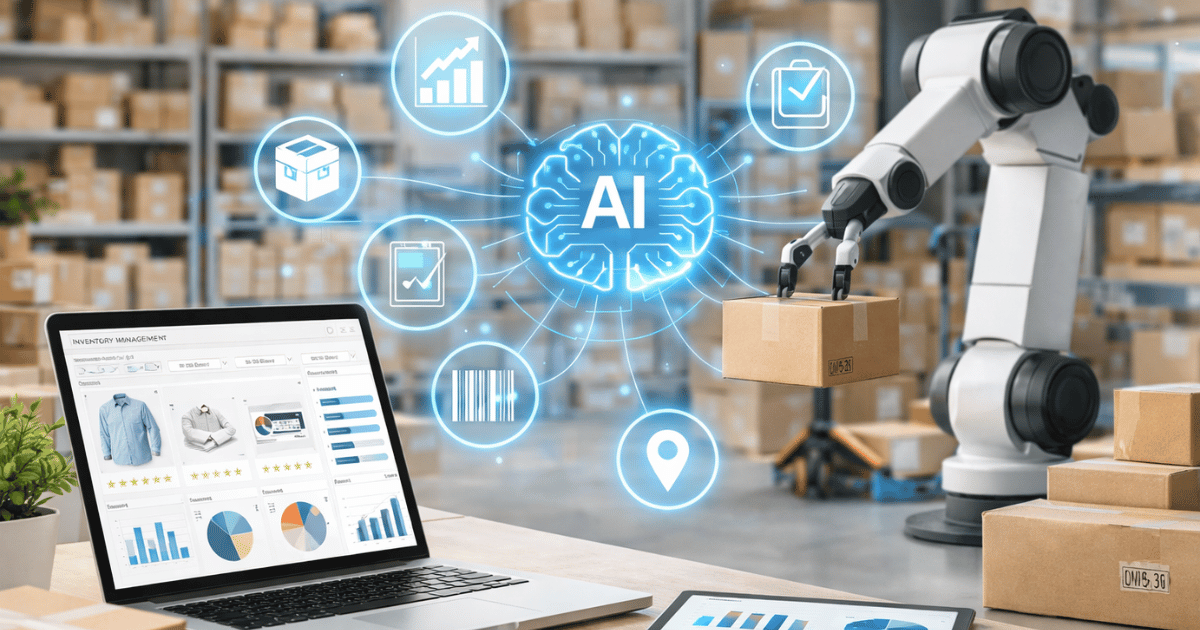
Spreadsheets and manual reorder points cannot keep pace with modern commerce. Product catalogs are expanding. Sales channels are multiplying. Customer expectations around delivery speed leave zero room for inventory errors.
- Use AI demand forecasting to replace static reorder rules, enabling continuous learning and more accurate, multi-dimensional predictions across thousands of SKUs.
- Integrate AI tools with ERP, eCommerce, and accounting systems to deploy faster, ensure clean data, and prevent fragile workarounds between disconnected platforms.
- Prioritize ROI and scalability when choosing a platform; select tools that reduce carrying costs, prevent stockouts, and scale with growing SKUs and warehouses.
Overstocking ties up cash and increases storage costs. Stockouts drive customers to competitors and damage brand trust. Both problems stem from the same root cause: inaccurate demand predictions based on outdated methods.
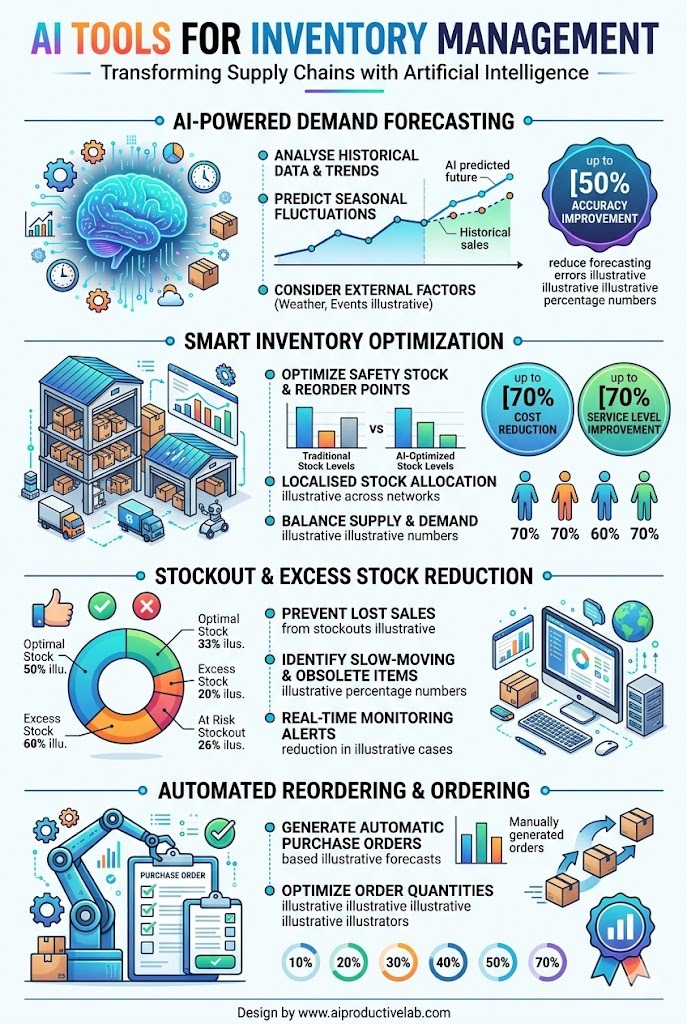
AI tools for inventory management solve this by processing massive volumes of data in real time. They analyze sales velocity, seasonal trends, supplier lead times, and even external factors like weather or economic shifts. The result is smarter purchasing decisions that protect margins and keep shelves stocked.
Businesses using AI demand forecasting software report inventory carrying cost reductions of 20 to 50 percent. That translates directly into healthier cash flow and stronger profitability.
How AI Changes Inventory Decision-Making
Traditional inventory systems rely on static rules. You set a reorder point, and the system triggers a purchase order when stock drops below that threshold. The problem is that reorder points rarely account for sudden demand shifts, promotional spikes, or supplier delays.
AI-powered systems take a fundamentally different approach. They learn from historical patterns and continuously adjust predictions based on new data. Machine learning models detect trends that human analysts would miss, especially across large product catalogs with thousands of SKUs.
These smart inventory management systems also factor in variables beyond sales data. They consider marketing calendars, competitor activity, logistics disruptions, and regional demand differences. This multi-dimensional analysis produces forecasts that are significantly more accurate than rule-based methods.
The shift from reactive restocking to predictive inventory planning is where businesses unlock real operational gains. You stop guessing and start making data-backed decisions that reduce waste at every level.
10 AI Tools for Inventory Management Worth Considering
1. Inventory Planner
Inventory Planner specializes in demand forecasting and automated purchasing for eCommerce and retail businesses. It calculates exactly how much stock to order and when, based on sales trends, lead times, and seasonal patterns.
The platform generates ready-to-send purchase orders with recommended quantities. It integrates natively with Shopify, Amazon, BigCommerce, and several wholesale systems. Merchants with complex catalogs find it especially valuable for eliminating guesswork from replenishment cycles.
2. NetSuite Demand Planning
Oracle NetSuite includes a built-in demand planning module powered by machine learning. It analyzes historical sales, open opportunities, and macroeconomic indicators to produce forward-looking demand forecasts across multiple locations and channels.
NetSuite suits mid-market and enterprise businesses already using the ERP platform. Its strength lies in connecting demand forecasts directly to procurement, warehouse operations, and financial planning within a single unified system.
3. Cin7
Cin7 is a cloud-based inventory and order management platform with AI-assisted demand forecasting. It manages stock across physical stores, warehouses, online marketplaces, and third-party logistics providers from one dashboard.
The platform excels at multichannel inventory synchronization. It prevents overselling by updating stock levels across all connected channels in real time. For brands selling on Amazon, Shopify, and wholesale simultaneously, Cin7 eliminates the chaos of disconnected inventory data.
4. Linnworks
Linnworks automates inventory and order management for multichannel sellers. Its forecasting engine predicts demand based on historical performance and adjusts reorder suggestions as sales patterns evolve.
The platform connects with over 100 sales channels and shipping carriers. It centralizes stock control so that every sale, return, and transfer updates inventory counts instantly. Linnworks is particularly popular among high-volume sellers managing thousands of orders daily.
5. Cogsy
Cogsy focuses exclusively on inventory optimization for direct-to-consumer brands. It forecasts demand, recommends optimal reorder dates, and alerts teams when stockouts or overstock situations are approaching.
What sets Cogsy apart is its operations planning layer. It factors in marketing campaigns, product launches, and cash flow constraints when generating replenishment recommendations. This makes it a strategic planning tool, not just a stock counter.
6. Flieber
Flieber is an AI supply chain management tool designed for brands selling on Amazon and direct channels. It combines demand forecasting with inventory allocation recommendations across fulfillment centers including FBA warehouses.
The platform predicts demand at the SKU level for each sales channel independently. It then recommends how to distribute inventory across warehouses to minimize shipping costs and delivery times. Brands scaling on Amazon find this channel-specific intelligence extremely valuable.
7. Brightpearl
Brightpearl is a retail operations platform with integrated AI-driven demand forecasting. It connects inventory management with accounting, purchasing, CRM, and warehouse management into one system built specifically for retail and wholesale businesses.
Its automation engine handles purchase order creation, stock transfers, and fulfillment routing without manual intervention. Brightpearl works well for brands processing high order volumes that need automated stock replenishment tools to maintain accuracy at speed.
8. Blue Yonder
Blue Yonder offers enterprise-grade AI supply chain and inventory optimization. Its machine learning models process vast datasets covering demand signals, supply constraints, transportation variables, and market conditions to generate highly accurate forecasts.
Major retailers and manufacturers use Blue Yonder to manage complex global supply chains. The platform supports scenario planning, allowing teams to model how disruptions or strategy changes would impact inventory positions before making commitments.
9. Katana
Katana is a manufacturing inventory platform that uses AI to optimize raw material planning and production scheduling. It connects sales orders directly to manufacturing workflows, ensuring materials are available exactly when production needs them.
For businesses that manufacture or assemble products, Katana fills a gap that generic inventory tools overlook. It tracks raw materials, work-in-progress, and finished goods simultaneously. This end-to-end visibility prevents production delays caused by missing components.
10. Lokad
Lokad takes a unique approach to warehouse inventory optimization through quantitative supply chain modeling. Instead of simple forecasts, it uses probabilistic models that account for uncertainty in demand, lead times, and supplier reliability.
The platform generates optimized purchasing and stocking decisions based on financial impact rather than just unit quantities. Lokad is best suited for businesses with complex supply chains where traditional forecasting tools consistently underperform.
Tool Comparison: Matching Solutions to Business Needs
| Tool | Core Strength | Best For | Key Integration |
|---|---|---|---|
| Inventory Planner | Demand forecasting and purchasing | eCommerce brands | Shopify, Amazon, BigCommerce |
| NetSuite | Unified ERP demand planning | Mid-market and enterprise | Native ERP ecosystem |
| Cin7 | Multichannel stock synchronization | Omnichannel retailers | Marketplaces, 3PLs, POS |
| Linnworks | High-volume order management | Multichannel sellers | 100+ channels and carriers |
| Cogsy | DTC inventory optimization | Direct-to-consumer brands | Shopify, Amazon |
| Flieber | Amazon and FBA allocation | Amazon-focused sellers | Amazon, Shopify, FBA |
| Brightpearl | Retail operations automation | High-volume retail | Accounting, CRM, warehousing |
| Blue Yonder | Enterprise supply chain AI | Global enterprises | ERP, WMS, TMS |
| Katana | Manufacturing inventory | Product manufacturers | Shopify, QuickBooks, Xero |
| Lokad | Probabilistic optimization | Complex supply chains | Custom API integrations |
How to Select the Right AI Inventory Tool
Choosing among AI tools for inventory management starts with understanding your operational complexity. A direct-to-consumer brand selling 200 SKUs on Shopify has very different needs than a manufacturer managing 10,000 components across global warehouses.
Start by mapping your current pain points. If stockouts are your primary issue, prioritize tools with strong demand forecasting like Inventory Planner or Cogsy. If channel synchronization causes overselling, Cin7 or Linnworks will deliver immediate relief.
Consider your existing technology stack. Tools that integrate natively with your eCommerce platform, ERP, and accounting software will deploy faster and deliver cleaner data. Forcing disconnected systems to communicate through workarounds creates fragility and maintenance headaches.
Budget matters, but calculate ROI rather than focusing solely on subscription cost. A tool costing 500 USD per month that prevents 10,000 USD in dead stock quarterly pays for itself multiple times over. Frame the investment in terms of waste reduction and cash flow improvement.
Finally, evaluate scalability. Your inventory complexity will grow as your business expands. Choose a platform that can handle increased SKU counts, additional warehouses, and new sales channels without requiring a full migration later.
The Real Cost of Ignoring AI in Inventory Operations
Businesses clinging to manual inventory processes pay a hidden tax every day. Excess stock occupies warehouse space that costs money. Stockouts result in lost sales and disappointed customers who may never return. Emergency reorders from suppliers carry premium pricing that erodes margins.
Predictive inventory planning eliminates most of these costs. AI models identify slow-moving products before they become dead stock. They flag reorder needs weeks in advance, giving procurement teams time to negotiate favorable terms with suppliers.
The operational benefits compound over time. As machine learning models process more data from your business, their accuracy improves. Forecasts become tighter. Purchasing decisions become sharper. The gap between your inventory performance and competitors using manual methods widens every quarter.
FAQs
They are software platforms that use machine learning and data analysis to forecast demand, automate stock replenishment, and optimize inventory levels across sales channels and warehouses.
AI analyzes historical sales data, seasonal trends, marketing calendars, and external variables to predict future demand more accurately than manual methods or static reorder rules.
Yes. Tools like Inventory Planner and Cogsy offer plans starting under 200 USD per month, making predictive inventory planning accessible to growing eCommerce brands.
Traditional software tracks current stock levels and uses fixed reorder points. AI tools learn from data patterns, predict future demand, and adjust recommendations dynamically as conditions change.
Most businesses notice improved forecast accuracy within 30 to 60 days. Measurable reductions in carrying costs and stockout rates typically follow within the first quarter of use.



 AI/ML Strategy and Consulting
 Data Science And Data Analytics
 Generative AI
 AI Consulting Services
 AI Automation Solutions
 API Integration


