


Managing patients efficiently has always been a challenge for hospitals and clinics. Staff shortages, administrative overload, and rising patient volumes make it harder every year. That is where artificial intelligence steps in.
- Automates scheduling, insurance verification, billing, and documentation to reduce manual work and speed patient throughput.
- Provides real-time clinical insights and imaging triage that flag risks and accelerate diagnosis for time-sensitive conditions.
- Improves patient engagement with automated reminders, conversational scheduling, virtual care, and follow-up tracking to reduce no-shows and gaps in care.
- Select platforms based on EHR integration, regulatory clearances, scalability, staff training needs, and measurable outcomes before scaling deployment.
AI tools for patient management now handle everything from scheduling to diagnostics. They reduce manual work, cut errors, and help care teams focus on what matters most. This guide covers 10 proven platforms making a real difference.
Why Hospitals Are Turning to AI for Patient Management
Healthcare systems face growing pressure to do more with less. Administrative tasks consume nearly 30% of healthcare costs in the United States alone. Clinicians spend hours on documentation instead of treating patients.
AI-powered patient management platforms solve this by automating repetitive processes. They also provide real-time clinical insights that improve decision-making. Hospitals using these tools report faster turnaround times and fewer billing errors.
The shift is not about replacing people. It is about giving care teams smarter tools to work with. Adoption rates have surged as platforms prove their value through measurable outcomes.
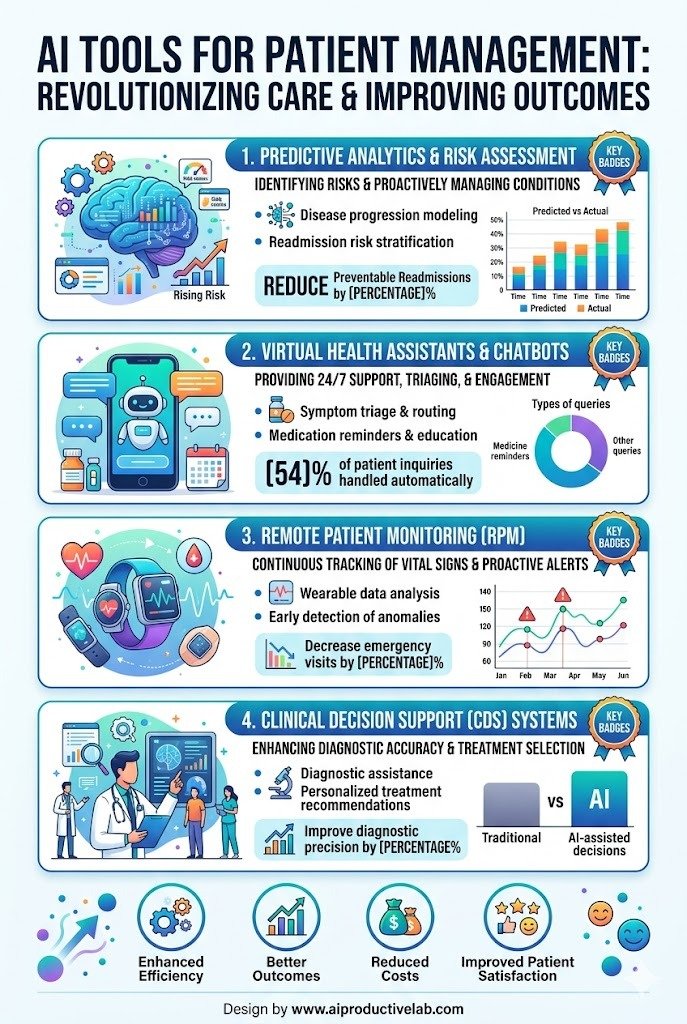
How AI Tools Improve Patient Management Workflows
AI enhances patient management across several critical areas. Understanding these use cases helps you pick the right tool for your facility.
Automating Administrative Tasks
Scheduling, insurance verification, and billing consume enormous staff hours. AI automates these processes with high accuracy. This frees front-desk teams to focus on patient interactions instead of paperwork.
Enhancing Clinical Decision Support
AI platforms analyze patient data in real time. They flag potential risks, suggest treatment paths, and alert clinicians to critical changes. These insights help doctors make faster, more informed decisions at the point of care.
Streamlining Communication and Follow-Ups
Missed appointments and poor follow-up hurt patient outcomes. AI tools send automated reminders, manage waitlists, and track post-visit care. This keeps patients engaged throughout their care journey.
10 AI Tools for Patient Management Worth Exploring
Here is a breakdown of platforms that are delivering measurable results in hospitals and clinics today.
1. Sully.ai — The All-in-One AI Healthcare Platform
Sully.ai acts as a complete AI team for healthcare organizations. It handles clinical documentation, patient intake, appointment management, and billing workflows. The platform integrates directly with major electronic health record systems.
What sets Sully apart is its ability to combine multiple functions into one dashboard. Clinics using Sully report significant reductions in administrative burden and faster patient throughput.
2. Suki AI — Voice-Powered Clinical Documentation
Suki AI is an ambient voice assistant built specifically for physicians. It listens during patient encounters and generates clinical notes automatically. Doctors spend less time typing and more time engaging with patients.
The platform learns each clinician’s preferences over time. This personalization improves accuracy and speeds up charting. Suki integrates with popular electronic health record platforms like Epic and Cerner.
3. DeepScribe — Ambient AI for Medical Notes
DeepScribe captures doctor-patient conversations and converts them into structured notes. It uses natural language processing to identify diagnoses, prescriptions, and care plans from spoken dialogue.
The tool reduces documentation time by up to 75%, according to user reports. It supports a wide range of specialties and adapts to different clinical workflows.
4. Aidoc — AI-Powered Radiology Triage
Aidoc focuses on diagnostic imaging and radiology. It analyzes medical scans in real time and flags critical findings like strokes, pulmonary embolisms, and fractures. Radiologists receive prioritized worklists based on urgency.
Over 1,000 healthcare facilities worldwide use Aidoc. The platform holds multiple FDA clearances, giving hospitals confidence in its clinical reliability. It significantly reduces time-to-diagnosis for emergency cases.
5. Viz.ai — Intelligent Care Coordination
Viz.ai uses AI to detect time-sensitive conditions directly from imaging data. It then routes alerts to the right specialist instantly. This is especially critical for stroke and cardiac care, where every minute counts.
The platform connects imaging, clinical teams, and patient data into one coordinated workflow. Hospitals using Viz.ai have documented faster treatment times and improved patient survival rates.
6. Tempus — Genomics-Driven Precision Medicine
Tempus combines AI with genomic sequencing to personalize cancer treatment. It analyzes molecular and clinical data to recommend targeted therapies. Oncologists use Tempus to match patients with the most effective treatment options.
The platform also supports clinical trial matching. This helps patients access cutting-edge treatments they might otherwise miss. Tempus partners with major cancer centers across the country.
7. Butterfly iQ+ — AI-Enhanced Point-of-Care Ultrasound
Butterfly iQ+ is a handheld ultrasound device powered by AI guidance. It helps clinicians perform bedside scans with real-time image interpretation. This makes diagnostics faster and more accessible, even in rural settings.
The AI overlay assists users in probe placement and image quality. It is particularly valuable for emergency departments and primary care clinics with limited imaging resources.
8. Talkie.ai — AI Voice Agent for Patient Scheduling
Talkie.ai automates inbound and outbound patient calls using conversational AI. It handles appointment booking, rescheduling, reminders, and basic inquiries without human intervention.
The platform reduces call wait times and frees up reception staff. Clinics using Talkie report fewer missed appointments and smoother daily operations. It works around the clock, supporting patients outside business hours.
9. Xsolis — AI for Utilization Management
Xsolis uses machine learning to streamline utilization review and case management. It predicts patient status, length of stay, and discharge readiness. This helps hospitals optimize bed management and reduce unnecessary costs.
The platform provides real-time visibility into patient progression. Case managers use it to make data-driven decisions instead of relying on manual chart reviews. Xsolis supports both acute and post-acute care settings.
10. OpenLoop Health — AI-Integrated Virtual Care Platform
OpenLoop Health connects healthcare providers with telehealth infrastructure powered by AI tools. It supports remote consultations, patient monitoring, and digital health assessments.
The platform helps clinics expand access to care without adding physical space. AI-driven triage assists providers in prioritizing virtual visits. OpenLoop is particularly useful for multi-state practices managing distributed patient populations.
How to Choose the Right AI Patient Management Tool
Selecting the best platform depends on your facility’s specific pain points. Use this comparison to narrow your options.
| Tool | Primary Use Case | Best For | EHR Integration |
|---|---|---|---|
| Sully.ai | All-in-one management | Clinics wanting a unified platform | Yes |
| Suki AI | Voice documentation | Physicians reducing charting time | Yes |
| DeepScribe | Ambient note-taking | Multi-specialty practices | Yes |
| Aidoc | Radiology triage | Hospitals with imaging departments | Yes |
| Viz.ai | Care coordination | Emergency and stroke centers | Yes |
| Tempus | Precision oncology | Cancer treatment centers | Yes |
| Butterfly iQ+ | Point-of-care imaging | Rural clinics, emergency rooms | Partial |
| Talkie.ai | Patient scheduling | High-volume outpatient clinics | Yes |
| Xsolis | Utilization management | Hospitals managing bed capacity | Yes |
| OpenLoop Health | Virtual care | Telehealth-focused practices | Yes |
Key Factors to Evaluate
Before committing to any platform, assess these critical areas:
- EHR compatibility: Ensure the tool integrates with your existing electronic health record system seamlessly.
- Regulatory status: Look for FDA clearances or certifications that validate clinical safety and accuracy.
- Scalability: Choose platforms that grow with your patient volume and expanding service lines.
- Staff training requirements: Evaluate how quickly your team can adopt the tool without disrupting daily operations.
- Measurable outcomes: Prioritize vendors who share real-world performance data and case studies from similar facilities.
What Results Can You Expect from AI Patient Management Tools?
Hospitals adopting these platforms consistently report tangible improvements. Documentation time drops by 50% or more with ambient AI scribes. Diagnostic turnaround speeds up significantly with AI-assisted imaging triage.
Scheduling tools reduce no-show rates by sending smart reminders at optimal times. Utilization management platforms help hospitals recover revenue lost to inefficient case reviews. These are not theoretical benefits — they reflect data from real deployments.
The key is starting with one clear problem and measuring results before scaling. Facilities that take this approach see the strongest return on investment.
FAQs
They are software platforms that use artificial intelligence to automate clinical and administrative tasks like scheduling, documentation, diagnostics, and care coordination in healthcare settings.
Most leading platforms offer direct integration with major electronic health record systems like Epic and Cerner through APIs, ensuring seamless data exchange without disrupting current workflows.
Many clinical AI tools, including Aidoc and Viz.ai, hold FDA clearances for specific diagnostic functions. Always verify a platform’s regulatory status before clinical deployment.
Costs vary widely based on facility size and tool complexity. Many platforms offer subscription pricing, and hospitals often recover costs through improved efficiency and reduced administrative overhead.
Absolutely. Tools like Talkie.ai and Sully.ai are designed to scale for smaller practices. They help reduce staff workload and improve patient engagement without requiring large upfront investments.




 AI/ML Strategy and Consulting
 Data Science And Data Analytics
 Generative AI
 AI Consulting Services
 AI Automation Solutions
 API Integration


