


Teachers work an average of 54 hours per week. Yet only half that time involves actual instruction. Grading, lesson planning, paperwork, and communication consume countless hours. Something has to give.
- AI automates routine tasks like grading and paperwork, reclaiming teacher time for instruction and student connection.
- Tools enable personalization at scale, creating leveled materials and identifying learning gaps for targeted interventions.
- Choose tools based on fit, ease of use, data privacy, cost, and evidence; start small and iterate for successful adoption.
- Address privacy, academic integrity, and preserve human connection; AI should amplify, not replace, teacher judgment and relationships.
AI tools for teachers address this unsustainable workload directly. Intelligent technology automates routine tasks while enhancing instructional quality. Educators reclaim time for what matters most: connecting with students.
Adoption is accelerating rapidly. According to a Gallup survey, 60% of K-12 public school teachers used AI tools during the 2024-2025 school year. Among these educators, 32% use AI at least weekly. The technology has moved from experimental curiosity to classroom essential.
The growth trajectory continues upward. Research from ElectroIQ shows generative AI tool usage among teachers increased 32% from the 2022-2023 to the 2023-2024 school years alone. Teachers recognize value and adopt accordingly.
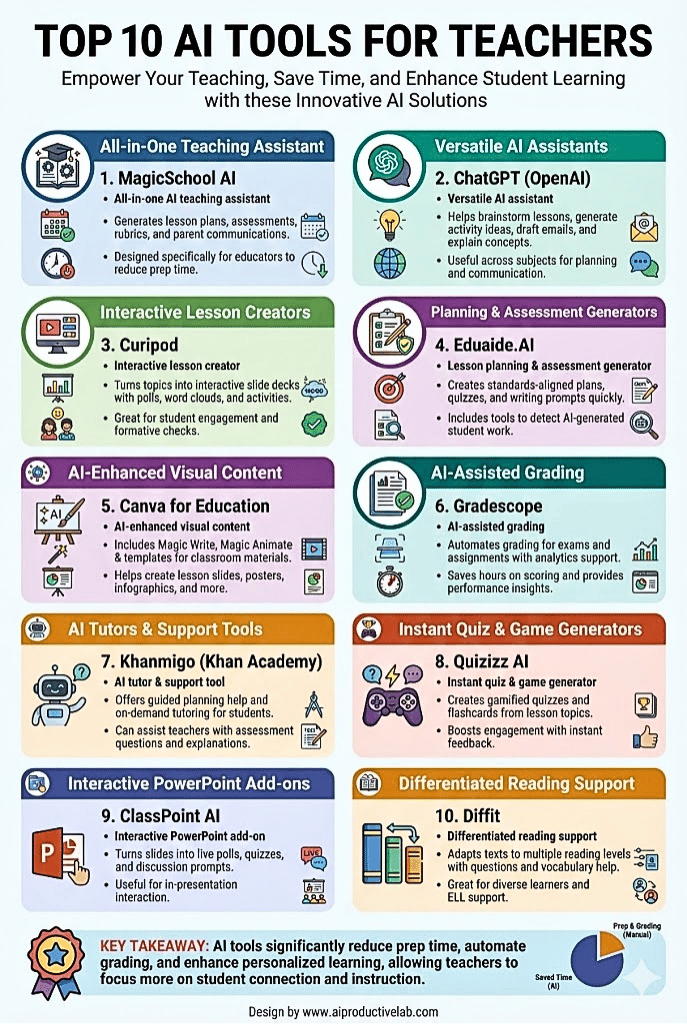
This guide explores AI tools for teachers comprehensively. You will learn specific tool categories transforming classroom practice. You will discover leading solutions in each category. You will understand implementation considerations for successful adoption. Most importantly, you will gain practical insight for selecting tools that match your teaching context and goals.
Why Teachers Need AI Tools Now
The Workload Crisis in Education
Teacher burnout reaches crisis levels. Administrative demands increase while planning time decreases. Class sizes grow while support shrinks. The profession loses talented educators who simply cannot sustain the pace.
AI offers meaningful relief. Intelligent tools handle tasks consuming teacher time without requiring teacher expertise. Grading multiple choice assessments, generating practice problems, drafting parent communications—machines perform these efficiently.
Key workload challenges AI addresses include:
- Assessment overload: Teachers grade hundreds of assignments weekly
- Differentiation demands: Diverse learners need individualized materials
- Communication volume: Parent and administrator correspondence multiplies
- Data management: Student information requires tracking and analysis
- Content development: Lessons need constant updating and creation
Teachers using AI tools report significant time savings. That recovered time translates directly to improved instruction and reduced burnout.
The Personalization Imperative
Every classroom contains diverse learners. Students arrive with different backgrounds, abilities, and needs. Meeting everyone individually seems impossible with traditional approaches.
AI enables personalization at scale. Tools generate differentiated materials matching individual student levels. Systems identify struggling learners requiring intervention. Platforms adapt content based on demonstrated understanding.
Personalization benefits include:
- Leveled content creation: Materials matching diverse reading abilities
- Learning gap identification: Pinpointing specific student needs
- Intervention targeting: Directing support where most effective
- Progress monitoring: Tracking individual advancement automatically
- Accommodation support: Assisting students with learning differences
Teachers cannot provide individual tutoring to thirty students simultaneously. AI tools extend personalization capacity dramatically.
Categories of AI Tools for Teachers
AI Grading and Assessment Tools
Grading consumes enormous teacher time. AI assessment tools provide immediate feedback while maintaining quality standards.
Leading AI grading solutions include:
- Gradescope: AI-assisted grading for STEM assignments and exams
- Turnitin: Plagiarism detection with AI writing analysis
- Formative: Real-time assessment with automatic feedback
- Edulastic: Standards-aligned assessments with AI scoring
- Writable: AI feedback for student writing assignments
These tools evaluate student work instantly. Teachers review AI assessments rather than starting from scratch. The approach maintains quality while dramatically reducing time investment.
Assessment tool capabilities include:
- Rubric-based evaluation: Consistent scoring against defined criteria
- Written response analysis: AI understanding of open-ended answers
- Plagiarism detection: Identifying copied or AI-generated content
- Progress tracking: Monitoring student advancement over time
- Feedback generation: Specific improvement suggestions for each student
AI Lesson Planning Tools
Lesson planning requires significant creative energy. AI planning tools generate ideas, activities, and materials accelerating preparation.
Leading AI planning solutions include:
- MagicSchool AI: Comprehensive teacher tools including lesson generators
- Eduaide.ai: AI-powered instructional design assistant
- Curipod: Interactive lesson creation with AI support
- Diffit: Differentiated content generation for diverse learners
- ChatGPT/Claude: General AI assistants for planning support
These tools transform planning from blank-page creation to guided refinement. Teachers provide objectives and constraints. AI generates draft materials for teacher review and customization.
Planning tool capabilities include:
- Lesson outline generation: Structured plans from learning objectives
- Activity suggestion: Engaging exercises matching content goals
- Differentiation support: Materials adapted for various levels
- Assessment alignment: Questions matching lesson objectives
- Resource recommendation: Supplementary materials for topics
AI Writing and Content Creation Tools
Teachers create enormous amounts of written content. Communications, instructions, rubrics, and explanations require constant composition.
Leading AI content tools include:
- Canva AI: Design and content creation with intelligent features
- Quillbot: Writing enhancement and paraphrasing
- Grammarly: Writing assistance with AI suggestions
- Beautiful.ai: Presentation creation with AI design
- Tome: AI-powered presentation and document generation
These tools accelerate content creation while maintaining professional quality. Teachers communicate more effectively with less effort.
Content creation capabilities include:
- Draft generation: Initial content from brief prompts
- Language enhancement: Improving clarity and professionalism
- Translation support: Materials in multiple languages
- Visual creation: Graphics and presentations automatically
- Template population: Filling standard formats efficiently
AI Student Support Tools
Students need help beyond class time. AI support tools provide assistance when teachers are unavailable.
Leading AI student support solutions include:
- Khan Academy Khanmigo: AI tutor integrated with educational content
- Photomath: Mathematics problem solving with explanations
- Quizlet Q-Chat: AI study companion for review
- Brainly: Homework help with AI-enhanced answers
- Socratic by Google: AI learning support across subjects
These tools extend support availability dramatically. Students receive help during homework, weekends, and late-night study sessions.
Student support capabilities include:
- On-demand tutoring: Instant help with questions
- Concept explanation: Multiple approaches to understanding
- Practice generation: Additional problems for skill building
- Study guidance: Recommendations for effective learning
- Progress encouragement: Motivation and confidence building
AI Administrative Tools
Administrative tasks burden teachers unnecessarily. AI administrative tools automate paperwork and organization.
Leading AI administrative solutions include:
- Copilot for Education: Microsoft’s AI assistant for educators
- Google Classroom AI features: Intelligent suggestions and automation
- Clever: AI-enhanced rostering and data management
- ClassDojo: Parent communication with AI support
- Remind: Messaging with intelligent scheduling and translation
Administrative tool capabilities include:
- Communication drafting: Parent and student messages
- Scheduling optimization: Calendar and deadline management
- Data organization: Student information management
- Report generation: Progress summaries and documentation
- Translation services: Multilingual family communication
How to Choose the Right AI Tools
Assess Your Specific Needs
Begin by identifying your biggest time drains and pain points:
- Where does your time go? Track activities consuming disproportionate hours
- What frustrates you most? Identify tasks feeling unnecessarily burdensome
- What do students need? Consider learner gaps AI might address
- What resources exist? Understand available technology and budget
- What training is available? Assess support for learning new tools
Targeted selection addresses real problems rather than adding technology for its own sake.
Evaluate Tool Quality and Fit
Consider multiple factors when selecting specific solutions:
- Ease of use: Can you learn the tool quickly without extensive training?
- Integration: Does it work with systems you already use?
- Data privacy: How does the tool protect student information?
- Cost: What are subscription fees relative to time savings?
- Evidence: Do other teachers report positive results?
Free trials allow testing before commitment. Start small and expand based on demonstrated value.
Plan for Implementation Success
Successful adoption requires thoughtful introduction:
- Start with one tool: Master a single solution before adding more
- Allow learning time: Expect initial slowdown before efficiency gains
- Seek peer support: Connect with colleagues using similar tools
- Iterate based on experience: Refine approaches as you learn
- Celebrate wins: Recognize time savings and quality improvements
Teachers who implement strategically realize greater benefits than those adopting haphazardly.
Challenges and Considerations
Data Privacy and Student Safety
AI tools require data demanding protection:
- Student information sensitivity: Learning data reveals personal details
- Regulatory compliance: FERPA and other requirements apply
- Vendor vetting: Third-party tools need security verification
- Parental consent: Families may need notification of AI use
- Institutional policies: School and district guidelines govern tool selection
Review privacy implications before introducing any AI tool to your classroom.
Academic Integrity Concerns
AI creates new challenges for authentic assessment:
- Student AI use: Learners may submit AI-generated work as their own
- Detection limitations: AI content detection remains imperfect
- Assignment redesign: Some assessments need restructuring for AI era
- Skill development: Students still need foundational capabilities
- Policy clarity: Clear expectations help students understand boundaries
Thoughtful assignment design and clear communication address most integrity concerns.
Maintaining Human Connection
Technology should enhance rather than replace human relationships:
- Relationship primacy: Student-teacher connections remain essential
- Judgment preservation: Human oversight of AI outputs matters
- Social learning: Peer interaction contributes to education
- Emotional support: Teachers provide irreplaceable encouragement
- Critical thinking: Human dialogue develops reasoning skills
The best AI implementations amplify human teaching rather than substituting for it.
Conclusion
AI tools for teachers address urgent challenges facing educators today. Assessment tools reduce grading burden. Planning tools accelerate lesson preparation. Content tools streamline communication. Student support tools extend assistance availability. Administrative tools automate paperwork.
Adoption has reached mainstream levels. With 60% of K-12 teachers using AI tools and usage growing 32% annually, the technology has proven its value. Teachers report meaningful time savings and improved instructional capacity.
Successful implementation requires thoughtful selection, gradual introduction, and ongoing refinement. Privacy considerations, academic integrity policies, and human connection preservation demand attention. Teachers navigating these considerations realize significant benefits.
The tools available today represent just the beginning. AI capabilities continue advancing rapidly. Teachers building AI fluency now position themselves for sustained effectiveness as technology evolves.
Discover how AI tools for teachers could transform your classroom practice and professional sustainability. Talk to our experts to understand which solutions fit your specific teaching context, student population, and professional goals.
FAQs
Top AI tools include MagicSchool AI for lesson planning, Gradescope for assessment, Khan Academy Khanmigo for student tutoring, and Canva AI for content creation.
Many AI tools offer free tiers with basic features. Premium subscriptions typically cost 10-30 USD monthly and provide advanced capabilities and unlimited usage.
Teachers use AI for grading assignments, generating lesson plans, creating differentiated materials, providing student feedback, and automating administrative communication tasks.
Safety depends on tool selection and implementation. Choose vendors with strong privacy policies, FERPA compliance, and data protection certifications before using with students.
No, AI augments teachers rather than replacing them. Technology handles routine tasks while teachers provide mentorship, motivation, and human connection that machines cannot replicate.




 AI/ML Strategy and Consulting
 Data Science And Data Analytics
 Generative AI
 AI Consulting Services
 AI Automation Solutions
 API Integration


