


What will shopping look like two years from now? The answer is being written by artificial intelligence today.
- Generative AI revolutionizes customer interactions with conversational chatbots, automated content, and virtual try-on experiences that reduce returns.
- Hyper-personalization delivers individualized recommendations, dynamic content, personalized pricing, and cross-channel consistency at scale.
- Predictive analytics forecast demand, anticipate churn, and enable proactive inventory, staffing, and marketing decisions.
- Computer vision powers cashierless checkout, shelf monitoring, and in-store robotics for real-time operational visibility.
- AI-driven supply chain optimization and sustainability reduce waste, manage supplier risk, and improve inventory and routing efficiency.
Retail stands at an inflection point. Customer expectations have never been higher. Operating costs continue climbing. Traditional approaches cannot keep pace with market demands. Retailers who adapt will thrive. Those who wait risk becoming irrelevant.
AI trends in retail are accelerating faster than most industry observers predicted. According to Gartner, global AI spending will exceed 2 trillion USD in 2026, growing 36.8% from 1.48 trillion USD in 2025. Nine in ten retail executives expect AI to increasingly replace traditional search engines by 2026, according to Deloitte research.
This guide explores the most significant AI trends transforming retail today. You will learn how leading brands apply these technologies. You will discover practical opportunities for your business. Most importantly, you will understand which trends deserve immediate attention and investment.
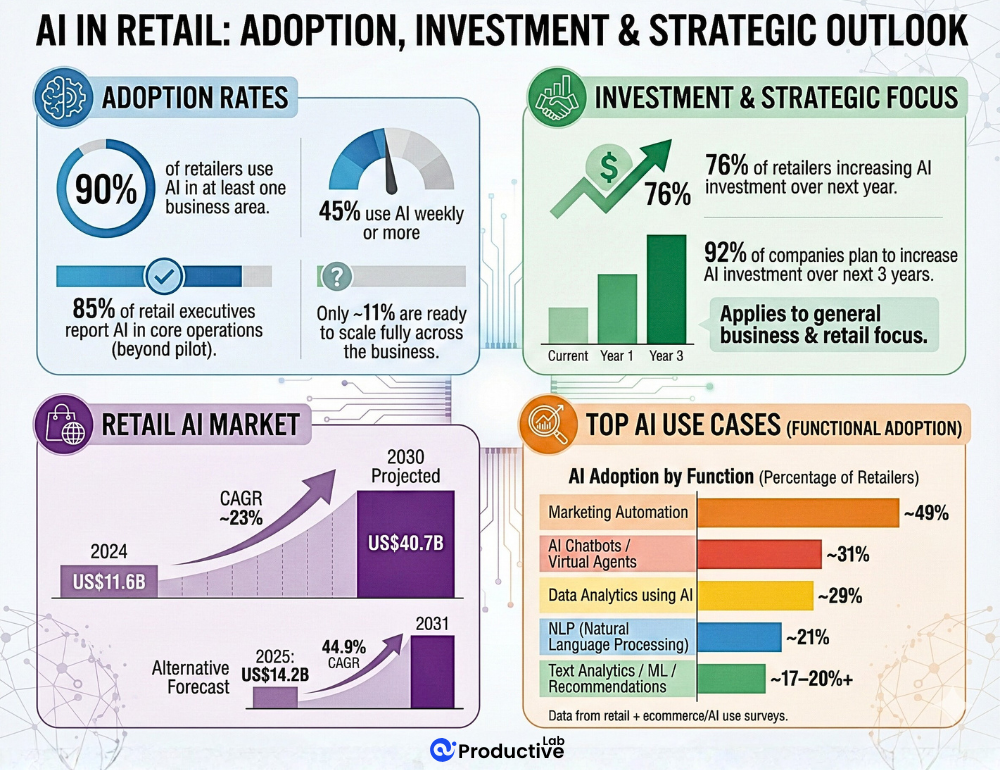
Why AI Matters More Than Ever in Retail
The Competitive Landscape Has Shifted
Retail competition no longer happens just on price or selection. Customer experience now determines winners and losers. Shoppers expect personalization, convenience, and instant service. AI enables retailers to deliver these expectations at scale.
The gap between AI adopters and laggards is widening. Early movers build capabilities that compound over time. They accumulate data, refine algorithms, and develop organizational expertise. Playing catch-up becomes increasingly difficult.
Economic Pressures Demand Efficiency
Labor costs continue rising while margins stay tight. Manual processes that worked before now strain profitability. AI automates routine tasks and augments human capabilities. Retailers achieve more with existing resources.
The technology has matured enough for mainstream adoption. What once required expensive custom development now comes packaged in accessible solutions. Mid-market retailers can access capabilities previously reserved for giants.
Top AI Trends Reshaping Retail in 2025-2026
Generative AI Transforms Customer Interactions
Generative AI has moved beyond novelty to practical retail applications. Chatbots powered by large language models handle complex customer inquiries naturally. They understand context, remember conversation history, and resolve issues without human intervention.
Product descriptions, marketing copy, and personalized recommendations now generate automatically. These systems create content at scale while maintaining quality and brand voice. Marketing teams focus on strategy while AI handles execution.
Visual generative AI enables virtual try-on experiences and product visualization. Customers see how furniture looks in their homes. They preview how clothes fit their bodies. This technology reduces purchase uncertainty and return rates.
Hyper-Personalization Becomes Standard
Basic personalization no longer impresses customers. They expect experiences tailored specifically to their preferences, behaviors, and context. AI enables this hyper-personalization across every touchpoint.
Modern AI systems analyze hundreds of signals to understand each customer. Purchase history combines with browsing behavior, location data, and external context. Every interaction becomes an opportunity for relevant engagement.
Key hyper-personalization capabilities include:
- Individualized product recommendations: Suggestions based on unique preference patterns, not just segment averages
- Dynamic content personalization: Website layouts, promotions, and messaging adapt per visitor
- Personalized pricing and offers: Discounts targeted based on customer value and price sensitivity
- Tailored communication timing: Messages arrive when each customer is most likely to engage
- Cross-channel consistency: Personalization persists across web, mobile, email, and in-store
Predictive Analytics Drive Proactive Decisions
Reactive retail management is giving way to predictive approaches. AI forecasts demand, identifies trends, and anticipates problems before they materialize. Retailers shift from responding to events to shaping outcomes.
Demand forecasting accuracy has improved dramatically. AI systems predict what customers will want, when they will want it, and in what quantities. These forecasts drive inventory positioning, staffing decisions, and marketing planning.
Predictive customer analytics identify shoppers likely to churn before they leave. They spot high-value customers early in their journey. They reveal cross-sell opportunities at optimal moments. Proactive engagement replaces reactive rescue attempts.
Computer Vision Expands In-Store Intelligence
Computer vision brings AI capabilities to physical retail environments. Cameras and sensors understand what happens in stores. They track customer movements, monitor shelf conditions, and enable frictionless checkout.
Cashierless checkout technology has moved beyond Amazon Go to broader adoption. Customers simply take items and leave. AI tracks selections and charges accounts automatically. This convenience appeals to time-pressed shoppers.
Shelf monitoring AI detects out-of-stocks, misplaced items, and pricing errors. Systems alert staff to issues requiring attention. Some retailers deploy robots that scan aisles continuously. Real-time visibility replaces periodic manual audits.
Voice Commerce Gains Momentum
Voice-activated shopping continues growing as smart speakers proliferate in homes. Customers reorder products, check order status, and discover items through voice commands. AI interprets natural speech and completes transactions seamlessly.
Retailers are optimizing for voice search discovery. Product information must answer questions people actually ask verbally. Voice-friendly content differs from traditional text optimization. Early movers capture voice shopping share.
Voice AI also transforms in-store experiences. Employees access information hands-free while helping customers. Voice-enabled kiosks provide assistance without staff involvement. The technology removes friction from shopping journeys.
AI-Powered Supply Chain Optimization
Supply chain disruptions taught retailers hard lessons about resilience. AI now helps predict and navigate supply challenges before they impact customers. Visibility and agility have become competitive necessities.
AI optimizes inventory across complex distribution networks. Systems determine optimal stock levels at each location. They recommend transfers between facilities. They balance service levels against carrying costs automatically.
Supplier risk monitoring uses AI to flag potential problems early. Systems analyze news, financial data, and operational signals. Retailers diversify or adjust before disruptions cascade. Proactive supply chain management replaces crisis response.
Sustainable Retail Through AI
Sustainability has moved from nice-to-have to business imperative. Customers increasingly factor environmental impact into purchasing decisions. Regulations require greater transparency about operations. AI helps retailers operate more sustainably.
AI reduces waste through better demand forecasting and inventory management. Fewer products end up in landfills or marked down heavily. Energy consumption optimizes based on store traffic patterns. Route optimization reduces delivery emissions.
Sustainability reporting benefits from AI data analysis. Systems track and report environmental metrics automatically. They identify improvement opportunities and monitor progress. Retailers demonstrate genuine commitment through measurable results.
How Leading Retailers Apply AI Today
Walmart’s Integrated AI Strategy
Walmart deploys AI across their entire operation comprehensively. Their systems optimize pricing, inventory, and supply chain simultaneously. Store associates use AI tools for tasks from stocking to customer service.
The retailer processes massive data volumes to power these applications. Their scale enables AI capabilities smaller competitors cannot match. Yet they make some tools available to marketplace sellers, extending AI benefits.
Sephora’s Digital Experience Innovation
Sephora has pioneered AI-powered beauty retail experiences. Their Virtual Artist lets customers try makeup virtually before purchasing. AI recommends products based on skin tone, preferences, and past purchases.
In-store experiences integrate with digital through AI. Sales associates access customer profiles and recommendation engines. The omnichannel approach creates consistency across touchpoints. Sephora demonstrates AI enhancing rather than replacing human service.
Starbucks’ Deep Personalization
Starbucks uses AI to personalize the coffee experience at scale. Their Deep Brew platform powers recommendations, inventory management, and labor scheduling. The mobile app delivers individualized offers that drive significant revenue.
Personalization extends beyond marketing to operations. AI predicts demand by store and time period. Equipment maintenance schedules optimize based on usage patterns. The company treats AI as fundamental infrastructure, not experimental technology.
Zara’s Agile Retail Model
Zara’s parent Inditex applies AI throughout their fast fashion operations. Systems detect emerging trends from social media and sales data. Design and production respond quickly to market signals.
Inventory optimization prevents both stockouts and overstock situations. Store-level forecasting positions the right products in the right locations. This AI-enabled agility defines their competitive advantage.
Preparing Your Retail Business for AI Trends
Assess Your Current Capabilities
Evaluate your existing technology foundation honestly. AI systems require quality data, modern infrastructure, and integration capabilities. Identify gaps between your current state and AI readiness.
Review your data collection and management practices. AI needs clean, comprehensive data to function effectively. Investment in data infrastructure often precedes successful AI implementation.
Prioritize High-Impact Opportunities
Not every AI trend deserves equal attention. Focus on applications addressing your biggest challenges. Match AI investments to strategic priorities and expected returns.
Consider starting with proven applications before exploring cutting-edge capabilities:
- Customer personalization: Proven ROI and relatively straightforward implementation
- Demand forecasting: Clear business value and measurable improvement potential
- Customer service automation: Immediate cost savings and experience improvements
- Inventory optimization: Direct impact on cash flow and customer satisfaction
Build Organizational Capabilities
Technology alone does not deliver AI value. Organizations need skills, processes, and culture to leverage AI effectively. Plan capability building alongside technology investment.
Train existing staff on AI concepts and applications. Hire specialized talent where necessary. Establish governance processes for AI oversight. Culture change often determines success more than technology selection.
Partner Strategically
Few retailers can build all AI capabilities internally. Strategic partnerships accelerate adoption and reduce risk. Technology vendors, consultants, and solution providers offer valuable expertise.
Evaluate partners based on retail experience and proven results. Request references and case studies from similar businesses. Consider long-term partnership potential beyond initial implementation.
Conclusion
AI trends in retail are reshaping how businesses operate and compete. From generative AI transforming customer interactions to predictive analytics driving proactive decisions, these technologies create new possibilities. Retailers who embrace AI thoughtfully will capture significant advantages.
Success requires more than technology adoption. It demands strategic focus, data readiness, and organizational commitment. Starting with high-impact applications builds capability and demonstrates value. Continuous learning and adaptation keep pace with evolving technology.
The retail industry’s AI transformation is just beginning. Current trends will accelerate and new capabilities will emerge. The businesses positioning themselves today will lead tomorrow’s market.
Explore how AI trends in retail could transform your business operations. Talk to our experts to identify the right priorities and approach for your specific situation and goals.
FAQs
Key trends include generative AI for customer interactions, hyper-personalization, predictive analytics, computer vision for stores, and AI-powered supply chain optimization. These technologies are reshaping retail operations.
According to Gartner, global AI spending will exceed 2 trillion USD in 2026, growing 36.8% from 2025. Retail represents a significant portion of this investment.
Yes, cloud-based AI solutions make advanced capabilities accessible to smaller retailers. Many platforms offer scalable pricing and pre-built applications requiring minimal technical expertise.
Retailers need quality sales history, customer behavior data, product information, and inventory records. External data like market trends and competitor information enhances AI effectiveness.
Implementation timelines vary from weeks for simple applications to months for complex systems. Starting with focused pilots delivers faster results before broader deployment.




 AI/ML Strategy and Consulting
 Data Science And Data Analytics
 Generative AI
 AI Consulting Services
 AI Automation Solutions
 API Integration


