

Global SaaS growth depends on clear communication across markets, languages, and buyer journeys. That sounds obvious, yet many teams still publish one English video and expect worldwide demand. That approach now limits reach, trust, and conversion. Buyers want content that feels local, relevant, and easy to understand.
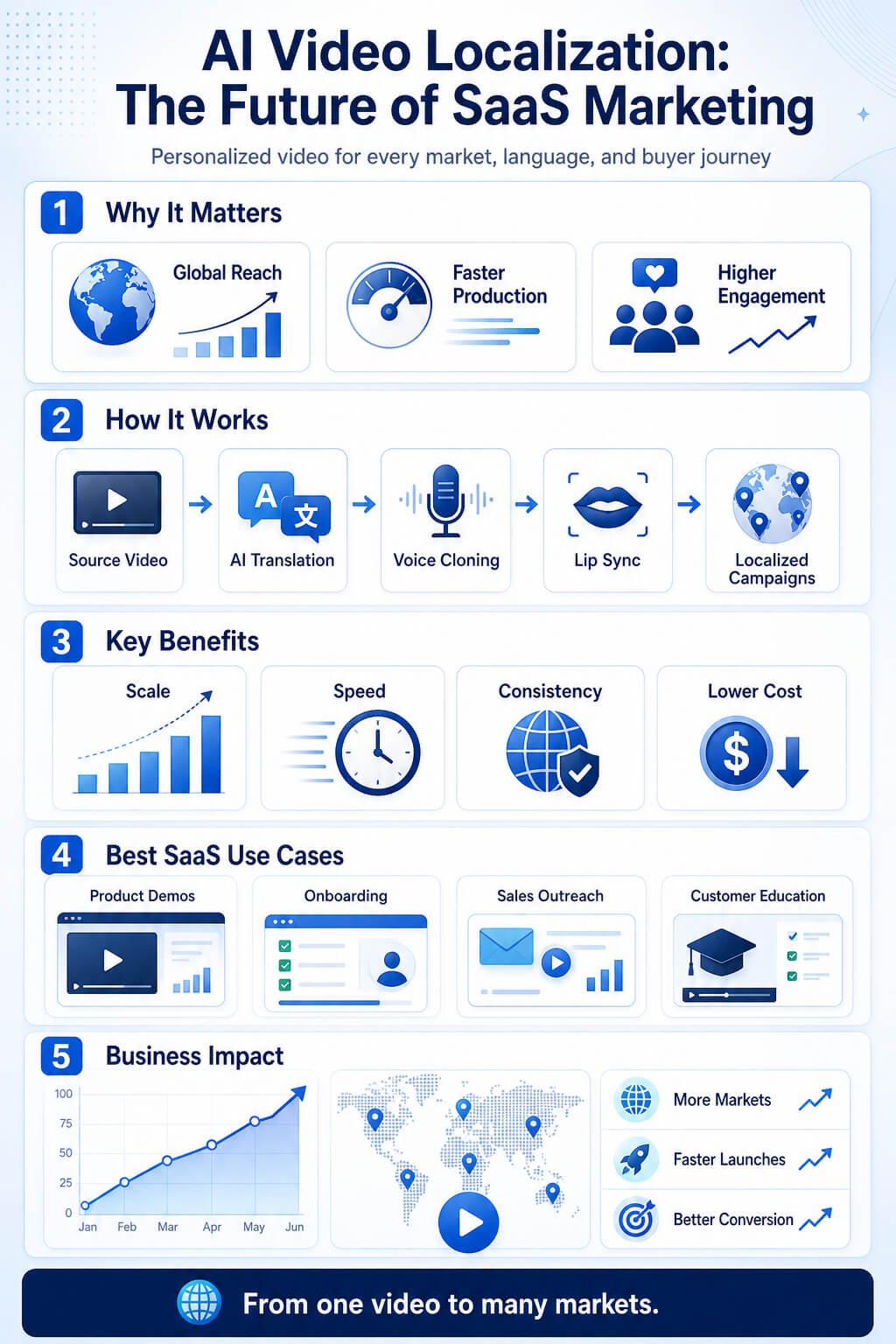
- AI lets teams localize core videos in days, enabling simultaneous regional launches and better alignment across product, sales, and marketing.
- AI reduces production costs and enables asset reuse, letting lean teams scale multilingual campaigns without full re-recording for every market.
- Localized video improves understanding, engagement, demo requests, onboarding completion, and retention by making messaging clearer and culturally relevant.
- AI workflows provide transcription, translation, subtitles, natural dubbing, lip-sync adaptation, regional message adjustment, and faster versioning for updates.
- Hybrid model required: humans refine tone, terminology, and compliance; measure watch time, CTR, demo bookings, activation, and retention by market.
That is why AI-Driven Video Localization is becoming a major force in global SaaS marketing. It helps teams adapt video content faster, lower production costs, and launch campaigns across regions without rebuilding everything manually. For SaaS companies with tight timelines, that shift matters.
In 2026, video is no longer just a brand asset. It supports product education, demand generation, onboarding, retention, and customer expansion. When that video speaks the viewer’s language and reflects local context, performance often improves across the funnel.
Why Video Localization Matters More For SaaS Brands Now
SaaS marketing depends on education. Prospects need to understand features, use cases, pricing logic, integrations, and outcomes before they commit. Video helps simplify those ideas, but only when the audience can follow the message without friction.
A localized video reduces that friction. It makes product demos clearer, onboarding smoother, and campaign messages more persuasive. Instead of asking international buyers to adjust to your content, you adjust the content to fit their expectations.
This matters because SaaS buying is rarely impulsive. Teams compare options carefully, involve several stakeholders, and review content across multiple touchpoints. If your multilingual video content feels native and easy to consume, your brand becomes easier to trust.
What Ai-Driven Video Localization Actually Includes
As more SaaS teams invest in multilingual video workflows, platforms like Medeo are becoming part of the broader localization stack. Today, AI can support a much broader localization workflow.
It can help with:
- Speech-to-text transcription for original video content
- Video translation into multiple target languages
- Subtitle generation with faster turnaround
- Voice dubbing that sounds more natural and consistent
- Lip-sync adaptation for stronger viewer immersion
- Regional message adjustment for cultural fit
- Faster versioning for product updates and feature launches
This means a single webinar, product walkthrough, or customer story can become a multi-market asset. Teams no longer need to restart production for every new geography.
How AI Is Changing The Speed Of Global SaaS Marketing
Traditional localization moves slowly. Teams often wait on transcription, translation, editing, review cycles, and voice production before publishing anything. That delay hurts campaign timing, especially when product updates happen often.
AI changes the timeline. Marketing teams can now localize core videos in days instead of weeks. That speed gives SaaS companies a real advantage when launching new features or entering new regions.
For example, imagine a SaaS company releasing a new analytics dashboard. The product marketing team creates one master demo in English. AI then helps generate localized versions for Spanish, German, French, and Japanese markets. Instead of staggering launches, the company supports regional campaigns almost simultaneously.
That speed creates better alignment between product, sales, and regional marketing teams. Everyone works from the same core asset, but each market still gets content that feels tailored.
Ai-Driven Video Localization Improves Campaign Efficiency
SaaS teams produce a huge volume of video. They create demo videos, onboarding flows, webinar clips, paid social assets, feature explainers, and customer education content. Localizing all of that manually can quickly become expensive.
AI helps reduce production pressure by making content reuse far more practical. Instead of creating fresh assets for each market, teams localize high-performing videos and extend their lifespan.
This improves efficiency in several ways:
- Lower production costs compared with full re-recording
- Faster campaign deployment across international regions
- More consistent messaging between markets
- Better asset reuse from existing video libraries
- Improved scalability for lean marketing teams
For many SaaS brands, that operational gain is just as valuable as the creative gain.
Better Localization Often Leads To Stronger Conversion Signals
Localization is not only about convenience. It directly affects how well prospects understand your offer and how confidently they move forward. That makes it a performance issue, not just a branding decision.
When viewers hear or read product messaging in their preferred language, they process information faster. They also feel that the company understands their needs, market, and business environment. That emotional signal matters during software evaluation.
Localized videos can improve:
- Watch time because the message is easier to follow
- Engagement rates because the content feels more relevant
- Demo requests because value becomes clearer
- Onboarding completion because instructions are easier to understand
- Customer retention because education improves product adoption
Not every market will show the same uplift. Still, many SaaS teams find that localized content performs better than generic global assets.
Where AI Localization Creates The Biggest Impact In The SaaS Funnel
Some video types benefit more from localization than others. The highest returns usually come from assets tied directly to revenue, activation, or retention.
Top-of-funnel demand generation
Paid video campaigns, social clips, thought leadership content, and educational explainers often perform better when localized early. These assets introduce your brand, so language clarity shapes first impressions.
If your international marketing strategy depends on market-specific acquisition, localized video can improve both relevance and click quality.
Mid-funnel product education
This is where many SaaS buyers need the most support. Feature videos, solution explainers, webinar highlights, and use-case walkthroughs help prospects connect your product to real business problems.
Localization here reduces confusion and shortens the path from interest to consideration.
Customer onboarding and expansion
Localized onboarding videos can reduce support volume and improve product adoption. They also help customer success teams deliver a more consistent experience across regions.
For subscription businesses, that matters deeply. Better onboarding often supports stronger retention, expansion, and long-term account value.
AI Localization Helps Regional Teams Move With Less Dependence
A common problem in global SaaS marketing is content bottlenecks. Central teams own the brand, but regional teams need speed and flexibility. Without scalable localization, local marketers often wait too long for usable assets.
AI makes that model easier to manage. Headquarters can produce a strong core message, while regional teams adapt it faster for their audiences. That improves consistency without slowing local execution.
This also supports sales enablement. Regional sales teams can share localized demos, onboarding videos, and educational clips that align with the broader global narrative. Buyers get a better experience, and internal teams waste less time recreating materials.
The Human Role Still Matters In Ai-driven Video Localization
AI is powerful, but it should not run without oversight. SaaS messaging often includes technical language, compliance claims, industry terminology, and product nuance. Those details need review.
The best results usually come from a hybrid model. AI handles speed, structure, and first-pass adaptation. Human reviewers then refine tone, terminology, and cultural accuracy before launch.
That review matters most when content involves:
- Industry-specific language such as finance, healthcare, or legal workflows
- Brand voice requirements across strategic campaigns
- Compliance-sensitive claims in regulated markets
- Customer-facing onboarding where clarity affects product adoption
The goal is not replacing human judgment. The goal is giving human teams leverage.
What Smart SaaS Marketers Should Measure
If you want to prove the value of localized video, focus on business outcomes rather than output volume. Publishing more translated assets means little if they do not move pipeline or improve user experience.
Track performance across the funnel, including engagement and conversion metrics. Useful indicators include watch time, click-through rate, demo bookings, onboarding completion, activation rate, and retention by market.
You should also compare localized and non-localized versions of similar campaigns. That side-by-side view often reveals whether localization is improving message clarity, not just reach.
A simple measurement framework includes:
- Choose priority markets based on revenue potential or expansion goals.
- Localize high-impact video assets instead of everything at once.
- Track funnel metrics by language and region over a defined period.
- Review qualitative feedback from sales, success, and local teams.
- Refine workflows based on what drives the strongest response.
Common Mistakes SaaS Brands Should Avoid
Some teams move fast with AI and overlook quality. That usually creates awkward content that feels translated rather than localized. Buyers notice that immediately.
Avoid these mistakes:
- Treating subtitles as full localization
- Ignoring regional buyer context and examples
- Skipping human review for technical or regulated content
- Localizing low-value assets before high-impact videos
- Using identical messaging across every market
Strong localization respects both language and context. That is what turns a translated asset into a persuasive one.
The Future Of Global SaaS Marketing Will Be More Localized By Default
The biggest shift is not technical. It is strategic. SaaS marketers are starting to treat localization as a built-in growth function rather than a post-production add-on.
As AI tools improve, video localization will become faster, more affordable, and more integrated into everyday campaign planning. That will raise buyer expectations. Prospects will increasingly expect content in their language from the first touchpoint onward.
For SaaS brands, the opportunity is clear. Teams that localize video intelligently can enter markets faster, educate buyers better, and support stronger customer experiences at scale. In a crowded category, that can become a real competitive edge.
AI-Driven Video Localization is changing global SaaS marketing because it aligns speed with relevance. It helps brands move faster without sounding generic. And in global growth, relevance usually wins.
FAQs
It is the use of AI to adapt video content for different languages and regions. It often includes transcription, translation, subtitles, dubbing, and message adjustment.
It helps international buyers understand products faster and trust the brand more. That can improve engagement, onboarding, and conversion quality across markets.
No, strong results still need human review for tone, accuracy, and context. AI speeds production, but people protect quality and brand credibility.
Start with demos, onboarding videos, webinar highlights, and paid campaign assets. These usually influence pipeline, activation, and retention most directly.
Track watch time, click-throughs, demo requests, onboarding completion, and retention. Compare localized content against non-localized versions by region.




 AI/ML Strategy and Consulting
 Data Science And Data Analytics
 Generative AI
 AI Consulting Services
 AI Automation Solutions
 API Integration