

Someone hands you a report, an essay, or a job application. It reads well. Slightly too well. You want to know whether a person wrote it or a model did.
- No single method proves authorship; combine signals like writing patterns, detectors, and provenance to reach a reasonable judgement.
- Human review detects uniform sentence rhythm, repetitive templates, generic examples, and missing specifics across a full piece.
- Detectors output probabilities; they need longer unedited English, fail on short or edited text, and have notable false positive rates.
- Provenance matters most: request revision histories, source notes, drafts, or cryptographic content credentials for stronger evidence.
- Match scrutiny to stakes: low stakes need quick checks, high stakes require process evidence and a conversation with the author.
The honest answer is that no single method proves authorship. Detection tools give probabilities, not verdicts. But a careful process combining several signals will get you to a reasonable judgement most of the time. This guide covers how to detect AI generated text using writing patterns, detector tools, and provenance evidence, and where each approach breaks down.
Why Detecting AI Text Is Harder Than It Looks
Large language models are trained on human writing. Their output is statistically similar to human text by design. Detectors look for subtle distributional artifacts rather than obvious tells.
That creates two problems. Light human editing defeats most detectors. And detectors trained on one type of text often fail on another. Research evaluating detection systems across different domains found that classifiers performing well in one dataset degraded significantly when tested elsewhere, because they had learned dataset-specific stylistic cues rather than stable signals of machine authorship.
So treat every method below as a signal, not proof.
Why You Want to Know Matters
Before you start testing, get clear on the stakes. The right level of rigour depends entirely on what happens next.
Low stakes. You are curious whether a marketing email or a LinkedIn post was AI-written. A quick detector check is fine. Nothing turns on the answer.
Medium stakes. You are an editor deciding whether to publish, or a hiring manager reviewing a writing sample. Here you want at least two independent signals before forming a view.
High stakes. Academic misconduct, employment decisions, legal disputes. In these cases a detector score is not sufficient evidence, full stop. You need process evidence and a conversation with the author.
Matching your method to the stakes prevents the most common failure in this area: treating a probability estimate as a finding of fact.
Method 1: Spot the Writing Patterns
Human review remains surprisingly effective, especially for people who use AI writing tools regularly. Research suggests frequent users of these tools become accurate and robust detectors themselves.
Here is what tends to give AI text away.
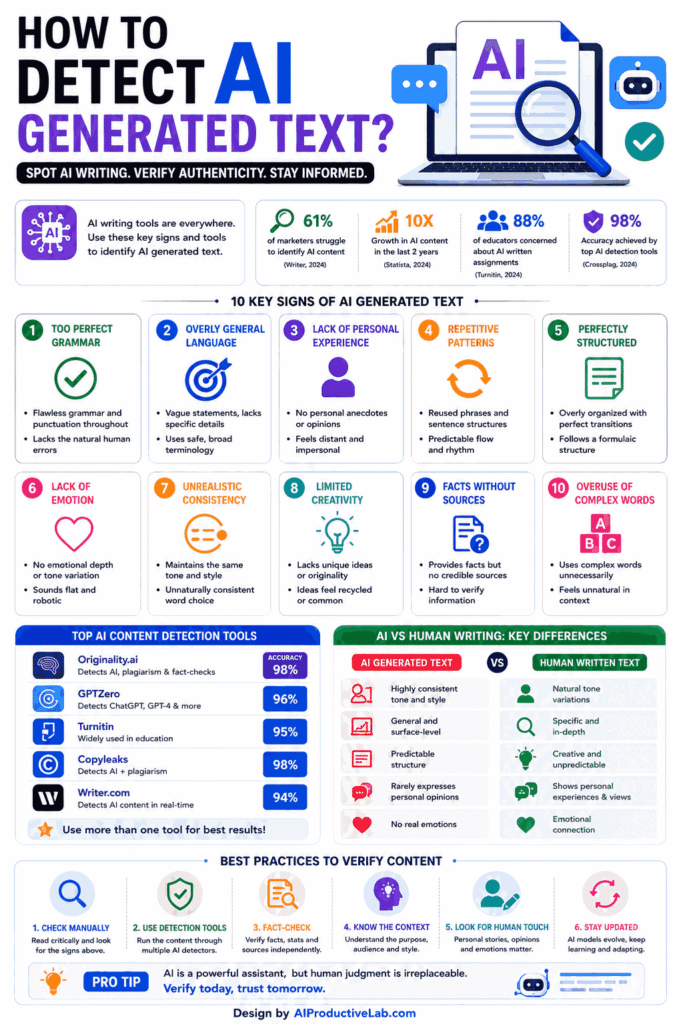
- Uniform sentence rhythm. Human writing varies. Sentences run long, then very short. AI output often holds a steady, even cadence throughout.
- Repetitive syntactic templates. The same sentence structure recurs across paragraphs, especially “not only X, but Y” and “it’s not just A, it’s B” constructions.
- Hedged, balanced conclusions. Every section ends with a tidy both-sides summary that commits to nothing.
- Generic examples. References to “a leading company” or “recent studies” without naming either.
- Vocabulary tics. Overuse of words like delve, leverage, robust, seamless, landscape, and testament.
- Missing specifics. No dates, no numbers, no proper nouns where a knowledgeable writer would include them.
- Flawless surface, shallow depth. Perfect grammar paired with claims that fall apart under a factual check.
One caveat: the most reliable signs come from recurring patterns across a full piece, not from a single word or phrase. Plenty of good human writers use the word “delve.”
Method 2: Run It Through AI Detection Tools
Detection tools estimate the probability that a model produced the text. Most work by measuring perplexity, meaning how predictable each word is, and burstiness, meaning how much sentence structure varies. AI output tends to score low on both.
| Tool | Notable For | Free Access |
|---|---|---|
| GPTZero | Widely used in education, clear reporting | Free tier available |
| Originality.ai | Publishing and SEO workflows, bulk scans | Paid |
| Winston AI | Detailed analysis with highlighted passages | Trial available |
| Copyleaks | Enterprise and multilingual support | Limited free |
| Turnitin | Integrated into academic submission systems | Institutional |
| Pangram | Research-backed, low reported false positive rate | Limited free |
| QuillBot AI Detector | Quick free checks on short passages | Free |
A few practical notes. Detectors need length. Most perform poorly under roughly 300 words. They also perform best on unedited English text and worse on short, technical, multilingual, or mixed human and AI writing.
Independent testing has consistently found that no detector identifies every sample correctly. Tools that catch obvious AI output often fail once a person has revised it. Even modest changes to sentence structure, transitions, and word choice noticeably reduce detection confidence.
The False Positive Problem
This is the part most guides skip, and it matters more than accuracy claims.
A widely cited 2023 Stanford study found that leading detectors misclassified a large majority of essays written by non-native English speakers as AI-generated, while performing near-perfectly on native speakers’ writing. The reason is structural: perplexity-based detection flags text that follows common, predictable patterns, and non-native writers often adhere more closely to standard syntax.
The finding is contested. Turnitin published a rebuttal noting the study used a small sample of short essays and reported no such bias in its own testing on longer texts. Later research on newer models found lower but non-zero false positive rates on the same benchmark.
The safe conclusion: even the best current tools report meaningful false positive rates on human writing. Never use a detector score alone to accuse someone. The consequences of a wrong call, academically or professionally, are severe and hard to undo.
Method 3: Check Provenance and Process
The most defensible answer to “was this written by AI?” is not a probability score. It is evidence about where the content came from and how it changed over time.
Probability scores fluctuate with every model update and editing pass. Provenance is about records, not guesses.
Practical provenance checks include:
- Revision history. Google Docs and Microsoft Word keep version histories. Human drafting shows messy, incremental change. Pasted AI output often appears as one large block.
- Source notes and research artifacts. Ask for the notes, outlines, or bookmarks behind the piece. Genuine research leaves a trail.
- Writing sample comparison. Compare against known work by the same person under similar conditions.
- Content Credentials. The C2PA standard attaches cryptographically signed metadata recording origin and edit history. Adoption is growing for images and increasingly for documents.
One important limitation: the absence of a provenance record does not mean content is synthetic. Screenshots and resaving strip metadata, and many tools do not attach credentials at all. Treat a valid credential as evidence of authenticity, but not its absence as evidence of fakery.
A Practical Multi-Signal Workflow
Combine methods rather than relying on one. Here is a workflow that holds up.
- Read it first. Note anything that feels off before any tool influences your judgement.
- Check the facts. AI text often contains confident errors, invented statistics, or citations that do not exist. This is frequently the strongest tell.
- Run two or three detectors. Agreement across independent tools is more meaningful than one high score.
- Look for process evidence. Request revision history, notes, or drafts.
- Compare to known work. Does the voice match previous writing from the same person?
- Talk to the author. A short conversation about the content’s reasoning reveals a great deal.
- Weigh everything together. Reach a conclusion from the full picture, not a percentage.
What This Means If You’re an Editor or Educator
Build policy around process, not detection. Ask for outlines, drafts, and source lists as part of normal submission. That makes AI use visible without requiring surveillance or accusations.
If a detector flags something, treat it as a prompt to investigate, not a finding. Open with a question, not a charge. Many institutions have moved toward assessment designs that make provenance natural, such as in-class work, oral defence, or staged drafts.
Does Google Penalize AI-Generated Content?
Not by default. Google does not penalize content simply because AI helped produce it. Its systems reward content that is accurate, original, and useful to readers, regardless of how it was made.
What does get penalized is low-value content produced at scale with no added insight. That happens to describe a lot of unedited AI output, which is why the two often get confused.
Final Thoughts
Learning how to detect AI generated text is really about building good judgement, not finding a magic tool. The technology is moving toward provenance and watermarking precisely because probability scores have proven fragile.
For now, read carefully, check facts, use detectors as a screening step, and ask for evidence of process. That combination is far more reliable than any single number, and far less likely to harm someone who did nothing wrong.
FAQs
No. All current detectors are probabilistic and report both false positives on human writing and false negatives on edited AI text.
Independent tests rank tools differently. Running two or three and comparing results is more reliable than trusting any single one.
Usually yes. Light human revision or paraphrasing significantly reduces detection confidence in most tools.
Research has found elevated false positive rates for non-native writers, though vendors dispute the extent. Extra caution is warranted.
Keep revision history, drafts, notes, and research sources. Process evidence is far stronger than any detector score.




 AI/ML Strategy and Consulting
 Data Science And Data Analytics
 Generative AI
 AI Consulting Services
 AI Automation Solutions
 API Integration