


A single teacher faces thirty unique learners. Each student arrives with different backgrounds, learning speeds, and knowledge gaps. Providing individualized attention to everyone seems impossible. Yet personalization remains the key to effective education.
- Personalized learning at scale tailors content, pace, and remediation to each student's needs, boosting mastery and retention.
- AI frees teachers from routine tasks like grading and tracking, enabling more high-impact instruction and student relationships.
- Early intervention and continuous analytics identify at-risk students sooner and target supports to prevent failure and dropout.
- 24/7 intelligent tutoring and accessibility tools expand equitable access, offering on-demand, low-cost support and accommodations.
This tension has defined teaching for centuries. Now AI offers a resolution.
The benefits of AI in education extend far beyond futuristic promises. Real schools achieve measurable results today. According to a Gallup survey, 60% of K-12 public school teachers used AI tools during the 2024-2025 school year. These educators report meaningful improvements in efficiency and student outcomes.
Microsoft’s 2025 AI in Education Report highlights growing institutional adoption. Thirty-three percent of education leaders now use AI accessibility tools helping students participate more fully. The technology addresses longstanding barriers to learning inclusion.
Teacher preparation is catching up quickly. By Fall 2025, 74% of school districts expect to offer AI training sessions for educators. This investment signals recognition of AI’s transformative educational potential.
This guide explores the concrete benefits of AI in education. You will learn how intelligent systems improve student outcomes, support teachers, and enhance institutional operations. You will understand specific advantages across different educational contexts. Most importantly, you will see why organizations investing in AI-powered education position themselves for sustained success.
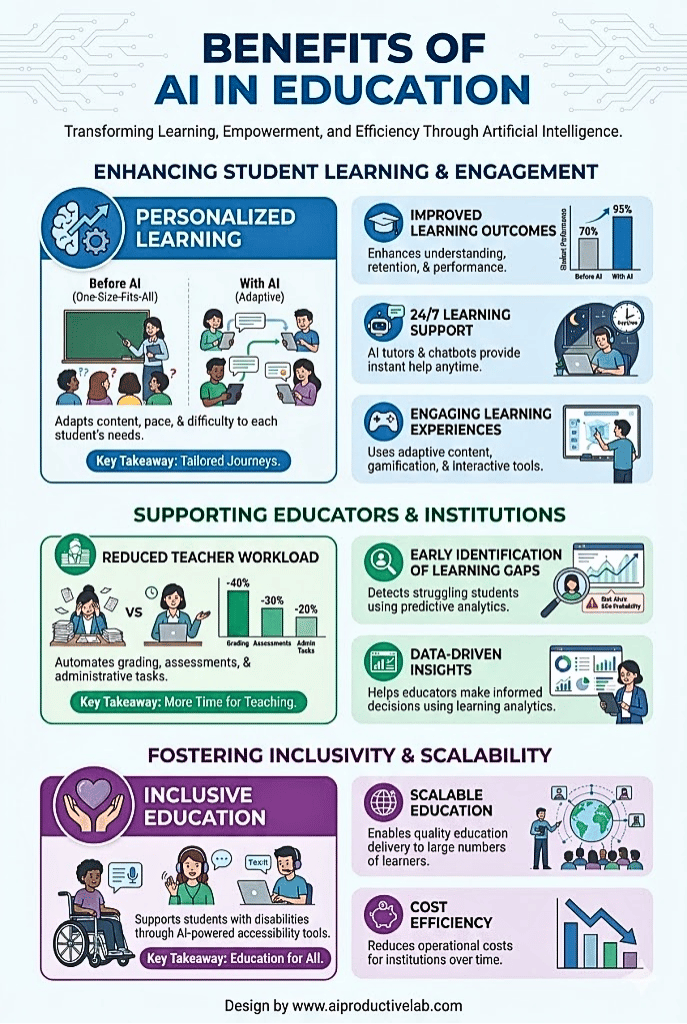
Personalized Learning at Scale
Adapting to Individual Student Needs
Every student learns differently. Traditional classrooms cannot accommodate this diversity effectively. AI changes this fundamental constraint.
AI-powered systems assess each learner continuously. They identify knowledge gaps requiring attention. They recognize mastered concepts allowing advancement. Content difficulty adjusts automatically based on individual performance.
Key personalization capabilities include:
- Real-time difficulty adjustment: Content complexity matches demonstrated understanding
- Custom learning paths: Sequences optimize for individual readiness and goals
- Pace flexibility: Progression speed aligns with personal learning velocity
- Format adaptation: Presentation style matches learner preferences
- Targeted remediation: Specific gaps receive focused attention
Students receiving personalized instruction learn faster and retain more. They experience appropriate challenge without frustration or boredom. The approach delivers tutoring-quality attention to every learner simultaneously.
Enhanced Teacher Effectiveness
Supporting Educators With Intelligent Tools
AI amplifies teacher impact rather than replacing human instruction. Technology handles routine tasks while educators focus on high-value interactions.
Teachers spend enormous time on administrative work. Grading, attendance, progress tracking, and communication consume hours better spent on instruction. AI automation reclaims this time for teaching.
Teacher support benefits include:
- Automated grading: AI evaluates assignments and provides feedback instantly
- Progress monitoring: Systems track student advancement automatically
- Resource recommendations: Tools suggest effective instructional materials
- Differentiation support: AI helps manage diverse classroom needs
- Administrative automation: Routine tasks complete without teacher attention
Research confirms AI helps teachers work more efficiently. When teachers save time on paperwork, they invest more energy in relationships and instruction that only humans provide effectively.
Improved Learning Outcomes
Delivering Measurable Academic Results
The benefits of AI in education include documented achievement gains. Students using AI-enhanced learning platforms consistently outperform those in traditional settings.
Outcome improvements stem from multiple factors. Immediate feedback prevents misconception entrenchment. Adaptive difficulty maintains engagement. Targeted practice addresses specific weaknesses. Data-driven refinement improves instruction continuously.
Measurable outcome benefits include:
- Higher completion rates: Personalization sustains engagement through course completion
- Better assessment scores: Targeted instruction improves demonstrated understanding
- Faster skill acquisition: Optimized paths reduce time to competency
- Stronger knowledge retention: Adaptive reinforcement improves long-term memory
- Increased student confidence: Success experiences build academic self-efficacy
These improvements compound over time. Students who learn effectively early develop stronger foundations for subsequent learning.
Expanded Access and Inclusion
Breaking Down Barriers to Education
AI democratizes quality education previously available only to privileged populations. Geographic, economic, and ability barriers diminish through intelligent technology.
Students in underserved areas access resources matching those in wealthy districts. Learners with disabilities receive accommodations automatically. Non-native speakers get real-time language support. Cost barriers decrease as AI scales efficiently.
Access and inclusion benefits include:
- Geographic independence: Quality instruction available regardless of location
- Disability accommodation: Automatic adaptations for diverse learning needs
- Language support: Real-time translation and language assistance
- 24/7 availability: Learning accessible anytime, not just during school hours
- Cost reduction: AI tutoring available at fraction of human tutoring expense
Microsoft’s research shows 33% of education leaders specifically use AI for accessibility tools. This intentional focus on inclusion expands educational opportunity meaningfully.
Early Intervention and Student Success
Identifying Struggling Learners Before They Fail
Traditional education identifies problems through lagging indicators. Failing grades reveal struggles only after students have fallen significantly behind. AI enables proactive intervention.
Predictive analytics detect warning signs early. Systems analyze engagement patterns, assignment completion, and performance trends. At-risk students receive attention before problems compound.
Early intervention benefits include:
- Proactive identification: Flagging students showing early warning signs
- Timely support: Intervention when help is most effective
- Dropout prevention: Addressing disengagement before students leave
- Resource optimization: Directing support services where most needed
- Success path guidance: Helping students navigate toward positive outcomes
Early intervention produces dramatic improvements in completion rates. Students receiving timely support graduate at significantly higher rates than those identified only after failure.
Immediate Feedback and Continuous Assessment
Accelerating Learning Through Rapid Response
Feedback timing matters enormously in learning. Students need to understand mistakes while the context remains fresh. Delayed feedback loses much of its instructional value.
AI provides immediate response to student work. Systems explain errors, suggest improvements, and guide learners toward understanding instantly. This rapid feedback loop accelerates skill development significantly.
Feedback benefits include:
- Instant error correction: Mistakes addressed before misconceptions solidify
- Specific guidance: Precise feedback targeting individual improvement areas
- Progress visibility: Clear advancement indicators sustaining motivation
- Continuous assessment: Understanding monitored constantly rather than periodically
- Reduced anxiety: Low-stakes practice without judgment pressure
Students receiving immediate feedback demonstrate faster skill acquisition and stronger retention compared to those waiting days for assignment returns.
Intelligent Tutoring and On-Demand Support
Providing Expert Assistance Anytime
Students need help at unpredictable moments. Questions arise during homework, weekend study sessions, or late-night review. Human tutors cannot be available continuously.
AI tutoring systems provide on-demand assistance around the clock. Intelligent chatbots answer questions, explain concepts, and guide problem-solving whenever learners need support.
Tutoring benefits include:
- 24/7 availability: Help accessible whenever questions arise
- Unlimited patience: Concepts explained repeatedly without frustration
- Multiple explanation approaches: Different strategies until understanding clicks
- Socratic guidance: Questions leading learners toward insight
- Judgment-free environment: Students ask without embarrassment
AI tutoring extends support availability dramatically while reducing costs that make human tutoring inaccessible to most families.
Efficient Administrative Operations
Streamlining Institutional Processes
Educational institutions handle enormous administrative workload. Enrollment, scheduling, communication, and compliance consume significant resources. AI automation streamlines these operations.
Administrative efficiency frees resources for educational mission. Staff redirect attention from paperwork to student support. Budgets stretch further when routine processes cost less.
Administrative benefits include:
- Enrollment automation: Application processing accelerated significantly
- Scheduling optimization: Efficient class and room assignments
- Communication scaling: Automated responses handling inquiry volume
- Document processing: Information extraction and organization
- Compliance monitoring: Regulatory requirements tracked automatically
Operational efficiency benefits extend beyond cost savings to improved student and family experience through faster, more responsive service.
Data-Driven Continuous Improvement
Using Analytics to Enhance Education
AI generates insights enabling ongoing educational enhancement. Data reveals what works, what doesn’t, and where improvement opportunities exist.
Continuous improvement becomes systematic rather than intuitive. Evidence guides curriculum development, instructional strategy, and resource allocation. Organizations learn what produces results and invest accordingly.
Analytics benefits include:
- Content effectiveness visibility: Data showing which materials produce best outcomes
- Common challenge identification: Patterns revealing widespread learning difficulties
- Intervention impact measurement: Evidence of what support strategies succeed
- Resource optimization: Guidance for highest-impact investments
- ROI demonstration: Metrics proving program value to stakeholders
Data-driven improvement compounds benefits over time. Organizations refining approaches based on evidence continuously enhance educational effectiveness.
Engagement and Motivation Enhancement
Keeping Learners Invested in Their Education
Student engagement predicts educational success more reliably than most factors. Engaged learners persist through challenges and invest effort in understanding. Disengaged students abandon learning regardless of available resources.
AI enhances engagement through personalization, gamification, and responsive interaction. Content relevance increases when matched to individual interests. Appropriate challenge sustains motivation without causing frustration.
Engagement benefits include:
- Optimal challenge calibration: Difficulty maintaining flow state engagement
- Interest-based content: Material connecting to individual preferences
- Progress gamification: Achievement systems sustaining motivation
- Responsive interaction: AI that adapts to learner feedback
- Autonomy support: Choice within personalized learning experiences
Higher engagement translates directly to better outcomes. Students who care about their learning invest the effort required for genuine understanding.
Conclusion
The benefits of AI in education span student outcomes, teacher effectiveness, institutional operations, and access expansion. Personalized learning reaches every student individually. Teachers gain time for high-impact human instruction. Early intervention prevents student failure. Analytics enable continuous improvement.
Adoption continues accelerating across educational contexts. With 60% of K-12 teachers already using AI tools and 74% of districts planning training programs, the transformation is well underway. Organizations investing now build capabilities that compound over time.
The technology augments rather than replaces human education. AI handles personalization at scale while teachers provide mentorship, motivation, and social learning that only humans offer. This combination produces results neither achieves alone.
Educational institutions and training organizations exploring AI position themselves for sustained success. The benefits are documented, the tools are available, and the implementation paths are increasingly clear.
Discover how the benefits of AI in education could transform outcomes within your institution or organization. Talk to our experts to understand which applications fit your specific learners, teachers, and educational objectives.
FAQs
Key benefits include personalized learning for every student, automated grading and administrative tasks, early identification of struggling learners, 24/7 tutoring support, and data-driven continuous improvement.
AI automates time-consuming tasks like grading and progress tracking, freeing teachers to focus on instruction, mentorship, and building relationships with students that only humans can provide.
Yes, research shows AI-enhanced learning produces higher completion rates, better assessment scores, faster skill acquisition, and stronger knowledge retention compared to traditional instruction methods.
No, AI actually expands educational access. Cloud-based platforms reduce costs significantly, making personalized learning available to schools and students regardless of economic resources.
No, AI augments teachers rather than replacing them. Technology handles routine tasks and personalization while teachers provide mentorship, motivation, and human connection essential for effective education.




 AI/ML Strategy and Consulting
 Data Science And Data Analytics
 Generative AI
 AI Consulting Services
 AI Automation Solutions
 API Integration


