


Real estate professionals work harder than ever yet struggle to keep pace with market demands. Agents juggle dozens of leads while manually qualifying each one. Property managers respond to maintenance requests around the clock. Investors analyze spreadsheets for weeks before making decisions. Brokerages spend heavily on marketing with unclear returns. The industry operates on processes designed for a different era.
- Automates repetitive tasks to reclaim agent time and boost operational efficiency across transactions and property management.
- Delivers data-driven insights and predictive models for accurate valuations, market forecasting, and better investment decisions.
- Enhances customer experience with personalized recommendations, instant 24/7 engagement, and tailored multi-channel communication.
The benefits of AI in real estate address these challenges directly. Intelligent systems automate repetitive tasks that consume professional time. Algorithms analyze data at speeds and scales impossible for humans. Personalized experiences emerge from understanding individual customer preferences. Operational costs decrease while service quality improves.
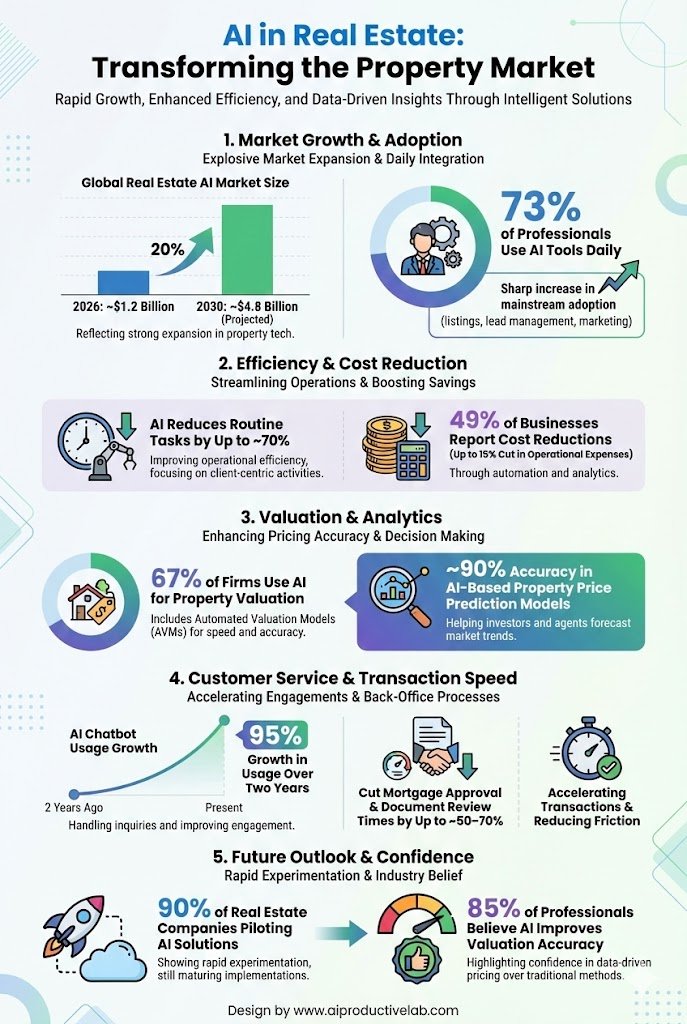
The impact is substantial and measurable. According to Morgan Stanley research, AI can automate 37% of tasks in real estate, representing 34 billion USD in operating efficiencies. JLL reports that 93% of real estate investors confirm tech-enabled properties deliver stronger performance and returns. Kolena research indicates property management automation can reduce operational costs by up to 70%.
This guide explores the benefits of AI in real estate comprehensively. You will understand specific advantages across different business functions. You will learn how organizations achieve measurable returns on AI investments. You will see practical applications delivering results today. Most importantly, you will gain insight for capturing AI benefits within your own real estate operations.
Understanding AI Benefits in Real Estate
Why AI Matters for Real Estate Now
The real estate industry has reached an inflection point where AI adoption determines competitive success. Several converging factors make AI benefits increasingly accessible and essential.
Key drivers include:
- Data explosion: Property, transaction, and behavioral data now exists in quantities enabling AI training
- Technology maturity: AI tools have evolved from experimental to production-ready
- Consumer expectations: Buyers and tenants expect instant, personalized experiences
- Competitive pressure: Early adopters establish advantages that compound over time
- Cost accessibility: AI solutions now fit budgets of individual agents to enterprise firms
- Integration ease: Modern tools connect with existing real estate systems readily
Organizations delaying AI adoption increasingly fall behind competitors who leverage these capabilities effectively.
How AI Delivers Value in Real Estate
AI creates value through several distinct mechanisms working across real estate operations.
Value creation pathways include:
- Automation: Handling repetitive tasks without human involvement
- Augmentation: Enhancing human capabilities with intelligent insights
- Acceleration: Completing processes faster than manual approaches
- Accuracy: Reducing errors through consistent algorithmic execution
- Analysis: Processing data volumes exceeding human capacity
- Anticipation: Predicting future outcomes to inform current decisions
These mechanisms combine differently across applications, but all deliver measurable business benefits.
Operational Efficiency Benefits
Task Automation and Time Savings
AI automates time-consuming tasks that traditionally required manual human effort. Morgan Stanley research confirms AI can automate 37% of real estate tasks, representing enormous time savings.
Automation benefits include:
- Document processing: Contracts, leases, and forms handled automatically
- Data entry elimination: Information extracted and recorded without manual input
- Scheduling automation: Appointments and showings coordinated intelligently
- Reporting generation: Performance reports created automatically
- Communication handling: Routine inquiries answered without staff involvement
- Follow-up automation: Leads nurtured through scheduled sequences
Time saved on automated tasks redirects to high-value activities. Agents invest more time with serious buyers. Managers focus on strategic decisions rather than administrative work.
Cost Reduction and Efficiency Gains
AI dramatically reduces operational costs across real estate business models.
Cost benefits include:
- Labor efficiency: Fewer staff hours required for routine operations
- Marketing optimization: Better targeting reduces wasted advertising spend
- Error reduction: Fewer costly mistakes requiring correction
- Energy savings: Smart buildings cut utility expenses significantly
- Maintenance optimization: Predictive approaches prevent expensive emergency repairs
- Administrative reduction: Automated processes lower overhead costs
Kolena research indicates property management automation can reduce costs by up to 70%. These savings improve margins or enable competitive pricing advantages.
Streamlined Workflows and Processes
AI optimizes how work flows through real estate organizations.
Workflow benefits include:
- Bottleneck elimination: AI identifies and addresses process constraints
- Parallel processing: Multiple tasks handled simultaneously
- Handoff automation: Work transitions between stages seamlessly
- Exception handling: Unusual situations flagged for human attention
- Progress tracking: Real-time visibility into transaction and project status
- Quality control: Automated checking ensures consistency and accuracy
Streamlined workflows accelerate transaction completion while reducing friction for all parties involved.
Customer Experience Benefits
Personalized Property Recommendations
AI transforms property search from generic filtering to intelligent matching that understands individual preferences.
Personalization benefits include:
- Preference learning: Systems understand buyer needs from behavior and feedback
- Proactive recommendations: Suitable properties surface before buyers search
- Lifestyle matching: Recommendations consider lifestyle priorities beyond basic criteria
- Evolving understanding: Recommendations improve as AI learns individual preferences
- Time savings: Buyers find suitable properties faster with less effort
- Satisfaction improvement: Better matches increase transaction satisfaction
Personalized experiences differentiate real estate services in competitive markets. Buyers remember organizations that understood their needs.
Instant Response and 24/7 Availability
AI enables immediate engagement when prospects show interest, regardless of time or agent availability.
Availability benefits include:
- Chatbot response: Questions answered instantly at any hour
- Lead capture: Interested buyers engaged before interest fades
- Information delivery: Property details provided on demand
- Appointment scheduling: Showings booked without phone tag
- Follow-up consistency: Every inquiry receives prompt attention
- Global reach: International buyers served across time zones
Response speed dramatically impacts conversion rates. Research shows leads contacted within five minutes convert at far higher rates than delayed responses.
Enhanced Communication and Engagement
AI improves how real estate professionals communicate with clients throughout relationships.
Communication benefits include:
- Personalized messaging: Communications tailored to individual situations
- Optimal timing: Messages delivered when recipients most likely engage
- Multi-channel coordination: Consistent experience across email, text, and social
- Progress updates: Automatic notifications keeping clients informed
- Milestone recognition: Acknowledgment of important dates and events
- Preference respect: Communication frequency and channel matching preferences
Better communication builds trust and strengthens relationships that generate referrals and repeat business.
Decision-Making Benefits
Data-Driven Insights and Analysis
AI processes vast data quantities to generate insights impossible through manual analysis.
Analytical benefits include:
- Market trend identification: Patterns visible across comprehensive data sets
- Opportunity recognition: Undervalued properties and emerging areas surfaced
- Risk assessment: Potential problems identified before they materialize
- Performance benchmarking: Results compared against relevant standards
- Predictive modeling: Future outcomes forecasted based on historical patterns
- Scenario analysis: Different strategies evaluated against likely outcomes
Better insights lead to better decisions. AI provides information advantages that translate to competitive advantages.
Accurate Property Valuations
AI valuation models deliver faster, often more accurate property value estimates.
Valuation benefits include:
- Speed: Instant estimates versus days for traditional appraisals
- Consistency: Same methodology applied across all properties
- Comprehensiveness: More data points considered than manual analysis
- Cost reduction: Lower expense per valuation enables more frequent assessment
- Objectivity: Algorithmic approach eliminates subjective variation
- Continuous improvement: Models refine accuracy through ongoing learning
Accurate valuations support better pricing, negotiation, and investment decisions across all real estate activities.
Predictive Capabilities
AI anticipates future outcomes, enabling proactive rather than reactive approaches.
Predictive benefits include:
- Market forecasting: Price and demand trends predicted before they manifest
- Lead scoring: Prospects most likely to transact identified early
- Maintenance prediction: Equipment failures anticipated before breakdowns occur
- Tenant behavior: Lease renewals and departures predicted in advance
- Investment timing: Optimal buy and sell moments identified
- Risk prediction: Potential problems flagged before they escalate
Predictive capabilities enable preparation and positioning that create competitive advantages.
Marketing and Sales Benefits
Enhanced Lead Generation
AI dramatically improves how real estate professionals find and capture potential clients.
Lead generation benefits include:
- Targeting precision: Ideal prospects identified from vast populations
- Behavioral signals: Purchase intent recognized from online activity
- Lookalike modeling: New prospects found resembling past successful clients
- Channel optimization: Marketing spend directed to highest-performing sources
- Content personalization: Messages tailored to individual interests
- Conversion optimization: Lead capture processes continuously improved
Better lead generation fills pipelines with higher-quality prospects requiring less effort to convert.
Improved Conversion Rates
AI enhances the process of converting prospects into clients.
Conversion benefits include:
- Lead qualification: Serious buyers identified and prioritized automatically
- Nurturing automation: Prospects maintained through intelligent follow-up
- Timing optimization: Outreach delivered when prospects most receptive
- Personalized engagement: Interactions tailored to individual needs
- Objection handling: Common concerns addressed proactively
- Pipeline management: Opportunities tracked and advanced systematically
Higher conversion rates mean more transactions from the same lead volume, improving marketing ROI significantly.
Visual Marketing Enhancement
AI transforms property marketing through intelligent visual content creation.
Visual marketing benefits include:
- Virtual staging: Empty spaces transformed into furnished rooms affordably
- Photo enhancement: Images optimized to professional quality automatically
- Video creation: Property videos generated from photos and data
- 3D tour generation: Immersive experiences created efficiently
- Personalized visuals: Marketing materials tailored to viewer preferences
- A/B testing: Best-performing visuals identified automatically
Enhanced visual marketing captures attention in crowded listing environments and generates more inquiries.
Competitive Advantage Benefits
Market Differentiation
AI capabilities distinguish real estate organizations from competitors still operating traditionally.
Differentiation benefits include:
- Superior service: Better experiences than manual competitors provide
- Faster execution: Speed advantages in time-sensitive markets
- Information advantages: Insights competitors lack access to
- Innovation perception: Reputation as forward-thinking industry leader
- Talent attraction: Tech-forward positioning appeals to top professionals
- Partnership opportunities: Technology capabilities attract valuable relationships
JLL research confirms 93% of investors report tech-enabled properties deliver stronger performance. Technology increasingly determines competitive success.
Scalability Without Proportional Costs
AI enables growth without equivalent increases in overhead and staffing.
Scalability benefits include:
- Volume handling: More transactions processed without proportional staff increases
- Geographic expansion: New markets served without local infrastructure
- Service consistency: Quality maintained as volume increases
- Cost efficiency: Per-transaction costs decrease with scale
- Rapid response: Growing demand handled without service degradation
- Flexible capacity: Ability to scale up or down as market conditions change
Scalability advantages compound over time, creating increasingly difficult gaps for competitors to close.
Continuous Improvement
AI systems improve through accumulated experience and data.
Improvement benefits include:
- Learning algorithms: Models refine accuracy through ongoing feedback
- Process optimization: Workflows improve based on performance data
- Personalization refinement: Individual understanding deepens over time
- Prediction accuracy: Forecasts improve as more data becomes available
- Error reduction: Systems learn from mistakes and avoid repetition
- Best practice identification: Successful patterns recognized and replicated
Continuous improvement creates compounding advantages that early adopters capture and late adopters struggle to match.
Realizing AI Benefits in Your Organization
Starting with High-Impact Applications
Begin with AI applications delivering clear, measurable benefits quickly.
High-impact starting points include:
- Chatbot deployment: Immediate lead capture and response improvement
- Virtual staging: Instant listing presentation enhancement
- Email automation: Consistent nurturing without manual effort
- Document processing: Administrative time reduction
- Lead scoring: Sales focus optimization
Quick wins build confidence and evidence supporting broader AI investment.
Measuring and Demonstrating ROI
Track AI impact through specific metrics demonstrating business value.
Key metrics include:
- Time savings: Hours reclaimed from automated tasks
- Cost reduction: Expenses eliminated through efficiency gains
- Lead conversion: Improvement in prospect-to-client rates
- Transaction speed: Reduction in days to close
- Customer satisfaction: Experience ratings and referral rates
- Revenue impact: Transactions and commission growth
Clear measurement justifies continued investment and identifies optimization opportunities.
Building Organizational Capability
Develop team skills and processes that maximize AI benefit realization.
Capability development includes:
- Training investment: Building staff competence with AI tools
- Process integration: Embedding AI into standard workflows
- Change management: Helping teams embrace new ways of working
- Feedback loops: Capturing insights to improve AI performance
- Experimentation culture: Encouraging testing of new AI applications
Technology delivers benefits only when organizations develop capabilities to leverage it effectively.
Conclusion
The benefits of AI in real estate span every aspect of property business operations. Task automation reclaims professional time for high-value activities. Cost reductions improve margins or enable competitive pricing. Customer experiences become personalized, responsive, and memorable. Decision-making improves through data-driven insights and predictive capabilities. Marketing generates more leads and higher conversion rates. Competitive advantages compound over time.
The scale of opportunity is substantial. Morgan Stanley research confirms 37% of real estate tasks can be automated, representing 34 billion USD in industry efficiency gains. Organizations capturing these benefits gain advantages that compound as AI systems learn and improve.
Implementation has become increasingly accessible. Tools exist for every budget and capability level. Starting points like chatbots, virtual staging, and email automation deliver immediate value. Expansion follows naturally as organizations build competence and confidence.
The competitive landscape increasingly favors AI adopters. Organizations leveraging these capabilities serve customers better, operate more efficiently, and make better decisions than traditional competitors. Advantages grow over time as AI systems improve through accumulated data and experience.
Real estate success increasingly depends on AI capability. Organizations building these capabilities now position themselves for sustained competitive advantage. Those delaying adoption face growing gaps that become increasingly difficult to close.
Explore how AI benefits could transform your real estate operations and results. Talk to our experts to understand which applications fit your specific business model, market focus, and organizational capabilities.
FAQs
The main benefits include task automation saving up to 37% of work time, improved property valuations, personalized customer experiences, enhanced lead generation, and significant cost reductions.
AI can reduce real estate operating costs substantially, with property management automation achieving up to 70% cost reduction according to industry research studies.
Yes, AI dramatically improves customer experience through personalized property recommendations, instant 24/7 response via chatbots, and tailored communications matching individual preferences and needs.
Absolutely, many AI tools are designed for small businesses with affordable pricing, including free chatbots, low-cost virtual staging, and email automation accessible to individual agents.
Many AI benefits appear immediately, such as time savings from automation and improved listing presentations from virtual staging, while analytical benefits compound over months.




 AI/ML Strategy and Consulting
 Data Science And Data Analytics
 Generative AI
 AI Consulting Services
 AI Automation Solutions
 API Integration


