
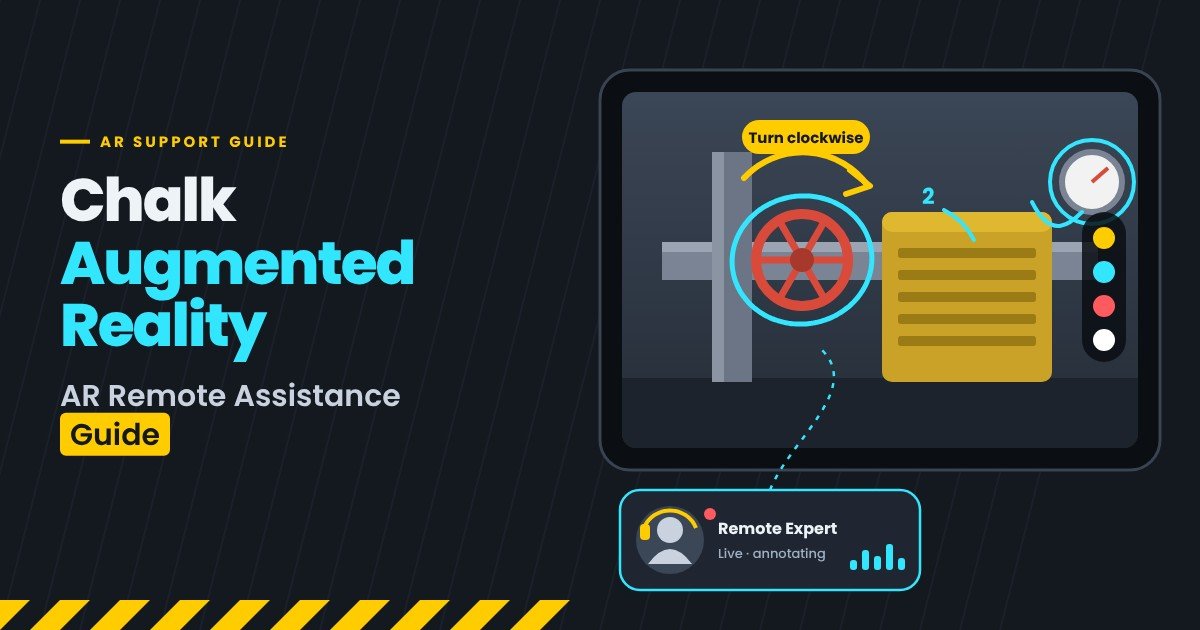
A technician stands in front of a failed pump. The one person who knows this machine is 600 miles away.
On a phone call, that expert says “the valve on the left.” Which left? Whose left? The technician checks the wrong valve, and an hour disappears.
Chalk augmented reality solves exactly this problem. The expert draws a circle on their screen, and that circle sticks to the real valve. The technician moves the phone, and the mark stays put.
That is the whole idea. It sounds small. In field service, it changes the economics of every call-out.
What Chalk Augmented Reality Is
Chalk is an AR remote assistance app from PTC, part of its Vuforia product family.
Two people share a live video view of the same physical object. Either one can draw annotations, called chalk marks, directly onto what they are both seeing. Voice runs alongside the video, so you talk while you draw.
The important part is that the marks are anchored in space, not drawn on the screen. They attach to surfaces and objects in the environment. Pan away and come back, and the arrow is still pointing at the same bolt.
That distinction matters more than it sounds. A drawing on a video feed is useless the moment the camera moves. An anchored mark survives movement, which is what makes it usable in a real workshop.
How It Works Without the Jargon
Three layers do the work.
Spatial tracking. The app uses the device camera and motion sensors to build an understanding of the space in front of it. It tracks where the device is and how it is oriented as the user moves.
Anchoring. When someone draws a mark, the app attaches it to a point in that spatial map rather than to a pixel on the screen. Vuforia’s tracking and Apple’s ARKit framework handle this underlying work.
Shared session. Both participants see the same video stream and the same annotations in real time, with audio running in parallel.
Everything happens on ordinary smartphones and tablets. There is no headset requirement, which removes the biggest adoption barrier in industrial AR.
Sessions can also be recorded, which quietly turns support calls into training material.
Why Drawing Beats Talking
The value is in removing ambiguity, and the gap is bigger than most people expect.
Consider the difference:
- On a phone call: “The connector behind the filter housing, the grey one, not the black one.”
- With a chalk mark: a circle around the connector.
Verbal spatial instructions fail for predictable reasons. Left and right depend on viewpoint. Component names vary between manuals and plants. Language differences compound it. And a stressed technician under time pressure mishears things.
Pointing removes all of that. It is why we point at things in person rather than describing them.
Real-World Use Cases
The pattern across deployments is consistent: situations where expertise is scarce and travel is expensive.
Field service and maintenance. A junior technician handles the visit. A senior specialist joins remotely only for the difficult part. One expert covers many more jobs per week.
Manufacturing support. Toyota adopted Chalk to connect staff across headquarters, local sites, and plants. The company reported easier troubleshooting, less travel, and fewer repeat visits, alongside compliance with its internal confidentiality rules. PTC’s published case study lists those as benefits without attaching numbers.
Equipment vendor support. A machine builder supports customers worldwide without flying engineers out. This is often the clearest return, because the alternative is a plane ticket.
Commissioning and installation. Walking a contractor through an unfamiliar installation on site.
Training and knowledge transfer. Recorded sessions become the procedure documentation nobody had time to write.
Inspection and sign-off. A remote reviewer marks up what needs attention rather than writing it in an email.
How It Compares to Other Approaches
Chalk occupies a specific position, and it is not always the right one.
| Approach | What it gives you | Where it falls short |
|---|---|---|
| Phone call | Instant, zero setup | No shared view, constant ambiguity |
| Standard video call | Shared view | Annotations do not stick when the camera moves |
| Chalk AR assistance | Anchored annotations on live video | Needs a decent device and network |
| Headset-based AR | Hands free for the technician | Hardware cost, comfort, and training overhead |
| AR work instructions | Step-by-step guidance, no expert needed | Must be authored in advance for each task |
The last row is the real decision. If a task repeats constantly, pre-authored work instructions scale better than a live call. Chalk earns its place on unpredictable problems, where nobody could have written the procedure in advance.
What You Need to Run It
The requirements are modest, which is the point.
- Devices. Smartphones or tablets on both ends. Camera and motion sensor quality affect tracking stability.
- Network. Live video needs reasonable bandwidth. Plants with poor coverage in the exact areas where machines fail are a genuine and common problem.
- Licensing. Sold on a per-user subscription basis through PTC and its resellers. Pricing is not published openly, so expect a quote.
- Nothing else. No headsets, no markers on equipment, no pre-authored content.
That last point is why remote assistance tends to be the first AR project a company completes. There is no content pipeline to build before you see value.
The Ownership Question Buyers Should Be Asking
This is the part most articles on Chalk leave out, and in 2026 it matters.
PTC agreed to be acquired by Schneider Electric in October 2026, in an all-cash deal valuing PTC at roughly $22.6 billion. Completion is expected by late 2027, subject to shareholder and regulatory approvals.
Vuforia is not named anywhere in the deal announcement. PTC’s own description of the business centres on CAD, PLM, ALM, and SLM. Its quarterly filing reported software revenue for PLM and CAD only. Separately, PTC sold its ThingWorx and Kepware businesses in March 2026 for about $531 million. ThingWorx previously supplied live equipment data to Vuforia Studio.
None of that means Chalk is being discontinued. It remains a listed, shipping product with no end-of-life notice, and Schneider’s industrial and energy businesses are a plausible home for AR work instructions.
But the pattern is enough to warrant diligence. If you are signing a multi-year commitment, get three things in writing:
- Contract term length and what happens to pricing at renewal.
- Explicit support commitments for the term.
- Data portability, so recordings and session history are exportable.
Then simply ask the vendor where Vuforia sits in the combined product roadmap. A straight answer is reassuring. An evasive one is also information.
Limitations Worth Knowing
Honest constraints, so a pilot does not surprise you.
Tracking degrades in hard conditions. Low light, reflective metal surfaces, and featureless walls all reduce anchoring stability. Industrial environments contain plenty of all three.
The technician’s hands are occupied. Holding a phone while working is awkward. This is the strongest argument for headsets, despite their cost.
Network coverage is the usual blocker. Basements, plant rooms, and enclosed machinery spaces often have the worst signal and the most breakdowns.
It needs an available expert. Remote assistance moves the expertise bottleneck. It does not remove it.
Security review takes time. Live video from a plant floor raises legitimate questions. Toyota’s case was partly about meeting confidentiality rules, which took deliberate work.
How to Run a Sensible Pilot
A structure that produces a decision rather than a demo.
- Pick one recurring, expensive problem. Ideally one where you currently send someone to site.
- Measure the baseline first. Travel cost, time to resolution, repeat visit rate. Without this, you cannot prove anything.
- Test in the worst location you have. If it works in the basement, it works everywhere. Testing in the office proves nothing.
- Run it for six to eight weeks with a small group of willing technicians.
- Compare against the baseline honestly, including the time spent coordinating calls.
- Then negotiate, with the roadmap questions above included.
Step three is the one teams skip, and it is where most pilots quietly fail after rollout. A demo in a well-lit meeting room tells you nothing about tracking stability next to a reflective steel housing in a poorly lit plant room, which is precisely where the expensive breakdowns happen.
Final Thoughts
Chalk augmented reality works because it solves a narrow problem completely. Pointing at something is better than describing it, and anchored annotations survive a moving camera in a way screen drawings do not.
It is also one of the few industrial AR applications with a genuinely short path to value. No content authoring, no headsets, no equipment instrumentation. A phone on each end and a reason to use it.
The caution for 2026 is commercial rather than technical. The product is shipping and supported, but its parent company is mid-acquisition and the AR portfolio has not been prominent in the deal. That is a reason to negotiate carefully, not a reason to walk away.
Pilot it on your most expensive recurring call-out, measure against a real baseline, and test it where the signal is worst. If it works there, the business case usually makes itself.
FAQs
What is Chalk augmented reality?
It is an AR remote assistance app from PTC’s Vuforia family. Two people share a live video view and draw annotations that stay anchored to real objects.
How is Chalk different from a normal video call?
Chalk marks attach to physical surfaces rather than the screen. Move the camera away and back, and the annotation still points at the same component.
Do I need an AR headset to use Chalk?
No. Chalk runs on ordinary smartphones and tablets, which is why it is often a company’s first successful AR deployment.
What does Vuforia Chalk cost?
Pricing is not published. It is sold as a per-user subscription through PTC and its resellers, so you will need a quote.
Is Vuforia Chalk still supported in 2026?
Yes, it remains a listed product with no end-of-life notice. PTC is mid-acquisition by Schneider Electric, so confirm support terms in your contract.

 AI/ML Strategy and Consulting
 Data Science And Data Analytics
 Generative AI
 AI Consulting Services
 AI Automation Solutions
 API Integration