
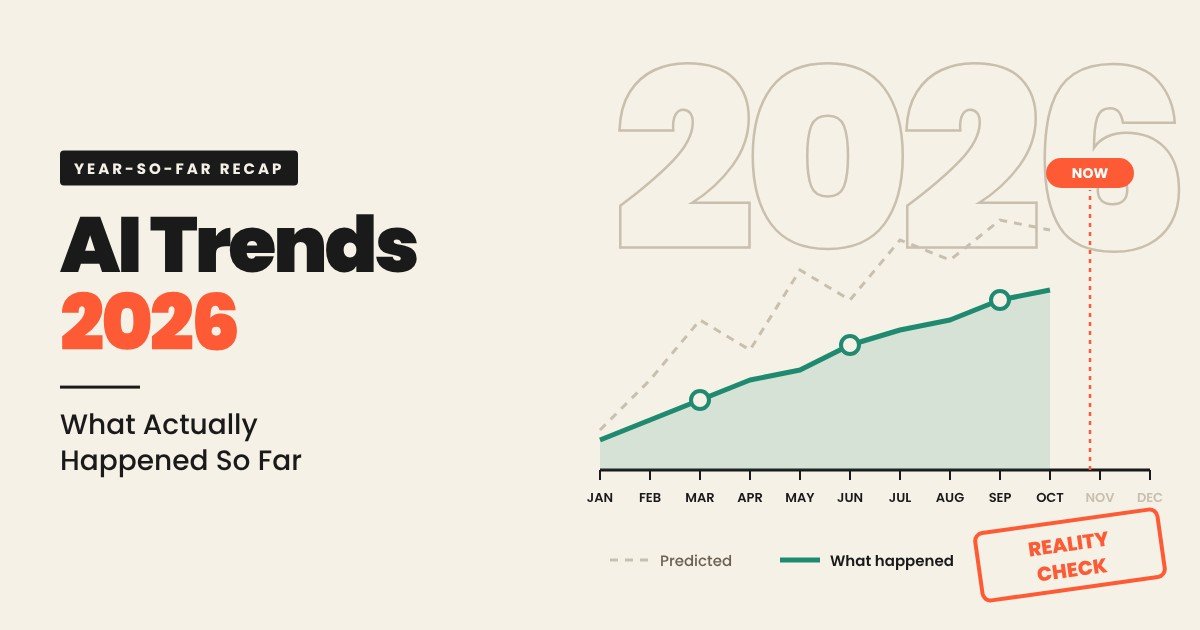
Most articles about AI trends in 2026 were written in December 2025. They were predictions.
This one is different. We are near the end of October 2026. The year has mostly happened. So instead of guessing, we can check the scoreboard.
The short version: capability ran ahead of deployment almost everywhere. Models got better. Adoption got broader. But the leap from “we use AI” to “AI does the work on its own” barely happened.
Here is what the data actually shows, and what it means for your planning.
The Headline Gap Nobody Predicted Correctly
One statistic frames the whole year.
Roughly 70% of organisations now use AI in at least one business function, according to Stanford HAI’s 2026 AI Index. That is mainstream adoption.
In the same report, deployment of autonomous agents sits in the single digits.
Read those two numbers together. Almost every company uses AI. Almost none has handed it a job to run unsupervised.
That gap is the real story of 2026. Everything else is a consequence of it.
Trend 1: Agents Went From Pilot to Pilot
The consensus prediction for 2026 was the year agents went to production. It did not happen at scale.
The technology improved genuinely. Orchestration frameworks matured. Protocols for tool access and payments got standardised. Several large firms shipped agent platforms.
What did not arrive was trust. Agents need supervision, and supervision costs money. That changes the business case completely.
The pattern that worked was narrow and bounded. Agents handling one defined task, inside one system, with a human reviewing output. The pattern that failed was the open-ended digital worker.
A useful example: OpenAI launched in-chat purchasing in early 2026 and retired it within weeks. The protocol survived. The product did not find users.
Trend 2: The Spending Question Became the Business Story
For the first half of 2026, the AI story was capability. By October, it was finance.
Big technology firms are on track for roughly $735 billion in combined capital spending this year, by one widely cited industry tally. Data-centre construction accelerated.
Then the questions started. Analysts flagged circular financing arrangements, where suppliers invest in customers who then buy their products. Credit markets began pricing in risk.
Both sides of this debate are serious.
- The bull case: demand for compute still exceeds supply, and infrastructure built now serves a decade.
- The bear case: revenue is not growing fast enough to service the debt, and the circularity hides weak end demand.
Nobody has settled it. For business planners, the practical implication is simpler. Do not build a strategy that assumes compute prices only fall.
Trend 3: Productivity Gains Are Real but Uneven
This is where 2026 produced the most useful data.
Measured productivity improvements on structured tasks, per the AI Index:
| Work type | Measured gain |
|---|---|
| Customer support | 14–15% |
| Software development | 26% |
| Marketing tasks | Up to 50% |
The important finding is the caveat attached. Gains shrink substantially on tasks requiring deeper reasoning or judgement.
That matches what practitioners report. AI compresses the predictable parts of a job. It does less for the parts that need context, negotiation, or accountability.
So the honest planning assumption is not “AI makes everyone 30% faster.” It is “AI makes specific, repetitive tasks much faster, and barely touches the rest.”
Trend 4: The Entry-Level Signal Got Harder to Ignore
One labour figure stands out. Employment for US software developers aged 22 to 25 fell by nearly 20% since 2024. Headcount for more experienced developers rose over the same period.
Correlation is not proof. Interest rates, post-pandemic over-hiring, and offshoring all played a part.
But the direction is consistent with what AI tools do well. They handle the bounded, well-specified work traditionally given to juniors.
Separately, about one third of surveyed organisations expect AI-driven workforce reductions in the coming year. That is an expectation, not an outcome. Track it rather than assuming it.
Trend 5: Search Discovery Changed Shape
AI answer engines moved from novelty to meaningful traffic source during 2026.
Google’s AI Mode scaled to enormous user numbers. AI Overviews became standard on informational queries. Assistants like ChatGPT and Perplexity became genuine research starting points.
The consequence for businesses was immediate. Being cited inside an AI answer started to matter as much as ranking on a results page.
This created a new discipline, variously called generative engine optimisation or AI search visibility. The tactics that work turn out to be unglamorous:
- Clear, structured, factually accurate content
- Strong third-party coverage and mentions
- Machine-readable product and service data
- Consistent entity information across the web
Notably, keyword tricks do not work on these systems. Credibility signals do.
Trend 6: Open-Weight Models Became a Cost Lever
A quieter 2026 trend with real budget impact.
Open-weight models closed much of the capability gap on routine tasks. For classification, extraction, summarisation, and routing, they became good enough.
Smart teams stopped sending every request to the most capable model. They built routing layers instead. Cheap model for easy work, expensive model for hard work.
This is now standard practice in cost-conscious engineering teams. If your AI bill grew faster than your usage this year, this is usually why.
Trend 7: Governance Moved From Policy to Plumbing
The EU AI Act’s obligations started biting in 2026. Compliance stopped being a legal memo and became an engineering requirement.
What changed practically:
- Teams had to document what their systems do and what data trained them.
- High-risk use cases needed human oversight designed in, not bolted on.
- Logging and traceability became product features, not nice-to-haves.
Most firms discovered their AI inventory was incomplete. Shadow AI use inside departments turned out to be widespread.
The firms that handled this well treated it as an operations project, not a legal one.
Trend 8: Physical AI Left the Lab, Barely
Robotics got the most dramatic demo reels of 2026 and the thinnest deployment data.
Vision-language-action models genuinely work. They let robots attempt tasks nobody explicitly programmed. That is a real breakthrough.
But Interact Analysis estimated only about 10% of the 20,000-plus humanoid robots produced in 2025 reached real operational environments. Independent assessment put autonomous task performance near 78%, against the 95% or better that unsupervised industrial work needs.
Two enterprise programmes published meaningful operating numbers. Nearly every other announcement was a partnership, not a result.
What Changed for Small and Mid-Sized Businesses
Enterprise coverage dominates AI reporting. The smaller-business picture looked different in 2026.
Access stopped being the problem. Capable models became cheap, and tools arrived packaged rather than bespoke. A ten-person firm could use the same model as a bank.
Three things actually moved the needle at this size:
- Content and marketing production. The clearest return, because output volume is measurable and review is fast.
- Customer support triage. Sorting and drafting rather than resolving. Humans still send the reply.
- Back-office extraction. Pulling data out of invoices, forms, and documents into usable records.
What did not work was buying an agent platform without a defined task. Smaller firms lack the supervision capacity that agentic systems still demand.
The practical advantage smaller businesses had this year was speed of decision. No committee, no procurement cycle, no legacy integration. Several moved faster than much larger competitors on exactly the same tools.
Predictions Versus Reality: A Scorecard
| Prediction made in late 2025 | What happened by October 2026 |
|---|---|
| Agents reach production at scale | Partly. Narrow agents yes, autonomous ones in single digits |
| AI capex keeps rising unquestioned | Rose sharply, then met serious financing scrutiny |
| Massive broad productivity gains | Real but concentrated in structured tasks |
| AI search reshapes discovery | Correct, and faster than expected |
| Humanoid robots enter factories | Overstated; pilots yes, fleets no |
| Model costs keep collapsing | Mostly held, but agent workloads raised total spend |
| Regulation stalls innovation | No. It added work, not blockers |
The pattern is consistent. Directional predictions were mostly right. Timing predictions were mostly too fast.
What to Watch Through Early 2027
Four things will decide how the next year reads.
Whether agent supervision costs fall. This is the single gate on autonomous deployment. Watch intervention rates, not accuracy claims.
Whether AI revenue catches up to AI spending. The financing debate resolves one way or the other, and it affects compute pricing for everyone.
Whether AI search traffic converts. Brands are getting cited. Whether that citation produces customers is still poorly measured.
Whether entry-level hiring recovers. If it does, 2026’s dip was cyclical. If it does not, the structural reading gains weight.
Final Thoughts
The most useful lesson from AI trends in 2026 is about pace, not direction.
Nearly every big prediction was correct about what would happen. Nearly all of them were wrong about when. Capability arrived faster than the organisational ability to use it.
That gap is where the opportunity sits. The constraint on most businesses this year was not model quality. It was process, data readiness, and the cost of supervising systems that are right 80% of the time.
So the practical move for the rest of 2026 is unexciting and effective. Find the repetitive, bounded, measurable tasks in your business. Automate those properly. Measure the result honestly.
Leave the autonomous digital workforce for when the supervision economics actually work.
FAQs
What is the biggest AI trend of 2026?
The gap between adoption and autonomy. About 70% of organisations use AI somewhere, but autonomous agent deployment remains in single digits.
Did AI agents live up to the hype in 2026?
Partly. Narrow, supervised agents delivered real value, but open-ended autonomous agents stayed stuck in pilots because supervision costs too much.
How much productivity does AI actually deliver?
Measured gains run about 14–15% in customer support, 26% in software development, and up to 50% on marketing tasks. Gains fall sharply on judgement-heavy work.
Is the AI investment boom a bubble?
Unresolved. Spending is near $735 billion this year, and analysts disagree over whether revenue growth and financing structures can support it.
What should businesses prioritise for 2027 planning?
Automate bounded, repetitive, measurable tasks first. Track intervention rates on anything agentic, and avoid plans that assume compute costs only fall.


 AI/ML Strategy and Consulting
 Data Science And Data Analytics
 Generative AI
 AI Consulting Services
 AI Automation Solutions
 API Integration