
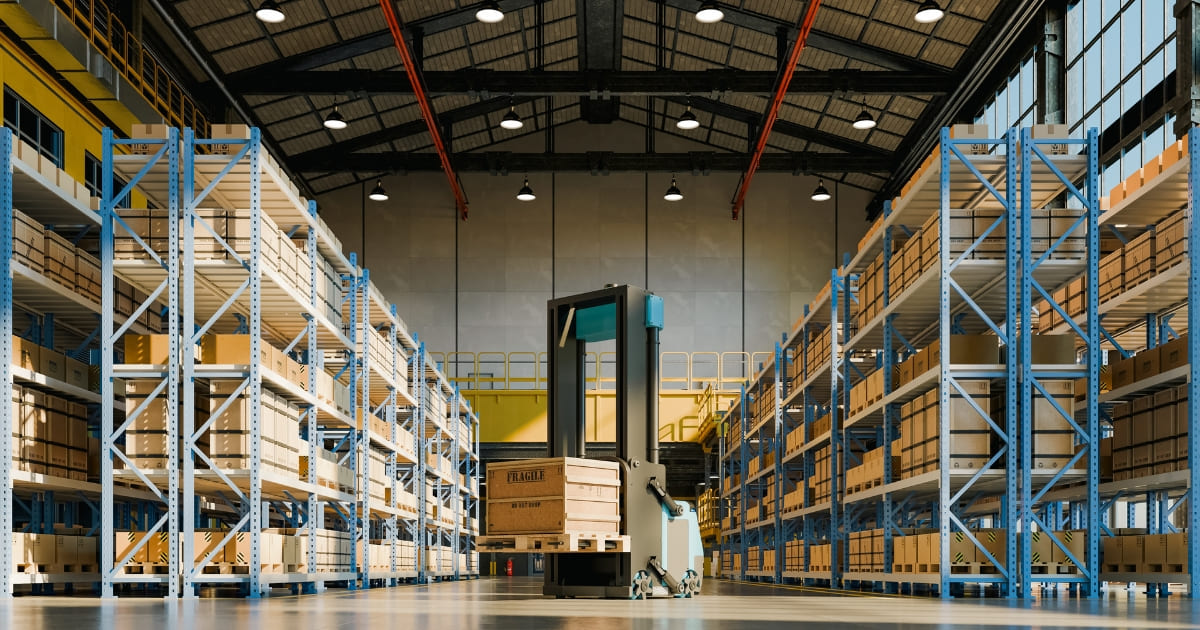
Warehouses are under more pressure than ever. Customers expect same-day shipping. SKU counts keep growing. Labor shortages make it harder to find and retain workers. Running a modern warehouse on manual processes alone is no longer sustainable.
- AI adds dynamic intelligence to workflows, optimizing inventory placement, demand forecasting, staffing, and computer vision quality checks to reduce errors and increase throughput.
- Autonomous robots and goods-to-person systems boost picker productivity, cut walking time, and maximize storage density in high-volume and space-constrained warehouses.
- Cloud WMS and AI platforms automate order routing, carrier selection, and multi-channel fulfillment while linking warehouse decisions to broader supply chain planning.
- Start by diagnosing bottlenecks, ensure data readiness, manage change with staff training, and expect measurable ROI within six to eighteen months.
AI tools for warehouse automation address these challenges head-on. They optimize inventory placement, guide robotic picking systems, predict demand fluctuations, and streamline every step from receiving to dispatch. The technology is no longer reserved for massive fulfillment centers. Mid-sized operations now access the same intelligence at an affordable scale.
Here are ten platforms and systems driving smarter warehouse operations right now.
Why Warehouses Need AI-Powered Automation in 2026
Traditional warehouse management relies on static rules and human decision-making. Workers follow fixed pick paths. Inventory sits wherever space is available. Reorder points are based on rough estimates. These methods waste time, space, and money.
AI introduces dynamic intelligence into every workflow. Machine learning algorithms analyze order patterns to position fast-moving products closer to packing stations. Computer vision systems inspect items for damage without slowing the line. Predictive models adjust staffing and inventory levels based on real-time demand signals.
The warehouses adopting AI-driven automation consistently outperform those that do not. They ship faster, carry less excess stock, and operate with fewer errors. In a market where fulfillment speed defines competitive advantage, that gap widens every quarter.
10 Best AI Tools for Warehouse Automation
1. Symbotic
Symbotic builds end-to-end AI-powered robotic warehouse systems. Its platform uses autonomous robots that store, retrieve, and organize inventory inside dense storage structures with minimal human involvement.
The AI engine continuously optimizes how products are stored based on order velocity and demand patterns. Symbotic’s systems operate inside major retailers and distributors, handling millions of cases per week. Its modular design lets warehouses scale capacity without major facility changes.
Best for: Large-scale distribution centers handling high-volume, case-level inventory.
2. Locus Robotics
Locus Robotics deploys autonomous mobile robots that work alongside warehouse staff during picking operations. Its AI assigns tasks to robots in real time, optimizing pick paths and balancing workloads across the floor.
Workers stay in their zones while robots travel between them, reducing walking time by up to 50%. The platform adapts instantly to changes in order volume, making it particularly effective during seasonal peaks.
Best for: Fulfillment centers looking to boost picker productivity without redesigning their layout.
3. 6 River Systems
6 River Systems, owned by Shopify, offers collaborative mobile robots called Chucks. These robots guide warehouse workers through optimized pick routes and carry items to packing stations.
The AI behind Chucks learns from operational data to improve routing efficiency over time. The system integrates with most warehouse management software and requires minimal infrastructure changes. Setup typically takes weeks rather than months.
Best for: E-commerce fulfillment operations that need fast deployment and flexible scaling.
4. Logiwa IO
Logiwa IO is a cloud-based warehouse management system built for high-volume direct-to-consumer fulfillment. Its AI engine automates order routing, inventory allocation, and shipping carrier selection.
The platform processes orders from multiple sales channels and determines the most efficient fulfillment strategy automatically. It integrates with over 200 e-commerce platforms, marketplaces, and shipping carriers. Logiwa also provides demand forecasting to help warehouses prepare for volume shifts.
Best for: Multi-channel e-commerce brands managing fulfillment across several warehouses or 3PL partners.
5. AutoStore
AutoStore is a cube-based storage and retrieval system powered by AI. Robots operate on a grid above densely packed inventory bins, retrieving items and delivering them to pick stations on demand.
The AI prioritizes bin placement based on order frequency. High-demand products move to the top of the grid for faster retrieval. AutoStore maximizes storage density, fitting up to four times more inventory in the same footprint compared to traditional shelving.
Best for: Warehouses with limited floor space that need to maximize storage capacity.
6. Covariant
Covariant specializes in AI-powered robotic picking. Its platform uses computer vision and deep learning to teach robotic arms how to identify, grasp, and sort a wide variety of items.
Unlike traditional pick-and-place robots programmed for specific products, Covariant’s system handles unpredictable item shapes, sizes, and packaging. It learns continuously from every interaction, improving accuracy over time. This makes it ideal for warehouses with diverse, constantly changing inventory.
Best for: Operations with high SKU diversity that need flexible, intelligent robotic picking.
7. Exotec
Exotec builds the Skypod system — a fleet of autonomous robots that move both horizontally and vertically within a warehouse racking structure. The AI orchestrates robot movements to minimize retrieval time and avoid congestion.
Skypod robots reach items stored at heights up to 12 meters, eliminating the need for mezzanines or manual high-reach equipment. The system delivers consistent throughput regardless of warehouse size or order complexity.
Best for: Warehouses needing high-density, high-speed goods-to-person automation.
8. Blue Yonder
Blue Yonder provides an AI-driven supply chain management platform with strong warehouse optimization capabilities. Its machine learning models forecast demand, plan labor, and optimize inventory placement across distribution networks.
The platform integrates warehouse execution with broader supply chain planning. This means inventory decisions inside the warehouse align with purchasing, transportation, and retail replenishment strategies. Blue Yonder suits companies that want warehouse intelligence connected to end-to-end supply chain visibility.
Best for: Enterprises that need warehouse automation tied to full supply chain planning.
9. GreyOrange
GreyOrange combines AI software with autonomous robotic systems for fulfillment operations. Its GreyMatter platform orchestrates robots, people, and workflows in real time to meet service-level targets.
The AI continuously reassigns tasks based on shifting priorities. If a rush order arrives, the system reallocates resources instantly. GreyOrange supports goods-to-person picking, sorting, and inventory replenishment across both warehouse and store environments.
Best for: Omnichannel retailers managing fulfillment from both warehouses and stores.
10. Berkshire Grey
Berkshire Grey develops AI-enabled robotic systems specifically for pick, pack, and sort processes. Its solutions automate some of the most labor-intensive tasks in warehouse operations.
The platform uses computer vision to identify items and intelligent gripping to handle them reliably. Berkshire Grey’s systems integrate directly into existing conveyor and sortation infrastructure. Companies deploy them to reduce labor dependency while maintaining or increasing throughput.
Best for: High-volume warehouses seeking to automate manual pick, pack, and sort workflows.
Comparing the Top AI Warehouse Automation Tools
| Tool | Primary Strength | Ideal Operation | Key AI Capability |
|---|---|---|---|
| Symbotic | End-to-end robotic automation | Large distribution centers | Demand-based storage optimization |
| Locus Robotics | Collaborative mobile robots | Fulfillment centers | Real-time task assignment and path optimization |
| 6 River Systems | Guided picking robots | E-commerce fulfillment | Learning-based route efficiency |
| Logiwa IO | Cloud-based WMS | Multi-channel e-commerce | Automated order routing and demand forecasting |
| AutoStore | Cube storage and retrieval | Space-constrained warehouses | Frequency-based bin prioritization |
| Covariant | AI robotic picking | High-SKU operations | Vision-based item recognition and grasping |
| Exotec | Vertical goods-to-person | High-density facilities | Autonomous 3D robot orchestration |
| Blue Yonder | Supply chain-connected WMS | Enterprise logistics | Predictive demand and labor planning |
| GreyOrange | Real-time fulfillment orchestration | Omnichannel retailers | Dynamic resource reallocation |
| Berkshire Grey | Robotic pick, pack, and sort | High-volume warehouses | Vision-guided intelligent gripping |
How to Choose the Right AI Tool for Your Warehouse
Selecting the right platform depends on your operation’s specific bottlenecks. Consider these factors carefully:
- Biggest pain point: If picking is your slowest process, robotic solutions like Locus or Covariant deliver the fastest impact. If storage is the constraint, AutoStore or Exotec free up space.
- Facility size and layout: Some robotic systems require specific infrastructure. Others, like 6 River Systems, work within existing layouts with minimal changes.
- SKU complexity: Warehouses with thousands of varied products need flexible AI like Covariant. Operations handling uniform cases may benefit more from Symbotic.
- Integration requirements: Cloud platforms like Logiwa and Blue Yonder connect with existing ERP and e-commerce systems. Robotic solutions need compatible conveyor and racking setups.
- Budget and ROI timeline: Robotics-as-a-service models from companies like Locus Robotics lower upfront costs. Full system installations from Symbotic or Exotec require larger capital investment but deliver long-term throughput gains.
Start by mapping your highest-cost, most error-prone workflow. Apply AI there first, measure results, then expand.
What Kind of ROI Can Warehouses Expect From AI Automation
The financial impact depends on your starting point, but the patterns are consistent. Most operations see a measurable return within six to eighteen months of deployment.
Labor savings represent the largest cost reduction for most warehouses. AI-guided robots reduce the number of workers needed for picking and sorting tasks. Error rates typically drop because AI systems pick and place items with greater accuracy than manual processes.
Throughput improvements are another major gain. Warehouses processing more orders per hour with the same footprint effectively increase capacity without building new facilities. When demand spikes hit, AI systems scale output by reallocating resources rather than scrambling for temporary labor.
Common Mistakes When Implementing Warehouse AI
The most frequent error is choosing technology before defining the problem. A cutting-edge robotic system adds no value if your real bottleneck is inventory accuracy or demand forecasting. Diagnose the issue first, then match the tool.
Another mistake is underestimating change management. Warehouse teams need training and time to trust new systems. Rushing deployment without preparing staff leads to resistance and underutilization. Involve floor-level workers early in the process.
Finally, avoid ignoring data readiness. AI tools rely on clean, structured data to perform well. If your inventory records are inaccurate or your WMS data is inconsistent, fix the foundation before layering AI on top.
FAQs
AI tools for warehouse automation are software platforms and robotic systems that use artificial intelligence to optimize tasks like inventory management, order picking, storage, and fulfillment inside warehouse operations.
Costs vary widely. Robotics-as-a-service models start at a few thousand dollars per month per robot. Full system installations from providers like Symbotic or Exotec can require significant capital investment depending on warehouse size.
Yes. Cloud-based platforms like Logiwa IO and collaborative robots from 6 River Systems offer scalable solutions designed for mid-sized operations. Many vendors offer flexible pricing that grows with your volume.
AI automates picking, sorting, packing, inventory placement, demand forecasting, labor scheduling, and order routing. Advanced systems also handle quality inspection using computer vision and real-time resource reallocation.
Cloud-based WMS platforms can go live in weeks. Collaborative robot deployments typically take one to three months. Full-scale robotic infrastructure installations may require six months or more depending on complexity and facility modifications.


 AI/ML Strategy and Consulting
 Data Science And Data Analytics
 Generative AI
 AI Consulting Services
 AI Automation Solutions
 API Integration