

AI agents stopped being demos in 2026. They now write and ship code, run research projects overnight, handle support tickets, and update CRM records without anyone watching. Gartner projected that 40% of enterprise applications would include task-specific agents by 2026, up from under 5% a year earlier. That prediction landed.
- Agents execute tasks autonomously, planning, acting, observing, and iterating, unlike chatbots that only suggest.
- Match agent specialty and tool access to the actual job: coding, research, repeatable workflows, or embedded enterprise platforms.
- Plan for heavy token usage and variable pricing; enforce governance, clear scopes, and human review on anything touching production or customers.
- Shortlist two candidates, run them on a real task you recently completed, and compare outputs to pick the right agent.
The problem is choosing one. Vendors publish their own rankings, pricing changes monthly, and half the tools on older lists no longer exist in the form described. This guide covers the best AI agents available today, split by the job you actually need done.
What Is an AI Agent?
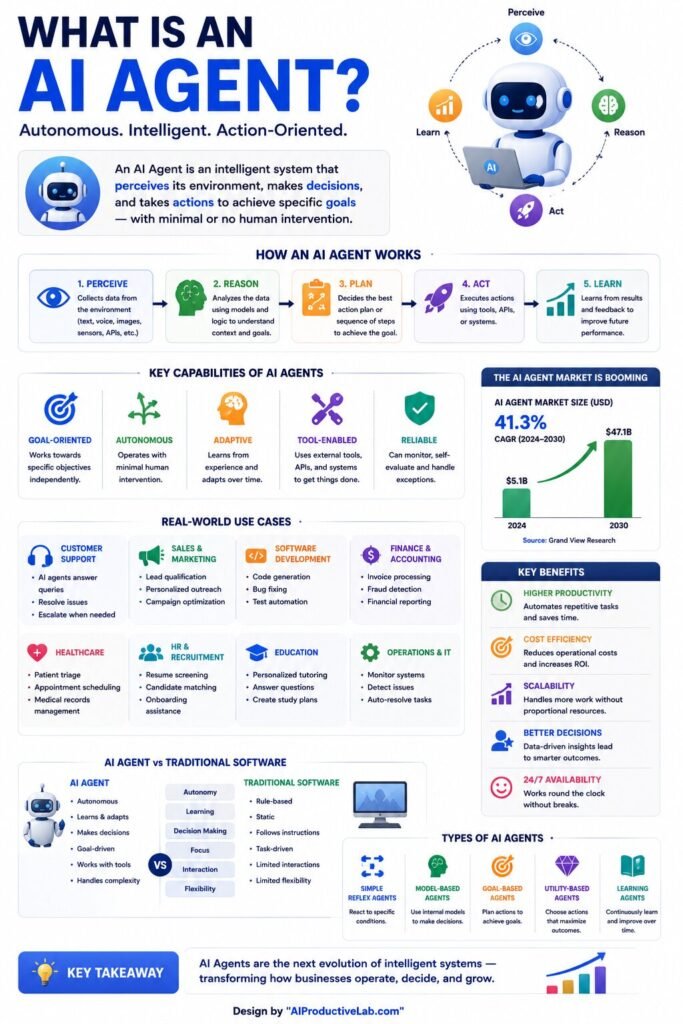
An AI agent is a software system that reasons, plans, takes actions, and iterates toward a goal. The difference from a chatbot is execution. A chatbot suggests. An agent does the work, checks the result, and tries again if it fails.
Most modern agents follow a loop: gather context, plan, act, observe the outcome, repeat. They connect to your tools through APIs or browser control. Some run on your local files. Others operate entirely in a cloud sandbox.
A useful rule from the developer community: agent equals model plus harness. The model supplies raw intelligence. The harness, meaning the memory, tools, permissions, and error handling around it, turns that intelligence into reliable work.
How We Compared the Best AI Agents
Feature lists rarely predict real performance. These factors matter more.
- Autonomy level: Can it run unsupervised for an hour, or does it need constant check-ins?
- Tool access: Does it reach your local files, your browser, your APIs, or all three?
- Pricing model: Flat subscription or credit-metered? Credits get expensive fast on long tasks.
- Failure behavior: Good agents stop and ask. Weak ones confidently produce wrong output.
- Governance: Who approves actions that touch production systems or customer data?
Best General-Purpose AI Agents
Claude Cowork
Cowork is Anthropic’s agent surface for knowledge work. It runs multi-step tasks in the background, works directly on your actual files, and checks in with intermediate output. It is bundled into paid Claude plans starting around $20 per month, with no separate agent fee. Strengths are reasoning quality and long-context analysis. It has narrower browser automation than dedicated agent platforms.
ChatGPT Agent Mode
OpenAI folded its earlier browser-only Operator product into a broader agent mode inside ChatGPT. It runs on a cloud virtual machine, browses the web, and completes multi-step tasks end to end. Higher tiers get significantly more allowance. The main limitation is that it has no local file access, so everything must flow through OpenAI’s infrastructure.
Manus
Manus popularized the general-purpose autonomous agent and turned it into a credit-metered product. It runs code, manages files in its own sandbox, and executes broad research tasks with real browser control. A free tier offers refreshing daily credits, which makes it easy to test. Watch the credit burn on long-running jobs, since costs are less predictable than flat plans.
Microsoft 365 Copilot
Copilot’s Researcher and Analyst agents work autonomously inside Office apps, generating reports and analyzing datasets without step-by-step prompting. Copilot Studio extends this into custom workflow agents across the Microsoft stack. Pricing runs roughly $20 to $30 per user monthly on top of a Microsoft 365 subscription. Best for organizations already committed to that ecosystem.
Best AI Coding Agents
Coding is where agents are most mature, and where the field is most crowded.
Claude Code
Claude Code operates in the terminal, IDE, or desktop app and handles large refactors and long autonomous runs. It loads full project context on each invocation, which helps on complex codebases. Plans start around $20 per month, with heavier tiers for sustained agentic use. Usage limits apply, so check current allowances before committing a team.
OpenAI Codex
Codex runs asynchronously in a sandboxed cloud environment and integrates tightly with GitHub workflows and pull request review. It is included across ChatGPT paid plans, with billing now aligned to token usage rather than message counts. Strong for delegated, well-scoped tickets rather than exploratory architecture work.
Cursor
Cursor is an AI-native IDE rather than a background agent. Its agent mode handles multi-step edits with checkpoints, which many developers prefer over full autonomy. Pricing starts around $20 per month, though usage limits vary sharply by model. Higher-quality models consume your allocation much faster.
Devin
Devin from Cognition is a fully autonomous software engineer for bounded, well-specified tasks. It plans, writes, tests, and iterates without intervention. Its price floor dropped dramatically in 2026, making it far more accessible. Output quality degrades on ambiguous requirements and complex architectural decisions, so scope tasks tightly.
OpenHands
OpenHands is the strongest free option. It is MIT-licensed, open source, and benchmarks competitively against paid alternatives on real bug-fixing tasks. You pay only for model API calls. Worth testing before you commit budget to a commercial coding agent.
Best AI Agents for Business Automation
Gumloop
Gumloop is an agent builder used by teams at companies including Shopify and Instacart. Its assistant builds agents for you, premium models are included without separate API keys, and MCP support connects almost any tool. A free plan exists, with paid tiers from around $37 per month including unlimited seats. Strong value for growing teams.
n8n
n8n is the open-source workflow automation platform that grew into an agent framework. Self-hosting is free forever, which makes it attractive for teams with data residency requirements or tight budgets. It demands more technical setup than no-code alternatives, but the ceiling is much higher.
Lindy AI
Lindy is a no-code agent builder for business workflows, with drag-and-drop creation and over 100 native API integrations rather than browser scraping. Pre-built templates cover lead routing, inbox triage, and CRM updates. Agents run on schedules or triggers. Pricing sits near $50 per month, and the free tier was removed in 2026.
MindStudio
MindStudio offers unlimited agents at a low flat rate and passes model costs through without markup. That pricing structure suits teams running many small agents rather than a few heavy ones. Expect to do more configuration yourself compared with fully managed platforms.
Best Enterprise AI Agent Platforms
Salesforce Agentforce
Agentforce takes independent action inside Salesforce: updating records, resolving cases, and qualifying leads. Its reasoning engine follows a reason-act-observe cycle for multi-step execution. Salesforce reports thousands of active deployments across dozens of countries. Best for organizations where the CRM is already the system of record.
Microsoft Copilot Studio
Copilot Studio lets enterprises build custom agents that trigger workflows across Microsoft services, with tuning for domain-specific behavior. If your company already pays for Microsoft 365, check what is bundled before buying a separate platform. Many teams discover they already own an agent builder.
AI Agent Comparison Table
| Agent | Best For | Typical Starting Price |
|---|---|---|
| Claude Cowork | Knowledge work on real files | ~$20/month |
| ChatGPT Agent | Browser and web tasks | ~$20/month |
| Manus | Autonomous research | Free credits; metered |
| Microsoft 365 Copilot | Microsoft-based teams | ~$20/user/month |
| Claude Code | Large refactors, terminal work | ~$20/month |
| OpenAI Codex | GitHub-based delegation | Included in ChatGPT plans |
| Cursor | AI-native IDE workflow | ~$20/month |
| Devin | Delegated, well-scoped tickets | From ~$20/month |
| OpenHands | Free open-source coding | Free plus API costs |
| Gumloop | Team agent building | Free; from ~$37/month |
| n8n | Self-hosted automation | Free self-hosted |
| Lindy AI | No-code business workflows | ~$50/month |
| Salesforce Agentforce | CRM-centred enterprise work | Custom |
Verify pricing directly with vendors. This category changes monthly.
How to Choose the Right AI Agent
Start from the work, not the leaderboard.
- Research and analysis: Claude Cowork or Manus handle long, multi-step investigation well.
- Shipping code: Claude Code or Cursor for hands-on work, Devin or Codex for delegated tickets.
- Repeatable business workflows: Gumloop, Lindy, or n8n if you want control and self-hosting.
- Already in Microsoft or Salesforce: Check what you own before buying anything new.
- Tight budget: OpenHands, n8n, and Manus free credits let you test the category for nothing.
What to Watch Out For
Agents burn tokens at roughly a hundred times the rate of a chat user. That reality reshaped pricing across the industry in 2026, with several vendors moving from flat plans to usage-based billing. Budget for variability.
Also plan for supervision. Autonomous runs can go long before producing reviewable output, and an agent working from ambiguous instructions will produce confident, wrong results. Give agents narrow scopes, clear success criteria, and a human review step on anything that touches customers or production.
Final Thoughts
There is no single best AI agent in 2026, and anyone claiming otherwise is usually selling one. The category has split into specialists: coding agents, research agents, workflow builders, and embedded enterprise platforms. Pick two candidates that match your actual bottleneck, run them on a real task you completed last month, and compare the output honestly. That test tells you more than any ranking.
FAQs
It depends on the task. Claude Cowork leads for knowledge work, Claude Code for programming, and Gumloop for team workflows.
Yes. OpenHands and n8n are open source and free to self-host, and Manus offers refreshing daily credits.
A chatbot responds with text. An agent plans, uses tools, takes real actions, and iterates until the task is complete.
Most general-purpose agents start near $20 per month. Enterprise platforms and heavy usage tiers can reach $200 monthly or more.
Partly. They handle well-defined tasks alone, but ambiguous work still needs human review before results are used.




 AI/ML Strategy and Consulting
 Data Science And Data Analytics
 Generative AI
 AI Consulting Services
 AI Automation Solutions
 API Integration