

Generative AI has moved out of the pilot stage. McKinsey’s global survey found that 65% of organizations already use generative AI regularly in at least one business function, roughly double the previous year. Gartner projects that more than 80% of enterprises will have deployed generative AI applications in production by the end of 2026.
- Generative AI creates new content, like text, code, images, audio, or synthetic data, distinct from predictive AI.
- High-value use cases include code generation, customer service automation, content creation, clinical documentation, and enterprise knowledge search.
- Start with short feedback loops, high-volume moderate-stakes work, and measure specific metrics like resolution time or hours saved.
- Ground models in verified internal data using retrieval-augmented generation to reduce hallucination and improve sourcing.
- Scale with governance, human oversight, auditing, and by restructuring workflows around measurable generative AI tasks.
The question has changed. It is no longer “should we try this?” but “which generative AI use cases actually deliver value?” Below are 15 applications already producing measurable results, with real examples from companies running them today.
What Counts as a Generative AI Use Case?
Generative AI creates new content: text, code, images, audio, or synthetic data. That distinguishes it from traditional AI, which classifies or predicts based on existing data.
The practical difference matters. Predictive AI tells you which customers might churn. Generative AI writes the retention email, drafts the discount policy, and summarizes why the churn happened. The use cases below all involve producing something new, not just scoring what already exists.
Highest-Value Generative AI Use Cases in 2026
1. Software Development and Code Generation
Software engineering has the highest adoption of any business function. Tools like GitHub Copilot, Cursor, and Claude Code now write, review, and refactor code, generate tests, and produce documentation. A 2026 survey of 457 software engineering researchers found genAI adoption widespread across the field. Teams report the biggest gains on boilerplate, test coverage, and unfamiliar codebases rather than novel architecture.
2. Customer Service Automation
Klarna’s AI assistant handles end-to-end customer service across 23 markets in more than 35 languages, covering refunds, returns, payment disputes, and account changes. This use case works because the feedback loop is short and measurable: resolution time, deflection rate, and satisfaction scores all move visibly. Human escalation paths remain essential for complex or emotional cases.
3. Content Creation and Copywriting
Marketing teams use generative AI for first drafts of blog posts, product descriptions, email campaigns, and social copy. It is among the highest-adoption use cases precisely because output is easy to measure. The teams getting real value apply editorial guardrails from day one: human sign-off, brand tone governance, and fact-checking before anything ships.
4. Ambient Clinical Documentation
This is one of the fastest-adopted use cases anywhere. Tools including Abridge, Microsoft Dragon Copilot, Suki, and Nabla listen to patient consultations and generate structured clinical notes directly into the electronic health record. Kaiser Permanente expanded AI scribes across 40 hospitals in eight states. WVU Medicine rolled Abridge out to 2,800 clinicians. Early adopters report saving 45 minutes to over two hours per physician per day.
5. Enterprise Knowledge Search and Summarization
Every large organization sits on documents nobody can find. Retrieval-augmented generation connects a model to internal wikis, contracts, tickets, and reports so employees can ask questions in plain language and get sourced answers. Grounding the model in verified internal data also reduces hallucination, which is why this pattern has become standard for regulated industries.
6. Marketing Personalization at Scale
Connected to CRM and marketing automation platforms, generative AI produces variant messaging for individual customer segments rather than one message for everyone. A retailer can generate hundreds of subject lines, product recommendations, and landing page versions tuned by segment. The constraint is data quality, not model capability.
7. Sales Research and Outreach
Sales teams use generative AI to research accounts, summarize past interactions, draft personalized outreach, and prepare call briefs. The strongest implementations pull from CRM history rather than generating generic messages, which is what separates useful personalization from obvious template spam.
8. Legal and Contract Review
Generative AI reviews contracts against a playbook, flags non-standard clauses, explains risk in plain English, and drafts suggested redlines. Legal teams use it as a first pass to triage volume, not as a replacement for counsel. The value is in surfacing the ten clauses worth a lawyer’s attention out of two hundred.
9. Automated Financial Reporting
Generative AI drafts earnings summaries, risk reports, and regulatory filings from structured financial data. Analysts shift from producing documents to reviewing exceptions and applying judgement. Because outputs are auditable against source data, this use case fits regulated environments better than most.
10. Fraud Detection and Deepfake Defence
Fraud has become a generative AI arms race. A reported 900% surge in deepfake-driven fraud since 2023 has made signature-based detection systems inadequate. Financial institutions now use generative models to simulate emerging fraud patterns and stress-test defences against synthetic identities and voice cloning.
11. Synthetic Data Generation
Regulated industries often cannot use real customer data for testing or model training. Generative AI creates statistically representative synthetic datasets that preserve patterns without exposing individuals. Recent research has validated synthetic data for statistical inference at scale, moving this from workaround to legitimate method.
12. Product and Industrial Design
Generative design tools produce many candidate designs against defined constraints such as weight, cost, and material limits. Engineers then select and refine rather than starting from a blank screen. Manufacturing and automotive teams use this to compress early-stage exploration from weeks to days.
13. Drug Discovery
Pharmaceutical research uses generative models to propose novel molecular structures with target properties, dramatically widening the candidate pool before expensive lab work begins. This does not shorten clinical trials, but it does change the economics of the earliest and cheapest stage of the pipeline.
14. Cybersecurity Threat Simulation
Security teams use generative AI to simulate realistic attack patterns and test defences before real attackers do. This matters more each year: Palo Alto Networks reported that 99% of surveyed organizations experienced at least one attack on AI apps or services in the previous year, as AI adoption expanded the attack surface.
15. Creative Production for Advertising
Ad teams generate video, image, and UGC-style creative from a product URL or brief, then test dozens of variations rather than two. Because creative volume is the main constraint on paid social performance, this use case has a direct, traceable link to revenue.
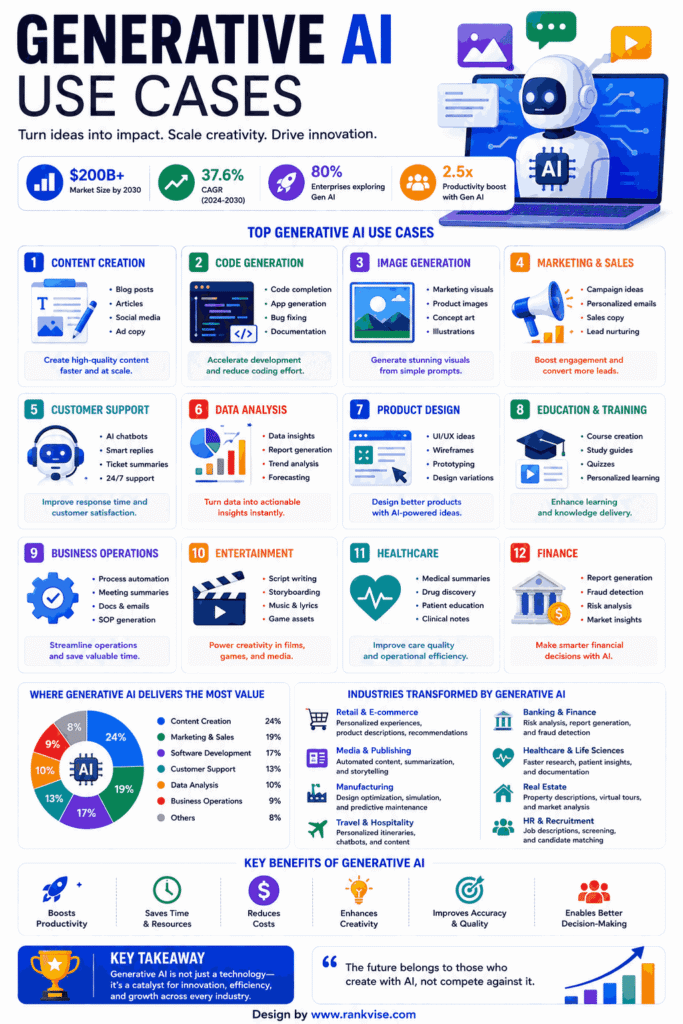
Use Cases by Business Function
| Function | Leading Use Case | Typical Payoff |
|---|---|---|
| Engineering | Code generation and testing | Developer time saved |
| Support | Automated resolution | Lower handling time |
| Marketing | Content and personalization | Faster campaign cycles |
| Sales | Research and outreach | More qualified conversations |
| Finance | Automated reporting | Analyst time redirected |
| Legal | Contract triage | Faster review throughput |
| Healthcare | Ambient documentation | Clinician hours returned |
| Security | Threat simulation | Earlier vulnerability discovery |
How to Pick Your First Use Case
Most failed AI programs start in the wrong place. A few rules help.
- Choose a short feedback loop. Pick work where you can measure a before-and-after number within weeks, not quarters.
- Start where volume is high and stakes are moderate. First-draft content, ticket triage, and code review all qualify.
- Measure something specific. Resolution time, review hours, time-to-draft. Adoption rates prove nothing on their own.
- Ground the model in your data. Retrieval-augmented generation on verified internal sources beats a clever prompt every time.
- Build literacy broadly. Organizations that train whole teams, not one designated “AI person,” reach value faster on every use case after the first.
What to Watch Out For
Governance cannot be an afterthought. As usage scales past the pilot, you need data privacy review, output auditing, and factual grounding built into the workflow.
The bigger shift underway is architectural. Single-prompt chatbots are giving way to agentic workflows that plan and execute multi-step tasks. Gartner projects that roughly 40% of enterprise applications will include task-specific AI agents by the end of 2026. That raises the value of these use cases and the importance of getting oversight right.
Final Thoughts
The organizations seeing real returns are not the ones experimenting broadly. They are the ones restructuring specific workflows around generative AI and measuring the result.
Pick one use case from this list that maps to a genuine bottleneck in your business. Run it for a quarter with a defined metric. What you learn there will tell you far more about where generative AI fits in your organization than any vendor demo.
FAQs
Content creation, code generation, customer service automation, marketing personalization, and document summarization lead enterprise adoption.
Traditional AI classifies or predicts from existing data. Generative AI produces new content such as text, code, images, or synthetic datasets.
Software development shows the highest adoption, while healthcare documentation delivers some of the clearest measurable time savings.
Choose high-volume, moderate-stakes work with a short feedback loop, such as first-draft content or support ticket triage.
Yes. Human review, output auditing, and data grounding remain essential, especially in regulated or customer-facing workflows.




 AI/ML Strategy and Consulting
 Data Science And Data Analytics
 Generative AI
 AI Consulting Services
 AI Automation Solutions
 API Integration