


You have thousands of customers but treat them all the same. Your marketing messages reach everyone identically. Some customers love your approach while others ignore you completely. The problem isn’t your product. The problem is your segmentation.
- AI segmentation uses machine learning to group customers by behavior and patterns, outperforming basic demographic approaches.
- Combines transactional, behavioral, demographic, psychographic, and engagement data for multi-dimensional, meaningful clusters.
- Key methods include clustering, predictive, behavioral, and real-time dynamic segmentation for adaptive marketing.
- Benefits: tighter targeting, scalable personalization, higher ROI, predictive intelligence, and operational efficiency.
- Successful implementation needs data readiness, clear objectives, right tools, activation in channels, and continuous measurement.
Traditional customer segmentation relies on basic demographics and broad categories. Age, location, and gender tell you something but miss the deeper patterns driving purchase behavior. Meanwhile, your customer data contains insights you cannot see or process manually.
AI customer segmentation changes this equation fundamentally. According to recent industry research, 92% of businesses now use AI-driven personalization to stimulate growth. The technology analyzes vast datasets to identify meaningful customer groups based on actual behavior rather than assumptions.
The shift matters because personalization drives results. McKinsey research confirms that consumers increasingly seek tailored online interactions. Companies that deliver personalized experiences capture more market share. Those relying on generic approaches fall behind competitors who understand their customers more deeply.
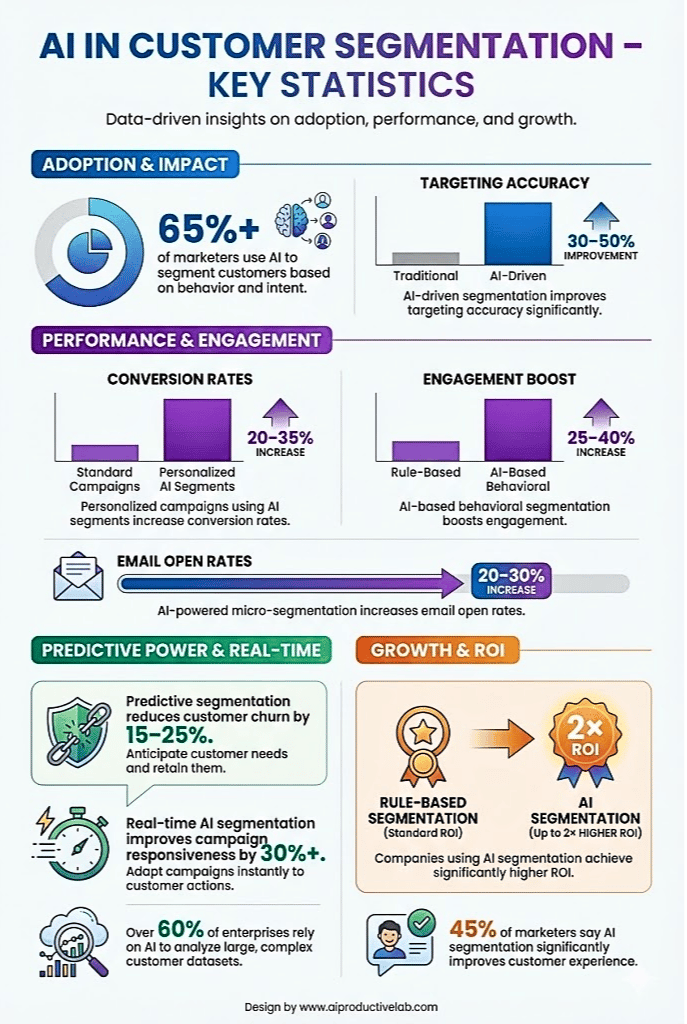
But implementing AI segmentation requires understanding what the technology actually does. How does machine learning identify customer groups? What data powers effective segmentation? How do organizations translate segments into marketing action?
This guide answers these questions comprehensively. You will learn specific AI segmentation methods transforming marketing effectiveness today. You will understand the measurable benefits organizations achieve. You will see practical implementation strategies for your own customer data. Most importantly, you will gain insight into turning AI-powered segments into marketing results.
What Is AI Customer Segmentation?
AI customer segmentation uses machine learning algorithms to group customers based on shared characteristics and behaviors. These systems analyze data patterns that humans cannot detect manually. They create segments based on actual behavior rather than assumed demographics.
Traditional segmentation divides customers into predefined categories. Marketers create segments based on age ranges, income brackets, or geographic regions. The approach provides some targeting value but misses behavioral nuances that truly predict purchase behavior.
AI segmentation discovers groups organically from data. Algorithms identify patterns without human assumptions about which characteristics matter. Segments emerge from actual customer behavior rather than marketer hypotheses. The results often reveal surprising groupings that traditional methods would miss.
The technology processes multiple data types simultaneously:
- Transactional data: Purchase history, order values, and buying frequency
- Behavioral data: Website visits, content engagement, and product browsing
- Demographic data: Age, location, income, and household composition
- Psychographic data: Interests, values, and lifestyle preferences
- Engagement data: Email opens, click patterns, and response history
AI analyzes these dimensions together to find meaningful clusters. Customers with similar patterns across multiple variables form segments. The approach captures complexity that single-variable segmentation cannot represent.
Key Methods of AI-Powered Segmentation
Clustering Algorithms
Clustering algorithms group customers based on similarity across multiple dimensions. The systems identify natural groupings without requiring predefined categories. K-means clustering and hierarchical clustering represent common approaches.
Clustering capabilities include:
- Automatic group discovery: Finding natural customer clusters in data
- Multi-dimensional analysis: Considering many variables simultaneously
- Similarity measurement: Quantifying how closely customers resemble each other
- Optimal segment sizing: Determining appropriate number of groups
- Outlier identification: Recognizing customers who don’t fit standard patterns
Clustering reveals segments you didn’t know existed. The technology finds meaningful groupings based on actual data patterns rather than marketer assumptions.
Predictive Segmentation
Predictive segmentation uses machine learning to forecast future customer behavior. Systems identify customers likely to convert, churn, or increase spending. Segments form around predicted outcomes rather than current characteristics.
Predictive capabilities include:
- Conversion likelihood scoring: Identifying prospects most likely to purchase
- Churn risk prediction: Flagging customers likely to leave
- Lifetime value forecasting: Estimating long-term customer worth
- Next purchase prediction: Anticipating what customers will buy next
- Engagement probability: Predicting response to marketing campaigns
Predictive segmentation enables proactive marketing. Teams reach customers before behaviors occur rather than reacting afterward.
Behavioral Segmentation
Behavioral segmentation groups customers by actions rather than attributes. AI analyzes browsing patterns, purchase behaviors, and engagement history. Segments reflect how customers actually interact with your brand.
Behavioral capabilities include:
- Purchase pattern analysis: Grouping by buying frequency and timing
- Browse behavior clustering: Segmenting by product interest patterns
- Engagement level grouping: Categorizing by interaction intensity
- Channel preference identification: Recognizing communication channel affinities
- Content consumption patterns: Clustering by information interests
Behavioral segments predict future actions more accurately than demographic segments. Past behavior indicates future behavior better than age or location.
Real-Time Dynamic Segmentation
Dynamic segmentation updates customer assignments continuously based on new data. Customers move between segments as their behavior changes. Systems respond to real-time signals rather than static classifications.
According to emerging AI segmentation trends, real-time data processing enables dynamic segments that adapt instantly to customer behavior changes. This represents a significant advancement over traditional periodic segmentation updates.
Dynamic capabilities include:
- Continuous reassignment: Moving customers between segments automatically
- Trigger-based updates: Responding to specific behavioral signals
- Recency weighting: Emphasizing recent behavior over historical patterns
- Context adaptation: Adjusting segments based on situational factors
- Lifecycle stage tracking: Following customers through relationship stages
Dynamic segmentation ensures marketing reflects current customer reality rather than outdated classifications.
Benefits of AI Customer Segmentation
Superior Targeting Precision
AI segmentation dramatically improves targeting accuracy:
- Finer granularity: More specific segments than manual methods allow
- Hidden pattern discovery: Finding segments invisible to human analysis
- Multi-factor consideration: Weighing many variables simultaneously
- Continuous refinement: Improving accuracy over time through learning
- Reduced waste: Avoiding spend on poorly matched audiences
Better targeting means marketing resources reach customers most likely to respond.
Enhanced Personalization at Scale
AI enables personalization that manual segmentation cannot support:
- Micro-segment messaging: Tailoring communications to small, specific groups
- Dynamic content matching: Serving relevant content based on segment membership
- Journey customization: Adapting customer paths to segment characteristics
- Product recommendations: Suggesting items aligned with segment preferences
- Timing optimization: Reaching segments when they’re most receptive
Personalization improves customer experience while increasing marketing effectiveness.
Improved Marketing ROI
AI segmentation delivers measurable return improvements:
- Higher conversion rates: Better targeting increases response
- Reduced acquisition costs: Efficient spend on high-potential prospects
- Increased customer lifetime value: Personalization drives retention and expansion
- Optimized budget allocation: Resources flow toward most responsive segments
- Faster campaign optimization: AI identifies winning approaches quickly
Predictive Business Intelligence
AI segmentation provides forward-looking insights:
- Churn prevention: Identifying at-risk customers before they leave
- Growth opportunity identification: Finding segments with expansion potential
- Product development guidance: Understanding segment needs and preferences
- Market trend detection: Recognizing emerging customer patterns
- Competitive positioning: Understanding segment-specific competitive dynamics
Operational Efficiency
AI reduces manual segmentation workload:
- Automated analysis: Systems process data without human intervention
- Continuous updates: Segments refresh automatically with new data
- Reduced analyst time: AI handles computation and pattern recognition
- Scalable processing: Systems manage growing data volumes efficiently
- Consistent methodology: Standardized segmentation across the organization
Practical Applications Across Industries
E-Commerce and Retail
AI segmentation transforms retail marketing:
- Purchase propensity segments: Targeting customers ready to buy
- Category affinity groups: Personalizing by product interest
- Price sensitivity clusters: Tailoring promotions appropriately
- Loyalty tier prediction: Identifying future high-value customers
- Seasonal behavior segments: Anticipating holiday and event purchases
Retailers using AI segmentation report significant improvements in campaign performance and customer retention.
Financial Services
Banks and financial institutions apply AI segmentation for:
- Product cross-sell targeting: Identifying customers ready for additional services
- Risk-based segmentation: Grouping by creditworthiness and risk profile
- Wealth tier clustering: Tailoring services to financial sophistication
- Life stage segments: Matching products to customer circumstances
- Churn prevention groups: Retaining valuable account holders
SaaS and Technology
Software companies leverage AI segmentation for:
- Usage pattern clusters: Grouping by product engagement levels
- Upgrade propensity segments: Identifying expansion opportunities
- Feature adoption groups: Targeting based on functionality usage
- Support need prediction: Anticipating customer assistance requirements
- Renewal risk identification: Flagging accounts requiring attention
Healthcare and Wellness
Healthcare organizations apply AI segmentation for:
- Health risk clustering: Grouping by wellness indicators
- Engagement pattern segments: Tailoring outreach to communication preferences
- Treatment adherence groups: Identifying patients needing support
- Preventive care targeting: Reaching patients who would benefit from screenings
- Chronic condition segments: Personalizing ongoing care communications
Implementing AI Customer Segmentation
Step 1: Assess Data Readiness
Evaluate your customer data foundation:
- Data inventory: Catalog available customer information sources
- Quality assessment: Evaluate accuracy and completeness
- Integration status: Understand connections between data systems
- Historical depth: Determine how much behavioral history exists
- Privacy compliance: Verify data usage meets regulatory requirements
Strong data foundations enable effective AI segmentation. Address gaps before implementing advanced analytics.
Step 2: Define Segmentation Objectives
Establish clear goals for segmentation initiatives:
- Marketing objectives: What campaigns will segments support?
- Business questions: What customer insights do you need?
- Action orientation: How will segments drive marketing decisions?
- Success metrics: How will you measure segmentation effectiveness?
- Stakeholder needs: Who will use segments and for what purposes?
Clear objectives guide algorithm selection and implementation priorities.
Step 3: Select Appropriate Tools
Choose AI segmentation technology matching your needs:
- Customer data platforms: Segment, mParticle, Treasure Data
- Marketing automation platforms: HubSpot, Salesforce, Adobe
- Analytics platforms: Google Analytics 4, Amplitude, Mixpanel
- Dedicated segmentation tools: Optimove, Peak AI, Faraday
- Custom solutions: Built on cloud ML platforms for unique requirements
Consider integration requirements, technical capabilities, and budget constraints.
Step 4: Start With High-Value Use Cases
Begin with applications delivering clear value:
- Email personalization: Tailoring messages to AI-defined segments
- Ad targeting: Using segments for advertising audience selection
- Product recommendations: Matching suggestions to segment preferences
- Retention campaigns: Targeting churn-risk segments proactively
- Acquisition optimization: Focusing on high-value prospect segments
Early wins build organizational confidence for expanded investment.
Step 5: Integrate With Marketing Execution
Connect segments to marketing channels:
- CRM integration: Sync segments to customer relationship systems
- Email platform connection: Enable segment-based email campaigns
- Advertising platform integration: Push segments to ad platforms
- Website personalization: Deliver segment-specific experiences
- Sales team enablement: Provide segment intelligence for conversations
Segments create value only when activated through marketing execution.
Step 6: Measure and Refine
Track segmentation effectiveness and improve continuously:
- Segment performance comparison: Measure results across groups
- Model accuracy assessment: Evaluate prediction quality
- Business impact measurement: Connect segments to revenue outcomes
- Feedback incorporation: Adjust based on marketing team input
- Regular refresh cycles: Update models as customer behavior evolves
Challenges and Considerations
Data Quality Requirements
AI segmentation depends on data quality. Incomplete or inaccurate data produces unreliable segments. Organizations must invest in data infrastructure before expecting AI segmentation value.
Address data quality through systematic cleaning, integration, and governance. Establish ongoing processes to maintain quality as data volumes grow.
Interpretability and Actionability
AI algorithms can create segments that are statistically valid but practically confusing. Marketers need to understand segments well enough to develop appropriate strategies.
Balance algorithmic sophistication with human interpretability. Ensure segments translate into clear marketing actions rather than abstract groupings.
Privacy and Consent
Customer segmentation using personal data requires appropriate consent and compliance. Regulations like GDPR and CCPA constrain how organizations collect and use customer information.
Build segmentation on consented first-party data. Implement appropriate data governance and privacy controls. Transparency with customers builds trust while ensuring compliance.
Conclusion
AI customer segmentation transforms marketing from broad targeting to precision engagement. Organizations deploy machine learning for clustering, predictive segmentation, behavioral analysis, and dynamic grouping. The benefits include superior targeting precision, enhanced personalization, improved ROI, and predictive business intelligence.
Implementation requires attention to data quality, clear objectives, appropriate tools, and marketing execution integration. Starting with high-value use cases builds confidence and demonstrates value. Continuous measurement and refinement ensure ongoing effectiveness.
The technology continues advancing toward real-time, dynamic segmentation that adapts instantly to customer behavior. Organizations building AI segmentation capabilities now establish foundations for sustained competitive advantage.
Marketing teams that embrace AI segmentation understand their customers more deeply. They deliver relevant experiences that customers appreciate and respond to. The result is stronger relationships and better business outcomes.
Explore how AI customer segmentation could transform your marketing targeting and personalization capabilities. Talk to our experts to understand which methods and tools fit your specific data, audience, and business objectives.
FAQs
AI customer segmentation uses machine learning to group customers based on shared behaviors and characteristics. It analyzes data patterns to create segments that predict future behavior more accurately than traditional methods.
Traditional segmentation uses predefined categories like age or location. AI segmentation discovers natural groupings from data patterns, considering multiple variables simultaneously to find segments humans would miss.
Effective AI segmentation requires transactional data, behavioral data, and engagement history. More data types enable more sophisticated segmentation, but even basic purchase history provides valuable starting points.
Basic AI segmentation can launch within weeks using existing platform features. Comprehensive custom implementations typically take three to six months depending on data readiness and integration complexity.
Yes, many marketing platforms include AI segmentation features accessible to businesses of all sizes. Tools like HubSpot, Mailchimp, and Google Analytics offer built-in segmentation without requiring technical expertise.




 AI/ML Strategy and Consulting
 Data Science And Data Analytics
 Generative AI
 AI Consulting Services
 AI Automation Solutions
 API Integration


