


A fraudster just made a purchase using your customer’s stolen card. You have milliseconds to stop it. Can your systems react fast enough?
- AI detects fraud in real time by scoring transactions and enabling millisecond interventions to block suspicious activity.
- Machine learning outperforms static rules by learning from data, adapting to evolving fraud tactics, and reducing false positives.
- Anomaly detection and continuous learning catch novel schemes and keep models effective against adaptive criminals.
- Implementation demands high-quality data, monitoring, explainability, and balance between fraud prevention and customer experience.
Fraud costs businesses staggering amounts every year. Criminals grow more sophisticated by the day. They use automation, artificial intelligence, and social engineering to exploit vulnerabilities. Traditional detection methods simply cannot keep pace with evolving threats.
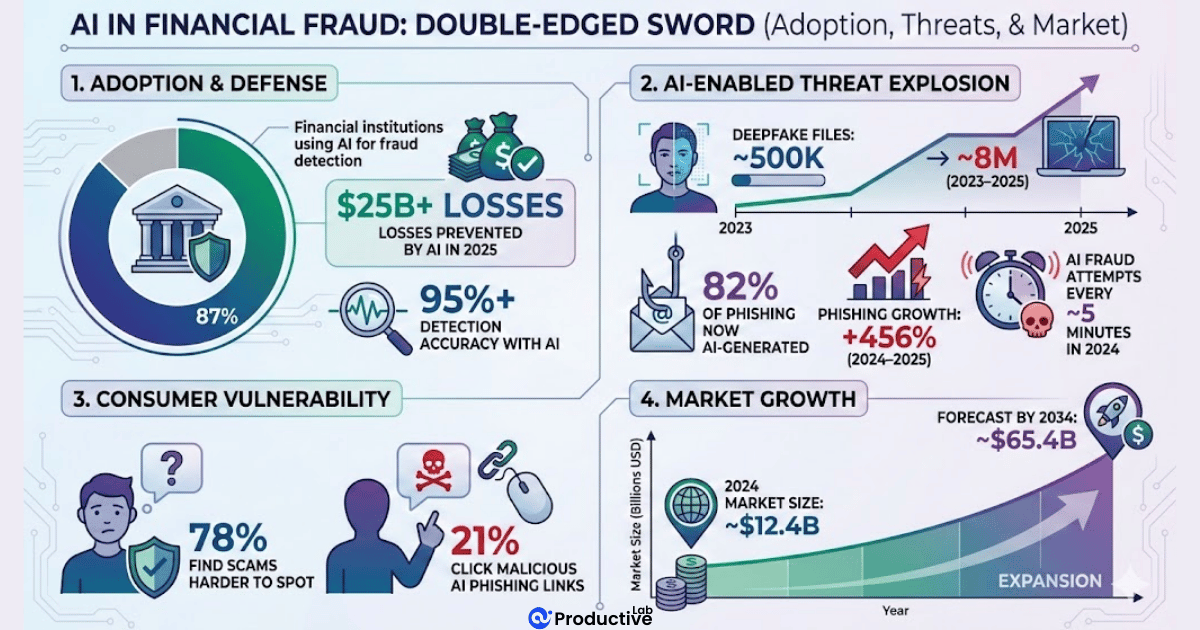
AI fraud detection has become essential for businesses handling financial transactions. According to Juniper Research, financial institutions will spend 21.1 billion USD on fraud detection and prevention in 2025. This investment will nearly double to 39.1 billion USD by 2030. The rapid growth reflects how critical these systems have become.
The stakes continue rising. Feedzai research reveals that over 50% of fraud attempts now involve AI and deepfakes. Criminals weaponize the same technologies businesses use for protection. This arms race demands increasingly sophisticated defenses.
This guide explains how AI fraud detection works in practical terms. You will learn the techniques powering these systems. You will discover the benefits and limitations of AI approaches. You will see real examples from organizations successfully fighting fraud.
What Is AI Fraud Detection?
AI fraud detection uses machine learning algorithms to identify suspicious activities automatically. These systems analyze transaction data, user behavior, and contextual signals to distinguish legitimate activity from fraud. They make decisions in real-time as events occur.
Traditional fraud detection relies on static rules created by humans. A rule might flag any transaction over 5,000 USD or any purchase from a high-risk country. These rules catch known patterns but miss novel fraud schemes.
AI systems learn from data rather than following explicit rules. They discover patterns that humans might never identify. They adapt as fraud tactics evolve. This flexibility makes AI far more effective against sophisticated criminals.
The technology processes information at scales impossible for human analysts. A single AI system might evaluate millions of transactions daily. It considers hundreds of variables for each decision. Speed and comprehensiveness give AI decisive advantages over manual review.
How Does AI Fraud Detection Work?
Data Collection and Feature Engineering
Effective AI fraud detection starts with comprehensive data. Systems gather information about transactions, users, devices, and context. This raw data becomes the foundation for fraud identification.
Key data sources include:
- Transaction details: Amount, merchant, category, time, location
- User information: Account history, behavior patterns, demographics
- Device signals: IP address, browser fingerprint, device characteristics
- Contextual data: Time of day, geographic patterns, session behavior
- Network information: Relationships between accounts and entities
Feature engineering transforms raw data into meaningful signals. Data scientists create variables that help models distinguish fraud from legitimate activity. Good features capture relevant patterns while ignoring noise.
Machine Learning Model Training
AI systems learn from historical data containing labeled examples of fraud and legitimate transactions. Supervised learning algorithms identify patterns that differentiate the two categories.
Common machine learning approaches include:
- Gradient boosting: Ensemble methods combining multiple decision trees for high accuracy
- Neural networks: Deep learning models capturing complex non-linear patterns
- Random forests: Tree-based models providing interpretable results
- Logistic regression: Simpler models offering transparency and baseline performance
Training requires balanced datasets with sufficient fraud examples. Since fraud is relatively rare, techniques like oversampling or synthetic data generation help models learn effectively.
Anomaly Detection
Not all fraud follows known patterns. New fraud schemes have no historical examples in training data. Anomaly detection identifies unusual activity that deviates from expected behavior.
These systems establish normal patterns for individual users and overall populations. They flag activity that falls outside expected ranges. Anomaly detection catches novel fraud types that supervised models might miss.
Unsupervised learning powers many anomaly detection systems. These algorithms find structure in data without labeled examples. They identify outliers that warrant investigation regardless of whether they match known fraud patterns.
Real-Time Scoring and Decision Making
AI fraud systems must operate in real-time during transactions. They receive data, process it through models, and return decisions in milliseconds. This speed enables intervention before fraud succeeds.
Each transaction receives a risk score indicating fraud probability. Thresholds determine actions based on scores:
- Low scores: Approve transaction automatically
- Medium scores: Request additional verification
- High scores: Block transaction and alert customer
Dynamic thresholds adjust based on context and business requirements. Higher-risk situations trigger more cautious responses. Balance between fraud prevention and customer friction requires ongoing optimization.
Continuous Learning and Adaptation
Fraud patterns change constantly as criminals adapt to defenses. AI systems must evolve alongside threats. Continuous learning keeps models current with emerging fraud tactics.
Feedback loops incorporate new fraud discoveries into model training. Confirmed fraud cases become training examples for future detection. False positives and negatives inform model adjustments.
Some systems use online learning, updating models with each new transaction. Others retrain periodically with accumulated data. Both approaches ensure detection capabilities stay current.
Types of Fraud AI Systems Detect
Payment Fraud
Payment fraud involves unauthorized use of payment methods. Stolen credit cards, compromised accounts, and synthetic identities enable criminals to make fraudulent purchases.
AI systems analyze transaction patterns to identify payment fraud. They consider purchase history, merchant risk, geographic patterns, and timing. Behavioral signals reveal when actual cardholders are not making purchases.
Account Takeover
Account takeover occurs when criminals gain access to legitimate user accounts. They exploit stolen credentials, phishing attacks, or security vulnerabilities. Once inside, they make unauthorized transactions or steal information.
AI detects account takeover by identifying unusual login behavior and account activity. Location changes, device switches, and behavior anomalies signal potential compromise. Systems challenge suspicious access attempts with additional verification.
Identity Fraud
Identity fraud uses stolen or fabricated personal information to open new accounts or obtain credit. Synthetic identities combine real and fake information to evade detection.
AI systems detect identity fraud during application and onboarding processes. They verify information consistency, check against known fraud patterns, and identify suspicious applications. Network analysis reveals connections to known fraud.
Insurance Fraud
Insurance fraud involves false or inflated claims to collect undeserved payments. Schemes range from staged accidents to exaggerated damage claims to completely fabricated incidents.
AI analyzes claims for indicators of fraud. Pattern recognition identifies suspicious claims characteristics. Network analysis reveals organized fraud rings. Predictive models prioritize claims for investigation.
Money Laundering
Money laundering disguises illegally obtained funds as legitimate income. Criminals layer transactions through multiple accounts and jurisdictions to obscure origins.
AI systems detect suspicious transaction patterns indicating laundering. They identify structuring, rapid movement of funds, and unusual relationship networks. These capabilities support regulatory compliance requirements.
Benefits of AI Fraud Detection
Implementing AI-powered fraud detection delivers measurable advantages:
- Superior accuracy: AI catches more fraud while generating fewer false positives than rule-based systems
- Real-time protection: Millisecond decisions enable intervention during transactions rather than after
- Adaptive defense: Machine learning evolves as fraud tactics change without manual rule updates
- Scalable coverage: AI handles transaction volumes impossible for human review teams
- Reduced losses: Better detection directly decreases fraud-related financial losses
- Improved customer experience: Fewer false positives mean less friction for legitimate customers
- Operational efficiency: Automation reduces manual review workload and associated costs
- Comprehensive analysis: AI considers hundreds of variables simultaneously for each decision
Challenges and Limitations
False Positives and Customer Friction
Even excellent AI systems generate false positives. Legitimate transactions get flagged as suspicious. Blocked transactions frustrate customers and damage relationships.
Balancing fraud prevention against customer experience requires careful tuning. Aggressive thresholds catch more fraud but create more friction. Conservative settings improve experience but allow more fraud through.
Adversarial Attacks
Sophisticated criminals study and probe AI detection systems. They test transactions to understand what triggers blocks. They modify behavior to evade detection while still committing fraud.
AI systems must resist adversarial manipulation. Robust models maintain performance against deliberate evasion attempts. Continuous updates counter adaptive criminal tactics.
Data Quality and Availability
AI effectiveness depends on data quality. Incomplete, inaccurate, or outdated information undermines model performance. Organizations must invest in data infrastructure to enable effective AI.
Privacy regulations limit some data collection and usage. Cross-border data restrictions complicate global fraud detection. Compliance requirements must inform AI implementation approaches.
Explainability Requirements
Regulations often require explanations for automated decisions. Complex AI models may not provide clear explanations for specific decisions. This opacity creates compliance and customer service challenges.
Explainable AI techniques help address transparency requirements. They reveal factors influencing individual decisions. Simpler models offer more explainability but sometimes sacrifice accuracy.
Real-World Examples of AI Fraud Detection
PayPal’s Machine Learning Platform
PayPal processes billions of transactions and must distinguish legitimate payments from fraud instantly. Their AI platform analyzes each transaction using machine learning models trained on historical fraud patterns.
The company reports that AI helps block billions of dollars in fraudulent transactions annually. Models consider thousands of signals for each decision. Continuous learning keeps detection current with evolving threats.
Mastercard’s Decision Intelligence
Mastercard’s Decision Intelligence applies AI to every transaction on their network. The system evaluates purchasing patterns and identifies anomalies indicating potential fraud.
The technology reduced false positives by up to 50% while improving fraud detection rates. Better accuracy benefits both merchants and cardholders. Real-time scoring enables instant decisions.
Stripe Radar
Stripe Radar provides AI fraud detection for businesses using their payment platform. Machine learning models train on billions of transactions across Stripe’s network. This broad data enables detection of patterns individual merchants could not identify.
Radar adapts to each merchant’s specific patterns and risk tolerance. Customizable rules layer on top of machine learning for flexibility. The system blocks millions of fraudulent transactions monthly.
HSBC and Google Cloud Partnership
HSBC partnered with Google Cloud to enhance their anti-money laundering capabilities. AI analyzes transactions to identify suspicious patterns indicating potential laundering.
The implementation significantly improved detection of previously unknown risk factors. Processing efficiency increased dramatically compared to previous approaches. The partnership demonstrates enterprise-scale AI fraud detection.
How to Implement AI Fraud Detection
Step 1: Assess Current Fraud Exposure
Begin by understanding your fraud landscape thoroughly. Quantify current losses, identify common fraud types, and evaluate existing detection capabilities. This assessment guides priorities and investment decisions.
Document false positive rates and their customer impact. Understand the tradeoffs your current approach makes between detection and friction.
Step 2: Evaluate Build Versus Buy Options
Decide whether to build custom AI capabilities or purchase vendor solutions. Consider your technical resources, data assets, and speed requirements.
Vendor solutions offer faster deployment and proven performance. Custom development enables tailored approaches for unique requirements. Most organizations combine both strategies.
Step 3: Prepare Your Data Foundation
AI requires quality data to function effectively. Audit existing data sources for completeness and accuracy. Identify gaps requiring new data collection.
Establish data pipelines feeding real-time AI systems. Historical data enables model training. Ongoing data flow supports continuous learning and improvement.
Step 4: Deploy With Appropriate Oversight
Implement AI systems with human oversight initially. Monitor performance closely during early deployment. Adjust thresholds and rules based on observed results.
Establish clear escalation procedures for edge cases. Define when human review is required. Balance automation benefits against need for judgment.
Step 5: Monitor and Improve Continuously
Track performance metrics rigorously over time. Monitor fraud rates, false positive rates, and customer impact. Identify trends requiring model updates or threshold adjustments.
Establish feedback loops incorporating new fraud discoveries. Regular model retraining maintains detection effectiveness. Continuous improvement sustains long-term value.
Conclusion
AI fraud detection has become essential for organizations handling financial transactions. Machine learning systems catch fraud that traditional rules miss. They adapt as criminals evolve their tactics. They operate at speeds and scales impossible for human reviewers.
Implementation requires thoughtful attention to data, model selection, and operational integration. False positives must be managed carefully to protect customer experience. Continuous learning and monitoring sustain effectiveness over time.
The organizations excelling at fraud prevention increasingly rely on sophisticated AI systems. They protect customers, reduce losses, and maintain trust. Their capabilities represent competitive advantages that grow over time.
Explore how AI fraud detection could strengthen your organization’s defenses. Talk to our experts to understand which approaches fit your specific fraud challenges and operational requirements.
FAQs
AI fraud detection uses machine learning algorithms to identify suspicious transactions and activities automatically. It analyzes patterns in data to distinguish legitimate activity from fraud in real-time.
Modern AI fraud detection systems achieve accuracy rates exceeding 95% while significantly reducing false positives. Performance varies based on data quality, model sophistication, and fraud types.
Yes, anomaly detection techniques identify unusual activity that deviates from expected patterns. This capability catches novel fraud schemes without prior examples in training data.
AI systems evaluate transactions in milliseconds, enabling real-time intervention during purchases. This speed prevents fraud before transactions complete rather than detecting it afterward.
Financial services, ecommerce, insurance, and healthcare see the greatest benefits from AI fraud detection. Any industry processing high transaction volumes or facing significant fraud exposure can benefit.




 AI/ML Strategy and Consulting
 Data Science And Data Analytics
 Generative AI
 AI Consulting Services
 AI Automation Solutions
 API Integration


