


Online courses have a completion problem. Most learners who start never finish. They lose motivation, fall behind, or simply disengage. The content exists, but something critical is missing. That something is personalization.
- AI enables real-time personalized learning paths that adapt content, pace, and format to each learner's needs.
- Recommendation engines and adaptive pathways increase engagement and completion by surfacing relevant next-best content.
- Automated assessment, tutoring, and predictive analytics provide immediate feedback and flag at-risk learners for early intervention.
- AI scales personalization and operational efficiency but requires data governance, quality oversight, and careful integration.
Traditional eLearning delivers identical experiences to every learner. The same videos play at the same pace for everyone. Assessments follow rigid sequences regardless of individual understanding. This one-size-fits-all approach ignores how learning actually works.
AI in eLearning changes this equation fundamentally. Intelligent systems adapt to individual learners in real-time. Content adjusts based on demonstrated understanding. Support appears precisely when learners need it most. The technology transforms passive content consumption into active, personalized learning journeys.
The market reflects this transformation’s significance. According to Didask research, the global eLearning market reached 320 billion USD in 2025, growing at 14% annually. AI drives much of this growth by delivering 76% greater learning efficiency compared to traditional approaches.
Scale continues expanding rapidly. Statista projects online learning platforms will reach 1 billion users by 2030. Organizations deploying AI-powered platforms capture disproportionate shares of this growing market.
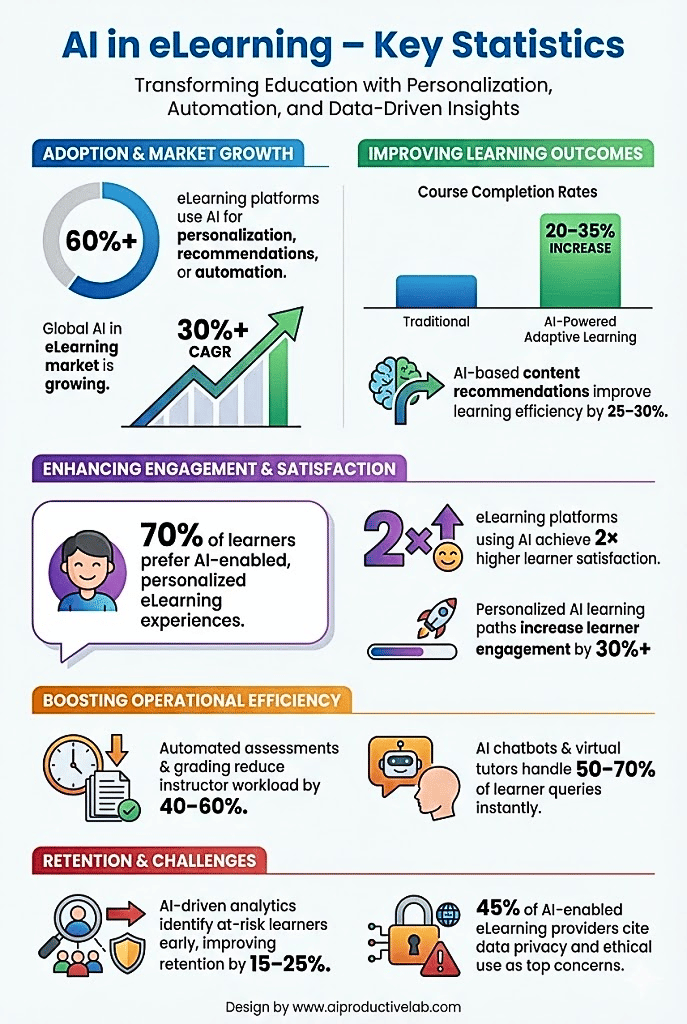
This guide explores AI in online education platforms comprehensively. You will learn specific AI capabilities transforming eLearning effectiveness. You will understand how leading platforms leverage intelligent features. You will see measurable benefits organizations achieve through AI-enhanced learning. Most importantly, you will gain practical insight for evaluating and implementing AI-powered eLearning solutions.
What Is AI in eLearning?
AI in eLearning applies artificial intelligence technologies to enhance online education delivery. These systems use machine learning, natural language processing, and data analytics to personalize instruction and improve learning outcomes.
The technology transforms how online learning platforms function. Traditional learning management systems deliver static content through predetermined sequences. AI-powered platforms adapt dynamically based on individual learner behavior and performance.
Core AI capabilities in eLearning include:
- Machine learning algorithms: Systems that identify patterns in learner data and improve over time
- Natural language processing: Technology enabling conversational interactions and content understanding
- Predictive analytics: Tools forecasting learner outcomes and identifying intervention needs
- Computer vision: Systems analyzing visual content and learner engagement
- Recommendation engines: Algorithms suggesting optimal learning paths and content
These technologies work together to create intelligent learning experiences. Platforms understand what learners know, what they need, and how they prefer to learn. Instruction adapts continuously to optimize individual outcomes.
The shift represents more than incremental improvement. AI fundamentally changes what online education can accomplish. Personalization previously requiring human tutors becomes available at massive scale. Assessment evolves from periodic testing to continuous understanding. Support transforms from reactive help desks to proactive intervention systems.
Key AI Features in Online Education Platforms
Adaptive Learning Pathways
Adaptive learning represents the most impactful AI application in eLearning. Systems customize content sequences based on individual learner performance and preferences.
Adaptive learning capabilities include:
- Real-time difficulty adjustment: Content complexity changes based on demonstrated mastery
- Prerequisite identification: Systems detect knowledge gaps requiring remediation
- Learning path optimization: Algorithms determine most efficient routes to objectives
- Pace personalization: Progression speed matches individual learning velocity
- Format adaptation: Content presentation adjusts to learning style preferences
Learners experiencing adaptive pathways progress faster with better retention. They spend time on material they need rather than reviewing concepts already mastered.
Intelligent Content Recommendations
AI recommendation engines suggest relevant content based on learner profiles and behavior. Systems analyze past performance, stated goals, and engagement patterns to surface optimal resources.
Recommendation capabilities include:
- Next-best-content suggestions: Identifying ideal subsequent learning activities
- Supplementary resource matching: Connecting learners with relevant supporting materials
- Peer learning connections: Suggesting collaboration opportunities with similar learners
- Interest-based discovery: Surfacing content aligned with demonstrated preferences
- Gap-targeted recommendations: Directing attention to areas needing development
Effective recommendations keep learners engaged while ensuring comprehensive skill development.
Automated Assessment and Feedback
AI transforms assessment from periodic testing to continuous evaluation. Systems analyze learner responses and provide immediate, specific feedback accelerating understanding.
Assessment capabilities include:
- Natural language evaluation: AI grading written responses and essays
- Code assessment: Automated evaluation of programming assignments
- Rubric-based scoring: Consistent application of evaluation criteria
- Error pattern analysis: Identifying systematic misconceptions across responses
- Personalized feedback generation: Creating specific improvement guidance for each learner
Immediate feedback prevents misconception entrenchment. Learners correct errors before incorrect understanding solidifies.
AI-Powered Tutoring and Support
Intelligent tutoring systems provide on-demand assistance simulating human instruction. Chatbots and virtual assistants answer questions, explain concepts, and guide problem-solving.
Tutoring capabilities include:
- 24/7 question answering: Immediate response to learner inquiries anytime
- Concept explanation: Multiple approaches to explaining difficult material
- Socratic dialogue: Guided questioning leading learners toward understanding
- Hint generation: Graduated assistance without providing direct answers
- Emotional support: Recognizing frustration and providing encouragement
AI tutoring extends support availability beyond instructor office hours. Learners receive help precisely when they need it.
Predictive Analytics and Early Intervention
AI analytics identify at-risk learners before they fail or disengage. Systems analyze behavioral patterns to predict outcomes and trigger proactive support.
Predictive capabilities include:
- Dropout risk identification: Flagging learners likely to abandon courses
- Performance forecasting: Predicting assessment outcomes before tests occur
- Engagement pattern analysis: Recognizing declining participation early
- Intervention timing optimization: Determining when support is most effective
- Success factor identification: Understanding what drives positive outcomes
Early intervention improves completion rates significantly. Problems receive attention before becoming insurmountable.
Automated Content Creation and Curation
AI accelerates content development while maintaining quality. Systems generate, summarize, and organize learning materials efficiently.
Content capabilities include:
- Question generation: Creating assessment items from learning content
- Summary creation: Producing concise overviews of longer materials
- Translation and localization: Adapting content for different languages and cultures
- Accessibility enhancement: Generating captions, descriptions, and alternative formats
- Content tagging and organization: Automatically categorizing materials for discovery
According to Articulate’s 2025 eLearning trends analysis, AI-generated content and personalization rank among the top trends shaping the industry this year.
Benefits of AI in Online Education Platforms
Dramatically Improved Learning Outcomes
AI-enhanced eLearning delivers measurable achievement gains:
- Higher completion rates: Personalization sustains engagement through course completion
- Better assessment performance: Targeted instruction improves demonstrated understanding
- Faster skill acquisition: Optimized paths reduce time to competency
- Stronger knowledge retention: Adaptive reinforcement improves long-term memory
- Greater transfer to application: Relevant practice improves real-world skill use
Research indicates AI delivers 76% greater efficiency in learning outcomes compared to traditional eLearning approaches.
Enhanced Learner Engagement
AI features combat the disengagement plaguing online education:
- Personalized relevance: Content connects to individual interests and goals
- Optimal challenge: Difficulty calibration prevents frustration and boredom
- Immediate feedback: Quick response maintains motivation and momentum
- Progress visibility: Clear advancement indicators sustain commitment
- Responsive support: Help available when needed prevents abandonment
Engaged learners invest more effort and persist through challenging material.
Operational Efficiency for Organizations
AI reduces costs while improving quality:
- Reduced instructor workload: Automation handles routine tasks
- Lower per-learner costs: AI scales without proportional staff increases
- Faster content development: Automated tools accelerate creation timelines
- Decreased support burden: Chatbots handle common inquiries automatically
- Improved resource allocation: Analytics guide investment toward highest-impact areas
Organizations serve more learners effectively with existing resources.
Data-Driven Continuous Improvement
AI generates insights enabling ongoing enhancement:
- Content effectiveness visibility: Data reveals which materials work best
- Learner need understanding: Analytics identify common challenges and gaps
- Intervention impact measurement: Systems track what support strategies succeed
- Trend identification: Patterns across learners inform curriculum development
- ROI demonstration: Metrics prove learning program value to stakeholders
Continuous improvement compounds benefits over time.
Scalable Personalization
AI enables individualization impossible through human instruction:
- Unlimited capacity: Systems serve any number of learners simultaneously
- Consistent quality: Every learner receives optimized experience
- Global accessibility: Personalized learning available worldwide
- Always available: 24/7 access without staffing constraints
- Cumulative intelligence: Systems improve as more learners participate
Personalization benefits extend to all learners rather than privileged few.
AI-Powered eLearning Platform Examples
Learning Management Systems With AI Features
Modern LMS platforms increasingly incorporate AI capabilities:
- Docebo: AI-powered content recommendations and skills gap analysis
- Cornerstone: Intelligent learning path suggestions and predictive analytics
- 360Learning: Collaborative learning with AI-enhanced content discovery
- Absorb LMS: Intelligent assistant and adaptive learning features
- Totara: Open-source platform with AI integration capabilities
These platforms serve enterprise training and educational institution needs with varying AI sophistication levels.
Specialized Adaptive Learning Platforms
Purpose-built adaptive platforms offer deeper personalization:
- Area9 Lyceum: Sophisticated adaptive learning based on cognitive science
- Realizeit: Granular adaptation with detailed learner modeling
- Smart Sparrow: Adaptive courseware creation and delivery
- Knewton: AI-powered personalization for educational publishers
- CogBooks: Adaptive learning with rich analytics
Specialized platforms typically offer more advanced AI but narrower feature sets.
AI-Enhanced Course Platforms
Consumer-focused platforms leverage AI for engagement:
- Coursera: AI recommendations and adaptive assessments
- Udemy: Personalized course suggestions based on learning history
- LinkedIn Learning: Skill-based recommendations tied to career goals
- Khan Academy: Adaptive practice with mastery-based progression
- Duolingo: Sophisticated AI personalization for language learning
These platforms demonstrate AI eLearning at massive consumer scale.
Implementing AI in Your eLearning Strategy
Assess Current State and Define Objectives
Begin with clear understanding of needs:
- Learning outcome goals: What should learners achieve?
- Current platform limitations: Where does existing eLearning fall short?
- Learner experience gaps: What frustrations do learners report?
- Operational constraints: What resources and capabilities exist?
- Success metrics: How will AI impact be measured?
Clear objectives guide technology selection and implementation priorities.
Evaluate AI Platform Options
Consider multiple factors when selecting solutions:
- Feature alignment: Do AI capabilities address your specific needs?
- Integration requirements: Will the platform connect with existing systems?
- Scalability: Can the solution grow with your learner population?
- Evidence of effectiveness: What outcomes have other organizations achieved?
- Total cost of ownership: What are full implementation and operational costs?
Pilot programs allow testing before major commitments.
Plan for Change Management
Technology success depends on human adoption:
- Stakeholder communication: Explain benefits and address concerns clearly
- Instructor preparation: Train facilitators on new platform capabilities
- Learner orientation: Help users understand and leverage AI features
- Feedback mechanisms: Create channels for ongoing input
- Iterative refinement: Plan continuous improvement based on experience
Organizations investing in change management realize greater AI benefits.
Monitor and Optimize
Track results and improve continuously:
- Outcome measurement: Assess learning results against objectives
- Engagement tracking: Monitor learner participation and completion
- User satisfaction: Gather feedback from learners and instructors
- Technical performance: Ensure systems function reliably
- ROI calculation: Quantify benefits relative to investment
Data-driven optimization compounds returns over time.
Challenges and Considerations
Data Privacy and Security
AI eLearning requires learner data demanding protection:
- Sensitive learning information: Performance data reveals cognitive patterns
- Regulatory compliance: GDPR, FERPA, and other requirements apply
- Vendor data practices: Third-party AI providers access learner information
- Consent requirements: Meaningful permission for AI-driven data use
- Security vulnerabilities: AI systems may create new attack surfaces
Establish robust data governance before deploying AI features.
Quality and Accuracy Concerns
AI-generated content requires oversight:
- Factual accuracy: AI may produce plausible but incorrect information
- Pedagogical soundness: Technically accurate content may be poorly designed
- Bias introduction: AI may reflect problematic patterns from training data
- Brand alignment: Generated content may not match organizational voice
- Human review needs: AI outputs require professional verification
Maintain quality control processes for AI-generated materials.
Integration Complexity
AI implementation involves technical challenges:
- Legacy system connections: Existing infrastructure may resist integration
- Data unification: AI requires consolidated learner information
- Vendor coordination: Multiple providers may need to work together
- Technical expertise: Implementation requires specialized skills
- Ongoing maintenance: AI systems need continuous attention
Plan for integration complexity in timelines and budgets.
Conclusion
AI in eLearning transforms online education from static content delivery to dynamic, personalized learning experiences. Intelligent systems adapt pathways, recommend content, automate assessment, provide tutoring support, predict outcomes, and accelerate content development. The benefits include improved learning outcomes, enhanced engagement, operational efficiency, and scalable personalization.
The market trajectory confirms AI’s central role in eLearning’s future. With the global market reaching 320 billion USD and heading toward 1 billion users, organizations deploying AI-powered platforms position themselves for sustained success.
Implementation requires careful platform evaluation, change management investment, and ongoing optimization. Challenges including data privacy, content quality, and integration complexity demand thoughtful navigation.
Organizations beginning their AI eLearning journey now build capabilities that compound over time. Those delaying adoption risk falling behind competitors delivering superior learning experiences through intelligent technology.
Explore how AI in online education platforms could transform your learning programs and outcomes. Talk to our experts to understand which features and platforms fit your specific learners, content, and organizational objectives.
FAQs
AI in eLearning applies artificial intelligence technologies like machine learning and natural language processing to personalize online learning, automate assessments, and provide intelligent tutoring and support.
AI improves platforms by adapting content to individual learners, providing instant feedback, predicting learner struggles, automating routine tasks, and recommending personalized learning paths.
Examples include Docebo, Cornerstone, Coursera, Khan Academy, and Duolingo. These platforms use AI for adaptive learning, content recommendations, and intelligent assessment features.
Yes, AI-enhanced corporate training delivers faster skill development, higher completion rates, and reduced costs. Organizations report significant improvements in training efficiency and employee performance.
Costs vary widely from free consumer platforms to enterprise solutions costing thousands monthly. Pricing typically depends on user count, feature requirements, and customization needs.




 AI/ML Strategy and Consulting
 Data Science And Data Analytics
 Generative AI
 AI Consulting Services
 AI Automation Solutions
 API Integration


