


Can machines make better financial decisions than humans? Increasingly, the evidence says yes—at least for certain tasks.
- AI detects and prevents complex fraud in real time, reducing false positives and scaling to millions of transactions.
- Advanced credit models use broader data to improve risk assessment, expand access, and speed lending decisions.
- AI chatbots and virtual assistants deliver 24/7 personalized customer service, reducing costs and improving engagement.
- Algorithmic trading and robo-advisors optimize portfolios and execute trades at speeds and scale beyond human capability.
- Key risks include bias, explainability gaps, model failure, data privacy concerns, and evolving regulatory uncertainty.
Financial institutions face unprecedented challenges today. Fraud schemes grow more sophisticated daily. Customers expect instant, personalized service around the clock. Regulatory requirements multiply while margins shrink. Traditional approaches cannot address these pressures effectively.
AI in finance has evolved from experimental technology to operational necessity. According to the World Economic Forum, financial services firms spent 35 billion USD on AI in 2023, with investments accelerating across banking, insurance, capital markets, and payments. Research from nCino indicates that 75% of banks with over 100 billion USD in assets will fully integrate AI strategies by 2025.
This comprehensive guide explores how artificial intelligence transforms the financial industry. You will learn the most impactful use cases driving adoption. You will understand both the benefits and the risks involved. You will see real examples from institutions leading this transformation. Most importantly, you will gain practical insights for applying AI in your financial operations.
What Is AI in Finance?
AI in finance refers to using machine learning, natural language processing, and other artificial intelligence technologies to improve financial services and operations. These systems analyze data, recognize patterns, make predictions, and automate decisions that traditionally required human judgment.
The technology spans a broad range of applications. Some AI systems process loan applications in seconds. Others detect fraudulent transactions among millions of legitimate ones. Still others provide personalized investment advice or predict market movements.
Financial AI differs from simple automation. Traditional software follows explicit rules programmed by humans. AI systems learn from data and improve over time. They handle complexity and ambiguity that rule-based systems cannot manage.
The technology has matured significantly in recent years. Early AI applications were narrow and experimental. Today’s systems handle sophisticated tasks reliably at scale. This maturity drives rapid adoption across the financial industry.
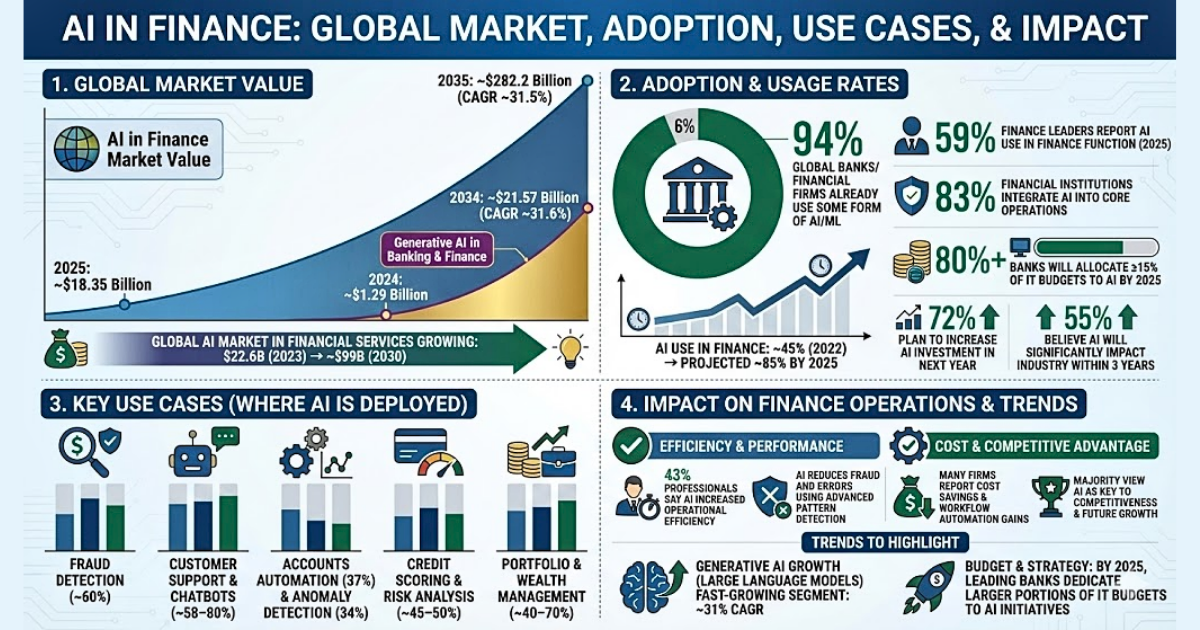
Key Use Cases for AI in Finance
Fraud Detection and Prevention
Fraud represents one of the most successful AI applications in finance. Traditional rule-based systems catch known fraud patterns but miss novel schemes. AI systems learn to recognize suspicious patterns without explicit programming.
According to Feedzai research, 90% of financial institutions now use AI to expedite fraud investigations and detect new tactics in real-time. These systems analyze transaction patterns, device information, location data, and behavioral signals simultaneously.
AI fraud detection offers several advantages over traditional approaches:
- Real-time analysis: Decisions happen in milliseconds during transactions
- Pattern recognition: AI identifies subtle anomalies humans would miss
- Adaptive learning: Systems evolve as fraud tactics change
- Reduced false positives: Better accuracy means fewer legitimate transactions blocked
- Scalability: AI handles millions of transactions without proportional cost increases
Machine learning models establish baseline behavior patterns for each customer. Deviations from these patterns trigger alerts or blocks. The more data the system processes, the more accurate it becomes.
Credit Scoring and Lending Decisions
Traditional credit scoring relies on limited data points like payment history and credit utilization. AI enables more sophisticated assessment using broader data sources and more nuanced analysis.
According to Deloitte, AI determines creditworthiness by harnessing data to predict default probability more accurately. This improves lending decisions while expanding access for underserved populations.
AI credit models consider factors traditional scoring ignores. They analyze cash flow patterns from bank statements. They consider employment stability and income trends. They examine spending behavior and financial management habits.
These models benefit both lenders and borrowers:
- Lenders: More accurate risk assessment reduces losses while enabling profitable lending to previously declined applicants
- Borrowers: Fair assessment based on actual financial behavior rather than limited traditional metrics
- Speed: AI processes applications in minutes rather than days
- Consistency: Automated decisions eliminate human bias and inconsistency
Alternative lenders pioneered AI credit scoring. Traditional banks now adopt similar approaches to remain competitive and serve customers better.
Customer Service and Chatbots
Financial institutions handle enormous volumes of customer inquiries. AI-powered chatbots and virtual assistants manage routine questions instantly. They operate around the clock without staffing constraints.
Modern financial chatbots understand natural language and context. They handle account inquiries, transaction questions, and basic service requests. They recognize when issues require human escalation.
Major banks report significant results from AI customer service:
- Bank of America’s Erica: Over 1.5 billion interactions since launch, handling tasks from balance inquiries to spending insights
- Capital One’s Eno: Provides proactive alerts and answers questions via text message
- HSBC’s Amy: Serves customers in multiple languages across Asian markets
These systems do more than answer questions. They analyze interactions to identify customer needs and opportunities. They provide personalized guidance based on individual financial situations.
Algorithmic Trading and Investment Management
AI transforms how investments are managed and trades are executed. Algorithmic trading systems analyze market data and execute trades at speeds impossible for humans. AI portfolio management optimizes investment decisions based on goals and risk tolerance.
Quantitative hedge funds pioneered AI trading strategies. Firms like Renaissance Technologies, Two Sigma, and DE Shaw built empires on algorithmic approaches. Their success attracted broader adoption across the investment industry.
AI investment applications include:
- High-frequency trading: Executing thousands of trades per second based on market microstructure
- Sentiment analysis: Mining news, social media, and alternative data for investment signals
- Portfolio optimization: Balancing risk and return across asset classes dynamically
- Robo-advisors: Providing automated investment management for retail investors
Robo-advisors democratized AI investment management. Platforms like Betterment, Wealthfront, and Schwab Intelligent Portfolios offer sophisticated portfolio management at low cost. They make institutional-quality investment approaches accessible to everyday investors.
Risk Management and Compliance
Financial institutions face complex regulatory requirements and risk exposures. AI helps manage both more effectively than manual approaches allow.
Risk management AI applications include:
- Market risk modeling: Predicting potential losses from market movements
- Credit risk assessment: Evaluating counterparty and portfolio credit exposures
- Operational risk monitoring: Identifying process failures and control weaknesses
- Liquidity management: Predicting cash flow needs and optimizing liquidity positions
Compliance automation represents a growing AI application area. Systems monitor transactions for suspicious activity. They screen customers against sanctions lists. They ensure adherence to trading regulations and reporting requirements.
Natural language processing enables AI to analyze regulatory text and identify relevant requirements. This capability helps institutions stay current with changing regulations across multiple jurisdictions.
Personalized Financial Advice
AI enables personalized guidance at scale. Systems analyze individual financial situations and provide tailored recommendations. They consider goals, risk tolerance, life stage, and behavioral patterns.
Personalized AI advice includes:
- Spending insights: Identifying patterns and suggesting improvements
- Savings recommendations: Setting optimal savings targets based on goals
- Debt management: Prioritizing repayment strategies
- Investment guidance: Recommending portfolios aligned with individual circumstances
- Financial planning: Projecting future scenarios and suggesting adjustments
These capabilities were once available only to wealthy clients with dedicated advisors. AI makes sophisticated financial guidance accessible to everyone. Banks use these tools to deepen customer relationships and improve financial outcomes.
Insurance Underwriting and Claims
Insurance companies apply AI throughout their operations. Underwriting AI assesses risk more accurately using broader data sources. Claims AI detects fraud while accelerating legitimate claim processing.
AI underwriting applications include:
- Risk assessment: Evaluating applicant risk using traditional and alternative data
- Pricing optimization: Setting premiums that reflect actual risk accurately
- Application processing: Automating routine underwriting decisions
- Portfolio management: Optimizing risk exposure across the book of business
Claims processing benefits from AI automation. Systems analyze claim submissions and supporting documentation. They identify potentially fraudulent claims for investigation. They approve straightforward claims automatically.
Insurers report faster processing, lower costs, and improved accuracy from AI adoption. Customers benefit from quicker decisions and fairer treatment.
Benefits of AI in Finance
Financial institutions adopting AI realize substantial benefits across multiple dimensions:
Operational Efficiency
- Cost reduction: Automating manual processes reduces operational expenses significantly
- Speed improvement: AI processes transactions and decisions in seconds rather than hours or days
- Scalability: Systems handle volume increases without proportional cost growth
- Error reduction: Automated processes eliminate human mistakes in routine tasks
Enhanced Decision Making
- Better predictions: AI models outperform traditional approaches for many forecasting tasks
- Broader data utilization: Systems incorporate information humans cannot process manually
- Consistency: Automated decisions apply criteria uniformly without human variability
- Continuous improvement: Models learn from outcomes and refine predictions over time
Improved Customer Experience
- Instant service: AI provides immediate responses without waiting for human availability
- Personalization: Systems tailor interactions and recommendations to individual needs
- Proactive engagement: AI identifies opportunities to help customers before they ask
- Accessibility: Digital AI services reach customers through preferred channels anytime
Risk Reduction
- Fraud prevention: AI catches fraudulent activity that traditional systems miss
- Credit accuracy: Better risk assessment reduces loan losses
- Compliance assurance: Automated monitoring ensures regulatory adherence
- Operational resilience: AI identifies and addresses process risks proactively
Risks and Challenges of AI in Finance
Algorithmic Bias and Fairness
AI systems can perpetuate or amplify biases present in training data. Credit models might discriminate against protected groups inadvertently. Hiring algorithms could favor certain demographics unfairly.
Financial institutions must test AI systems rigorously for bias. They need diverse data and careful model design. Ongoing monitoring ensures fairness as systems evolve.
Regulators increasingly scrutinize AI fairness. The Consumer Financial Protection Bureau examines AI credit decisions. European regulations require algorithmic transparency. Institutions must demonstrate that AI treats customers fairly.
Explainability and Transparency
Complex AI models often function as “black boxes.” They produce accurate predictions without clear explanations. This opacity creates problems for regulated industries.
Customers deserve explanations when denied credit or insurance. Regulators require institutions to justify decisions. Internal risk management needs to understand model behavior.
Explainable AI techniques help address these challenges. They provide insight into how models reach decisions. Financial institutions increasingly require explainability in AI systems they deploy.
Model Risk and Reliability
AI models can fail in unexpected ways. They might perform poorly when conditions differ from training data. They could be manipulated by adversaries who understand their vulnerabilities.
Model risk management has become critical for financial AI. Institutions must validate models rigorously before deployment. They need ongoing monitoring to detect performance degradation. They require fallback procedures when AI systems fail.
Data Privacy and Security
AI systems require extensive data to function effectively. This creates privacy concerns and security risks. Financial data is particularly sensitive and attractive to attackers.
Institutions must protect AI training data and model details. They need customer consent for data usage. They must comply with privacy regulations like GDPR and CCPA.
Cybersecurity for AI systems presents unique challenges. Attackers might try to corrupt training data or manipulate model outputs. Robust security practices must evolve alongside AI adoption.
Regulatory Uncertainty
Regulation of AI in finance continues evolving rapidly. Different jurisdictions take different approaches. Requirements may change as regulators gain experience with AI applications.
Financial institutions navigate uncertain regulatory terrain. They invest in AI while managing compliance risk. They engage with regulators to shape sensible policy. Staying current with regulatory developments requires ongoing attention.
Job Displacement Concerns
AI automates tasks previously performed by humans. This raises concerns about job losses in the financial industry. Some roles will diminish or disappear as AI capabilities expand.
However, AI also creates new roles and opportunities. Institutions need people to develop, monitor, and manage AI systems. Human judgment remains essential for complex decisions. The workforce will evolve rather than simply shrink.
Real-World Examples of AI in Finance
JPMorgan Chase: COIN and Beyond
JPMorgan Chase has invested heavily in AI across their operations. Their COIN (Contract Intelligence) system analyzes legal documents that previously required 360,000 hours of lawyer time annually. The AI completes this work in seconds.
The bank uses AI for fraud detection, trading, customer service, and risk management. They employ thousands of data scientists and engineers focused on AI development. CEO Jamie Dimon has called AI “critical” to the bank’s future.
Goldman Sachs: Marcus and Machine Learning
Goldman Sachs applies AI throughout their consumer and institutional businesses. Their Marcus consumer bank uses AI for credit decisions and customer service. Trading operations employ machine learning for market analysis and execution.
The firm has built internal AI platforms that developers use across the organization. They partner with technology companies and acquire AI startups. Investment in AI capabilities continues accelerating.
Ant Group: AI-Native Finance
Alibaba’s Ant Group built financial services on AI from the beginning. Their systems process millions of loan applications daily. They assess risk in real-time using thousands of data variables.
Ant’s AI capabilities enable financial inclusion at unprecedented scale. Small businesses access credit within minutes. Consumers receive personalized financial products instantly. The company demonstrates what AI-native finance can achieve.
Lemonade: AI Insurance Innovation
Insurtech Lemonade built their insurance company around AI from day one. Their chatbot Maya handles policy applications in seconds. AI Jim processes claims, sometimes paying them instantly.
The company reports that AI handles the vast majority of interactions without human involvement. This efficiency enables lower prices and faster service. Lemonade shows how AI can transform traditional industries.
PayPal: Fraud Prevention at Scale
PayPal processes billions of transactions and must distinguish legitimate activity from fraud instantly. Their AI systems analyze transactions using thousands of signals. They adapt continuously as fraud tactics evolve.
The company reports blocking billions of dollars in fraudulent transactions annually. Their AI enables the trust that makes digital payments work. Without it, fraud losses would make the business model impossible.
How to Implement AI in Financial Services
Assess Current Capabilities and Needs
Begin by understanding your starting point honestly. Evaluate existing technology infrastructure and data assets. Identify the most pressing business challenges AI could address.
Document current processes and their limitations. Quantify the potential value from AI improvements. This foundation guides prioritization and investment decisions.
Start With High-Value, Lower-Risk Applications
Not all AI applications offer equal value or risk profiles. Identify opportunities with clear business cases and manageable implementation challenges.
Good starting points often include:
- Fraud detection enhancement: Proven technology with clear ROI
- Customer service automation: Visible benefits and contained scope
- Process automation: Operational efficiency with limited risk exposure
- Analytics and insights: Decision support without automated action
Build organizational capability and confidence through early successes before tackling more ambitious applications.
Invest in Data Foundation
AI systems require quality data to function effectively. Many financial institutions discover data challenges when implementing AI. Address data issues proactively.
Key data investments include:
- Data integration: Connecting siloed systems and sources
- Data quality: Cleaning and standardizing information
- Data governance: Establishing policies for management and usage
- Data infrastructure: Building platforms that support AI workloads
These investments pay dividends across multiple AI initiatives. They often become prerequisites for meaningful progress.
Build or Partner for Capabilities
Decide how to acquire AI capabilities. Options include building internal teams, partnering with technology vendors, or combining approaches.
Considerations for this decision include:
- Strategic importance: Core capabilities may warrant internal development
- Talent availability: Specialized AI talent is scarce and expensive
- Speed requirements: Partners may accelerate time to value
- Customization needs: Unique requirements may require internal development
Most institutions adopt hybrid approaches. They partner for standard capabilities while building internally for competitive differentiation.
Establish Governance and Risk Management
AI requires appropriate oversight and risk management. Establish governance structures before deployment. Define roles, responsibilities, and decision rights clearly.
Key governance elements include:
- Model risk management: Validation, monitoring, and control processes
- Ethical guidelines: Principles for responsible AI development and use
- Regulatory compliance: Procedures ensuring adherence to requirements
- Accountability structures: Clear ownership for AI systems and outcomes
Proactive governance prevents problems and builds stakeholder confidence. It becomes increasingly important as AI adoption expands.
Conclusion
AI in finance has matured from experimental technology to operational necessity. The applications span fraud detection, credit decisions, customer service, trading, risk management, and beyond. Leading institutions deploy AI extensively while newcomers disrupt traditional approaches.
The benefits are substantial: operational efficiency, enhanced decisions, improved customer experience, and reduced risk. But challenges exist too. Algorithmic bias, explainability, model risk, privacy, and regulation all require careful attention.
Success with AI in finance requires strategic focus and disciplined execution. Start with high-value applications that address real business challenges. Invest in data foundations that enable AI effectiveness. Build governance structures that ensure responsible deployment.
The financial industry’s AI transformation will continue accelerating. Institutions that master these technologies will thrive.




 AI/ML Strategy and Consulting
 Data Science And Data Analytics
 Generative AI
 AI Consulting Services
 AI Automation Solutions
 API Integration


