


Your competitor just launched a campaign that seems to read customers’ minds. Their ads appear at exactly the right moment with exactly the right message. Their emails feel personally crafted for each recipient. How are they doing it?
- AI amplifies human marketers by automating data analysis, personalization, and repetitive tasks for greater speed and scale.
- Generative AI accelerates content creation and optimization across text, image, and video while preserving human creative direction.
- Personalization at scale tailors experiences per individual, improving conversion rates, engagement, and customer lifetime value.
- Predictive analytics and ad optimization forecast behavior, allocate budget efficiently, and boost return on ad spend.
- Successful implementation requires data infrastructure, governance, skills development, and privacy-first practices.
The answer is artificial intelligence. AI in marketing has shifted from experimental curiosity to competitive necessity. According to SurveyMonkey research, 88% of marketers now use AI in their day-to-day roles. Those who ignore this transformation risk falling irreversibly behind.
The market validates this shift with substantial investment. Statista reports that global AI marketing revenues will reach approximately 47 billion USD in 2025. This figure is projected to exceed 107 billion USD in coming years. Marketers and organizations recognize AI’s transformative potential.
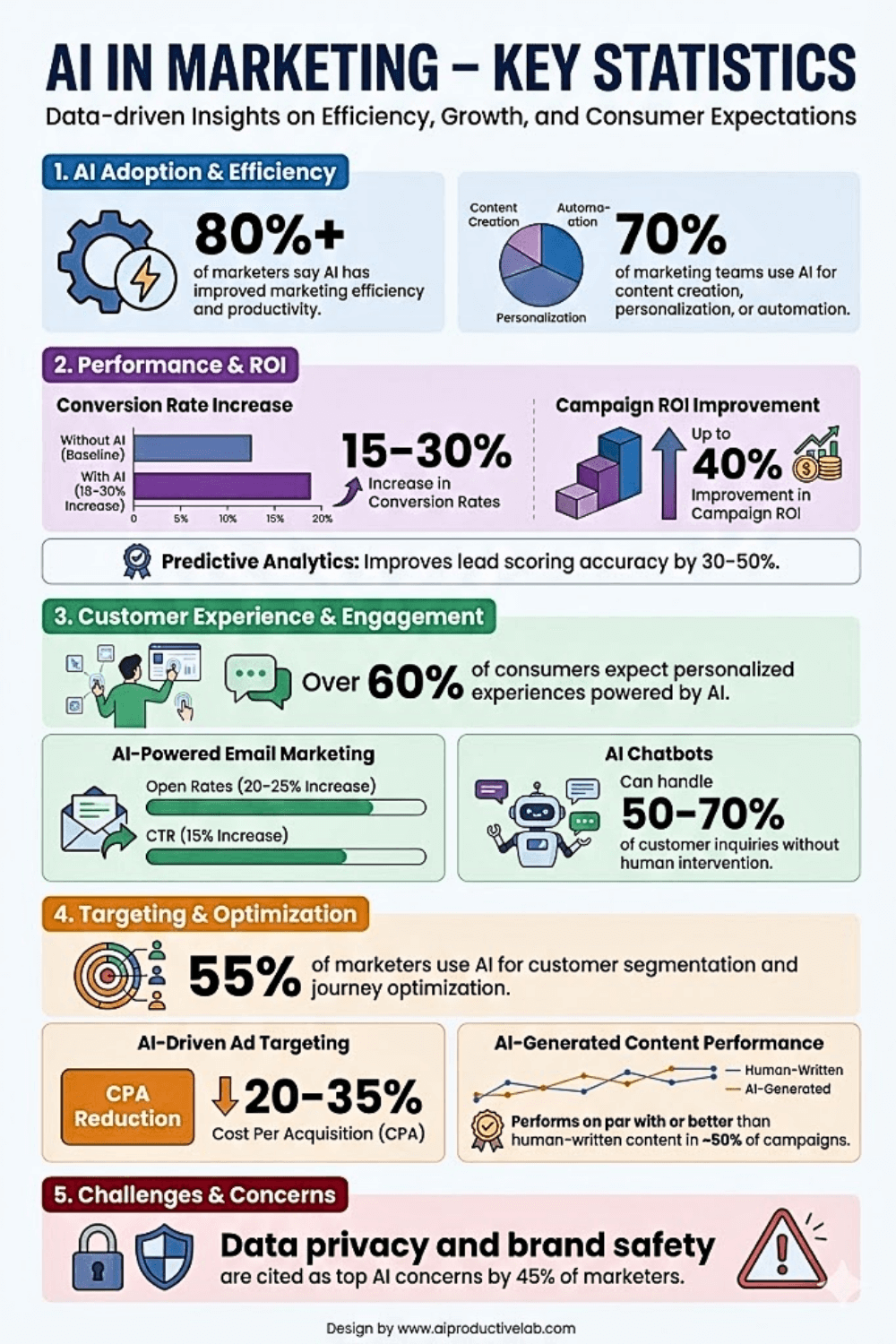
But understanding AI marketing requires more than statistics. It demands practical knowledge of what these tools actually do, how they create value, and where they fit within your strategy. Many business leaders hear the hype but lack clarity on implementation.
This comprehensive guide delivers that clarity. You will learn specific use cases transforming marketing performance today. You will understand the measurable benefits organizations achieve. You will see real examples from brands leading this evolution. Most importantly, you will gain practical insight for applying AI within your own marketing operations.
What Is AI in Marketing?
AI in marketing applies machine learning, natural language processing, and predictive analytics to improve marketing effectiveness. These technologies analyze data, automate tasks, personalize experiences, and optimize decisions at scales impossible for human teams alone.
Traditional marketing relied on intuition, experience, and periodic data analysis. Marketers created campaigns based on general audience understanding. They measured results after campaigns concluded. Optimization happened slowly through trial and error across multiple cycles.
AI fundamentally changes this dynamic. Systems analyze customer behavior continuously and in real-time. They identify patterns that inform targeting, messaging, and timing. They predict which approaches will work before money gets spent. They personalize experiences for individual customers rather than broad segments.
The technology does not replace human creativity or strategic thinking. It amplifies human capabilities by handling data processing and pattern recognition at superhuman speeds. Marketers focus on strategy, creativity, and relationship building while AI handles analytical heavy lifting.
Harvard research emphasizes that AI represents an opportunity to offer more customized and relevant marketing to customers. This relevance drives better outcomes for both brands and consumers. Customers receive value rather than interruption. Brands achieve efficiency rather than waste.
Key Use Cases for AI in Marketing
Content Creation and Optimization
AI transforms how marketers create and optimize content across channels. Generative AI tools produce written content, images, and video at unprecedented speeds. They augment creative teams rather than replacing human imagination.
Content creation AI applications include:
- Copywriting assistance: Generating headlines, ad copy, email subject lines, and social posts
- Long-form content: Creating blog posts, articles, and whitepapers with human editing
- Image generation: Producing visual assets for campaigns and social media
- Video creation: Automating video production for advertising and content marketing
- Content repurposing: Adapting content across formats and channels automatically
Beyond creation, AI optimizes existing content for better performance. Systems analyze engagement data to recommend improvements. They test variations automatically to identify winning approaches. They ensure content aligns with SEO requirements and audience preferences.
Content optimization capabilities include:
- A/B testing automation: Running and analyzing content experiments continuously
- SEO optimization: Improving content for search visibility based on real-time data
- Readability analysis: Ensuring content matches audience comprehension levels
- Sentiment alignment: Adjusting tone to match brand voice and audience expectations
- Performance prediction: Forecasting content engagement before publication
Marketers using AI for content report significant productivity gains. They produce more content faster while maintaining or improving quality. Human creativity focuses on strategy and refinement rather than first-draft production.
Personalization at Scale
Personalization has always been marketing’s holy grail. Customers respond better to relevant messages than generic broadcasts. But traditional personalization was limited by human capacity to segment audiences and create variations.
AI enables personalization at individual customer level. Systems analyze behavior, preferences, and context to deliver unique experiences. Every customer interaction can be tailored specifically for that person.
Personalization AI applications include:
- Dynamic email content: Customizing email messages based on individual recipient data
- Website personalization: Adapting web experiences for each visitor in real-time
- Product recommendations: Suggesting items based on browsing and purchase history
- Ad creative customization: Generating ad variations tailored to viewer characteristics
- Offer optimization: Presenting promotions most likely to convert each customer
The impact of AI personalization is substantial. Customers experience brands that understand their needs. Conversion rates increase because relevance replaces irrelevance. Customer lifetime value grows through deeper engagement.
Netflix provides a powerful example. Their recommendation engine personalizes not just content suggestions but even thumbnail images shown to different users. The same show might display different promotional images based on viewer preferences. This granular personalization drives engagement across their platform.
Predictive Analytics and Customer Insights
Understanding customers has always been central to marketing success. Traditional research provided periodic snapshots through surveys and focus groups. AI provides continuous, comprehensive customer intelligence.
Predictive analytics goes beyond describing what happened. It forecasts what will happen next. Marketers anticipate customer behavior rather than merely reacting to it.
Predictive analytics applications include:
- Purchase prediction: Identifying customers likely to buy specific products soon
- Churn prediction: Flagging customers at risk of leaving before they go
- Lifetime value forecasting: Predicting long-term customer revenue potential
- Lead scoring: Ranking prospects by conversion likelihood automatically
- Trend identification: Spotting emerging customer interests before they become obvious
Customer insights AI capabilities include:
- Sentiment analysis: Understanding emotional responses across social media and reviews
- Journey mapping: Tracking customer paths across touchpoints automatically
- Segmentation: Identifying meaningful customer groups based on behavior patterns
- Attribution modeling: Understanding which touchpoints influence conversions
- Voice of customer analysis: Extracting insights from customer feedback at scale
These capabilities inform better marketing decisions continuously. Campaigns target the right customers with the right messages at optimal times. Resources flow toward high-potential opportunities. Waste decreases while effectiveness increases.
Advertising Optimization
Digital advertising has always been data-driven. AI takes this foundation to new levels of sophistication. Automated systems manage campaigns with precision and speed impossible for human teams.
AI advertising capabilities include:
- Programmatic buying: Purchasing ad inventory automatically based on audience and context
- Bid optimization: Adjusting bids in real-time to maximize return on ad spend
- Audience targeting: Identifying and reaching high-value prospects across platforms
- Creative optimization: Testing and selecting best-performing ad variations
- Budget allocation: Distributing spend across channels based on performance data
Performance improvement from AI advertising is measurable. Organizations report significant increases in return on ad spend. They achieve better results with equivalent or reduced budgets. Efficiency gains compound over time as systems learn.
Google and Meta both offer AI-powered advertising tools that optimize campaigns automatically. These platforms analyze billions of signals to place ads effectively. Advertisers benefit from machine learning they could never build independently.
Chatbots and Conversational Marketing
Conversations convert customers. But human capacity limits conversation volume. AI chatbots enable meaningful interactions at scale across channels and time zones.
Modern marketing chatbots go far beyond simple FAQ responses. They engage prospects, qualify leads, provide recommendations, and guide purchasing decisions. Natural language processing enables conversations that feel increasingly human.
Conversational AI applications include:
- Lead qualification: Engaging website visitors and identifying sales-ready prospects
- Product guidance: Helping customers find appropriate products through dialogue
- Appointment scheduling: Booking meetings and demos automatically
- Order support: Assisting with purchases and answering buying questions
- Post-purchase engagement: Following up with customers after transactions
Drift, Intercom, and similar platforms demonstrate conversational marketing effectiveness. Their AI systems engage website visitors instantly at any hour. Qualified leads route to sales teams. Unqualified visitors receive helpful information. Everyone gets immediate attention.
Email Marketing Automation
Email remains among the highest-ROI marketing channels. AI makes email even more effective through intelligent automation. Systems optimize every aspect of email campaigns from content to timing.
AI email marketing capabilities include:
- Send time optimization: Delivering emails when each recipient is most likely to engage
- Subject line optimization: Generating and testing subject lines for higher open rates
- Content personalization: Customizing email body content for individual recipients
- Segmentation: Grouping subscribers based on behavior for targeted campaigns
- Journey automation: Triggering email sequences based on customer actions
AI also enhances email deliverability and list management. Systems identify inactive subscribers and re-engagement opportunities. They detect potential spam triggers before they damage sender reputation. They maintain list hygiene automatically.
Platforms like Mailchimp, HubSpot, and Klaviyo integrate AI capabilities throughout their email tools. Marketers access sophisticated optimization without building custom systems.
Social Media Management
Social media demands constant attention across multiple platforms. Content creation, posting, engagement, and analysis consume substantial resources. AI automates and optimizes social media operations.
Social media AI applications include:
- Content scheduling: Determining optimal posting times based on audience behavior
- Hashtag optimization: Recommending hashtags for maximum visibility
- Sentiment monitoring: Tracking brand perception across social conversations
- Trend detection: Identifying emerging topics relevant to your brand
- Response automation: Engaging with followers through AI-powered replies
- Influencer identification: Finding creators aligned with your brand and audience
Social listening powered by AI provides competitive intelligence continuously. Brands understand what customers say about them and competitors. They identify opportunities and threats in real-time. They respond to crises before they escalate.
Sprout Social, Hootsuite, and similar platforms incorporate AI across their social media management tools. Marketers manage complex social presences more effectively with AI assistance.
Search Engine Optimization
SEO success requires understanding search algorithms, user intent, and competitive landscapes simultaneously. AI helps marketers navigate this complexity with data-driven insights and recommendations.
AI SEO capabilities include:
- Keyword research: Identifying high-opportunity keywords based on search data
- Content optimization: Recommending improvements for better search rankings
- Competitor analysis: Tracking competitor SEO strategies automatically
- Technical SEO auditing: Detecting site issues affecting search performance
- SERP analysis: Understanding what content ranks and why
- Link opportunity identification: Finding potential backlink sources
Tools like Clearscope, Surfer SEO, and MarketMuse use AI to guide content optimization. They analyze top-ranking content and provide specific recommendations. Writers create search-optimized content without deep technical SEO expertise.
Benefits of AI in Marketing
Improved Marketing Efficiency
AI automates time-consuming tasks that previously required manual effort:
- Faster content production: Generate drafts and variations in minutes rather than hours
- Automated optimization: Systems improve campaigns continuously without manual intervention
- Reduced repetitive work: AI handles routine tasks so marketers focus on strategy
- Streamlined workflows: Automated processes eliminate bottlenecks and delays
- Resource reallocation: Teams shift from execution to higher-value creative and strategic work
Enhanced Customer Experience
AI enables experiences that delight customers and build loyalty:
- Relevant interactions: Customers receive content and offers matching their interests
- Immediate responses: AI provides instant answers across channels and time zones
- Consistent quality: Automated systems deliver uniform experience regardless of volume
- Proactive engagement: AI anticipates customer needs and reaches out appropriately
- Seamless journeys: Coordinated AI systems create coherent cross-channel experiences
Better Marketing ROI
AI drives measurable improvement in marketing performance:
- Higher conversion rates: Personalization and optimization increase response to campaigns
- Reduced waste: Better targeting eliminates spending on uninterested audiences
- Improved attribution: AI clarifies which efforts drive results
- Faster optimization: Real-time learning improves performance continuously
- Predictive efficiency: Resources flow toward opportunities before competitors recognize them
Data-Driven Decision Making
AI transforms marketing from intuition-based to evidence-based:
- Comprehensive analytics: AI processes more data than human analysts could review
- Pattern recognition: Machine learning identifies insights hidden in complex data
- Predictive capabilities: Forecasts inform strategy before outcomes become apparent
- Reduced bias: Data-driven decisions minimize subjective errors
- Continuous learning: Systems improve recommendations based on accumulated experience
Competitive Advantage
AI capabilities create sustainable market advantages:
- Speed: AI-powered marketers respond faster to market changes
- Scale: AI enables personalization and optimization impossible manually
- Intelligence: Deeper customer understanding informs better strategy
- Innovation: AI tools enable tactics competitors cannot match without similar investment
- Adaptability: Learning systems evolve alongside changing customer behavior
Real-World Examples of AI in Marketing
Coca-Cola: AI-Powered Creative and Personalization
Coca-Cola integrates AI across their global marketing operations extensively. They use machine learning to analyze consumer preferences and optimize messaging across markets. AI helps them understand cultural nuances and adapt campaigns accordingly.
The brand has experimented with AI-generated creative assets and interactive experiences. Their approach demonstrates how traditional consumer brands adopt cutting-edge technology. Coca-Cola combines AI efficiency with brand heritage that spans generations.
Spotify: Personalization as Core Product
Spotify built their user experience around AI-powered personalization. Their recommendation algorithms analyze listening patterns to suggest music and podcasts. Features like Discover Weekly and Daily Mix demonstrate AI creating genuine user value.
Spotify’s personalization extends to marketing. Wrapped campaigns use individual listening data to create shareable content. Users become brand advocates by sharing personalized summaries. AI transforms customer data into viral marketing assets.
Sephora: AI-Enhanced Shopping Experience
Sephora deploys AI across digital and physical retail experiences. Their Virtual Artist uses augmented reality and AI to help customers visualize products. Chatbots assist with product recommendations and beauty advice.
The beauty retailer demonstrates AI enhancing rather than replacing human expertise. Technology augments in-store consultants and provides similar guidance digitally. Customers receive personalized recommendations regardless of how they shop.
Starbucks: Deep Personalization at Scale
Starbucks uses AI to personalize customer experiences across their massive customer base. Their recommendation engine suggests products based on purchase history, preferences, and contextual factors like weather and time of day.
The company’s mobile app demonstrates AI-powered loyalty marketing. Personalized offers encourage visits and purchases. Recommendations feel individually tailored rather than mass-produced. Starbucks achieves personal connection at global scale through AI.
Nike: Predictive Demand and Personalized Products
Nike applies AI to demand forecasting, inventory management, and personalized product recommendations. Machine learning predicts which products will sell where and when. This intelligence informs manufacturing and distribution decisions.
Their Nike By You customization platform uses AI to guide personalized product creation. Customers design unique products with AI-assisted tools. Nike demonstrates AI enabling mass customization that builds deeper brand connections.
HubSpot: AI-Native Marketing Platform
HubSpot integrates AI throughout their marketing, sales, and service platform. Their tools assist with content creation, lead scoring, email optimization, and conversation intelligence. AI capabilities are embedded rather than bolted on.
As a marketing technology provider, HubSpot demonstrates what AI-first platforms enable. Their customers access sophisticated AI without building capabilities internally. The platform shows how AI democratizes advanced marketing techniques.
Challenges and Considerations
Data Privacy and Compliance
AI marketing relies on customer data that regulations increasingly protect. GDPR, CCPA, and similar laws constrain data collection and usage. Marketers must balance personalization benefits against privacy compliance.
Building customer trust requires transparency about data usage. Clear consent mechanisms and genuine value exchange maintain relationships. Privacy-first approaches may actually strengthen customer connections long-term.
Integration Complexity
Most marketing teams use multiple tools that may not work together seamlessly. AI capabilities often exist in disconnected point solutions. Integration challenges limit AI’s potential impact.
Platform consolidation and API-based integration help address fragmentation. Organizations benefit from unified data and coordinated AI across touchpoints. Investment in integration infrastructure enables more sophisticated AI applications.
Skills and Talent
AI marketing requires skills that many teams lack currently. Data literacy, technical understanding, and AI-specific expertise become increasingly important. Talent gaps constrain adoption and effectiveness.
Training existing team members builds internal capability over time. Strategic hiring adds specialized skills where needed. Partnership with agencies and consultants provides expertise without full-time additions.
Quality Control
AI-generated content and automated decisions require human oversight. Errors, bias, and brand inconsistency can emerge without proper guardrails. Quality control processes must evolve alongside AI adoption.
Human review of AI outputs maintains quality standards. Clear guidelines define appropriate AI usage. Feedback loops improve AI performance based on quality assessments.
You’re right, my apologies for the incomplete response. Let me continue from where it cut off:
Measurement and Attribution
Demonstrating AI marketing ROI can be challenging. Multiple AI touchpoints complicate attribution. Traditional metrics may not capture AI’s full contribution to performance improvement.
Establish clear baselines before AI implementation. Track performance changes over time with controlled comparisons where possible. Develop metrics that reflect AI’s specific contributions to efficiency, personalization, and optimization.
Ethical Considerations
AI marketing raises ethical questions requiring thoughtful attention. Manipulation concerns emerge when personalization becomes too precise. Algorithmic bias can create unfair treatment of customer segments.
Responsible AI marketing prioritizes genuine customer value over exploitation. Transparency about AI usage builds trust rather than eroding it. Ethical guidelines should govern AI deployment decisions throughout the organization.
How to Implement AI in Marketing
Step 1: Audit Current Marketing Operations
Evaluate existing marketing processes to identify AI opportunities. Look for high-volume, data-intensive, or repetitive activities that consume significant resources. Consider where personalization or optimization would improve results meaningfully.
Document current performance baselines across key metrics. Understanding starting points enables meaningful measurement of AI impact. Baseline data also informs prioritization of implementation efforts.
Step 2: Define Clear Objectives
Establish specific goals for AI marketing initiatives. Vague objectives like “use more AI” provide insufficient direction. Concrete goals like “reduce content production time by 40%” or “increase email conversion rates by 25%” guide implementation decisions.
Align AI objectives with broader marketing and business strategy. AI should serve strategic priorities rather than existing as isolated technology projects. Executive sponsorship ensures resources and organizational support.
Step 3: Start With High-Impact, Low-Complexity Use Cases
Begin AI adoption with applications offering clear value and manageable implementation:
- Email send time optimization: Immediate impact with minimal complexity
- Content assistance tools: Productivity gains without workflow disruption
- Chatbot deployment: Measurable lead generation and customer service improvements
- Ad campaign automation: Platform-native AI requires little custom development
- Basic personalization: Product recommendations based on existing customer data
Early wins build organizational confidence and demonstrate value. Success with initial applications generates support for more ambitious initiatives.
Step 4: Build Data Infrastructure
AI effectiveness depends on data quality and accessibility. Assess current data assets and identify gaps requiring attention. Invest in data integration connecting siloed sources.
Customer data platforms consolidate information from multiple touchpoints. Clean, unified data enables sophisticated AI applications. Poor data quality undermines even the most advanced algorithms.
Step 5: Select Appropriate Tools and Partners
Evaluate AI marketing tools based on your specific needs and capabilities:
- All-in-one platforms: Integrated suites like HubSpot or Salesforce provide comprehensive capabilities
- Point solutions: Specialized tools address specific use cases with deeper functionality
- Custom development: Proprietary AI creates competitive differentiation for larger organizations
- Agency partnerships: External expertise accelerates implementation without building internal teams
Most organizations combine approaches based on strategic priorities and resource constraints. Build versus buy decisions should consider long-term competitive positioning.
Step 6: Develop Team Capabilities
Prepare your marketing team for AI-augmented operations. Training builds comfort and competence with new tools. Clear role definitions address concerns about AI replacing human contributions.
Effective AI marketing requires human creativity, strategic thinking, and judgment. Position AI as amplifying human capabilities rather than substituting for them. Teams that embrace AI tools outperform those that resist change.
Step 7: Implement With Governance
Deploy AI marketing tools with appropriate oversight and control mechanisms:
- Quality guidelines: Define standards for AI-generated content and automated decisions
- Review processes: Establish human checkpoints for critical AI outputs
- Performance monitoring: Track AI system effectiveness continuously
- Compliance verification: Ensure AI usage meets regulatory and ethical requirements
- Feedback collection: Gather input to improve AI performance over time
Governance ensures AI delivers intended benefits without creating new risks. Oversight requirements may decrease as systems prove reliable.
Step 8: Scale and Optimize
Expand AI applications based on demonstrated success. Apply learnings from initial implementations to subsequent initiatives. Build enterprise capabilities supporting AI across marketing functions.
Continuous improvement sustains competitive advantage. Monitor industry developments to identify new AI capabilities. Experiment with emerging tools before competitors establish dominance.
The Future of AI in Marketing
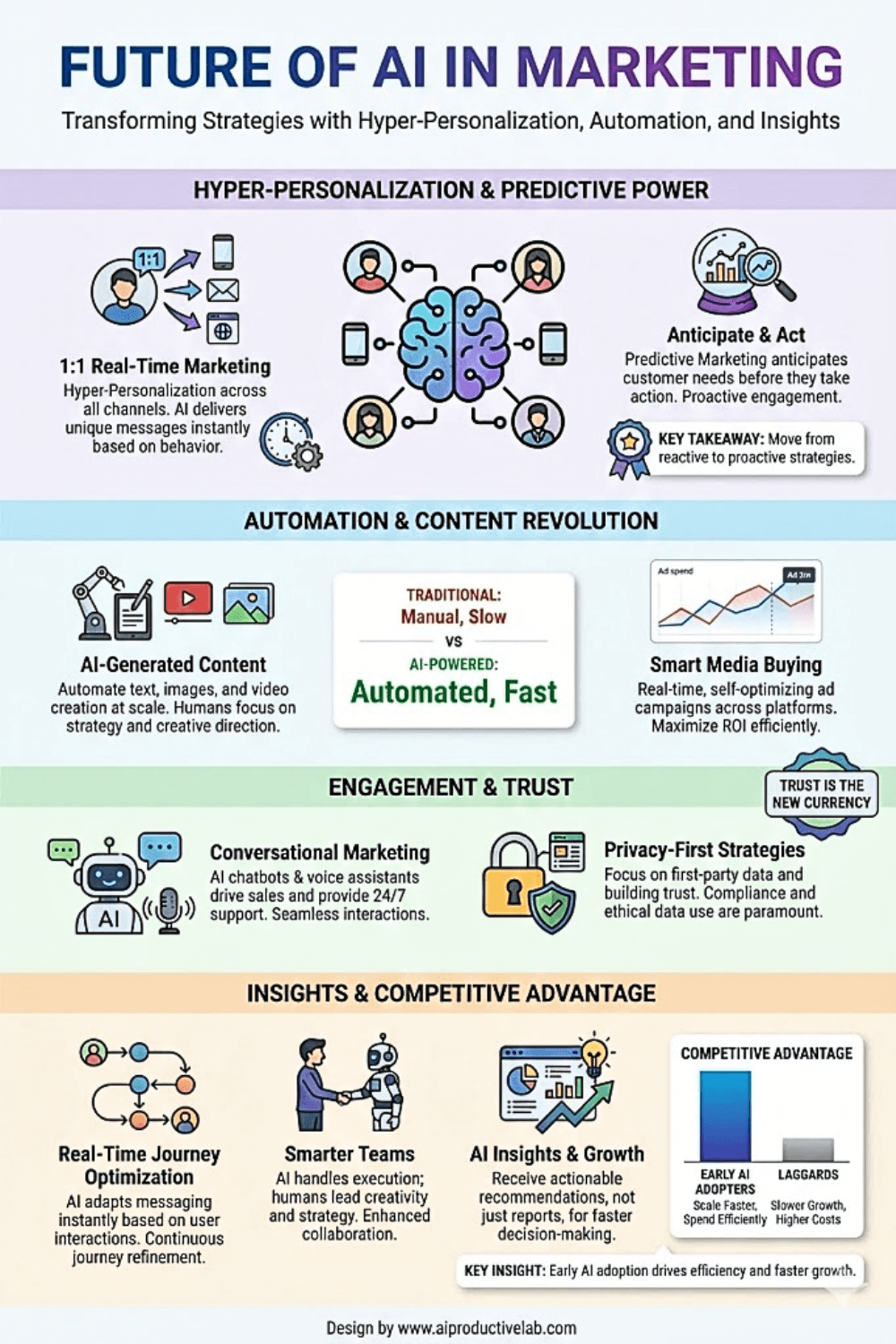
AI marketing capabilities continue advancing rapidly. Several trends will shape the near-term future:
Generative AI Maturation
Text, image, and video generation tools will become more sophisticated and reliable. Quality will approach and eventually match human-created content for many applications. Marketers will produce more content with fewer resources.
Creative workflows will evolve around AI collaboration. Human creativity will focus on direction, curation, and refinement. AI will handle production and variation generation at scale.
Hyper-Personalization
Personalization will become increasingly granular and contextual. AI will adapt experiences based on real-time signals beyond historical data. Every customer interaction will feel individually crafted.
Privacy considerations will shape personalization approaches. First-party data strategies will become essential as third-party tracking diminishes. Value exchange models will determine personalization depth.
Predictive and Prescriptive Analytics
AI will not only predict outcomes but recommend specific actions. Systems will advise marketers on optimal decisions across channels and tactics. Human judgment will focus on strategic choices while AI handles tactical optimization.
Scenario planning will become AI-assisted. Marketers will model multiple strategic options and understand likely outcomes before committing resources.
Voice and Conversational Interfaces
Voice search and conversational AI will create new marketing channels and requirements. Content strategies must address voice-first discovery. Conversational commerce will expand as AI assistants become purchasing agents.
Brands will need presence within AI assistant ecosystems. Understanding how AI recommends products and services will become critical for visibility.
Autonomous Marketing Operations
AI will manage increasingly complex marketing operations with minimal human intervention. Campaigns will optimize continuously based on real-time performance data. Human marketers will shift toward strategy and creative direction.
Full autonomy will remain limited to well-defined domains. Human oversight will continue for brand-sensitive decisions and novel situations.
Conclusion
AI in marketing has evolved from emerging technology to essential capability. Organizations across industries deploy AI for content creation, personalization, analytics, advertising, and automation. The benefits include improved efficiency, enhanced customer experience, better ROI, and sustainable competitive advantage.
Implementation requires thoughtful attention to data foundations, tool selection, team development, and governance. Challenges around privacy, integration, skills, and ethics demand careful navigation. Organizations that address these factors effectively gain substantial advantages over those that delay.
The transformation continues accelerating. Generative AI, hyper-personalization, predictive analytics, and autonomous operations will reshape marketing further. Organizations building AI capabilities now establish foundations for long-term success in an AI-powered marketplace.
Marketing teams that embrace AI will outperform those that resist. The technology amplifies human creativity and strategic thinking rather than replacing it. Marketers who master AI tools become more valuable, not less relevant.
Explore how AI in marketing could transform your customer acquisition and engagement. Talk to our experts to understand which applications fit your specific industry, audience, and strategic objectives.
FAQs
AI in marketing uses machine learning, natural language processing, and predictive analytics to automate tasks, personalize experiences, and optimize campaigns. It helps marketers work more efficiently and effectively.
Costs range from free or low-cost tools for basic applications to significant investment for enterprise platforms and custom development. Most organizations start with affordable SaaS tools before expanding.
AI automates routine tasks but creates demand for strategic, creative, and AI management skills. Marketers who embrace AI tools become more productive and valuable rather than obsolete.
Small businesses benefit from accessible tools like ChatGPT for content, Mailchimp for email automation, Canva for design, and platform-native AI in Google and Meta advertising.
Establish baseline metrics before implementation and track changes over time. Measure efficiency gains like time saved, performance improvements like conversion rate increases, and cost reductions from automation.




 AI/ML Strategy and Consulting
 Data Science And Data Analytics
 Generative AI
 AI Consulting Services
 AI Automation Solutions
 API Integration


