


Production planners face an impossible puzzle daily. Customer orders change without notice. Machines break down unexpectedly. Suppliers miss delivery dates. Raw materials arrive late. Workers call in sick. Balancing all these variables manually overwhelms even the most experienced teams.
- AI continuously optimizes schedules using thousands of variables for real-time, adaptive production planning.
- Improved demand forecasting reduces inventory and aligns production closer to actual customer demand.
- Constraint-based optimization balances capacity, materials, labor, and changeovers to maximize utilization.
- Phased implementation and integration with ERP/MES minimize risk while delivering measurable cost and service gains.
- Successful adoption requires data quality improvements and change management to shift planners into exception roles.
AI production planning solves this complexity. Intelligent algorithms process thousands of variables simultaneously. Systems adjust schedules in real-time as conditions change. Optimization happens continuously rather than periodically. The technology transforms chaotic planning into strategic advantage.
The impact is measurable and significant. According to McKinsey, AI-led demand sensing reduces inventory 20-30% while improving fulfillment rates. Research from DataRobot shows 15% lower logistics costs through intelligent planning. Organizations implementing AI production planning gain efficiency impossible through manual methods.
The market trajectory confirms growing adoption. Grand View Research reports the AI in manufacturing market reached 5.32 billion USD in 2024 with projections reaching 47.88 billion by 2030. Production planning represents one of the highest-value applications driving this growth.
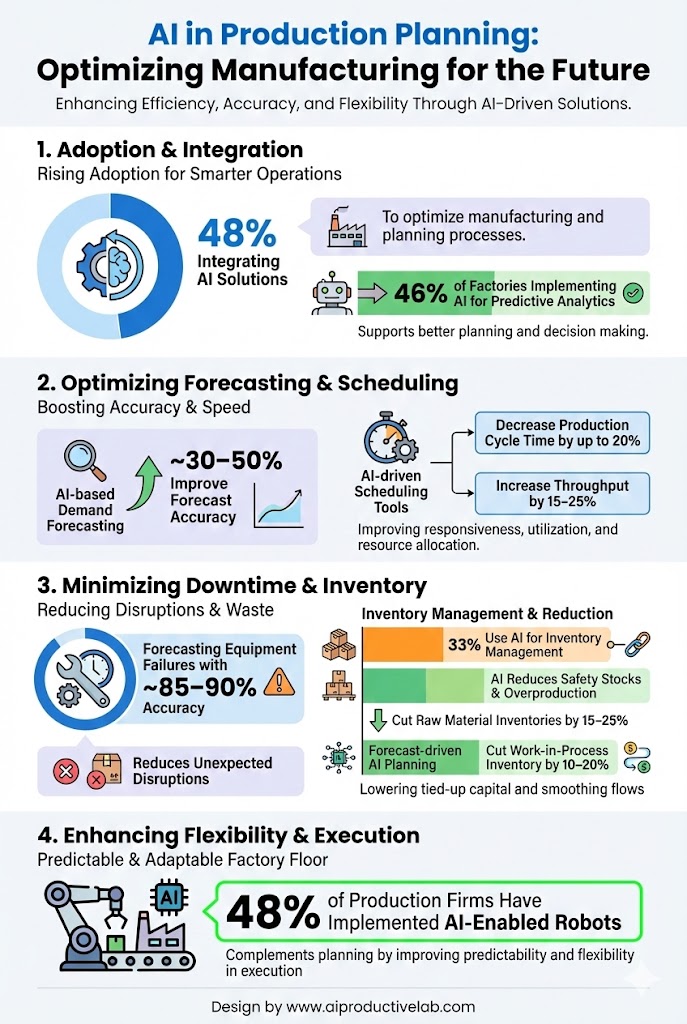
This guide explores AI production planning comprehensively. You will learn how the technology transforms scheduling and optimization. You will understand specific benefits organizations achieve. You will see practical applications across manufacturing environments. Most importantly, you will gain insight for evaluating AI planning opportunities within your own operations.
What Is AI Production Planning?
AI production planning applies artificial intelligence to optimize manufacturing schedules, resource allocation, and production sequencing. The technology analyzes demand forecasts, capacity constraints, material availability, and operational variables to create optimal production plans.
Traditional planning relies on spreadsheets, experience, and periodic updates. Planners make decisions based on limited information processed through human cognition. Changes require manual recalculation. Optimization reflects what planners can process, not true optimal solutions.
AI planning fundamentally changes this approach through continuous, comprehensive optimization.
Core technology components include:
- Demand forecasting algorithms: Predicting customer orders and market needs
- Constraint optimization engines: Balancing capacity, materials, and requirements
- Machine learning models: Improving predictions based on historical patterns
- Real-time data integration: Connecting to production systems and sensors
- Scenario simulation: Evaluating alternatives before implementation
- Automated scheduling: Generating optimized production sequences
The technology processes information beyond human capability. Thousands of orders, hundreds of machines, dozens of constraints—AI evaluates all combinations to find optimal solutions. Planners receive recommendations they could never calculate manually.
This intelligence enables manufacturing agility impossible through traditional methods. Plans adapt as conditions change. Schedules optimize continuously rather than weekly. Resources allocate based on actual rather than assumed requirements.
How AI Production Planning Works
Demand Forecasting and Prediction
Effective production planning begins with accurate demand forecasting. AI analyzes historical patterns and external factors to predict future requirements.
Forecasting capabilities include:
- Historical pattern analysis: Learning from past demand cycles and trends
- Seasonality recognition: Identifying recurring patterns across time periods
- External factor integration: Incorporating economic indicators and market data
- Customer behavior modeling: Predicting order patterns from specific accounts
- Promotion impact estimation: Forecasting demand changes from marketing activities
- New product forecasting: Predicting demand for items without historical data
AI forecasting improves accuracy 20-50% over traditional statistical methods. Better predictions enable better planning. Inventory reduces while service levels improve.
Constraint-Based Optimization
AI planning engines optimize schedules while respecting operational constraints.
Optimization considerations include:
- Machine capacity: Available production hours and capabilities
- Labor availability: Workforce schedules and skill requirements
- Material supply: Raw material and component availability
- Tooling and fixtures: Equipment needed for specific products
- Changeover requirements: Setup times between different products
- Quality considerations: Process requirements affecting sequencing
Optimization algorithms evaluate millions of possible schedules. They find solutions balancing competing objectives—minimizing costs while meeting delivery dates while maximizing equipment utilization. Human planners cannot process this complexity.
Real-Time Adaptation
AI planning systems adjust continuously as conditions change.
Adaptation capabilities include:
- Order change incorporation: Updating schedules as demand shifts
- Machine status integration: Responding to breakdowns and maintenance
- Material availability updates: Adjusting for supply delays or arrivals
- Workforce changes: Accommodating attendance and availability shifts
- Priority management: Resequencing for urgent orders
- Performance feedback: Refining plans based on actual versus planned results
Real-time adaptation maintains schedule validity. Traditional weekly planning becomes obsolete within days. AI planning stays current continuously.
Key Benefits of AI Production Planning
Significant Inventory Reduction
AI planning reduces inventory through improved forecasting and timing precision.
Inventory benefits include:
- Safety stock optimization: Lower buffers with better demand prediction
- Work-in-process reduction: Smoother flow minimizing queue inventory
- Finished goods optimization: Producing closer to actual demand timing
- Raw material efficiency: Ordering based on refined requirements
- Obsolescence prevention: Reducing excess inventory of slow-moving items
McKinsey research documents 20-30% inventory reduction through AI-led demand sensing. Lower inventory releases working capital while reducing carrying costs and obsolescence risk.
Improved On-Time Delivery
Better planning translates directly to better customer service performance.
Delivery benefits include:
- Realistic promising: Accurate dates based on true capacity analysis
- Schedule adherence: Plans that account for actual production realities
- Priority management: Intelligent sequencing protecting critical orders
- Disruption recovery: Faster replanning when problems occur
- Proactive communication: Earlier visibility to potential delivery issues
On-time delivery improvements strengthen customer relationships. Reliable suppliers earn preferred status and price premium tolerance.
Enhanced Resource Utilization
AI optimization maximizes output from available resources.
Utilization benefits include:
- Machine efficiency: Higher productive time percentage
- Labor productivity: Better alignment of workforce to requirements
- Changeover minimization: Intelligent sequencing reducing setup time
- Bottleneck management: Optimal loading of constrained resources
- Energy efficiency: Production timing optimizing energy costs
Utilization improvements generate more output without additional capital investment. Existing assets become more productive through intelligent planning.
Reduced Operating Costs
AI planning decreases costs through multiple mechanisms simultaneously.
Cost reduction sources include:
- Overtime reduction: Better planning avoiding expedited production
- Logistics optimization: Efficient shipping through better timing
- Quality improvement: Reduced defects from rushed production
- Administrative efficiency: Less time spent on manual planning
- Inventory carrying costs: Lower storage and financing expenses
Organizations implementing AI planning report 10-20% cost reductions in planning-influenced categories. Benefits compound across interconnected cost elements.
Greater Operational Agility
AI enables faster response to changing conditions and opportunities.
Agility benefits include:
- Rapid replanning: Quick schedule updates when conditions change
- What-if analysis: Fast evaluation of alternative scenarios
- New product introduction: Easier integration of new items into schedules
- Demand responsiveness: Faster reaction to order changes
- Opportunity capture: Ability to accept rush orders profitably
Agility becomes competitive advantage in volatile markets. Organizations responding faster capture opportunities competitors cannot pursue.
AI Production Planning Applications
Discrete Manufacturing
Discrete manufacturers producing individual items benefit significantly from AI planning.
Discrete manufacturing applications include:
- Job shop scheduling: Optimizing complex routings through multiple work centers
- Assembly line balancing: Coordinating component availability with assembly schedules
- Make-to-order planning: Managing custom products with variable requirements
- Mixed-model sequencing: Optimizing production of multiple products on shared lines
- Batch sizing optimization: Determining efficient production quantities
Automotive, aerospace, electronics, and machinery manufacturers deploy AI planning extensively. Complex product structures and routing flexibility create optimization opportunities.
Process Manufacturing
Continuous and batch process manufacturers apply AI planning to their unique challenges.
Process manufacturing applications include:
- Campaign planning: Optimizing sequences of batches minimizing changeovers
- Tank and vessel scheduling: Managing limited capacity resources efficiently
- Recipe optimization: Adjusting formulations based on material availability
- Quality-constrained scheduling: Sequencing based on product compatibility
- Yield optimization: Planning for actual versus theoretical output
Chemical, pharmaceutical, food, and beverage manufacturers achieve significant value through AI planning addressing process-specific constraints.
Multi-Site Operations
Organizations with multiple facilities use AI to optimize across locations.
Multi-site applications include:
- Demand allocation: Assigning orders to optimal production locations
- Capacity balancing: Shifting work between sites based on loading
- Transfer optimization: Planning inter-facility shipments efficiently
- Network inventory: Coordinating stock across locations
- Capability matching: Routing products to appropriate facilities
Global manufacturers leverage AI for planning complexity spanning geographies, time zones, and organizational boundaries.
Supply Chain Integration
AI planning extends beyond factory walls to encompass supply chain coordination.
Supply chain applications include:
- Supplier coordination: Aligning material deliveries with production needs
- Customer collaboration: Integrating customer forecasts and schedules
- Logistics synchronization: Coordinating production with transportation
- Distribution planning: Connecting manufacturing to warehouse operations
- End-to-end visibility: Comprehensive view across supply chain stages
Integrated planning delivers benefits impossible through functional optimization alone.
Real-World Examples and Results
Consumer Goods Manufacturing
A global consumer products company implemented AI production planning across 15 manufacturing facilities. The system optimizes schedules considering demand forecasts, material availability, and production constraints.
Results achieved:
- 25% reduction in finished goods inventory
- 15% improvement in on-time delivery performance
- 12% decrease in production changeover time
- 8% increase in overall equipment effectiveness
The implementation paid for itself within nine months through inventory reduction alone.
Automotive Parts Supplier
An automotive components manufacturer deployed AI planning to manage make-to-order production with tight delivery requirements.
Results achieved:
- 40% reduction in planning cycle time
- 22% improvement in schedule adherence
- 18% decrease in expediting costs
- 95% on-time delivery versus 82% previously
The system handles demand volatility that previously required constant manual intervention.
Pharmaceutical Production
A pharmaceutical company implemented AI planning to optimize batch manufacturing while maintaining regulatory compliance.
Results achieved:
- 30% reduction in batch campaign changeovers
- 20% decrease in work-in-process inventory
- 15% improvement in equipment utilization
- Maintained 100% compliance with batch sequencing requirements
The implementation demonstrated AI planning works within highly regulated environments.
Implementing AI Production Planning
Assessment and Readiness
Successful implementation begins with honest evaluation of current capabilities and opportunities.
Assessment steps include:
- Current process analysis: How do you plan production today?
- Pain point identification: Where do planning failures occur?
- Data availability review: What information exists for AI analysis?
- System landscape evaluation: What technology foundation exists?
- Benefit prioritization: Where will AI planning deliver greatest value?
Clear understanding of starting position enables realistic planning and appropriate expectations.
Solution Selection
Choose AI planning solutions matching your specific requirements and environment.
Selection criteria include:
- Manufacturing type fit: Does the solution address your production model?
- Constraint handling: Can it manage your specific planning constraints?
- Integration capability: Will it connect with existing systems?
- Scalability: Can the solution grow with your needs?
- Implementation support: Does the vendor provide adequate assistance?
Evaluate solutions through detailed demonstrations using your actual planning scenarios.
Phased Implementation
Deploy AI planning progressively to manage risk and build capability.
Implementation phases include:
- Pilot deployment: Prove value on limited scope before expanding
- Process integration: Connect AI planning to operational workflows
- User adoption: Train planners to work effectively with AI recommendations
- Continuous refinement: Improve models based on production experience
- Scope expansion: Extend to additional products, facilities, or functions
Phased approaches reduce risk while building organizational confidence and capability.
Challenges and Considerations
Data Quality Requirements
AI planning requires accurate, comprehensive data for reliable optimization.
Data considerations include:
- Master data accuracy: Correct routings, standards, and parameters
- Inventory visibility: Real-time stock information across locations
- Capacity data: Accurate machine and labor availability
- Demand information: Reliable forecasts and order data
- Performance data: Actual versus planned results for learning
Data quality improvement often precedes AI planning implementation. Organizations should assess data readiness carefully.
Change Management
AI planning changes how planners work and make decisions.
Change considerations include:
- Role evolution: Planners become exception managers rather than schedule creators
- Trust development: Building confidence in AI recommendations
- Skill requirements: New capabilities needed for AI-augmented planning
- Process redesign: Workflows adapting to AI-generated schedules
- Performance measurement: Metrics reflecting AI planning contribution
People and processes must evolve alongside technology. Change management deserves significant attention.
Integration Complexity
AI planning must connect with existing manufacturing systems.
Integration requirements include:
- ERP systems: Order management and master data
- MES platforms: Shop floor execution and feedback
- Warehouse systems: Material availability information
- Quality systems: Constraint and specification data
- Business intelligence: Reporting and analytics platforms
Integration complexity varies by organization. Assess requirements thoroughly before selecting solutions.
Conclusion
AI production planning transforms manufacturing operations through intelligent optimization. Algorithms process thousands of variables to find solutions human planners cannot calculate. Real-time adaptation maintains schedule validity as conditions change. The technology delivers measurable improvements across key performance metrics.
The benefits are substantial and documented. Inventory reductions of 20-30% release working capital. On-time delivery improvements strengthen customer relationships. Resource utilization increases generate more output from existing assets. Operating costs decrease through multiple mechanisms.
The market trajectory confirms AI planning’s value. Growth projections to 47.88 billion USD by 2030 reflect accelerating adoption. Organizations across manufacturing sectors recognize intelligent planning as competitive necessity.
Implementation requires thoughtful approach. Assessment identifies opportunities and requirements. Solution selection matches technology to specific needs. Phased deployment manages risk while building capability. Change management prepares organizations for new ways of working.
Organizations maintaining traditional planning methods accept unnecessary inefficiency and missed optimization opportunities. AI production planning has matured into proven technology delivering reliable results. The question is no longer whether to implement, but how quickly.
Explore how AI production planning could transform your manufacturing operations and competitive position. Talk to our experts to understand which applications fit your specific production environment, planning challenges, and strategic objectives.
FAQs
AI production planning uses artificial intelligence to optimize manufacturing schedules, resource allocation, and production sequencing by analyzing demand, capacity, and constraints simultaneously.
According to McKinsey research, AI-led demand sensing and production planning reduces inventory 20-30% while simultaneously improving fulfillment rates and customer service performance.
Discrete manufacturing, process manufacturing, and mixed-mode operations all benefit from AI production planning, with applications spanning automotive, pharmaceutical, consumer goods, and electronics industries.
Initial pilot implementations typically require 3-6 months, with broader rollout taking 12-18 months depending on organizational complexity and integration requirements.
Yes, modern AI planning solutions integrate with major ERP platforms including SAP, Oracle, and Microsoft Dynamics through standard APIs and pre-built connectors.




 AI/ML Strategy and Consulting
 Data Science And Data Analytics
 Generative AI
 AI Consulting Services
 AI Automation Solutions
 API Integration


