


Every learner is unique. Yet traditional education treats everyone identically. Thirty students sit in identical rows, receiving identical instruction at identical speeds. Some struggle to keep pace. Others grow bored waiting for classmates to catch up. The approach fails both groups consistently.
- AI systems continuously assess learners and adapt instruction in real time to individual needs and mastery levels.
- Adaptive content adjusts difficulty, sequencing, and format to optimize engagement and accelerate learning.
- Intelligent feedback and predictive analytics provide timely interventions and prevent misconceptions from solidifying.
- Personalization yields measurable benefits: higher achievement, better retention, increased engagement, and efficient use of time.
- Successful adoption requires readiness, instructor preparation, equity safeguards, data privacy, and human-AI balance.
AI personalized learning offers a fundamentally different model. Intelligent systems adapt to individual learners in real-time. Content difficulty adjusts based on demonstrated understanding. Learning paths customize around individual strengths and gaps. Each student receives instruction calibrated precisely to their needs.
The approach delivers measurable results. According to research on personalized learning effectiveness, adaptive learning systems produce significant improvements in learning outcomes across K-12, higher education, and corporate training environments. Students learn faster and retain more when instruction matches their individual needs.
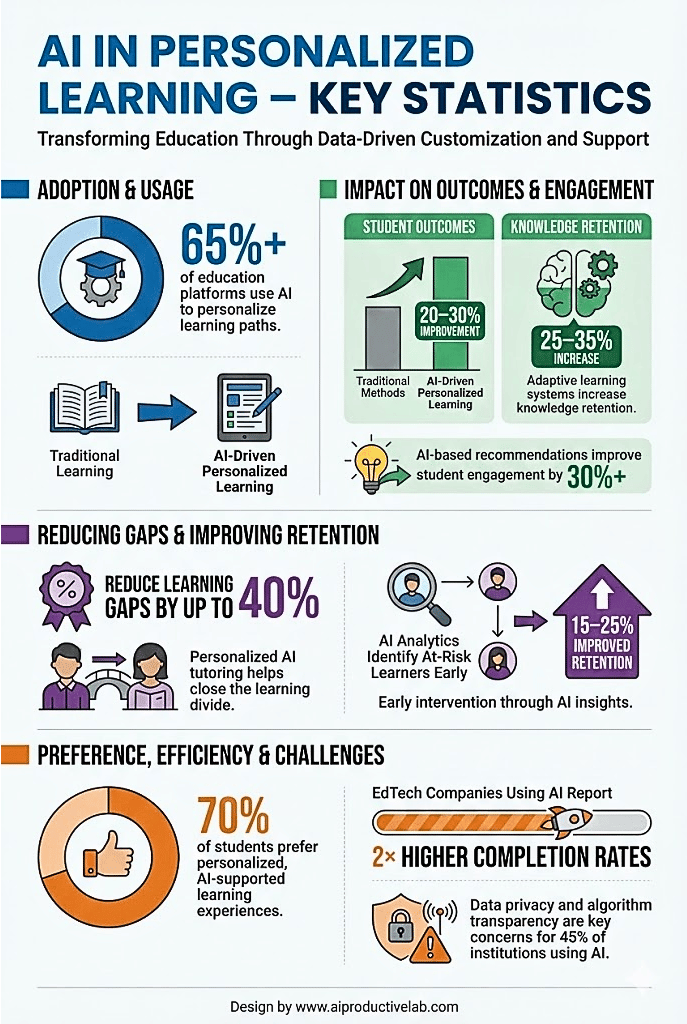
The technology has matured significantly in recent years. Machine learning algorithms now analyze learning patterns with remarkable sophistication. Natural language processing enables conversational tutoring experiences. Predictive analytics identify struggling learners before they fall behind. These capabilities combine to create truly individualized education at scale.
This guide explores AI personalized learning comprehensively. You will learn how the technology works and what makes it effective. You will understand specific applications transforming education today. You will see measurable benefits organizations achieve through implementation. Most importantly, you will gain practical insight for applying personalized learning within your own educational context.
What Is AI Personalized Learning?
AI personalized learning uses artificial intelligence to customize educational experiences for individual learners. These systems continuously assess understanding and adapt instruction accordingly. Every learner receives a unique educational path optimized for their specific needs.
Traditional education operates on a one-size-fits-all model. Teachers design lessons for average students. Those above or below average receive suboptimal instruction. The approach represents an unavoidable compromise given human limitations.
AI removes this constraint. Systems process individual learner data continuously. They identify knowledge gaps requiring attention. They recognize mastered concepts allowing advancement. They adjust difficulty to maintain optimal challenge levels. The adaptation happens automatically and instantly.
The technology draws on several AI capabilities:
- Machine learning: Algorithms that improve through experience with learner data
- Natural language processing: Systems understanding and generating human language
- Predictive analytics: Tools forecasting learner outcomes and needs
- Knowledge modeling: Representations of subject matter and learning progressions
- Learner profiling: Dynamic models of individual capabilities and preferences
These capabilities combine to create adaptive learning experiences. Systems know what learners understand, what they need next, and how best to present that material. The personalization extends beyond content to encompass pacing, format, and instructional approach.
How Does AI Personalized Learning Work?
Continuous Assessment and Diagnosis
AI personalized learning begins with understanding each learner’s current state. Systems assess knowledge continuously rather than through periodic tests. Every interaction provides diagnostic information.
Assessment mechanisms include:
- Embedded questions: Knowledge checks integrated naturally into learning content
- Response pattern analysis: Evaluating answer accuracy, speed, and confidence
- Error diagnosis: Identifying specific misconceptions causing mistakes
- Prerequisite mapping: Understanding foundational knowledge supporting new learning
- Progress tracking: Monitoring mastery development across topics over time
This continuous assessment creates detailed learner profiles. Systems know precisely what each individual understands and where gaps exist.
Dynamic Content Adaptation
Based on assessment data, AI systems adjust what learners encounter. Content adapts across multiple dimensions to optimize learning effectiveness.
Adaptation dimensions include:
- Difficulty calibration: Adjusting challenge level to maintain optimal engagement
- Concept sequencing: Ordering topics based on individual readiness
- Prerequisite insertion: Adding foundational content when gaps appear
- Practice volume adjustment: Providing more or less repetition based on mastery
- Content format variation: Presenting material through preferred modalities
The adaptation happens invisibly. Learners simply experience instruction that works for them without awareness of underlying personalization.
Intelligent Feedback and Guidance
AI provides immediate, specific feedback that accelerates learning. Systems explain errors, suggest strategies, and guide learners toward understanding.
Feedback capabilities include:
- Error explanation: Clarifying why answers are incorrect
- Hint generation: Providing graduated assistance without giving answers
- Strategy suggestion: Recommending effective problem-solving approaches
- Progress visualization: Showing learners their advancement and achievements
- Encouragement calibration: Motivational messaging matched to learner needs
Immediate feedback prevents misconception entrenchment. Learners correct errors before incorrect understanding solidifies.
Predictive Intervention
Advanced AI systems anticipate problems before they occur. Predictive analytics identify learners likely to struggle and trigger proactive support.
Predictive capabilities include:
- At-risk identification: Flagging learners showing early warning signs
- Difficulty anticipation: Predicting which concepts will challenge specific learners
- Engagement forecasting: Recognizing declining motivation before disengagement
- Intervention timing: Determining optimal moments for additional support
- Resource matching: Connecting struggling learners with appropriate assistance
Prediction enables prevention rather than remediation. Problems receive attention before they compound into serious learning deficits.
Key Benefits of AI Personalized Learning
Improved Learning Outcomes
Personalized instruction produces measurable achievement gains:
- Higher completion rates: Learners finish more courses and programs
- Better assessment scores: Performance improves on standardized measures
- Deeper understanding: Mastery-based progression ensures genuine comprehension
- Faster skill acquisition: Optimized instruction accelerates learning
- Stronger retention: Understanding persists longer when instruction matches needs
Research consistently demonstrates personalized learning outperforms traditional approaches. The U.S. Department of Education report on AI and learning highlights significant potential for improved educational outcomes through intelligent personalization.
Enhanced Learner Engagement
Personalization sustains motivation and interest:
- Optimal challenge: Difficulty calibration prevents both frustration and boredom
- Relevance connection: Content relates to individual interests and goals
- Autonomy support: Learners exercise choice within personalized paths
- Progress visibility: Clear advancement feedback maintains motivation
- Reduced anxiety: Appropriate difficulty levels decrease stress
Engaged learners invest more effort and persist through challenges. Personalization creates conditions supporting sustained engagement.
Efficient Use of Learning Time
AI personalization eliminates wasted instructional time:
- No redundant review: Learners skip material they already understand
- Targeted remediation: Time focuses on actual knowledge gaps
- Optimized pacing: Progression matches individual learning speed
- Reduced frustration: Less time spent struggling with inappropriate content
- Accelerated mastery: Efficient paths to learning objectives
Time efficiency matters especially in corporate training contexts where employee time carries significant cost.
Scalable Individualization
AI delivers personalization impossible through human instruction alone:
- Unlimited capacity: One system serves unlimited learners simultaneously
- Consistent quality: Every learner receives optimized instruction
- 24/7 availability: Personalized learning accessible anytime
- Cost efficiency: Per-learner costs decrease at scale
- Data accumulation: Systems improve as more learners participate
Human tutoring produces excellent outcomes but cannot scale economically. AI personalization extends tutoring benefits to all learners.
Actionable Learning Analytics
AI systems generate insights valuable beyond individual learners:
- Curriculum effectiveness: Data reveals which content works and which doesn’t
- Common misconceptions: Patterns identify widespread understanding gaps
- Resource optimization: Analytics guide instructional investment
- Instructor support: Teachers receive guidance on student needs
- Continuous improvement: Feedback loops enhance system effectiveness
Organizations gain visibility into learning processes previously opaque to measurement.
Applications of AI Personalized Learning
Adaptive Learning Platforms
Adaptive platforms represent the most common AI personalized learning application. These systems adjust content continuously based on learner performance.
Leading adaptive learning platforms include:
- DreamBox Learning: Mathematics instruction adapting to student understanding
- Khan Academy: Comprehensive subjects with AI-powered practice and recommendation
- Carnegie Learning: Mathematics and literacy with intelligent tutoring
- ALEKS: Assessment-driven learning for mathematics and science
- Duolingo: Language learning with sophisticated personalization
These platforms serve millions of learners across educational contexts. They demonstrate AI personalized learning at production scale.
Intelligent Tutoring Systems
Intelligent tutoring systems provide one-on-one instruction simulating human tutors. They engage learners in dialogue, answer questions, and guide problem-solving.
Intelligent tutoring capabilities include:
- Conversational interaction: Natural language dialogue with learners
- Socratic questioning: Prompting deeper thinking through strategic questions
- Worked example explanation: Walking through solution processes step-by-step
- Misconception correction: Addressing specific errors in understanding
- Metacognitive coaching: Teaching learners how to learn more effectively
These systems excel in structured domains like mathematics, science, and programming where problem-solving processes follow identifiable patterns.
Corporate Training Personalization
Businesses apply AI personalized learning to workforce development:
- Onboarding customization: New employee training adapted to prior knowledge
- Skill gap remediation: Targeted development addressing specific weaknesses
- Compliance training efficiency: Required learning completed faster through personalization
- Leadership development: Executive education matched to individual needs
- Just-in-time learning: Performance support delivered at moment of need
Corporate applications emphasize efficiency. Employees spend less time in training while acquiring more relevant skills.
Language Learning Applications
Language education showcases AI personalization particularly well:
- Vocabulary building: Word learning optimized through spaced repetition algorithms
- Grammar instruction: Rule teaching adapted to demonstrated understanding
- Conversation practice: AI dialogue partners providing speaking opportunity
- Pronunciation feedback: Speech recognition offering correction guidance
- Cultural context: Background knowledge matching learner interests
Applications like Duolingo, Babbel, and Rosetta Stone demonstrate sophisticated personalization serving hundreds of millions of language learners.
Special Education Support
AI personalization addresses diverse learning needs:
- Learning disability accommodation: Adaptations for dyslexia, dyscalculia, and other conditions
- Gifted learner acceleration: Advanced content for students needing greater challenge
- Attention support: Presentation adjustments for attention difficulties
- Accessibility features: Adaptations for visual, auditory, or motor impairments
- Pace flexibility: Extended time without peer comparison pressures
Personalization serves learners traditional approaches often fail. Technology accommodates diversity human instruction struggles to address.
Implementing AI Personalized Learning
Assess Readiness and Define Objectives
Begin by evaluating organizational preparedness:
- Learning objectives clarity: What should learners know or do after training?
- Current state assessment: Where do existing approaches fall short?
- Technology infrastructure: What systems and connectivity exist?
- Data availability: What learner information can support personalization?
- Stakeholder alignment: Do instructors, administrators, and learners support change?
Clear objectives guide technology selection and implementation priorities.
Select Appropriate Solutions
Choose tools matching your specific context:
- Subject matter fit: Does the platform address your content areas?
- Learner population match: Is the tool designed for your audience?
- Integration capability: Will it connect with existing systems?
- Evidence of effectiveness: What outcomes have other implementations achieved?
- Vendor stability: Will the provider exist and improve long-term?
Pilot solutions before full deployment. Small-scale testing reveals fit issues before major investment.
Prepare Instructors and Support Staff
Human preparation determines implementation success:
- Technology training: Ensure staff can operate new systems effectively
- Pedagogical development: Help instructors understand personalized learning approaches
- Role clarification: Define how human and AI instruction complement each other
- Change management: Address concerns and resistance constructively
- Ongoing support: Provide continued assistance as implementation matures
Instructors who understand and embrace personalization amplify its effectiveness.
Launch and Iterate
Deploy systematically while planning continuous improvement:
- Phased rollout: Begin with limited scope before expanding
- Outcome monitoring: Track learning results from implementation start
- User feedback collection: Gather input from learners and instructors
- Adjustment cycles: Refine approaches based on evidence and feedback
- Success celebration: Recognize achievements to build momentum
Implementation improves through iteration. Early imperfection is expected and addressable.
Challenges and Considerations
Data Privacy Protection
Personalized learning requires learner data demanding careful protection:
- Sensitive information: Learning data reveals cognitive patterns
- Minor protection: Student data requires enhanced safeguards
- Consent requirements: Meaningful permission for data use
- Vendor agreements: Clear data protection commitments from providers
- Regulatory compliance: Meeting FERPA, GDPR, and other requirements
Establish robust data governance before deploying personalization systems.
Equity and Access Concerns
AI benefits must reach all learners fairly:
- Technology access: Not all learners have devices and connectivity
- Algorithmic bias: Systems may disadvantage certain populations
- Digital literacy: Effective use requires technology skills
- Cultural relevance: Content must respect diverse backgrounds
- Accommodation adequacy: Systems must serve learners with disabilities
Monitor outcomes across learner populations to identify and address disparities.
Balancing Technology and Human Connection
Learning involves relationships technology cannot fully replicate:
- Mentorship value: Human guidance provides irreplaceable support
- Social learning: Peer interaction contributes to understanding
- Emotional support: Human empathy addresses learner struggles
- Motivation inspiration: Teachers inspire in ways AI cannot
- Critical thinking development: Human dialogue builds reasoning skills
Design implementations preserving essential human elements alongside AI efficiency.
Conclusion
AI personalized learning transforms education from standardized delivery to individualized experience. Intelligent systems assess understanding continuously, adapt content dynamically, provide immediate feedback, and predict learner needs proactively. The results include improved outcomes, enhanced engagement, efficient time use, and scalable individualization.
Applications span adaptive learning platforms, intelligent tutoring systems, corporate training, language education, and special education support. Implementation success requires readiness assessment, appropriate solution selection, instructor preparation, and iterative refinement.
Challenges including data privacy, equity concerns, and human connection balance require thoughtful navigation. Organizations addressing these considerations realize significant educational benefits.
The technology continues advancing. Tomorrow’s AI personalized learning will understand learners more deeply and adapt more responsively. Organizations building capabilities now establish foundations for sustained educational excellence.
Explore how AI personalized learning could transform educational outcomes within your institution or organization. Talk to our experts to understand which applications fit your specific learners, content, and objectives.
FAQs
AI personalized learning uses artificial intelligence to customize educational experiences for individual learners. Systems assess understanding continuously and adapt content, pacing, and instructional approach based on each learner’s needs.
AI analyzes learner performance data to adjust content difficulty, sequence topics appropriately, provide targeted feedback, and predict where additional support is needed. The adaptation happens automatically and continuously.
Key benefits include improved learning outcomes, enhanced engagement, efficient use of learning time, scalable individualization, and actionable analytics for continuous improvement.
Yes, businesses report significant improvements in training efficiency and effectiveness. AI personalization reduces time employees spend in training while improving skill acquisition and retention.
Popular platforms include Khan Academy, DreamBox Learning, Duolingo, Carnegie Learning, and ALEKS. Many learning management systems now incorporate AI personalization features as well.




 AI/ML Strategy and Consulting
 Data Science And Data Analytics
 Generative AI
 AI Consulting Services
 AI Automation Solutions
 API Integration


