


What if you could see business threats before they materialized? That capability is no longer science fiction. It is AI-powered reality.
- AI enables continuous, real-time risk detection by analyzing vast data streams to surface emerging threats earlier than periodic assessments.
- Machine learning improves risk quantification and scenario modeling, enhancing decision making and prioritization of mitigation efforts.
- AI automates monitoring and response workflows, increasing operational efficiency and reducing losses from prevented incidents.
- Successful implementation requires quality data, strong governance, integration with processes, and hybrid talent for sustainable value.
Every business faces risks that can disrupt operations, damage reputation, or threaten survival. Market volatility, cyber attacks, regulatory changes, and supply chain failures create constant uncertainty. Traditional risk management struggles to keep pace with accelerating threats.
AI risk management transforms how organizations identify, assess, and respond to threats. According to McKinsey’s 2025 Global Survey on AI, organizations increasingly deploy artificial intelligence to anticipate risks and automate responses. The technology shifts risk management from reactive firefighting to proactive protection.
The stakes have never been higher. Cyber attacks grow more sophisticated daily. Supply chain disruptions cascade across global networks. Regulatory requirements multiply across jurisdictions. Organizations that master AI risk management gain decisive advantages over those relying on outdated approaches.
This guide explains how AI transforms risk management in practical terms. You will learn the key applications driving adoption. You will understand benefits and implementation challenges. You will see real examples from organizations leading this transformation.
What Is AI Risk Management?
AI risk management uses machine learning, natural language processing, and predictive analytics to enhance how organizations handle threats. These systems analyze data continuously to identify emerging risks, assess their potential impact, and recommend or automate responses.
Traditional risk management relies heavily on periodic assessments and human judgment. Risk teams review exposures quarterly or annually. They analyze historical data and apply experience to anticipate problems. This approach misses fast-moving threats and struggles with complexity.
AI systems operate continuously and comprehensively. They process information streams that human analysts could never monitor manually. They detect patterns indicating emerging risks before they become crises. They quantify exposures with greater accuracy than traditional methods.
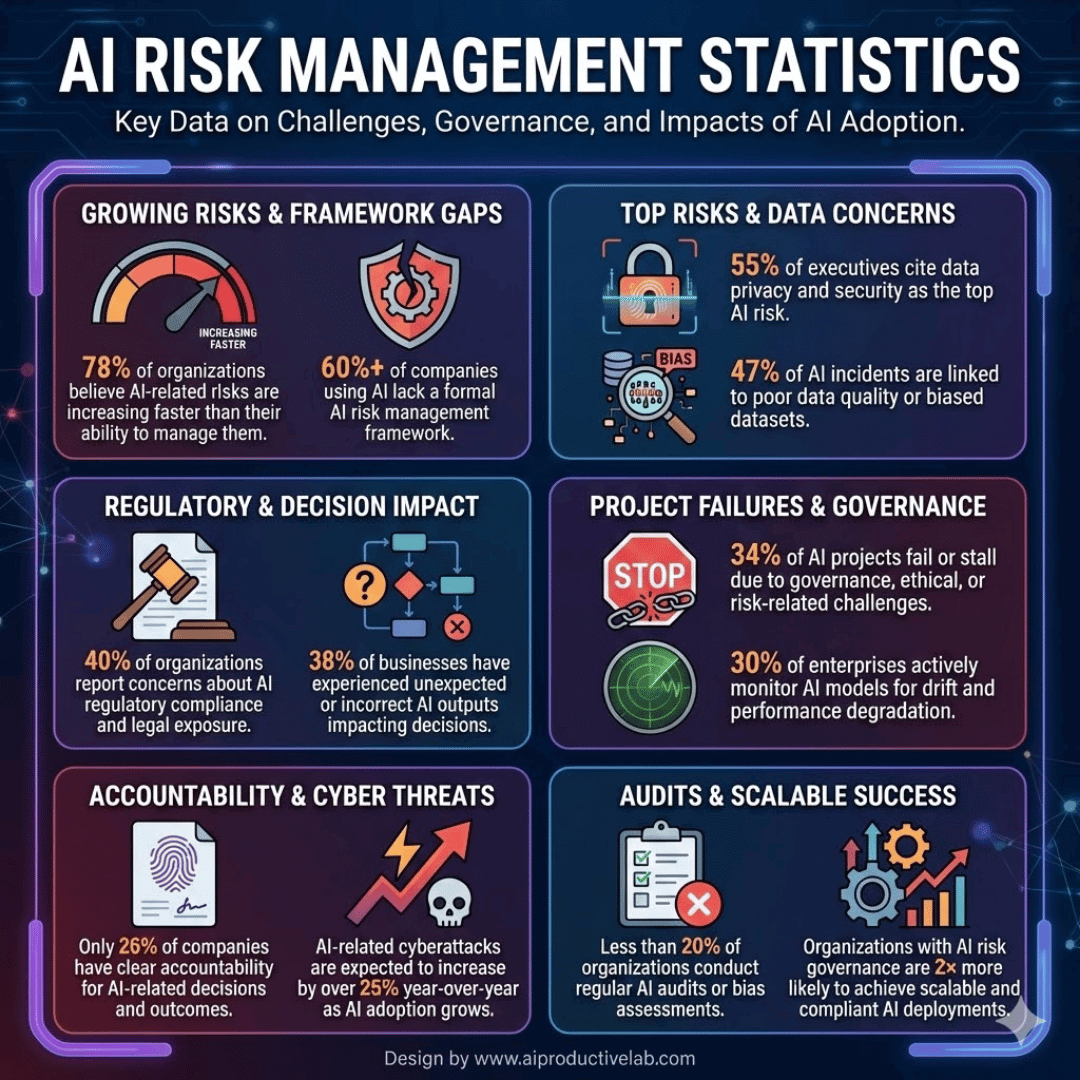
The technology does not eliminate human judgment from risk management. It augments human capabilities with machine intelligence. Risk professionals receive better information faster. They focus attention on decisions requiring human insight rather than data processing.
Key Use Cases for AI in Risk Management
Operational Risk Monitoring
Operational risks arise from failures in processes, systems, or people. Equipment breakdowns, human errors, and process failures disrupt business operations. AI systems detect warning signs and enable intervention before failures occur.
According to Workday research, AI helps businesses anticipate threats and streamline operations at scale. Predictive maintenance systems analyze sensor data to forecast equipment failures. Process monitoring identifies anomalies indicating control weaknesses.
Key operational risk applications include:
- Predictive maintenance: Forecasting equipment failures before breakdowns occur
- Process anomaly detection: Identifying unusual patterns indicating potential problems
- Quality monitoring: Detecting production issues in real-time
- Workforce risk analysis: Predicting turnover, safety incidents, and compliance gaps
- Business continuity planning: Modeling disruption scenarios and recovery options
Financial Risk Assessment
Financial risks threaten organizational stability and profitability. Market volatility, credit exposures, and liquidity challenges require careful management. AI enhances assessment accuracy and response speed.
Machine learning models predict market movements and quantify portfolio risks. They analyze credit exposures across counterparties and geographies. They forecast cash flow needs and optimize liquidity positioning.
AI financial risk capabilities include:
- Market risk modeling: Predicting potential losses from price movements
- Credit risk assessment: Evaluating counterparty and portfolio exposures
- Liquidity forecasting: Predicting cash requirements and optimizing positions
- Stress testing: Modeling impacts of adverse scenarios automatically
- Investment risk analysis: Quantifying portfolio risks and optimization opportunities
Cybersecurity Risk Management
Cyber threats represent growing risks for every organization. Attackers constantly develop new techniques to breach defenses. AI provides essential capabilities for detection and response.
Security AI systems analyze network traffic patterns to identify intrusions. They detect anomalous user behavior indicating compromised credentials. They prioritize vulnerabilities based on actual exploitation risk.
According to cybersecurity research, attackers increasingly use AI to develop sophisticated attacks. Defenders must deploy AI capabilities to maintain effective protection. The technology enables detection of threats that rule-based systems miss.
Supply Chain Risk Monitoring
Supply chain disruptions cascade through global networks with devastating effects. Raw material shortages, logistics failures, and supplier problems interrupt operations. AI provides visibility and early warning capabilities.
AI systems monitor supplier health indicators continuously. They track news, financial data, and operational signals. They identify risks before they impact the organization.
MetricStream research notes that predictive analytics enables organizations to highlight potential risk hotspots like supply chain disruptions before they materialize. This early warning capability enables proactive mitigation.
Regulatory and Compliance Risk
Regulatory requirements multiply across industries and jurisdictions. Compliance failures result in fines, enforcement actions, and reputational damage. AI helps organizations stay current and demonstrate adherence.
Natural language processing analyzes regulatory text to identify relevant requirements. AI monitors transactions and activities for compliance violations. Automated reporting ensures timely and accurate submissions.
AI compliance capabilities include:
- Regulatory change monitoring: Tracking and analyzing new requirements automatically
- Transaction monitoring: Detecting potential violations in real-time
- Policy mapping: Connecting regulations to internal controls and procedures
- Compliance testing: Automating control effectiveness verification
- Reporting automation: Generating required disclosures accurately
Reputational Risk Surveillance
Reputation influences customer decisions, talent attraction, and stakeholder confidence. Negative events spread rapidly through social media and news channels. AI monitors sentiment and enables rapid response.
AI systems scan social media, news, and review platforms continuously. They detect emerging reputation threats in real-time. They alert communications teams to developing situations requiring attention.
Sentiment analysis quantifies reputation trends over time. Organizations track how specific events impact perception. This visibility enables data-driven reputation management.
Benefits of AI Risk Management
Organizations implementing AI risk management realize substantial advantages:
Enhanced Risk Visibility
- Comprehensive monitoring: AI tracks risks across the entire organization continuously
- Earlier detection: Pattern recognition identifies emerging threats before they escalate
- Hidden risk discovery: Machine learning finds risks human analysis might miss
- Real-time awareness: Continuous monitoring replaces periodic assessment snapshots
Improved Decision Making
- Better predictions: AI models forecast risk outcomes more accurately than traditional approaches
- Quantified exposures: Machine learning provides precise risk measurements
- Scenario analysis: AI enables rapid modeling of potential future states
- Prioritization guidance: Systems rank risks by actual impact likelihood
Operational Efficiency
- Automated monitoring: AI reduces manual surveillance workload significantly
- Faster response: Real-time detection enables immediate intervention
- Resource optimization: Focus human attention on high-value judgment tasks
- Scalable coverage: AI handles growing data volumes without proportional cost increases
Reduced Losses
- Prevented incidents: Early detection enables intervention before losses occur
- Faster recovery: Quicker response limits damage when incidents happen
- Better preparedness: Predictive insights inform contingency planning
- Optimized controls: Data-driven decisions improve control effectiveness
Challenges and Considerations
Data Quality Requirements
AI systems require comprehensive, accurate data to function effectively. Many organizations have fragmented or inconsistent risk data. Data quality improvement often precedes successful AI implementation.
Investment in data infrastructure pays dividends across multiple AI applications. Clean, integrated data enables effective modeling. Poor data quality undermines even sophisticated algorithms.
Model Risk and Validation
AI models can fail in unexpected ways. They may perform poorly when conditions differ from training data. Organizations must validate models rigorously and monitor performance continuously.
According to Diligent research, effective AI risk management requires robust governance frameworks. Model validation, documentation, and oversight ensure reliable performance. Risk management of AI systems themselves becomes critical.
Integration With Existing Processes
AI must integrate with established risk management frameworks. Standalone AI tools provide limited value without process connection. Integration requires attention to workflows, data flows, and decision points.
Change management ensures adoption by risk professionals. Training builds capability and confidence with new tools. Gradual rollout allows organizations to learn and adjust.
Talent and Skills
AI risk management requires new skills not always present in traditional risk teams. Data science, machine learning, and analytics capabilities become essential. Organizations must build or acquire these skills.
Hybrid teams combining risk expertise with technical skills often prove most effective. Risk professionals understand business context. Data scientists bring technical capabilities. Collaboration produces practical solutions.
Ethical and Governance Considerations
AI decisions raise ethical questions requiring careful attention. Algorithmic bias could produce unfair outcomes. Lack of transparency undermines accountability and trust.
Strong governance frameworks address these concerns. Clear policies guide AI development and deployment. Oversight mechanisms ensure responsible use. Documentation supports audit and review.
Real-World Examples of AI Risk Management
BlackRock: Aladdin Risk Platform
BlackRock’s Aladdin platform applies AI to investment risk management at massive scale. The system analyzes portfolio exposures across asset classes and scenarios. It serves both BlackRock and external asset managers.
Aladdin processes enormous data volumes to quantify risks continuously. Machine learning models predict market behavior and correlations. The platform demonstrates enterprise-scale AI risk capabilities.
Marsh McLennan: Insurance Risk Analytics
Marsh McLennan uses AI to enhance insurance and risk advisory services. Their analytics platforms assess client exposures using machine learning models. AI enables more accurate risk quantification and pricing.
The company applies natural language processing to analyze policy documents and claims data. Predictive models identify emerging risk trends. AI capabilities differentiate their advisory services.
Siemens: Operational Risk Management
Siemens deploys AI for operational risk management across their industrial operations. Predictive maintenance systems forecast equipment failures using sensor data. Quality monitoring detects manufacturing issues in real-time.
AI enables proactive intervention before failures disrupt operations. The company reports significant reductions in unplanned downtime. Operational AI demonstrates manufacturing risk management value.
HSBC: Financial Crime Risk
HSBC applies AI to detect financial crime including money laundering and fraud. Machine learning models analyze transactions for suspicious patterns. Natural language processing monitors communications for compliance risks.
The bank’s AI capabilities process millions of transactions daily. They identify risks that traditional rule-based systems miss. HSBC demonstrates AI transforming compliance risk management.
How to Implement AI Risk Management
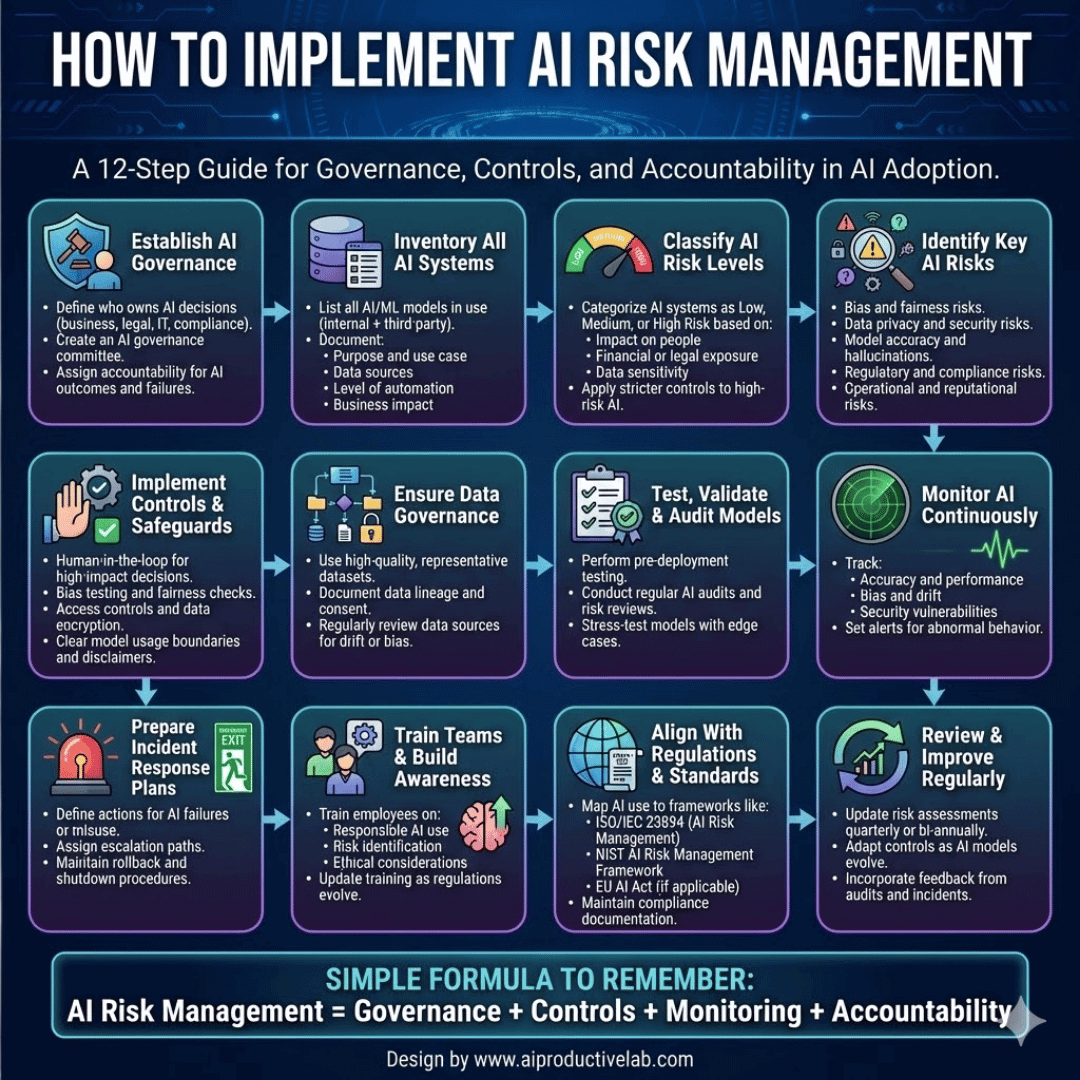
Step 1: Assess Current State and Priorities
Evaluate existing risk management capabilities honestly. Identify the highest-value opportunities for AI enhancement. Prioritize based on risk exposure, data availability, and business impact.
Document current processes and their limitations. Understand where AI can add the most value. This assessment guides implementation sequencing.
Step 2: Build Data Foundation
Audit data assets relevant to priority risk areas. Identify quality issues requiring remediation. Establish data integration connecting siloed sources.
Invest in data infrastructure before expecting AI results. Quality data enables effective modeling. Poor data undermines even sophisticated algorithms.
Step 3: Start With Focused Pilots
Begin with targeted AI applications addressing specific risk areas. Pilots demonstrate value while building organizational capability. Success builds support for broader deployment.
Select pilots with clear success metrics. Measure results against defined objectives. Document learnings for future implementation phases.
Step 4: Establish Governance Framework
Define policies governing AI development and deployment. Establish oversight mechanisms ensuring responsible use. Document models and decisions for accountability.
Create clear roles and responsibilities for AI risk systems. Define escalation procedures when AI identifies significant risks. Governance ensures sustainable value creation.
Step 5: Scale Successful Applications
Expand AI capabilities based on pilot results. Replicate successful approaches across additional risk areas. Build enterprise platforms supporting multiple applications.
Continuous improvement sustains competitive advantage. Monitor performance and refine models over time. Learning from experience enhances effectiveness.
Conclusion
AI risk management represents a fundamental advancement in how organizations protect themselves. Machine learning enables earlier threat detection than traditional approaches allow. Predictive analytics quantify exposures with greater accuracy. Automation accelerates response when risks materialize.
Implementation requires thoughtful attention to data, governance, and integration. Quality data provides the foundation for effective AI. Strong governance ensures responsible deployment. Process integration delivers practical value.
The organizations mastering AI risk management gain significant advantages. They see threats earlier and respond faster. They quantify exposures more accurately. They operate more efficiently than competitors relying on outdated methods.
The transformation of risk management continues accelerating. Organizations that build AI capabilities now will lead their industries. Those waiting risk falling behind as threats evolve faster than traditional defenses can adapt.
Explore how AI risk management could strengthen your organization’s defenses. Talk to our experts to understand which applications fit your specific risk profile and operational context.
FAQs
AI risk management uses machine learning and predictive analytics to identify, assess, and respond to business threats automatically. It enables earlier detection and faster response than traditional approaches.
AI analyzes vastly more data than human analysts can process and identifies subtle patterns indicating emerging risks. Machine learning models discover relationships that traditional analysis misses.
AI applies across risk categories including operational, financial, cybersecurity, supply chain, regulatory compliance, and reputational risks. Most organizations start with one or two priority areas.
Initial pilots typically take three to six months from planning to results. Enterprise-wide deployment extends over multiple years as capabilities expand across risk areas.
AI risk systems require historical risk event data, operational metrics, external data feeds, and real-time information streams. Data quality significantly impacts model effectiveness.




 AI/ML Strategy and Consulting
 Data Science And Data Analytics
 Generative AI
 AI Consulting Services
 AI Automation Solutions
 API Integration


