

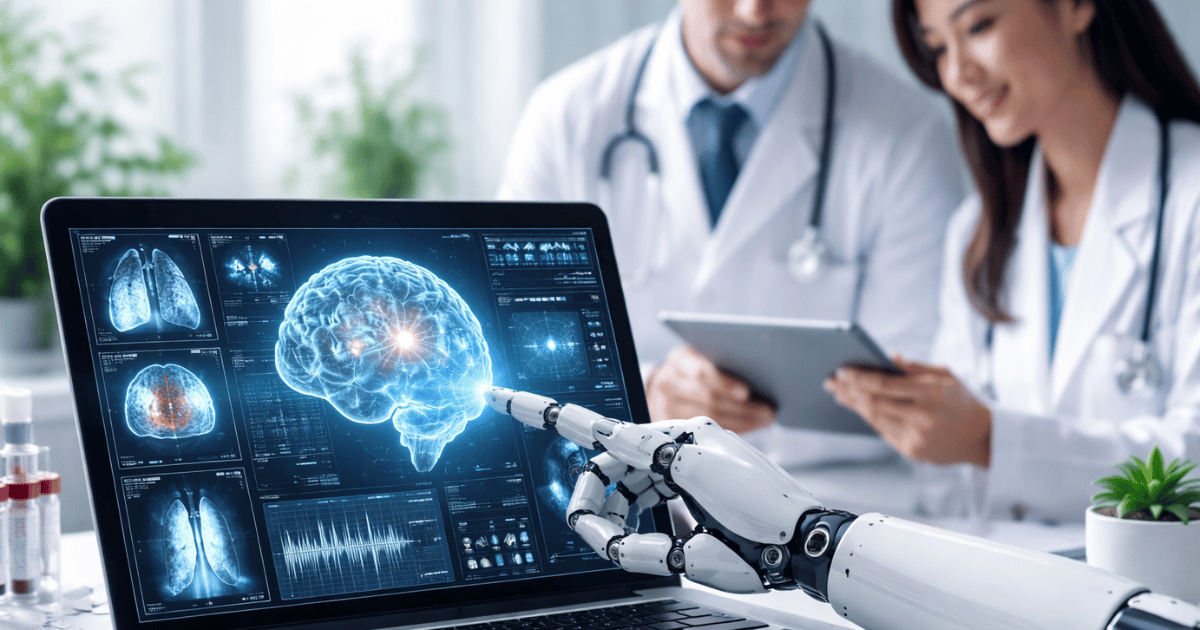
Misdiagnosis remains one of the biggest challenges in modern medicine. Studies estimate that diagnostic errors affect roughly 12 million adults in the United States each year. Many of these errors happen not because doctors lack skill, but because the volume of data they must process exceeds human capacity.
- Clinically deployed AI tools accelerate and improve diagnostic accuracy across specialties while complementing physician judgment.
- Prominent platforms like Aidoc, PathAI, Viz.ai, Tempus, and IDx-DR serve radiology, pathology, neurology, oncology, and ophthalmology.
- Clinical validation, regulatory clearance, EHR integration, transparent methodology, and continuous updates define trustworthy diagnostic AI.
- AI augments physicians by handling pattern recognition at scale; human-AI collaboration preserves contextual, ethical, and clinical judgment.
- Real-world use shows decreased time to treat and better triage, especially for strokes, pulmonary embolism, and urgent radiology findings.
AI tools for diagnosis are changing that equation. They analyze medical images, patient records, lab results, and clinical symptoms with a speed and consistency that complement human expertise. These are not experimental prototypes. They are working platforms deployed in hospitals and clinics worldwide.
This guide covers AI diagnostic tools making a measurable difference right now. You will learn what each one does, which medical specialty it serves, and why clinicians trust it alongside their own judgment.
How Do AI Diagnostic Tools Work?
AI diagnostic platforms use machine learning algorithms trained on millions of medical data points. They learn to recognize patterns in images, lab values, and clinical presentations that correlate with specific diseases or conditions.
When a physician inputs patient data, the AI compares it against its trained models. It then generates a list of possible diagnoses, flags abnormalities, or highlights findings that warrant urgent attention. The doctor reviews these outputs and makes the final clinical decision.
Think of it as an extremely well-read assistant that never forgets a case it has studied. It does not replace the physician. It makes sure nothing gets overlooked during the diagnostic process.
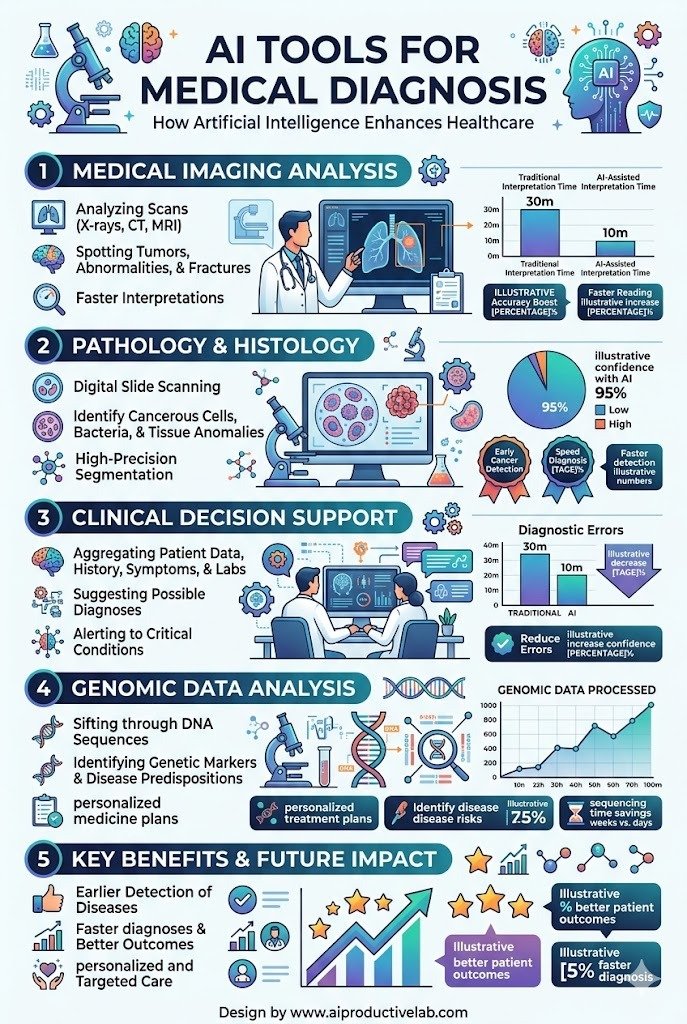
10 AI Tools for Diagnosis Worth Knowing
1. Aidoc — Radiology Triage and Critical Finding Detection
Aidoc runs continuously in the background of radiology departments. It analyzes CT scans in real time and flags life-threatening conditions like pulmonary embolisms, intracranial hemorrhages, and cervical spine fractures.
The platform reprioritizes radiologist worklists automatically. Critical cases jump to the top of the queue. This reduces the time between scan completion and diagnosis for emergency patients. Over 1,000 medical centers use Aidoc globally, making it one of the most widely adopted AI radiology tools.
2. PathAI — Pathology Slide Analysis
Pathologists examine tissue samples under microscopes to detect cancer and other diseases. PathAI applies machine learning to digitized pathology slides, identifying patterns that indicate malignancy with high precision.
The platform reduces variability between pathologists reading the same slide. It also speeds up analysis for high-volume labs processing thousands of samples weekly. Major pharmaceutical companies and diagnostic laboratories use PathAI for both clinical diagnostics and drug development research.
3. Glass Health — AI-Generated Differential Diagnoses
Glass Health acts as a clinical thinking partner. Physicians enter patient symptoms, history, and findings. The AI generates a ranked differential diagnosis along with a suggested clinical plan for each possibility.
Recent independent testing ranked Glass Health among the top AI platforms for medical accuracy. It scored competitively in the NOHARM benchmark, which evaluates AI systems on complex medical questions. Clinicians use it as a second opinion tool, particularly for complex or ambiguous cases.
4. AMBOSS LiSA — Clinical Decision Intelligence
AMBOSS built its reputation as a medical learning platform. Its AI assistant, LiSA, extends that knowledge base into clinical decision support. LiSA answers diagnostic questions using evidence-based medical content curated by physicians.
In the 2026 NOHARM evaluation, AMBOSS LiSA scored highest among all tested medical AI platforms at 62.3% on complex clinical scenarios. It bridges the gap between medical reference material and real-time diagnostic support, helping physicians access relevant knowledge without leaving their workflow.
5. IDx-DR — Autonomous Diabetic Retinopathy Detection
IDx-DR holds a unique distinction. It was the first FDA-authorized AI diagnostic system that makes screening decisions without requiring a specialist to interpret results. The tool analyzes retinal images and determines whether a patient shows signs of diabetic retinopathy.
Primary care clinics use IDx-DR to screen diabetic patients during routine visits. Patients who test positive receive referrals to ophthalmologists. Those who test negative avoid unnecessary specialist appointments. This AI-powered screening tool expands diagnostic access in communities with limited eye care specialists.
6. Viz.ai — Stroke Detection and Care Coordination
Every minute matters during a stroke. Viz.ai analyzes CT angiography scans and detects large vessel occlusions, the blockages that cause the most devastating strokes. It alerts the neurovascular team directly on their mobile devices with the scan images.
This automated medical imaging analysis cuts the time from scan to treatment decision. Hospitals using Viz.ai report significantly faster door-to-treatment times. The platform covers multiple conditions beyond stroke, including pulmonary embolism and aortic emergencies.
7. Tempus — Genomic and Clinical Data Analysis
Tempus combines clinical data with genomic sequencing to help oncologists choose targeted cancer treatments. The platform analyzes a patient’s tumor genetics alongside outcomes data from similar cases to recommend the most effective therapies.
It processes one of the largest libraries of clinical and molecular data in the world. Oncologists use Tempus when standard treatment protocols have not worked or when a cancer’s genetic profile suggests a targeted therapy might outperform conventional options.
8. Zebra Medical Vision — Multi-Condition Imaging Analysis
Zebra Medical Vision analyzes medical images for multiple conditions simultaneously. A single chest X-ray scan can be screened for pneumothorax, pleural effusion, lung nodules, and cardiomegaly in one pass.
This multi-condition approach makes it valuable for emergency departments and general radiology practices that need broad screening capabilities. The platform holds multiple regulatory clearances across different countries and imaging modalities.
9. Butterfly iQ+ with AI — Point-of-Care Ultrasound
Butterfly iQ+ is a handheld ultrasound device that connects to a smartphone. Its AI guidance system helps clinicians who are not ultrasound specialists perform and interpret scans accurately at the bedside.
The AI provides real-time guidance on probe positioning and image quality. It also assists with automated measurements and finding identification. Emergency physicians, primary care doctors, and rural practitioners use it to perform diagnostic imaging in settings where traditional ultrasound machines are unavailable.
10. SkinVision — Consumer Skin Cancer Screening
SkinVision puts preliminary skin cancer detection in the hands of patients. Users photograph suspicious moles or skin lesions with their smartphone. The AI analyzes the image and assigns a risk level based on patterns associated with melanoma and other skin cancers.
High-risk results prompt users to visit a dermatologist. The app does not diagnose cancer. It identifies which spots deserve professional evaluation. Clinical studies show SkinVision detects high-risk lesions with sensitivity comparable to general practitioners, making it a useful early warning system.
How These AI Diagnostic Tools Compare
| Tool | Specialty | Primary Function | User |
|---|---|---|---|
| Aidoc | Radiology | Critical finding detection in CT scans | Radiologists |
| PathAI | Pathology | Tissue sample analysis for cancer | Pathologists |
| Glass Health | General medicine | Differential diagnosis generation | Physicians |
| AMBOSS LiSA | General medicine | Evidence-based clinical decision support | Physicians |
| IDx-DR | Ophthalmology | Autonomous diabetic retinopathy screening | Primary care clinics |
| Viz.ai | Neurology/Emergency | Stroke detection and team alerting | Neurovascular teams |
| Tempus | Oncology | Genomic analysis for treatment matching | Oncologists |
| Zebra Medical Vision | Radiology | Multi-condition imaging screening | Radiologists |
| Butterfly iQ+ | Point-of-care | AI-guided portable ultrasound | Emergency and primary care |
| SkinVision | Dermatology | Skin lesion risk assessment | Patients |
What Makes a Good AI Diagnostic Tool?
Not all AI diagnostic platforms deliver equal value. The best tools share common characteristics that separate them from weaker alternatives.
- Clinical validation through peer-reviewed studies proves the tool performs accurately on real patient populations, not just curated test datasets.
- Regulatory clearance from bodies like the FDA confirms the platform meets safety and efficacy standards required for clinical use.
- Seamless integration with existing health record systems ensures physicians can use the tool without disrupting their established workflows.
- Transparent methodology lets clinicians understand how the AI reaches its conclusions, building appropriate trust in the outputs.
- Continuous learning and updates keep the algorithms current as medical knowledge evolves and new disease patterns emerge.
Physicians should evaluate any AI disease detection tool against these criteria before incorporating it into clinical practice.
Will AI Replace Doctors in Diagnosis?
This question surfaces frequently. The answer is clear. AI will not replace physicians. It will replace outdated workflows that slow physicians down.
Diagnostic AI handles pattern recognition at scale. It catches findings that might be missed during a busy shift. It processes data faster than any human could. But it cannot conduct a physical exam, read a patient’s body language, or weigh the emotional and social factors that influence treatment decisions.
The strongest results come from human-AI collaboration. A radiologist using Aidoc catches more critical findings than either the radiologist or the AI working alone. An oncologist using Tempus considers treatment options informed by thousands of similar cases. The combination outperforms either approach in isolation.
Medicine remains fundamentally human. AI diagnostic tools simply ensure that human expertise operates with the best possible information.
FAQs
Leading platforms include Aidoc for radiology, PathAI for pathology, Glass Health for differential diagnosis, Viz.ai for stroke detection, and Tempus for cancer genomics. Each serves a specific clinical specialty with validated accuracy.
Many are. IDx-DR was the first FDA-authorized autonomous diagnostic AI. Aidoc, Viz.ai, and Butterfly iQ+ also hold FDA clearances. Always verify a tool’s regulatory status before clinical deployment.
Consumer tools like SkinVision offer preliminary risk assessments, not definitive diagnoses. They help users decide when to seek professional evaluation. A qualified healthcare provider should always confirm any AI-generated health finding.
In specific tasks like medical image analysis, top AI tools match or exceed average physician accuracy. However, they perform best as support tools that enhance physician decision-making rather than standalone diagnostic systems.
Most enterprise-grade platforms integrate with major electronic health record systems like Epic and Cerner. Integration capabilities vary by vendor, so healthcare organizations should verify compatibility during evaluation.



 AI/ML Strategy and Consulting
 Data Science And Data Analytics
 Generative AI
 AI Consulting Services
 AI Automation Solutions
 API Integration


