


Running a hospital or clinic has never been more demanding. Staff shortages persist. Patient volumes grow. Administrative tasks consume hours that clinical teams cannot spare. Meanwhile, patients expect faster service, better communication, and fewer errors at every touchpoint.
- AI platforms automate repetitive clinical and administrative workflows, improving efficiency, accuracy, and patient satisfaction.
- Choose tools that target your biggest bottleneck first to maximize impact and justify expansion.
- Prioritize native EHR integration to reduce customization, speed deployment, and protect data consistency.
- Measure outcomes during pilots: quantify staff hours saved, revenue recovered, and patient throughput before full rollout.
- Plan change management, invest in training, and verify vendor security and compliance to ensure successful adoption.
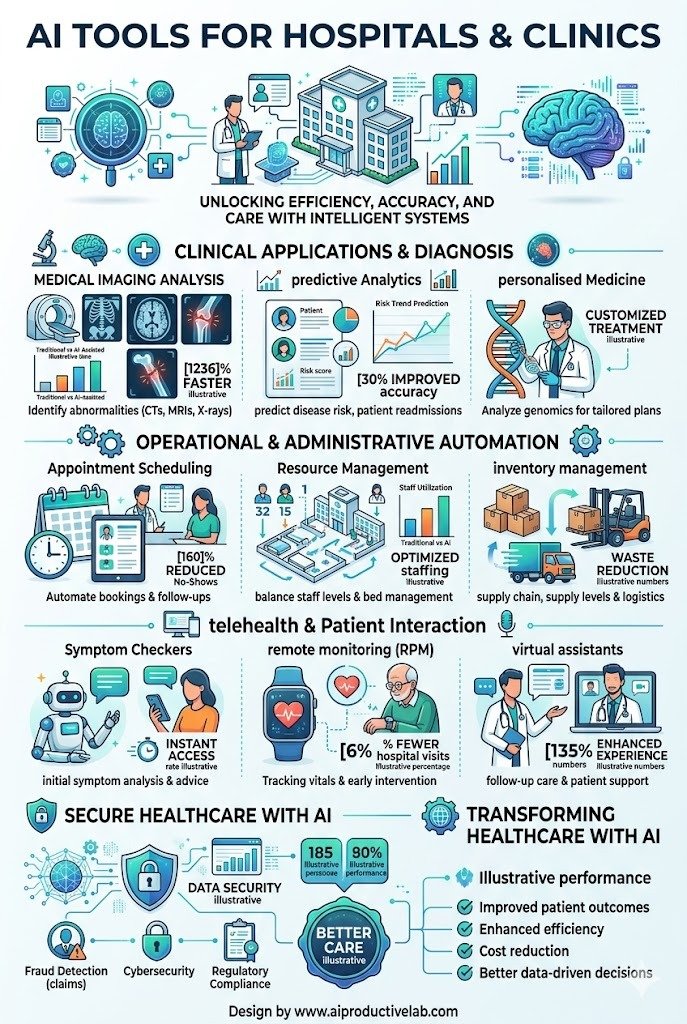
AI tools for hospitals and clinics address these pressures head-on. They automate repetitive workflows, surface critical insights faster, and help medical teams focus on what matters most: patient care. These are not theoretical solutions. They are platforms running inside healthcare facilities today, delivering measurable improvements in efficiency, accuracy, and patient satisfaction.
This guide highlights 10 AI-powered tools that solve real problems for hospitals and clinics. Each one targets a specific operational or clinical challenge with proven results.
Why Are Hospitals and Clinics Adopting AI Now?
Healthcare organizations delayed AI adoption for years. Concerns about data privacy, regulatory compliance, and integration complexity created hesitation. That cautious approach has shifted dramatically.
Several forces are driving the change. Clinician burnout has reached crisis levels, with documentation burdens cited as a primary factor. Operating costs continue climbing while reimbursement rates stagnate. Patients increasingly choose providers based on convenience and digital experience, not just clinical reputation.
AI offers a path through these challenges without requiring massive staffing increases. A single AI tool can absorb work that previously required multiple full-time employees. When deployed thoughtfully, these platforms pay for themselves within months through efficiency gains and error reduction.
10 AI Tools Transforming Hospital and Clinic Operations
1. Sully.ai — All-in-One AI Healthcare Platform
Sully.ai positions itself as a complete AI team for healthcare organizations. It combines clinical documentation, patient communication, scheduling assistance, and administrative automation into one unified platform.
What makes Sully.ai valuable for hospitals and clinics is its breadth. Instead of purchasing five separate AI tools, organizations get integrated capabilities that share data and work together. The platform handles appointment scheduling, patient intake forms, follow-up communications, and clinical note generation from a single interface. This reduces vendor management complexity and improves data consistency across workflows.
2. Suki AI — Voice-Powered Clinical Documentation
Physicians spend nearly two hours on documentation for every hour of patient interaction. Suki AI attacks this problem directly with a voice-activated assistant that drafts clinical notes in real time during patient encounters.
The physician speaks naturally during the appointment. Suki listens, extracts relevant clinical information, and generates structured notes that flow directly into the electronic health record system. It learns each doctor’s preferences and documentation style over time. Clinics using Suki report physicians saving over an hour daily on charting, time they redirect toward seeing additional patients or leaving work at a reasonable hour.
3. Abridge — Ambient Clinical Documentation
Abridge takes a similar approach to documentation but focuses on generating comprehensive visit summaries from natural doctor-patient conversations. The AI captures the entire encounter and produces notes organized by medical standards.
Hospitals appreciate Abridge for its accuracy and its ability to generate patient-facing summaries alongside clinical documentation. Patients receive clear, understandable visit recaps that improve follow-through on treatment plans. This dual output serves both clinical and patient engagement needs from a single recording.
4. Qventus — Operational Command Center AI
Hospital operations involve constant decisions about bed assignments, surgical schedules, discharge timing, and staffing levels. Qventus uses predictive AI to optimize these decisions in real time.
The platform analyzes patient flow data, historical patterns, and current census to recommend actions that reduce bottlenecks. It predicts which patients are likely ready for discharge and alerts care teams proactively. Hospitals using Qventus report reduced emergency department boarding times, shorter lengths of stay, and improved surgical throughput. It functions as an intelligent operations layer that helps administrators make better decisions faster.
5. Notable Health — AI-Powered Patient Intake and Registration
Patient registration creates friction at the front door of every clinic. Notable Health automates intake workflows using intelligent digital forms that pre-populate with existing patient data and adapt based on visit type.
The platform verifies insurance eligibility automatically, collects medical history updates before the appointment, and routes completed forms to the appropriate clinical systems. Front desk staff handle exceptions rather than processing every patient manually. Clinics using Notable report significant reductions in check-in wait times and registration errors, which directly improves patient satisfaction scores.
6. Olive AI — Revenue Cycle Automation
Billing and claims processing drain enormous resources from healthcare organizations. Olive AI automates repetitive revenue cycle tasks including prior authorization requests, claims status checking, eligibility verification, and denial management.
The platform identifies claims likely to be denied before submission and flags issues for correction. It follows up on outstanding claims automatically and escalates only the cases that require human intervention. Hospitals using revenue cycle AI tools like Olive recover more revenue faster while reducing the administrative staff hours dedicated to chasing payments.
7. Viz.ai — Clinical Communication and Care Coordination
When a critical condition appears on an imaging scan, every minute of delay between detection and treatment affects patient outcomes. Viz.ai analyzes medical images using AI and instantly alerts the appropriate specialist team via mobile notification.
A CT scan showing signs of a large vessel occlusion stroke triggers an immediate alert to the neurovascular team, complete with the scan images on their phones. This automated clinical communication platform eliminates the delays caused by traditional communication chains. Hospitals report significantly faster treatment initiation for time-sensitive conditions including stroke, pulmonary embolism, and aortic emergencies.
8. Hyro — AI-Powered Patient Communication
Phone calls flood hospital call centers daily. Patients call about appointments, prescriptions, billing questions, directions, and dozens of other routine inquiries. Hyro deploys conversational AI that handles these interactions automatically.
The AI assistant answers patient calls, schedules appointments, routes prescription refill requests, and provides facility information without human involvement. It understands natural language and handles complex multi-step conversations. Call centers using Hyro deflect a significant percentage of routine calls, freeing human agents to handle complex patient needs that genuinely require a personal touch.
9. Aidoc — Radiology Workflow Prioritization
Radiology departments process thousands of imaging studies daily. Aidoc runs AI analysis on every scan in the background and identifies critical findings that need immediate attention. It automatically reprioritizes the radiologist’s worklist so urgent cases get read first.
The platform detects conditions including intracranial hemorrhages, pulmonary embolisms, cervical spine fractures, and pneumothorax. Over 1,000 healthcare facilities worldwide use Aidoc. It integrates with existing radiology systems and requires no workflow changes from the radiologist. The AI simply ensures the most critical studies never wait in a queue behind routine scans.
10. DeepScribe — AI Medical Scribe for Clinics
DeepScribe combines ambient listening technology with AI-powered note generation specifically designed for outpatient clinics. It records clinical encounters, identifies medically relevant information, and produces documentation that meets billing and compliance requirements.
The platform works across multiple specialties and adapts to each physician’s workflow. Unlike traditional human scribes who require training and scheduling, DeepScribe is available for every appointment without staffing constraints. Clinics using the platform report improved documentation quality, faster note completion, and higher physician satisfaction with their daily workflow.
How These 10 Tools Compare at a Glance
| Tool | Primary Function | Best For | Key Benefit |
|---|---|---|---|
| Sully.ai | Unified AI platform | Multi-department hospitals | All-in-one integration |
| Suki AI | Voice-powered documentation | Physicians in any setting | Saves 1+ hour daily on charting |
| Abridge | Ambient visit documentation | Hospitals and large clinics | Dual clinical and patient summaries |
| Qventus | Operational optimization | Hospital administrators | Reduces bottlenecks and wait times |
| Notable Health | Patient intake automation | Outpatient clinics | Faster check-in, fewer errors |
| Olive AI | Revenue cycle automation | Billing departments | Faster reimbursement, fewer denials |
| Viz.ai | Critical care coordination | Emergency and specialty teams | Minutes saved in stroke and PE care |
| Hyro | Patient call center AI | High-volume call centers | Deflects routine calls automatically |
| Aidoc | Radiology triage | Imaging departments | Critical findings flagged instantly |
| DeepScribe | Clinic documentation | Outpatient practices | AI scribe without staffing needs |
How to Choose the Right AI Tools for Your Facility
Selecting AI healthcare software requires more than comparing feature lists. Your facility’s specific pain points should drive every decision.
Start With Your Biggest Bottleneck
Identify the workflow that wastes the most time, generates the most errors, or creates the most frustration for staff and patients. A clinic drowning in documentation needs Suki or DeepScribe first. A hospital struggling with patient flow needs Qventus. Solve the most painful problem before expanding to other tools.
Prioritize Integration With Your EHR
Any AI tool you adopt must work seamlessly with your electronic health record system. Platforms that integrate natively with Epic, Cerner, or MEDITECH require less customization and deliver faster returns. Ask every vendor for specific integration documentation and reference clients running your same EHR.
Calculate Return on Investment Realistically
Measure AI tools against concrete outcomes. How many staff hours does the tool save weekly? How much additional revenue does it recover? How many patients can you see with the freed capacity? Quantify these figures during a pilot phase before committing to a full rollout.
Plan for Change Management
Technology only works when staff actually use it. Invest in training, gather physician feedback during pilots, and designate internal champions who help colleagues adopt the new tools. The most powerful AI platform delivers zero value if clinicians bypass it because they find it confusing or disruptive.
What Challenges Should Healthcare Facilities Expect?
AI adoption in healthcare is not without obstacles. Anticipating common challenges helps you navigate them effectively.
- Data privacy compliance requires rigorous vetting of every vendor’s security practices, certifications, and data handling policies before any patient information enters their platform.
- Staff resistance often stems from fear of replacement or added complexity. Clear communication that AI handles administrative tasks while humans remain essential for patient care reduces pushback.
- Integration complexity varies by tool and existing infrastructure. Budget time and technical resources for implementation, testing, and troubleshooting.
- Ongoing costs extend beyond subscription fees. Factor in training, maintenance, updates, and potential workflow adjustments when calculating total cost of ownership.
- Regulatory changes in healthcare AI move quickly. Stay informed about evolving guidelines from the FDA and other regulatory bodies that govern clinical AI use.
FAQs
Qventus leads for operational optimization, while Olive AI excels at revenue cycle automation. Sully.ai offers an all-in-one platform combining clinical, administrative, and communication capabilities for multi-department healthcare facilities.
Pricing varies significantly based on facility size and tool complexity. Small clinic solutions start around 500 to 1,000 USD monthly, while enterprise hospital platforms can range from 5,000 to over 50,000 USD monthly depending on scope and user count.
Most leading healthcare AI platforms offer native integrations with major electronic health record systems including Epic, Cerner, and MEDITECH. Always verify specific compatibility and request a technical integration assessment before purchasing.
Yes. Tools like Suki AI, DeepScribe, and Notable Health offer pricing tiers scaled for smaller practices. Many deliver positive ROI within months through time savings, reduced errors, and increased patient throughput.
Reputable healthcare AI vendors maintain HIPAA compliance and provide Business Associate Agreements. Always verify compliance certifications, request security documentation, and review data handling practices before sharing any protected health information.


 AI/ML Strategy and Consulting
 Data Science And Data Analytics
 Generative AI
 AI Consulting Services
 AI Automation Solutions
 API Integration


