

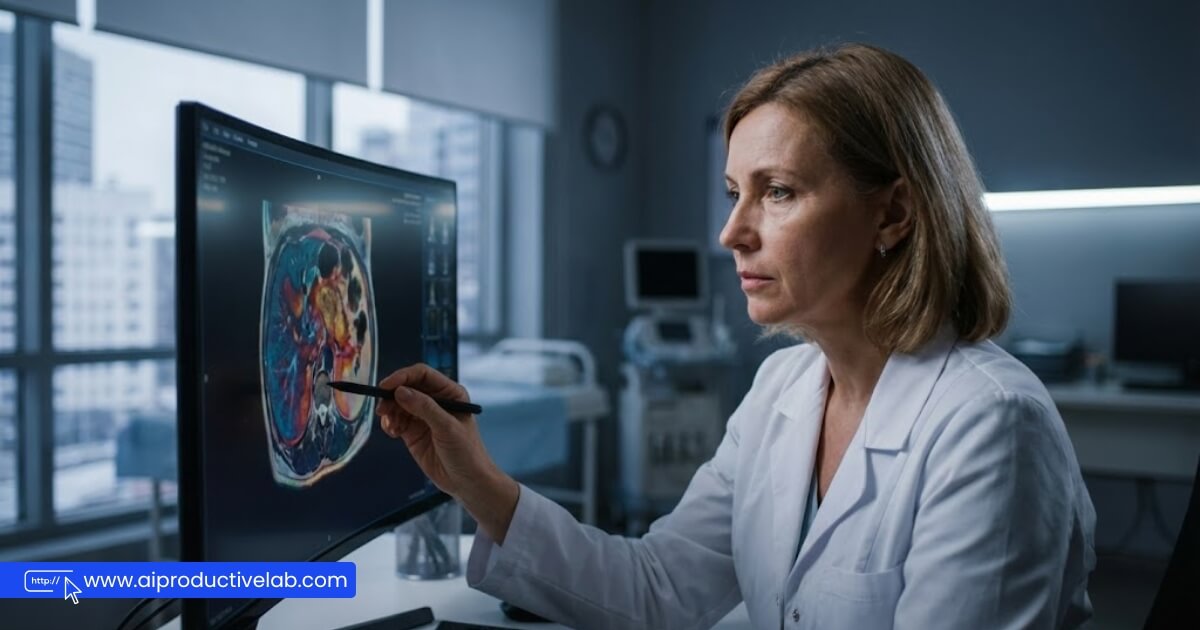
When Machines Learn to See What We Can’t
A radiologist reviews hundreds of medical scans each day. The human eye is remarkable, but fatigue sets in, patterns blur together, and subtle abnormalities can slip through. Now imagine an intelligent system that never tires, learns from millions of cases, and catches what even trained experts might miss.
- AI augments clinicians by analyzing medical images and data to detect abnormalities with high accuracy and speed.
- Core technologies include deep learning, computer vision, and natural language processing for images, signals, and clinical text.
- Key applications: radiology, pathology, cardiology, ophthalmology, dermatology, and emerging mental health assessments.
- Challenges include regulatory clearance, EHR integration, data bias, clinician trust, and clear accountability for decisions.
This is the promise of ai in medical diagnosis—and it’s already becoming reality across hospitals and clinics worldwide.
For healthcare organizations and business leaders, understanding how artificial intelligence transforms diagnostic medicine isn’t just about technology. It’s about better patient outcomes, operational efficiency, and staying competitive in an industry undergoing rapid change. Whether you’re a hospital administrator, healthcare investor, or curious professional, this guide breaks down everything you need to know about how ai in medical diagnosis works, why it matters, and where it’s heading.
What Does AI in Medical Diagnosis Actually Mean?
At its core, ai in medical diagnosis refers to computer systems that analyze medical data—images, lab results, patient histories, genetic information—to identify diseases, predict health risks, and support clinical decision-making.
Unlike traditional software that follows pre-programmed rules, these systems learn from data. Feed an algorithm millions of chest X-rays labeled as “normal” or “pneumonia,” and it starts recognizing patterns that distinguish the two. Over time, it improves, sometimes matching or exceeding human diagnostic accuracy in specific tasks.
Think of it as giving doctors a highly trained assistant that has studied more cases than any human could in a lifetime. The physician still makes the final call, but they now have powerful support.
How AI Diagnoses Diseases: The Core Technologies
Several technologies power diagnostic artificial intelligence. Understanding them helps clarify what’s possible today versus what remains aspirational.
Machine Learning and Deep Learning
Machine learning algorithms identify patterns in data without being explicitly programmed for each scenario. Deep learning, a subset using neural networks inspired by the human brain, excels at processing complex information like images and unstructured text.
When applied to medical imaging, deep learning models can detect tumors, fractures, and other abnormalities with impressive precision. These systems continuously improve as they encounter new data, making them increasingly valuable diagnostic partners.
Computer Vision
Computer vision enables machines to interpret visual information from medical images. Whether analyzing mammograms for breast cancer, retinal scans for diabetic eye disease, or skin photographs for melanoma, computer vision algorithms extract diagnostic insights from pixels.
This technology transforms how radiologists, pathologists, and dermatologists work—not by replacing them, but by highlighting areas of concern and reducing the chance that critical findings get overlooked.
Natural Language Processing
Medical records contain vast amounts of unstructured text: physician notes, discharge summaries, lab reports. Natural language processing allows AI systems to read, understand, and extract meaningful information from these documents.
By analyzing clinical notes alongside other data, these systems can identify patients at risk for certain conditions, flag potential drug interactions, or surface relevant information that might otherwise remain buried in lengthy records.
Key Applications: Where AI Diagnosis Is Making an Impact
The use of ai in medical diagnosis spans virtually every medical specialty. Here are the areas seeing the most significant transformation.
Radiology and Medical Imaging
Radiology represents the most mature application of diagnostic AI. Algorithms now assist with detecting lung nodules on CT scans, identifying breast cancer in mammograms, spotting brain hemorrhages, and flagging spinal fractures.
These systems don’t replace radiologists. Instead, they serve as a safety net—a second pair of eyes that catches findings a busy physician might miss during a heavy workload. Studies show that combining AI analysis with human review often produces better results than either alone.
Pathology and Cancer Detection
Digital pathology uses AI to analyze tissue samples at the cellular level. Algorithms can identify cancer cells, grade tumor severity, and even predict how aggressive a malignancy might be based on microscopic features invisible to the human eye.
For cancer patients, faster and more accurate pathology means quicker treatment decisions and better outcomes. For healthcare systems, it means more efficient use of specialized pathologist time.
Cardiology and Heart Disease
AI algorithms analyze electrocardiograms to detect irregular heart rhythms, predict cardiac events, and identify patients at risk for heart failure. Some systems can spot atrial fibrillation—a leading cause of stroke—from a simple smartwatch reading.
This capability extends diagnostic reach beyond traditional clinical settings, potentially catching heart conditions before they become emergencies.
Dermatology and Skin Conditions
Smartphone-based AI tools can analyze photographs of skin lesions and moles, distinguishing benign spots from potentially cancerous ones. While these applications aren’t meant to replace dermatologist evaluation, they help patients and primary care physicians know when specialist referral is warranted.
Ophthalmology and Eye Disease
Diabetic retinopathy, a leading cause of blindness, requires regular eye screenings for millions of diabetic patients. AI systems can analyze retinal photographs with diagnostic accuracy comparable to specialists, making screening accessible in primary care settings where ophthalmologists aren’t available.
Mental Health Assessment
Emerging applications analyze speech patterns, facial expressions, and written text to identify signs of depression, anxiety, and other mental health conditions. While still developing, these tools could help identify patients who need support but haven’t sought care.
Benefits for Healthcare Organizations and Patients
The adoption of ai in medical diagnosis delivers measurable advantages across the healthcare ecosystem.
Improved Diagnostic Accuracy
AI systems trained on millions of cases can detect patterns humans might miss. Studies have shown diagnostic AI matching or exceeding specialist performance for specific conditions, particularly in imaging-based diagnosis.
Faster Results and Earlier Detection
Speed matters in medicine. AI can analyze a scan in seconds, prioritizing urgent cases and ensuring critical findings receive immediate attention. Earlier detection of conditions like cancer dramatically improves treatment success rates.
Extended Access to Expertise
Not every community has subspecialist physicians. AI tools bring expert-level diagnostic capability to rural clinics, community hospitals, and underserved regions—democratizing access to quality care.
Reduced Physician Burnout
By handling routine analysis and flagging cases that need attention, AI reduces the cognitive load on overworked clinicians. Physicians can focus their expertise on complex cases and patient relationships rather than repetitive screening tasks.
Operational Efficiency and Cost Savings
Faster diagnosis means shorter hospital stays, fewer unnecessary tests, and more efficient resource allocation. For healthcare organizations managing tight margins, these efficiency gains translate directly to financial sustainability.
Challenges and Considerations for Decision-Makers
Implementing ai in medical diagnosis isn’t without hurdles. Business leaders should understand the obstacles alongside the opportunities.
Regulatory Approval and Compliance
Medical AI applications require regulatory clearance, whether from the FDA in the United States or equivalent bodies elsewhere. Navigating approval processes takes time and resources, and regulations continue evolving as the technology advances.
Integration with Existing Systems
Most healthcare organizations operate legacy electronic health record systems. Integrating AI tools seamlessly into clinical workflows requires technical investment and change management. Solutions that disrupt established workflows face adoption resistance.
Data Quality and Bias
AI systems reflect the data they’re trained on. If training datasets underrepresent certain populations, the resulting algorithms may perform poorly for those groups. Ensuring equity requires careful attention to data diversity and ongoing performance monitoring.
Trust and Adoption
Clinicians need confidence in AI recommendations before relying on them. Building trust requires transparency about how systems work, clear evidence of clinical validation, and positioning AI as decision support rather than autonomous decision-making.
Liability and Accountability
When AI contributes to a diagnostic error, questions of responsibility arise. Healthcare organizations must establish clear policies about human oversight, documentation, and ultimate accountability for clinical decisions.
The Road Ahead: What’s Coming Next
The field of ai in medical diagnosis continues advancing rapidly. Several trends will shape its future.
Multimodal AI systems will combine imaging, genomics, lab results, and clinical notes for more comprehensive diagnostic insights. Rather than analyzing data in silos, these systems will synthesize information the way experienced clinicians do.
Predictive diagnostics will shift medicine from reactive to proactive. Instead of identifying disease after symptoms appear, AI will increasingly predict who’s at risk before problems develop, enabling preventive intervention.
Ambient intelligence will embed diagnostic capability into everyday devices. Wearables that continuously monitor vital signs, smart mirrors that track skin changes, and voice assistants that detect speech patterns associated with neurological conditions are already emerging.
Explainable AI will address the “black box” problem. New techniques help algorithms explain their reasoning, showing clinicians why a particular diagnosis was suggested rather than just what the conclusion was.
Conclusion: A Partnership Between Human and Machine
The transformation of medical diagnosis through artificial intelligence isn’t about replacing physicians. It’s about augmenting human expertise with tools that extend what’s possible.
For patients, this means earlier detection, faster answers, and more personalized care. For healthcare organizations, it means improved outcomes, operational efficiency, and the ability to do more with limited resources. For clinicians, it means powerful support that handles routine analysis while freeing them to focus on the complex, human aspects of medicine.
The organizations that thrive in this new landscape will be those that embrace ai in medical diagnosis thoughtfully—investing in the right solutions, preparing their teams for change, and keeping patient outcomes at the center of every decision.
The future of diagnosis is collaborative. Human insight and artificial intelligence, working together, can achieve what neither could alone.
Frequently Asked Questions
Accuracy varies by application, but in many specific tasks, AI matches or exceeds specialist performance. For example, some algorithms detect diabetic retinopathy with over 90% accuracy and identify certain cancers in medical images with precision comparable to experienced radiologists. However, AI performs best as a support tool combined with human oversight rather than as a standalone diagnostic system.
No. AI serves as a powerful decision-support tool, not a replacement for physicians. The technology excels at pattern recognition and data analysis, but clinical diagnosis involves patient communication, contextual judgment, and nuanced decision-making that requires human expertise. The most effective approach combines AI capabilities with physician knowledge and experience.
AI applications exist across numerous conditions including various cancers (breast, lung, skin, colon), diabetic retinopathy, cardiac arrhythmias, pneumonia, tuberculosis, bone fractures, neurological conditions, and skin diseases. The technology is most advanced for conditions where diagnosis relies heavily on image analysis or pattern recognition in structured data.
Yes, medical AI applications undergo rigorous regulatory review before clinical deployment. In the United States, the FDA clears diagnostic AI as medical devices, requiring evidence of safety and effectiveness. Similar regulatory frameworks exist in Europe, Asia, and other regions. Healthcare organizations should only implement AI tools that have received appropriate regulatory clearance.
Costs vary widely depending on the solution, scale of implementation, and required infrastructure. Some cloud-based AI tools operate on subscription models with relatively modest per-study fees, while enterprise-wide implementations may require significant upfront investment. Organizations should evaluate total cost of ownership including integration, training, and ongoing maintenance alongside potential efficiency gains and outcome improvements.
Key barriers include integration challenges with existing electronic health record systems, regulatory compliance requirements, clinician trust and adoption, data quality and bias concerns, cost considerations, and liability questions. Successful implementation requires addressing both technical and organizational change management aspects.




 AI/ML Strategy and Consulting
 Data Science And Data Analytics
 Generative AI
 AI Consulting Services
 AI Automation Solutions
 API Integration


