

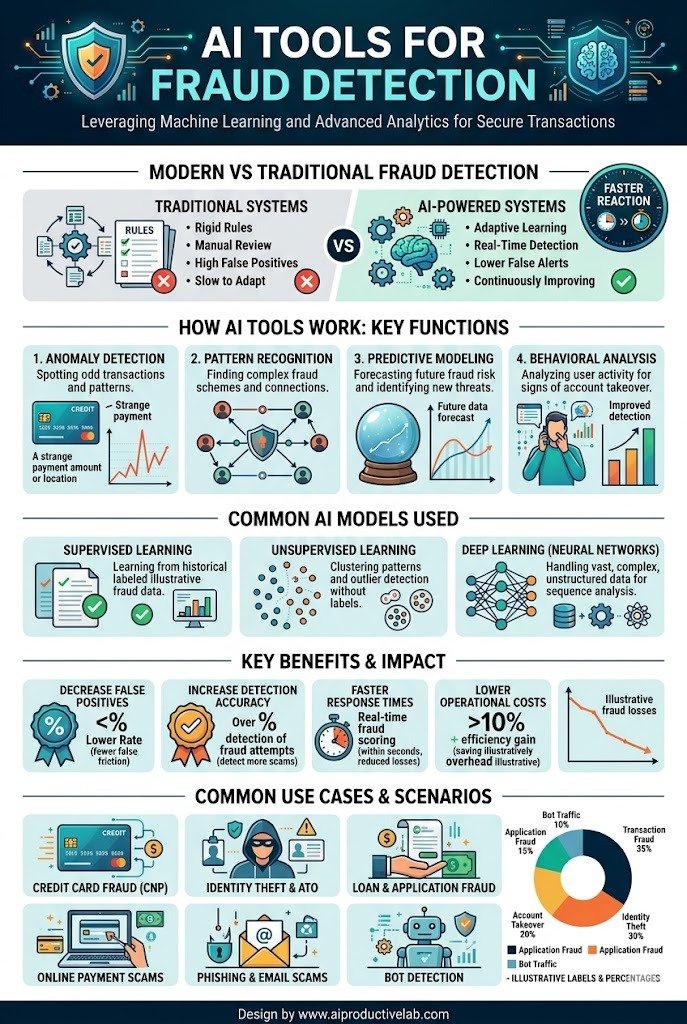
Fraud is evolving faster than manual review teams can keep up. Criminals use sophisticated techniques including synthetic identities, deepfake documents, and coordinated account takeover attacks. Rule-based detection systems catch yesterday’s fraud patterns but miss today’s emerging threats.
- AI builds dynamic behavioral profiles and adapts continuously, detecting context-specific fraud while cutting false positives compared to static rule-based systems.
- Market-leading tools specialize by use case: real-time payment monitoring, behavioral biometrics, identity verification, AML screening, and network-based decisioning.
- Select tools by primary fraud vector, integration complexity, false positive rates, chargeback guarantees, and the vendor's data network strength.
- AI fraud prevention lowers losses and manual review costs, improves approval rates, and delivers measurable ROI as models learn from every transaction.
AI tools for fraud detection change the equation entirely. They analyze millions of data points per second, identify suspicious patterns in real time, and adapt to new attack methods without waiting for human analysts to write new rules. Businesses using AI-powered fraud prevention software detect threats earlier, reduce losses faster, and block fewer legitimate customers.
The shift from reactive investigation to proactive prevention is what separates modern fraud programs from outdated ones.
How AI Detects Fraud Differently Than Traditional Systems
Traditional fraud detection relies on fixed rules. If a transaction exceeds a set amount or originates from a flagged country, the system triggers an alert. These rules catch obvious fraud but generate massive volumes of false positives. They also miss anything that falls outside predefined criteria.
Machine learning fraud detection takes a fundamentally different approach. AI models learn what normal behavior looks like for each customer, account, or device. They build dynamic profiles based on transaction history, spending patterns, login habits, and interaction timing.
When activity deviates from those established patterns, the system flags it. The critical advantage is context. A 5,000 USD purchase might be normal for one customer but highly suspicious for another. AI evaluates each event against individual behavioral baselines rather than applying blanket rules.
These models also improve continuously. Every confirmed fraud case and every false positive correction refines the model’s accuracy. Over time, detection rates increase while false alerts decrease. This self-improving capability is what makes automated fraud analysis platforms fundamentally superior to static rule engines.
10 AI Tools for Fraud Detection Leading the Market
1. Featurespace
Featurespace created the ARIC Risk Hub, one of the most advanced real-time fraud monitoring tools available. It uses adaptive behavioral analytics to profile every customer and flag anomalies as transactions happen.
The platform catches card fraud, payment scams, account takeovers, and money laundering. It serves major banks and payment processors globally. Featurespace consistently reduces false positives by over 70 percent compared to rule-based systems, protecting revenue without blocking legitimate customers.
2. Darktrace
Darktrace applies self-learning AI to cybersecurity and fraud prevention across enterprise networks. Its technology understands normal digital behavior for every user and device within an organization. It detects insider threats, data exfiltration, and fraudulent access attempts autonomously.
Financial institutions, retailers, and healthcare organizations use Darktrace to catch threats that signature-based tools miss entirely. The platform responds to attacks in real time, containing threats before they cause damage.
3. SEON
SEON is a fraud prevention platform built for digital businesses. It combines device fingerprinting, email and phone intelligence, and behavioral analytics to assess risk on every user interaction. Signup fraud, payment fraud, and account abuse are its core focus areas.
The platform works especially well for fintech companies, online marketplaces, and gaming platforms. SEON delivers risk scores in milliseconds, enabling businesses to block fraudsters at the point of entry without slowing down legitimate users.
4. Sardine
Sardine specializes in transaction fraud detection AI using device intelligence and behavioral biometrics. It tracks how users type, swipe, and navigate to distinguish genuine customers from bots and fraudsters.
The platform detects fraud at account opening, during transactions, and across money movement events. Banks, neobanks, and crypto exchanges use Sardine to stop fraud before funds leave accounts. Its behavioral approach catches sophisticated attacks that transaction-level analysis alone would miss.
5. Hawk AI
Hawk AI focuses on anti-money laundering and payment fraud detection for banks and payment companies. Its machine learning models monitor transactions against dynamic risk profiles and regulatory requirements simultaneously.
The platform reduces alert volumes dramatically while catching more genuine threats. Compliance and fraud teams investigate fewer false leads and focus resources on cases that actually matter. Hawk AI helps institutions meet regulatory obligations without drowning in manual review work.
6. ComplyAdvantage
ComplyAdvantage provides AI-driven risk intelligence for fraud, money laundering, and terrorist financing detection. It screens customers against global sanctions lists, watchlists, and adverse media sources using natural language processing and machine learning.
The platform updates its risk database in real time, catching emerging threats faster than traditional data providers. Over 1,000 financial institutions use ComplyAdvantage to automate customer screening and transaction monitoring while staying ahead of regulatory expectations.
7. Jumio
Jumio is an identity verification AI tool that prevents fraud at the point of onboarding. It uses computer vision and machine learning to verify government-issued IDs, match selfies to documents, and detect forged or manipulated credentials.
The platform catches deepfake photos, synthetic identities, and stolen documents before fraudsters gain account access. Banks, fintech platforms, and online marketplaces use Jumio to verify customers in seconds while maintaining a smooth onboarding experience.
8. Forter
Forter provides real-time fraud decisioning for eCommerce merchants. It evaluates every transaction using behavioral analytics, device intelligence, and network data to approve or decline orders instantly.
The platform guarantees its decisions with a chargeback liability model. If Forter approves a transaction that turns out to be fraudulent, it covers the loss. This shifts fraud risk entirely off the merchant’s balance sheet, making it uniquely attractive to online retailers.
9. Riskified
Riskified uses machine learning to approve more legitimate eCommerce orders while blocking fraud. Its models analyze the global merchant network to identify trusted shoppers and suspicious patterns across billions of transactions.
Like Forter, Riskified offers chargeback guarantees on approved orders. Its strength lies in maximizing approval rates. Many merchants discover that their previous fraud tools were declining significant volumes of legitimate orders. Riskified recovers that lost revenue while maintaining strong fraud protection.
10. Socure
Socure is an identity verification and fraud prevention platform that predicts identity fraud risk using machine learning. It analyzes data from hundreds of sources including credit bureaus, government records, social media, and device signals.
The platform excels at detecting synthetic identities, which are fabricated profiles that combine real and fake information. Synthetic identity fraud is one of the fastest-growing threats in financial services. Socure catches these fabricated identities at onboarding before they cause downstream losses.
Comparison Table: Matching Tools to Fraud Challenges
| Tool | Primary Function | Best For | Industry Focus |
|---|---|---|---|
| Featurespace | Behavioral transaction monitoring | Real-time payment fraud | Banking, payments |
| Darktrace | Network threat detection | Cyber and insider fraud | Cross-industry |
| SEON | Digital risk scoring | Signup and payment fraud | Fintech, marketplaces |
| Sardine | Behavioral biometrics | Account and transaction fraud | Banking, crypto |
| Hawk AI | AML and payment monitoring | Compliance-driven fraud | Banks, payments |
| ComplyAdvantage | Risk intelligence screening | AML and sanctions | Financial services |
| Jumio | Identity document verification | Onboarding fraud | Banking, fintech, eCommerce |
| Forter | eCommerce fraud decisioning | Online transaction fraud | Retail, eCommerce |
| Riskified | Order approval optimization | Chargeback prevention | eCommerce |
| Socure | Identity fraud prediction | Synthetic identity fraud | Financial services |
How to Choose the Right AI Fraud Detection Tool
Selecting among AI tools for fraud detection depends on where your business faces the greatest risk. Fraud manifests differently across industries, and no single platform covers every scenario perfectly.
Start by identifying your primary fraud vector. If payment fraud drives the majority of your losses, Featurespace or Forter will deliver the most immediate impact. If onboarding fraud and fake accounts are the core problem, Jumio or Socure should be your first evaluation.
Consider the integration requirements. Most anti-fraud technology solutions connect via API, but implementation timelines vary significantly. Platforms built for your specific industry and tech stack deploy faster and generate results sooner.
Evaluate the false positive rate carefully. A tool that blocks fraud but also declines 10 percent of legitimate customers costs you revenue on both sides. The best platforms optimize both detection accuracy and customer approval rates simultaneously.
Chargeback guarantee models offered by Forter and Riskified deserve special attention from eCommerce businesses. They eliminate financial risk entirely for approved transactions. Compare the guarantee fee against your current fraud loss rate to determine whether this model saves money.
Finally, assess the vendor’s data network. Machine learning fraud detection improves with more data. Platforms processing billions of transactions across thousands of businesses build stronger models than tools limited to your data alone. Network intelligence is a genuine competitive differentiator.
The Business Case for AI-Powered Fraud Prevention
Fraud losses are the most visible cost, but they are not the only one. Manual review teams are expensive. Customer friction from false declines erodes loyalty. Regulatory fines for compliance failures can be devastating. Reputational damage from publicized breaches lingers for years.
AI-powered fraud prevention software addresses all of these costs simultaneously. Detection rates improve by 30 to 50 percent compared to rule-based systems. False positives drop by 50 to 70 percent. Investigation teams handle higher case volumes without added headcount.
The return on investment compounds over time. Models trained on your specific data become more precise with every transaction they evaluate. Fraud teams shift from reactive firefighting to strategic risk management. The total cost of fraud, including direct losses, operational overhead, and customer impact, decreases measurably within the first quarter of deployment.
FAQs
They are software platforms that use machine learning and behavioral analytics to identify suspicious transactions, fake identities, and fraudulent activities in real time across digital channels.
Machine learning builds dynamic behavioral profiles and adapts to new fraud patterns automatically, catching threats that fixed rule-based systems miss while generating fewer false alerts.
Banking, financial services, eCommerce, insurance, and fintech see the strongest returns. Any industry processing high volumes of digital transactions or customer onboarding benefits significantly.
The best platforms minimize false positives dramatically. Tools like Featurespace and Riskified specifically optimize for approving legitimate transactions while catching genuine fraud.
Most API-based tools deploy within two to six weeks. Enterprise platforms with deeper system integrations may require 60 to 90 days for full implementation and model training.




 AI/ML Strategy and Consulting
 Data Science And Data Analytics
 Generative AI
 AI Consulting Services
 AI Automation Solutions
 API Integration