

Credit decisions once relied on rigid scorecards and manual reviews. That era is fading fast. Today, AI tools for credit scoring help lenders assess risk with greater speed, accuracy, and fairness than traditional models ever could.
- AI credit scoring uses machine learning and alternative data to build dynamic, inclusive risk profiles beyond traditional bureau-based models.
- Modern platforms offer explainability, bias testing, and audit trails to satisfy regulators while improving decision speed and fairness.
- Select tools based on institution size, data maturity, deployment speed, scalability, and ongoing model monitoring to prevent drift.
These platforms analyze thousands of data points in seconds. They evaluate patterns that human analysts might miss entirely. For lenders, this means fewer defaults. For borrowers, it means broader access to credit.
This guide covers 10 AI-powered credit scoring tools reshaping the lending landscape. Each one brings a unique approach to credit risk assessment, from behavioral analytics to alternative data modeling.
Why Are Lenders Moving Toward AI Credit Scoring?
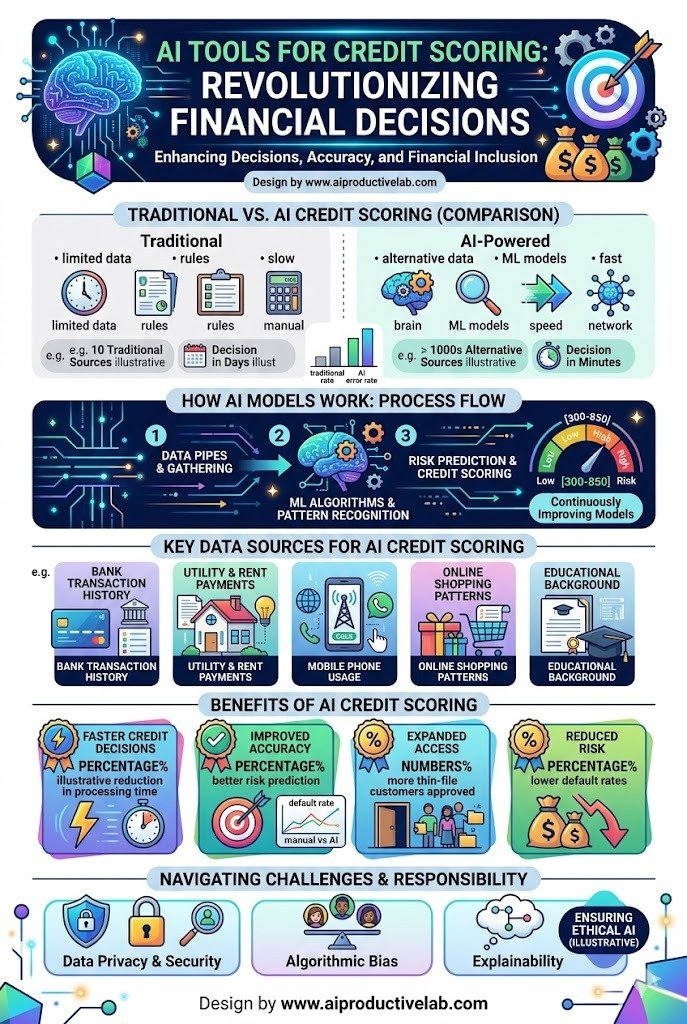
Traditional credit scoring models like FICO rely heavily on payment history and credit utilization. They work well for borrowers with established credit files. But they leave out millions of thin-file or no-file consumers entirely.
AI credit scoring software fills that gap. Machine learning models ingest alternative data sources such as rent payments, utility bills, and banking behavior. They build dynamic risk profiles that update continuously.
Lenders using predictive credit analytics report measurable improvements. False decline rates drop. Approval rates rise without increasing portfolio risk. Regulatory bodies are also warming up to explainable AI models, which makes adoption easier for banks and fintechs alike.
10 AI Tools for Credit Scoring Worth Evaluating
1. Zest AI
Zest AI helps financial institutions replace legacy scorecards with transparent machine learning models. Its platform builds custom credit models trained on an institution’s own data.
- Best for: Banks and credit unions seeking fairer lending outcomes
- Key feature: Model explainability tools that satisfy regulatory requirements
- Standout advantage: Documented reduction in charge-off rates by up to 30%
Zest AI has earned a strong reputation for helping lenders reduce bias in automated credit decisioning while maintaining compliance with fair lending laws.
2. Experian PowerCurve
Experian PowerCurve combines bureau data with advanced analytics to automate credit decisions at scale. It supports the full credit lifecycle from origination to collections.
- Best for: Large enterprises and global lenders
- Key feature: Pre-built strategy templates and real-time decisioning
- Standout advantage: Direct integration with Experian’s proprietary data assets
PowerCurve gives lenders flexibility to customize decision flows while leveraging one of the world’s largest consumer credit databases.
3. Equifax Ignite
Equifax Ignite is a cloud-based analytics platform built for data scientists and credit risk teams. It provides access to differentiated data, analytical sandboxes, and pre-built machine learning models.
- Best for: Data-driven risk teams at mid-to-large financial institutions
- Key feature: Access to alternative and trended credit data
- Standout advantage: Enables rapid model prototyping within a secure environment
Ignite stands out for teams that want deep control over model development without sacrificing data breadth.
4. FICO Platform
FICO remains an industry standard, but its newer AI-driven platform goes well beyond the classic score. FICO Platform supports real-time credit risk assessment using machine learning and optimization tools.
- Best for: Institutions already embedded in the FICO ecosystem
- Key feature: Decision orchestration across multiple lending products
- Standout advantage: Combines decades of scoring expertise with modern AI capabilities
This platform bridges the gap between legacy scoring trust and next-generation predictive credit analytics.
5. Scienaptic AI
Scienaptic offers a plug-and-play AI credit underwriting platform designed for speed. Lenders can deploy pre-trained or custom models without heavy IT lift.
- Best for: Community banks and credit unions looking for quick deployment
- Key feature: AI-powered credit decisioning with real-time model monitoring
- Standout advantage: Claims up to 15% approval rate increases with no added risk
Scienaptic makes advanced credit scoring accessible to smaller institutions that lack large data science teams.
6. Upstart
Upstart operates as both a lending marketplace and an AI lending platform. Its models evaluate over 1,600 variables to predict repayment probability more accurately than traditional scores.
- Best for: Fintechs and digital-first lenders
- Key feature: Uses education, employment history, and behavioral data for scoring
- Standout advantage: Approved as a compliant AI model by multiple US regulators
Upstart’s approach to alternative credit scoring has expanded credit access particularly for younger borrowers with limited credit histories.
7. SAS Credit Scoring
SAS delivers enterprise-grade credit scoring software embedded within its broader analytics ecosystem. It supports regulatory-compliant model development, validation, and deployment.
- Best for: Large banks and regulated financial institutions
- Key feature: End-to-end model lifecycle management
- Standout advantage: Strong governance and audit trail capabilities
SAS is a go-to choice for institutions where model transparency and regulatory documentation are non-negotiable.
8. LenddoEFL (now part of FICO)
LenddoEFL pioneered psychometric and digital footprint-based credit scoring. It assesses borrower risk using smartphone metadata, behavioral patterns, and social signals.
- Best for: Lenders in emerging markets with thin-file populations
- Key feature: Non-traditional data inputs for credit risk modeling
- Standout advantage: Enables credit access where bureau data is scarce or nonexistent
This tool is especially relevant for microfinance institutions and lenders operating in regions with low credit bureau coverage.
9. Provenir
Provenir is a cloud-native decisioning platform that integrates data, AI, and workflow automation into a unified environment. It supports credit scoring, fraud detection, and onboarding.
- Best for: Fintechs and lenders seeking an all-in-one decisioning layer
- Key feature: Low-code interface for building credit decisioning workflows
- Standout advantage: Over 400 pre-built data integrations for real-time enrichment
Provenir appeals to agile teams that want to iterate quickly on credit models without relying on IT bottlenecks.
10. CreditVidya (now Creditvidya by SESAMm)
CreditVidya uses alternative data and machine learning to score borrowers who fall outside traditional credit bureau coverage. It analyzes device data, financial behavior, and transactional patterns.
- Best for: Digital lenders and NBFCs in emerging economies
- Key feature: Alternative data scoring engine with real-time API access
- Standout advantage: Processes applications in under 30 seconds with minimal data inputs
CreditVidya is a strong fit for lenders focused on financial inclusion and rapid digital onboarding.
How to Choose the Right AI Credit Scoring Tool
Selecting the right platform depends on your institution’s size, data maturity, and regulatory environment. Here’s a quick comparison framework:
| Factor | What to Evaluate |
|---|---|
| Data Sources | Does it support alternative data, bureau data, or both? |
| Explainability | Can the model outputs satisfy regulators and auditors? |
| Deployment Speed | Is it plug-and-play or does it require months of integration? |
| Scalability | Can it handle your current and projected application volumes? |
| Bias Testing | Does the platform include fairness and bias audit tools? |
| Pricing Model | Per-decision, subscription, or enterprise licensing? |
Lenders should also evaluate vendor support for model monitoring. AI models drift over time. Continuous validation ensures your credit risk assessment stays accurate as borrower behavior shifts.
What Makes AI Credit Scoring More Accurate Than Traditional Models?
Traditional scorecards evaluate five to ten variables at most. Machine learning credit risk models analyze hundreds or thousands. They detect non-linear relationships between borrower attributes and default risk that linear models simply cannot capture.
AI models also adapt. They retrain on fresh data, adjusting to economic shifts and changing borrower profiles. This dynamic learning loop is what separates predictive credit analytics from static rule-based systems.
The result is measurable. Lenders using AI-driven scoring report approval rate gains of 10 to 25 percent without a corresponding rise in defaults. That translates directly to revenue growth and broader credit access.
FAQs
AI tools for credit scoring use machine learning algorithms to evaluate borrower risk. They analyze traditional and alternative data to produce more accurate and inclusive credit decisions.
FICO scores rely on a fixed set of credit bureau variables. AI credit scoring software uses hundreds of dynamic data points, including behavioral and transactional data, for a more complete risk picture.
Yes, many platforms like Zest AI, FICO Platform, and SAS include explainability and bias-testing tools designed to meet fair lending regulations such as ECOA and FCRA.
Absolutely. Lenders using machine learning credit risk models often see 10 to 25 percent increases in approval rates while maintaining or reducing overall default risk.
Alternative credit scoring evaluates non-traditional data like rent payments, utility bills, and digital behavior. It helps lenders assess borrowers who lack conventional credit histories.




 AI/ML Strategy and Consulting
 Data Science And Data Analytics
 Generative AI
 AI Consulting Services
 AI Automation Solutions
 API Integration